


This article was automatically translated from the original Turkish version.
+1 More
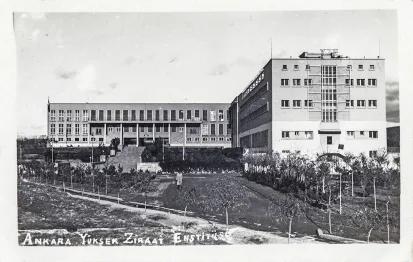
Ankara Higher Institute of AgricultureTürk Maarif Ansiklopedisi
Type(s) | Public Higher Education and Research Institution (with the status of an Agricultural University) | ||||||||
|---|---|---|---|---|---|---|---|---|---|
Location | Türkiye Ankara | ||||||||
First Rector | Prof. Dr. Friedrich Falke | ||||||||
Successor Institutions | Ankara University (Faculties of Agriculture and Veterinary Medicine), Istanbul University (Faculty of Forestry) | ||||||||
Parent Institution | Ankara Higher School of Agriculture (1930) | ||||||||
Closure Date | 1948 | ||||||||
Foundation Date | 10 June 1933 (Law Adoption), 30 October 1933 (Inauguration) | ||||||||
Ankara Yüksek Ziraat Enstitüsü is a higher education and research institution established in Ankara in 1933 with the aim of researching modern agricultural techniques and training specialists, in line with the agricultural development goals of the Republic of Türkiye. As part of the university reforms carried out in the tenth year of the Republic, the institute began operations simultaneously with Istanbul University. Although named an institute, its academic structure, authority, and resources fully qualified it as a complete agricultural university.

Ankara Yüksek Ziraat Enstitüsü(Ankara Üniversitesi)
The foundations of the institution were laid by a law enacted in 1927 that granted the Ministry of Agriculture the authority to establish higher schools in agriculture and veterinary science. During this period, a report prepared in 1928 by a team of experts invited from Germany under the leadership of Dr. Oldenburg demonstrated the necessity of a modern higher education institution, leading to the commencement of construction of the institute’s buildings. As a pioneering institution during the preparatory phase, the Ankara Higher Agricultural School opened in 1930, and the Higher Agricultural Institute was formally established by Law No. 2291 adopted on 10 June 1933. The institute began its educational activities on 30 October 1933 at an opening ceremony presided over by then Prime Minister İsmet İnönü.
The Higher Agricultural Institute was organized as a legal entity with scientific and administrative autonomy under the Ministry of Agriculture. According to its founding law, the institute initially comprised four faculties: Natural Sciences, Agriculture, Veterinary Science, and Agricultural Arts. The number of faculties increased to five in 1934 when the Higher Forestry School in Istanbul was incorporated into the institute under the name Faculty of Forestry. The administrative structure of the institute followed a hierarchical academic governance model consisting of a rector, senate, teaching council, Institute Grand Council, and faculty councils.
The faculties were subdivided into various institutes according to specialization. The Faculty of Natural Sciences housed institutes of physics, chemistry, geology, botany, and zoology, while the Faculty of Agriculture included specialized units in economics, plant cultivation and breeding, zootechnics, and soil science. The Faculty of Agricultural Arts, which laid the foundations of food engineering education in Türkiye, consisted of institutes of agricultural arts, agricultural machinery, and village arts. In 1937, following the official change of the title “baytar” to “veterinary physician,” the Faculty of Veterinary Science was renamed the Faculty of Veterinary Medicine.
Turkish-German scientific cooperation played a decisive role in establishing the academic staff of the Higher Agricultural Institute. The institute commenced operations with a team composed of professors invited from Germany and their Turkish assistant staff. Including its first rector, Prof. Dr. Friedrich Falke, a total of 17 German professors served during the founding phase. Unlike the German scientists who had fled the Nazi regime and were working at Istanbul University, the majority of German academic staff at the Higher Agricultural Institute came to Türkiye under official agreements with the German government and held contractual positions.
Nevertheless, scientists such as Wilhelm Salomon-Calvi, Otto Gerngross, Max Pfannenstiel, and Hans Bremer, who held refugee status or later acquired it, also served at the institute and contributed significantly to Türkiye’s scientific heritage. These scholars conducted field research examining Turkish agriculture, geology, and biological diversity in addition to their teaching duties. The foreign experts who served between 1933 and 1942 gradually handed over their positions to Turkish academics they had trained.
The Higher Agricultural Institute assumed a leading role in institutionalizing academic research in Türkiye. The institution functioned not merely as an educational center but also as a “Ziraat Erkânıharbiyesi” — a body dedicated to solving the nation’s agricultural challenges. It was among the first institutions in Türkiye to conduct and oversee doctoral studies. Between 1933 and 1948, a total of 76 doctoral dissertations were completed within the institute. The first doctoral degrees in chemistry, physics, geology, and pharmacology in Türkiye were awarded under its auspices.
The institute’s publications were classified into five categories to promote the dissemination of scientific knowledge: scientific research including doctoral and associate professorship theses, textbooks, student handbooks, the “Öğütler Çiftçiye” series offering practical advice to farmers, and announcements. Additionally, the institute’s library, established within its premises and containing approximately 40,000 volumes, served as one of the leading scientific resource centers of the era.
In addition to technical agricultural education, the institute placed great importance on documenting the cultural values of Anatolia. Within the Faculty of Agricultural Arts, the Village Handicrafts Institute collected textile and handicraft products from various regions of Türkiye beginning in the 1930s, using them as teaching materials and conducting detailed analyses. Textiles, clothing elements, and technical analyses gathered through field research by students and faculty members formed the institute’s ethnographic collection. These artifacts, bearing the YZE label, were systematically recorded with analyses of fiber properties, weaving techniques, and dye composition, thereby serving as the foundation for the first academic studies on Turkish handicrafts.
For 15 years of operation, the Higher Agricultural Institute functioned as a research and education center for Turkish agriculture, forestry, and veterinary medicine. In 1946, amendments to the Universities Law and the enactment of Law No. 5234 in 1948 terminated the institute’s legal personality. As a result of this transformation, the Faculty of Veterinary Medicine and the Faculty of Agriculture were incorporated into the newly established Ankara University, while the Faculty of Forestry was integrated into Istanbul University. The Higher Agricultural Institute constitutes the institutional and academic foundation of today’s Ankara University Faculties of Agriculture and Veterinary Medicine.
Ankara University. "Ankara Üniversitesi Ziraat Fakültesi’nin Kısa Tarihçesi." Accessed February 14, 2026. https://www.agri.ankara.edu.tr/wp-content/uploads/sites/10/2020/05/ZiraatFakultesi.pdf.
Atatürk Ansiklopedisi. "Yüksek Ziraat Enstitüsü." Accessed February 14, 2026. https://ataturkansiklopedisi.gov.tr/detay/122/Yüksek-Ziraat-Enstitüsü.
Dölen, Emre. “Ankara Yüksek Ziraat Enstitüsü.” *Türk Maarif Ansiklopedisi*. Last updated December 18, 2022. Accessed February 14, 2026. https://turkmaarifansiklopedisi.org.tr/ankara-yuksek-ziraat-enstitusu.
Töre, Erkan. “Cumhuriyet Döneminde Ankara’da Yüksek Ziraat Enstitüsü’nün Kurulması ve Çalışmaları.” *Ankara Üniversitesi Türk İnkılâp Tarihi Enstitüsü Atatürk Yolu Dergisi*, no. 41 (May 2008): 111–131. Accessed February 14, 2026. https://dergipark.org.tr/en/download/article-file/13236.
Töre, Erkan. “Modernleşme Sürecinde Bir Bilim ve Eğitim Kurumu: Ankara Yüksek Ziraat Enstitüsü (1933-1948).” *Ankara Araştırmaları Dergisi* 6, no. 1 (2018): 11–32. Accessed February 14, 2026. https://ankaradergisi.org/jvi.aspx?un=JAS-83997&volume=6&issue=1.
Türkiye Büyük Millet Meclisi. “Ankara’da Bir Yüksek Ziraat Enstitüsü Teşkiline Dair Kanun.” Kanun No. 2291. June 10, 1933. Accessed February 14, 2026. https://www5.tbmm.gov.tr/tutanaklar/KANUNLAR_KARARLAR/kanuntbmmc012/kanuntbmmc012/kanuntbmmc01202291.pdf.

Ankara Higher Institute of AgricultureTürk Maarif Ansiklopedisi
Type(s) | Public Higher Education and Research Institution (with the status of an Agricultural University) | ||||||||
|---|---|---|---|---|---|---|---|---|---|
Location | Türkiye Ankara | ||||||||
First Rector | Prof. Dr. Friedrich Falke | ||||||||
Successor Institutions | Ankara University (Faculties of Agriculture and Veterinary Medicine), Istanbul University (Faculty of Forestry) | ||||||||
Parent Institution | Ankara Higher School of Agriculture (1930) | ||||||||
Closure Date | 1948 | ||||||||
Foundation Date | 10 June 1933 (Law Adoption), 30 October 1933 (Inauguration) | ||||||||
No Discussion Added Yet
Start discussion for "Ankara Higher Institute of Agriculture" article
Academic Structure and Faculties
Role of German Scientists and Academic Staff
Scientific Research, Publications, and Doctoral Studies
Ethnographic Studies and Cultural Heritage
Institutional Transformation and Integration into Ankara University