

This article was automatically translated from the original Turkish version.
+1 More
Entry into Service | 1959 | ||||||||
|---|---|---|---|---|---|---|---|---|---|
Length(s) | 33.10 metres | ||||||||
Engine(s) | 4 × Ivchenko AI-20L or AI-20M turboprops | ||||||||
Manufacturer(s) | Antonov Design Bureau (OKB-153) | ||||||||
Height(s) | 10.53 metres | ||||||||
Type(s) | Medium-range Turboprop Military Transport Aircraft | ||||||||
Maximum Speed | 777 km/h (419 knots) | ||||||||
Empty Weight | 28,000 kg | ||||||||
Wing Area | 121.7 m² | ||||||||
Wingspan | 38.00 metres | ||||||||
Capacity | 20,000 kg cargo / 90 troops / 60 paratroopers | ||||||||
Crew | 5-6 (2 pilots, flight engineer, navigator, radio operator, optional tail gunner) | ||||||||
NATO Name | Cub | ||||||||
Full Name | Antonov An-12 | ||||||||
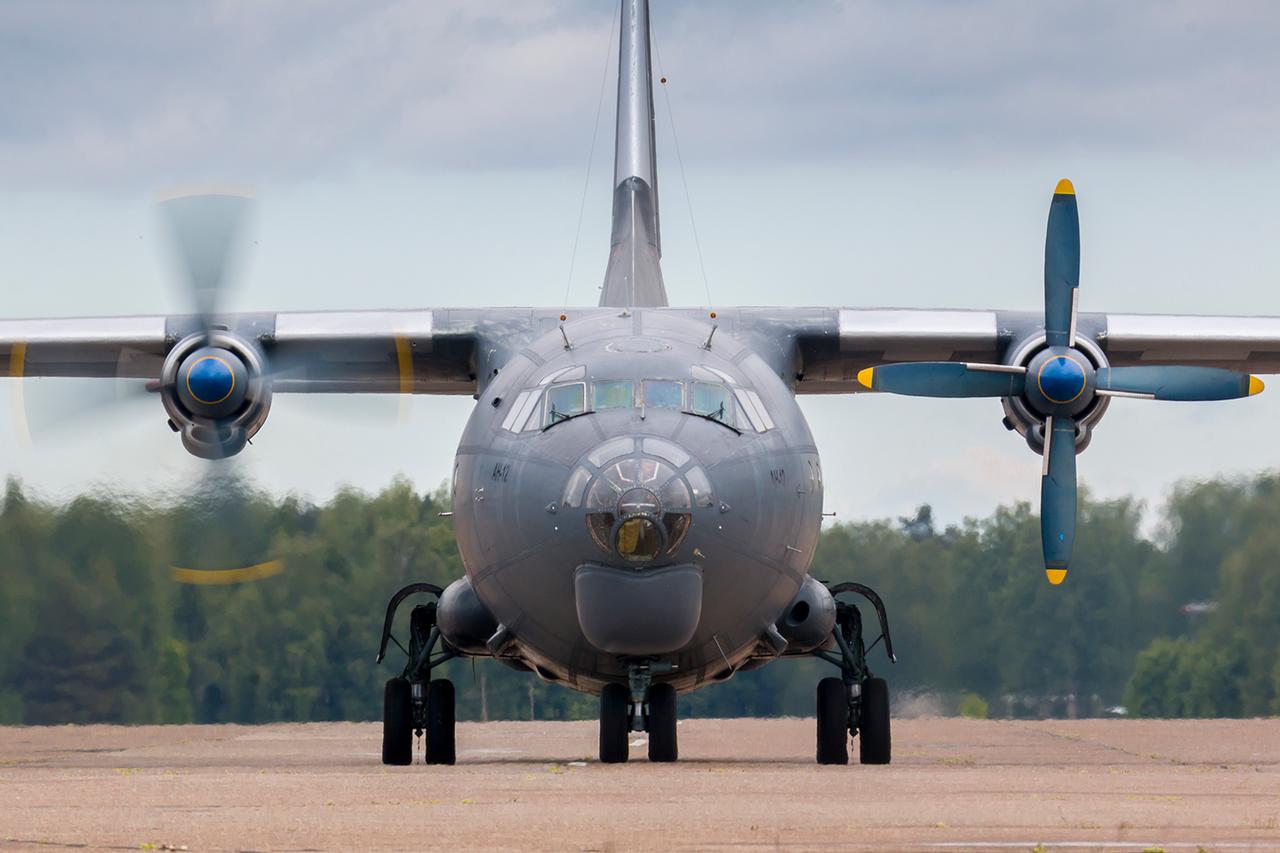
The Antonov An-12 is a four-engine turboprop military transport aircraft developed by the Antonov Design Bureau (OKB-153) during the Soviet Union era. Designed in the mid-1950s, the aircraft made its first flight on 16 December 1957. It is considered the military variant of the civilian passenger aircraft Antonov An-10, and differs from its civilian counterpart through a modified fuselage structure, particularly in the rear loading doors and defensive turrets.
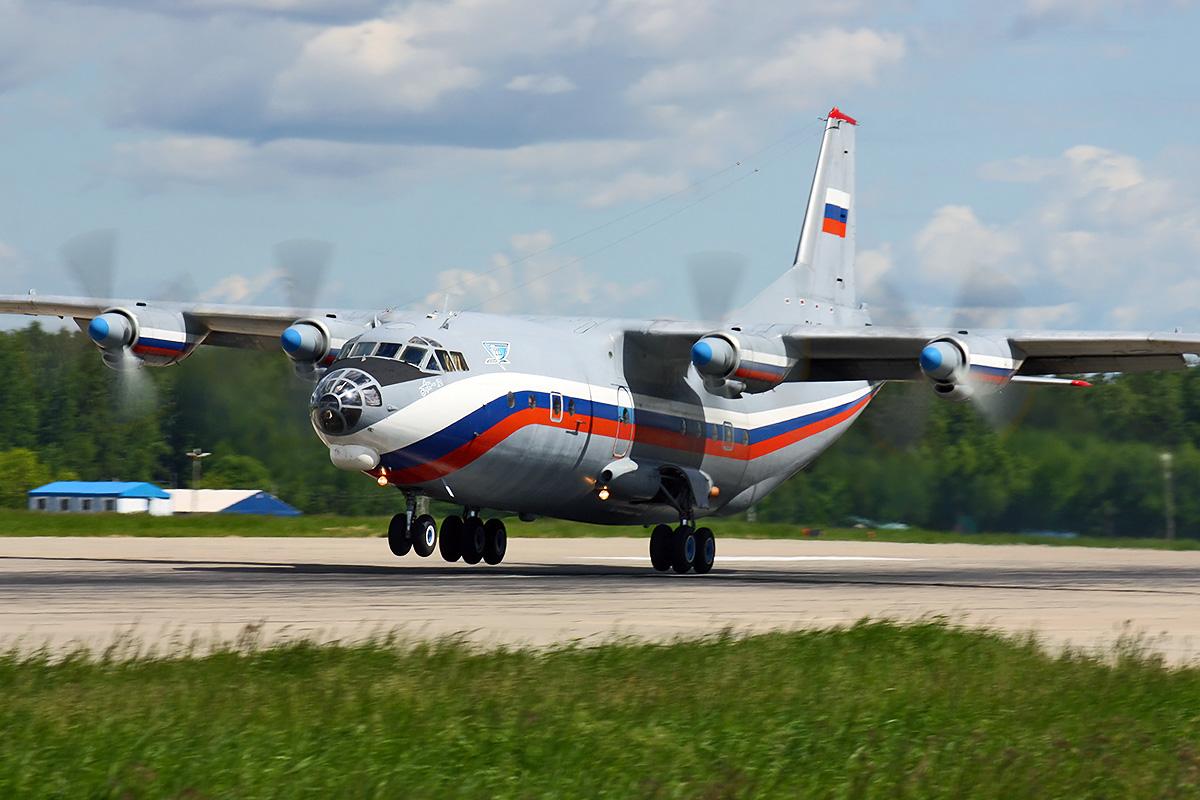
AN-12 (Dmitry Terekhov)
The design process of the Antonov An-12 began in the early 1950s with the Soviet Union’s need for a durable, high-capacity transport aircraft capable of meeting its military logistics requirements. The Design Bureau (OKB-153) constructed the aircraft on a shared platform with the contemporary civilian passenger aircraft, the Antonov An-10. This “twin-development” strategy reduced production costs and standardized components; however, the An-12 was distinctly modified to meet military needs, featuring a redesigned rear fuselage, a loading ramp, and defensive armament absent in the civilian model.
Although the An-12’s basic design philosophy resembles its Western counterpart, the Lockheed C-130 Hercules, Soviet operational doctrine prioritized ruggedness and compatibility with unprepared airstrips. The undercarriage was optimized with low-pressure tires to enable landings on soft terrain, while the high-mounted wings protected the engines from foreign object damage (FOD). Revisions to the tail section during the prototype phase finalized the aircraft’s distinctive vertical stabilizer and large cargo door configuration.
One of the most critical aspects of development was the integration of the Ivchenko AI-20 turboprop engines, calibrated to deliver high torque and fuel efficiency at low altitudes rather than high-altitude performance. The cockpit’s forward glazing was designed with a wide glass nose to improve the navigator’s visibility for ground targeting and landing approaches. Following its first successful test flight in 1957, the aircraft rapidly entered series production and became the main strategic transport asset of the Soviet Air Forces.【1】

Antonov AN-12 Technical Drawing (Generated by Artificial Intelligence)
The Antonov An-12 is powered by four Ivchenko AI-20L or AI-20M turboprop engines, each producing approximately 4,000 horsepower (2,983 kW). The fuselage structure is optimized to carry a maximum cargo load of 20,000 kg (about 20 tonnes), directly influencing the aircraft’s operational range. With a full payload, the aircraft has a range of approximately 3,600 kilometers; in ferry range configuration (unloaded with additional fuel), it can reach up to 5,700 kilometers.
The aircraft’s dimensions conform to Soviet military classifications as a medium transport: wingspan is 38 meters, and overall length is 33.10 meters. With a wing area of 121.7 square meters, the high-wing configuration keeps the engines elevated to minimize foreign object damage. The maximum takeoff weight (MTOW) varies by variant but generally hovers around 61,000 kg, while the cruising speed remains stable between 535 and 670 kilometers per hour.【2】
The internal cargo compartment is configured to support versatile operational roles: it measures 13.5 meters in length, 3.5 meters in width, and 2.6 meters in height. The crew capacity typically consists of five or six personnel: two pilots, one flight engineer, one navigator, one radio operator, and optionally a tail gunner. For defense, two 23 mm NR-23 cannons mounted in the tail position are among the most distinctive technical features of its military variants.【3】
AN-12 Flight (Cargospotter)
Since entering service with the Soviet Air Forces in 1959, the Antonov An-12 became the cornerstone strategic transport aircraft of the Eastern Bloc and played critical roles in numerous conflicts. Its first major military trial came during the 1968 Prague Spring, when Warsaw Pact forces were rapidly deployed into Czechoslovakia. An-12 fleets delivered thousands of troops and heavy equipment to Prague’s Ruzyně Airport within a short timeframe, demonstrating the aircraft’s rapid deployment capability.
During the Soviet-Afghan War (1979–1989), the An-12 formed the backbone of logistical support, distinguished by its ability to operate from high-altitude airstrips in rugged mountainous terrain. However, during this period, the aircraft acquired a somber nickname, the “Black Tulip,” as it was the primary means of repatriating the bodies of Soviet soldiers killed in combat. The aircraft proved vulnerable to shoulder-fired surface-to-air missiles (MANPADS), prompting the integration of advanced countermeasures in later models.【4】
On the international stage, the An-12 was extensively used not only for military purposes but also in humanitarian aid and civil cargo operations. The Indian Air Force employed it during the 1962 Sino-Indian War and the 1971 Indo-Pakistani War, both as a transport and an improvised bomber. Today, following the dissolution of the Soviet Union, aircraft remaining in the inventories of Russia, Ukraine, and numerous Central Asian nations continue active service in civil cargo operations, particularly in regions with inadequate infrastructure such as Africa and the Middle East.
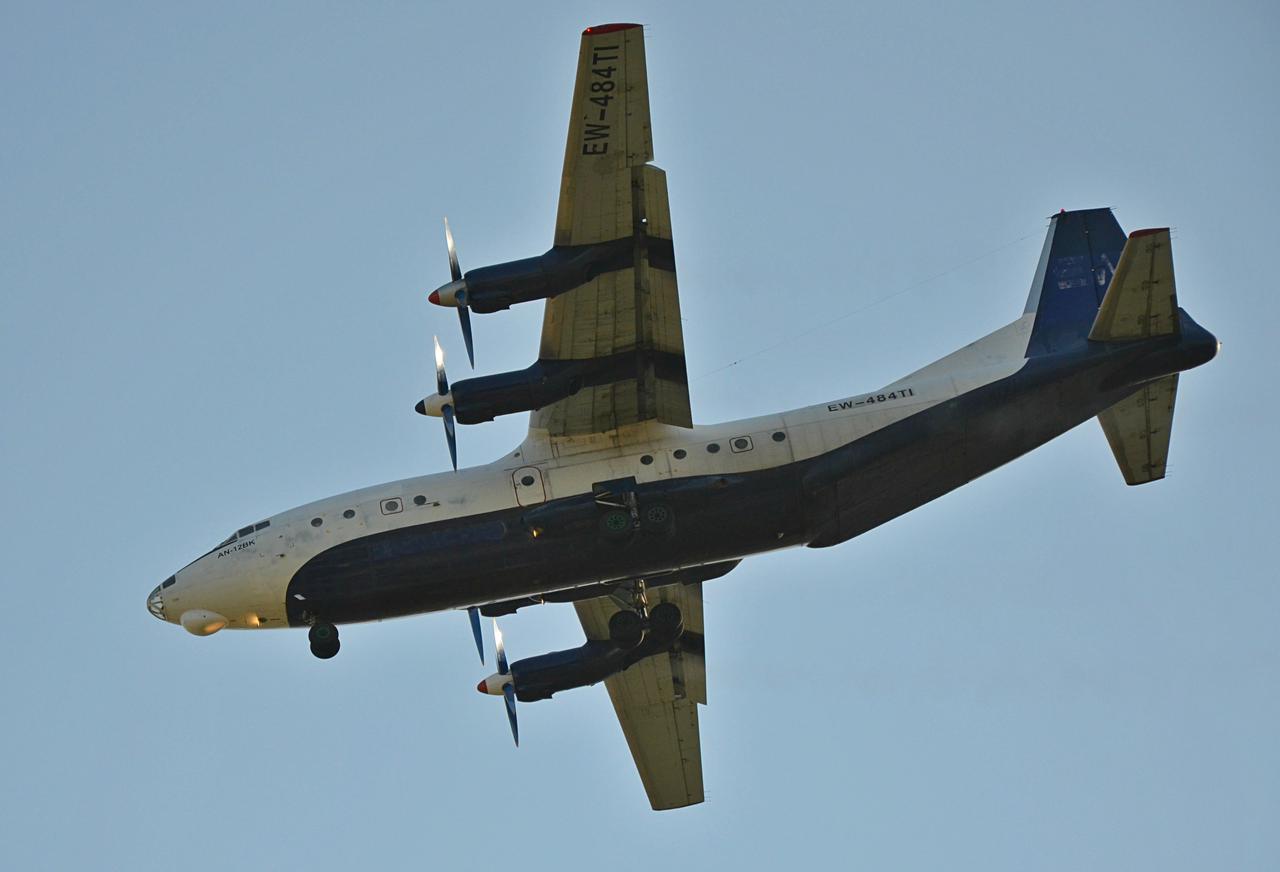
Antonov An-12-BK (Max Benidze)
Throughout its production life, more than 60 different variants of the Antonov An-12 were developed in response to evolving technology and changing military requirements. The base model, An-12 (Izdeliye T), introduced in 1957, was the first military transport version and established the aircraft’s standard fuselage configuration. The An-12A, introduced in the early 1960s, improved operational efficiency by increasing fuel capacity and incorporating Ivchenko AI-20A engines.
The An-12B, specially designed for airborne units, is one of the most common variants, equipped with a reinforced cargo floor and paratroop drop systems. A derivative of this model, the An-12BK, became the standard transport model from the late 1960s onward, featuring upgraded avionics, more powerful AI-20M engines, and expanded cargo capacity. Additionally, the An-12PL variant was developed for polar operations and fitted with retractable ski-type landing gear to enable landings on snow-covered runways.【5】
The An-12 platform was also modified for specialized missions. Among these, the An-12PP (or An-12BK-PPS) is an electronic warfare (EW) variant equipped with signals intelligence (ELINT) and active radar jamming capabilities. The Shaanxi Y-8, produced under license by the People’s Republic of China, is the most significant international variant, based directly on the An-12 design and still in production today in modernized forms such as the Y-9. These Chinese models either retained the original glass nose or transitioned to enclosed nose designs to accommodate modern radar systems.

Shaanxi Y-8 Variant (Peter Garwood)
Due to its long service life and operation under demanding conditions, the Antonov An-12 is associated with numerous accidents in aviation history. Many of these stem from aging airframes, overloading, technical failures, and operations in regions with inadequate infrastructure. On 4 November 2015, an An-12BK operated from Juba International Airport in South Sudan crashed shortly after takeoff, killing all 37 people on board. Official reports confirmed that the aircraft was overloaded beyond its capacity, which impaired its climb performance and caused the crash.
One of the most notable recent accidents occurred on 16 July 2022 near Kavala, Greece. A Meridian Airways An-12BK, originating in Serbia and carrying 11.5 tonnes of munitions bound for Bangladesh via Jordan, crashed while attempting an emergency landing after an engine fire. All eight crew members perished. Due to the explosive cargo on board, secondary explosions occurred in the wreckage for days, severely hampering search and rescue operations.【6】

Wreckage of the aircraft in Kavala (Anadolu Ajansı)
The accident on 30 August 2014 in the Tamanrasset region of Algeria further highlighted the risks of operating in challenging geographical conditions. An aircraft operated by a Ukrainian company, carrying oil equipment, crashed into mountainous terrain approximately three minutes after takeoff from Tamanrasset Airport, killing all seven crew members. Aviation authorities determined that the crash occurred at a critical altitude following an engine failure, during which the aircraft was unable to maintain sufficient altitude.
The Antonov An-12 is regarded not only as a military transport aircraft but also as a foundational figure in aviation history whose design established industry standards for modern cargo aircraft. Its combination of high-wing configuration, rear loading ramp, and robust multi-wheel undercarriage remains a fundamental configuration in modern transports such as the Airbus A400M and Embraer C-390. Despite being produced with 1950s technology, many examples have remained in active service for over 60 years, becoming a symbol of longevity in aviation.
The aircraft’s technological legacy has left a profound mark on China’s aerospace industry. The Shaanxi Y-8 and its modernized derivative, the Y-9, retain the core design elements of the An-12 while incorporating digital cockpits and composite materials. This demonstrates the forward-thinking nature of the original design. Furthermore, the operational experience gained by the Soviet Union during its intervention in Afghanistan provided the engineering foundation for the development of the next-generation Antonov An-124 Ruslan and An-225 Mriya.
Anadolu Ajansı. "Kavala’da Düşen Uçağın Mürettebatının Cesetleri Bulundu." Anadolu Ajansı, July 17, 2022. Accessed March 11, 2026. https://www.aa.com.tr/tr/dunya/kavalada-dusen-ucagin-murettebatinin-cesetleri-bulundu/2639043
Antonov Company. “AN-12: Military Transport Aircraft.” Antonov Company. Accessed March 11, 2026. https://www.antonov.com/en/history/an-12
Benidze, Max. “Antonov An-12-BK.” Flickr, July 21, 2017. Accessed March 11, 2026. https://www.flickr.com/photos/maxbenidze/36083905405/
Bureau of Aircraft Accidents Archives. “Crash of an Antonov AN-12BK in Tamanrasset: 7 Killed.” BAAA. Accessed March 11, 2026. https://www.baaa-acro.com/crash/crash-antonov-12bk-tamanrasset-7-killed
Bureau of Aircraft Accidents Archives. “Crash of an Antonov AN-12BK near Eleftheroupolis: 8 Killed.” BAAA. Accessed March 11, 2026. https://www.baaa-acro.com/crash/crash-antonov-12bk-near-eleftheroupolis-8-killed
Cargospotter. "Antonov An-12 Video." YouTube, May 21, 2014. Accessed March 11, 2026. https://www.youtube.com/watch?v=T7T9jgiqPmo
Colin Cooke Photo. “RA-12108 Antonov AN-12BK Balkan.” Flickr, May 26, 2023. Accessed March 11, 2026. https://www.flickr.com/photos/cooke1/52929302079/
Garwood, Peter. “China Postal Airlines Shaanxi Y-8 (An-12).” Flickr, October 1, 1999. Accessed March 11, 2026. https://www.flickr.com/photos/petermgarwood/51831254230/
Goebel, Greg. “Antonov An-12.” AirVectors. July 1, 2024. Accessed March 11, 2026. https://www.airvectors.net/avan12.html
SFO Museum Aviation Collection. "Lotus Airways Cargo, Antonov An-12." SFO Museum Collection, 2004. Accessed March 11, 2026. https://collection.sfomuseum.org/objects/1762760235/
Terekhov, Dmitry. “AN-12.” Flickr, 6 June 2015. Accessed March 11, 2026. https://www.flickr.com/photos/44400809@N07/25174359685/
Terekhov, Dmitry. “Antonov An-12BK Starting Up.” Flickr, June 10, 2018. Accessed March 11, 2026. https://www.flickr.com/photos/44400809@N07/41851575325/
The Aviation Zone. "Antonov An-12 ‘Cub’ – Aircraft Overview and Specifications." The Aviation Zone. Accessed March 11, 2026. https://www.theaviationzone.com/antonov-an-12/
[1]
Antonov Company. "AN-12: Military Transport Aircraft." Antonov Company. Access Date: 11 March 2026. https://www.antonov.com/en/history/an-12.
[2]
Antonov Company. "AN-12: Military Transport Aircraft." Antonov Company. Access Date: 11 March 2026. https://www.antonov.com/en/history/an-12.
[3]
The Aviation Zone. "Antonov An-12 'Cub' - Aircraft Overview and Specifications."The Aviation Zone. Access Date: 11 March 2026.https://www.theaviationzone.com/antonov-an-12/.
[4]
Goebel, Greg. "Antonov An-12." AirVectors. Last updated 1 July 2024. Access Date: 11 March 2026.https://www.airvectors.net/avan12.html.
[5]
Goebel, Greg. "Antonov An-12." AirVectors. Last updated 1 July 2024. Access Date: 11 March 2026.https://www.airvectors.net/avan12.html.
[6]
Derya Gülnaz Özcan, "Kavala'da düşen uçağın mürettebatının cesetleri bulundu," Anadolu Ajansı, 17 July 2022, accessed 11 March 2026,https://www.aa.com.tr/tr/dunya/kavalada-dusen-ucagin-murettebatinin-cesetleri-bulundu/2639043.

Entry into Service | 1959 | ||||||||
|---|---|---|---|---|---|---|---|---|---|
Length(s) | 33.10 metres | ||||||||
Engine(s) | 4 × Ivchenko AI-20L or AI-20M turboprops | ||||||||
Manufacturer(s) | Antonov Design Bureau (OKB-153) | ||||||||
Height(s) | 10.53 metres | ||||||||
Type(s) | Medium-range Turboprop Military Transport Aircraft | ||||||||
Maximum Speed | 777 km/h (419 knots) | ||||||||
Empty Weight | 28,000 kg | ||||||||
Wing Area | 121.7 m² | ||||||||
Wingspan | 38.00 metres | ||||||||
Capacity | 20,000 kg cargo / 90 troops / 60 paratroopers | ||||||||
Crew | 5-6 (2 pilots, flight engineer, navigator, radio operator, optional tail gunner) | ||||||||
NATO Name | Cub | ||||||||
Full Name | Antonov An-12 | ||||||||
Design and Development
Technical Specifications
Operational History
Variants (Models)
Significant Accidents and Incidents
Industrial Legacy and Current Status