

This article was automatically translated from the original Turkish version.
+1 More
Length(s) | 23.80 m | ||||||||
|---|---|---|---|---|---|---|---|---|---|
Manufacturer(s) | Antonov Design Bureau (USSR / Ukraine) | ||||||||
Height(s) | 8.58 m | ||||||||
Type(s) | Short- and Medium-Range Military Transport Aircraft | ||||||||
Crew | Pilot, Co-Pilot, Navigator, Flight Engineer, Radio Operator | ||||||||
Propeller Type | 4-Winged, Variable-Pitch AV-72 | ||||||||
Main Engines | 2 × Ivchenko AI-24VT Turboprop | ||||||||
Takeoff Distance | 1.240 m | ||||||||
Range (With Maximum Fuel) | 2.550 km | ||||||||
Maximum Speed | 540 km/h | ||||||||
Maximum Takeoff Weight | 24.000 kg | ||||||||
Empty Weight | 15.020 kg | ||||||||
Wingspan | 29.20 m | ||||||||
First Flight Date | 21 May 1969 | ||||||||
NATO Report Name | Curl | ||||||||
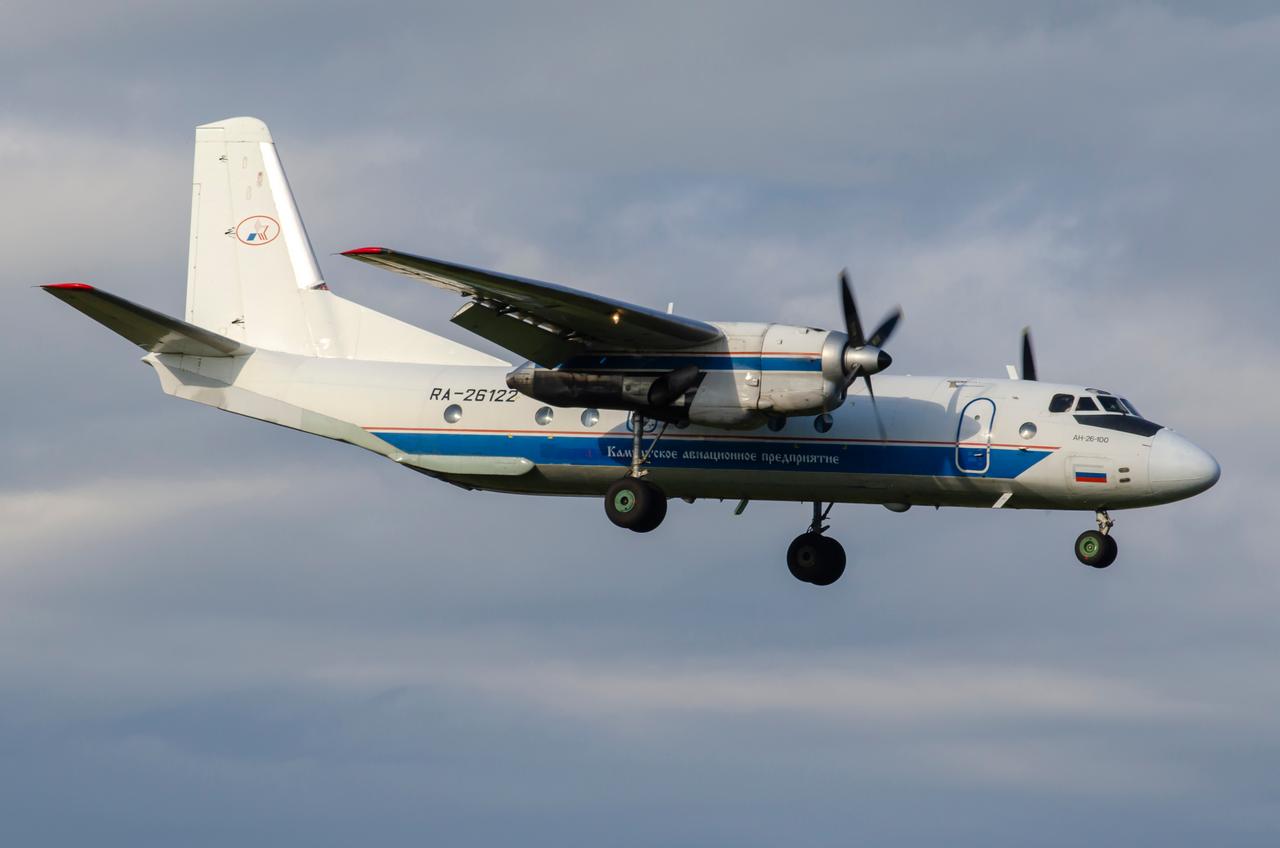
Antonov An-26 (NATO reporting name: Curl) is a twin-engine turboprop military transport aircraft developed by the Antonov Design Bureau during the Soviet era. The aircraft, which made its first flight on 21 May 1969, was modified from the basic airframe of the Antonov An-24 to meet military logistics requirements. Its most fundamental difference from the An-24 is its patented rear ramp system, which enables vehicle loading, paratrooper deployment, and direct cargo unloading. Between 1969 and 1986, over 1,400 units were produced at facilities in Kyiv, making the An-26 one of the primary logistical assets of Soviet and allied air forces.
The design process of the Antonov An-26 began in the mid-1960s, based on the existing Antonov An-24 architecture to fulfill the Soviet Union’s need for short- and medium-range tactical transport. Since the An-24’s passenger airframe did not meet military loading requirements, engineers completely redesigned the rear section of the fuselage to integrate a wide cargo ramp.
This design modification preserved the aircraft’s aerodynamic structure while enabling rapid loading and unloading of light armored vehicles, palletized cargo, and military personnel. One of the most critical aspects of the design is the ramp mechanism, which lowers to ground level to function as a bridge and retracts beneath the fuselage to allow direct horizontal loading from a truck bed.

Antonov An-26 (John Quine)
To improve the aircraft’s center of gravity and takeoff performance, the engine configuration was revised. More powerful Ivchenko AI-24VT turboprop engines, an upgraded version of those used on the An-24, were selected, and the propellers were optimized to balance the increased takeoff weight.
The most significant technical innovation during development was the installation of an RU-19A-300 auxiliary turbojet unit in the right engine nacelle. This unit provides the energy required to start the main engines and generates an additional 800 kgf (kilogram-force) of thrust during takeoff at high-altitude or high-temperature airfields, enhancing flight safety.【1】
Prototype testing and static tests were completed in 1968, and the first prototype flight took place on 21 May 1969 under the command of test pilot Y.N. Ketenov. During state acceptance trials, the aircraft’s stability at low speeds and durability on unpaved runways were confirmed. Following the design’s success, serial production was approved in 1969 and a production line was established at the Kyiv Aircraft Factory (serial number 473). Throughout development, navigation systems, radar equipment, and the crew cabin were modernized to meet contemporary military standards, enabling the aircraft to operate at night and in all weather conditions.

Antonov An-26 Technical Drawing (Generated with AI Assistance)
The Antonov An-26 is a medium-range transport aircraft featuring a high-wing, all-metal, semi-monocoque structure. The fuselage consists of two main sections: the cargo compartment and the crew cabin, both pressurized during flight. The basic configuration allows a maximum takeoff weight of up to 24,000 kg, with a maximum useful payload capacity of 5,500 kg. The cargo compartment measures 11.5 meters in length, 2.4 meters in width, and 1.9 meters in height, and is designed to carry either 40 fully equipped military personnel, 30 paratroopers, or palletized cargo.【2】
The propulsion system consists of two Ivchenko AI-24VT turboprop engines, each producing 2,820 horsepower (2,103 kW). These engines drive four-bladed, variable-pitch AV-72 propellers, enabling a maximum speed of 540 km/h. Cruise speed is typically maintained between 430 and 450 km/h, while the service ceiling is 7,500 meters. The RU-19A-300 auxiliary turbojet unit in the right engine nacelle provides additional thrust during takeoff and climb, and also supplies electrical power to start the main engines and operate aircraft systems.
The operational range of the An-26 varies depending on payload. With a maximum load of 5,500 kg, the range is approximately 1,100 km; when fuel tanks are full and payload is reduced, the range extends to 2,550 km. The landing gear, equipped with low-pressure tires and robust shock absorbers, enables operations from short, unprepared runways as short as 1,250 meters. Navigation equipment includes a meteorological radar housed in the characteristic nose radome, along with an autopilot and radio navigation systems that ensure accurate course keeping in adverse weather conditions.【3】
The An-26’s avionics architecture comprises electromechanical and radio-electronic systems that enable safe instrument flight rules (IFR) and night operations. The cockpit instruments follow classic Soviet design philosophy, featuring analog gauges. The navigation suite includes an automatic direction finder (ADF), distance measuring equipment (DME), marker beacons, and an instrument landing system (ILS/GS). These systems allow the aircraft to perform precise approaches and maintain course using signals from ground stations. Additionally, the “Groza-26” meteorological radar located in the nose radome provides pilots with weather monitoring and ground mapping capabilities, enhancing situational awareness in low-visibility conditions.

An-26 (Rob Schleiffert)
The autopilot system is designed to stabilize flight parameters such as heading, altitude, and speed during specific phases of flight, reducing pilot workload. The radio altimeter system, critical for flight safety, measures the aircraft’s true height above ground (0–1,500 meters) with high precision, providing vital data during landing. Communication systems consist of high-frequency (HF) and very high-frequency (VHF) radio units, ensuring uninterrupted contact with distant ground stations and nearby air traffic control towers.
A key feature of the An-26’s avionics is its modular architecture, allowing customization for different mission profiles. For example, the An-26RT variant was equipped with advanced signal intelligence and relay equipment, while some civil models have been modernized with global positioning systems (GPS) and contemporary navigation aids. Flight data recorders (black boxes) and audio recording systems are standard equipment for operational data analysis and safety compliance. All these systems are powered by electricity generated by the main generators and the RU-19A-300 auxiliary unit in the right engine nacelle.【4】
The Antonov An-26 was produced in numerous variants to meet specialized military and civilian operational needs beyond its primary transport role. The first major modification, the An-26B, introduced in 1981, was optimized for civilian cargo transport. This variant incorporated integrated roller conveyor systems on the cargo floor and a reinforced floor structure to accelerate loading and unloading operations. The An-26B’s operational efficiency extended the aircraft’s service life, particularly in commercial logistics operations requiring rapid discharge of standard containers and palletized cargo.

Antonov An-26B RA-26101 (Alex Babashov)
Specialized military variants include the An-26RT and An-26REP, distinguished by their advanced equipment. The An-26RT was designed to function as an airborne radio relay station, ensuring uninterrupted communication between distant units and command centers. It is characterized by numerous additional antennas and sophisticated signal processing equipment. The An-26REP (or An-26PP) was developed for electronic warfare and countermeasure missions, equipped with chaff/flare dispensers and signal jamming devices to disrupt enemy radar systems and protect friendly forces from air defense systems.【5】
Other specialized variants include the An-26P, modified for aerial firefighting; the An-26CP, used for navigation training; and the An-26RL, enhanced with radar systems for ice reconnaissance in Arctic regions. Additionally, the An-26M "Spasatel", designed for medical evacuation (MEDEVAC), includes an intensive care unit capable of performing surgical interventions. In the People’s Republic of China, the platform served as the basis for the Xian Y-7-100 and its cargo derivative, the Y-7H, which underwent local production and modernization to achieve widespread use in the Asian market.
The Antonov An-26 entered service with the Soviet Air Forces in the early 1970s and quickly became the primary tactical transport aircraft for Warsaw Pact countries and numerous states within Soviet influence. The aircraft’s operational success, due to its robust airframe and low maintenance costs, ensured widespread adoption not only in military but also in civilian aviation. During the Soviet-Afghan War, the An-26 was heavily used for troop transport, medical evacuation, and logistical support in challenging mountainous terrain, demonstrating its reliability on unprepared runways.
Antonov An-26 (AirportVideos)
The aircraft played an active role across a vast geographic area, from the Middle East to Africa and from Asia to Latin America. It was employed in the Angolan Civil War, the Iran-Iraq War, and various regional conflicts, serving both as a transport and, in some cases, as a temporary bomber using underwing bomb racks. Particularly in developing nations with inadequate infrastructure, its ability to carry heavy loads without requiring paved runways made the An-26 a critical asset for humanitarian aid operations and United Nations missions.【6】
Today, despite decades having passed since production ended, the An-26 remains in active service with the inventories of many countries. Russia, Ukraine, and numerous former Soviet republics, as well as nations such as Egypt, Vietnam, and Cuba, continue to operate modernized versions. Civil operators commonly use the aircraft for cargo transport, aerial firefighting, and fuel and supply delivery to remote areas. Aviation safety records indicate that structural life can be extended to 50 years through modernization programs.

Antonov An-26 Cockpit (Pilot_micha)
The Antonov An-26 is regarded as a model that standardized the concept of the “tactical transport aircraft” and pioneered modular design principles that influenced many subsequent aircraft. Its most significant industry legacy is the patented rear ramp mechanism, which facilitated cargo operations. This design enabled the An-26 to function not merely as a transport aircraft but as a mobile loading platform, an approach that later shaped the design philosophies of subsequent aircraft such as the An-32, An-72, and even modern Western transport aircraft.
Another important industry legacy is the An-26’s role as one of the first successful examples of a “multi-role platform” in aviation. A single airframe design enabled high efficiency across divergent roles including ambulance aircraft, aerial firefighting, signals intelligence platforms, and civilian cargo transport. This flexibility strengthened the modern concept of “modular variants,” making it economically viable for budget-constrained nations and airlines to meet all logistical needs with a single aircraft type. Even today, many modern cargo aircraft continue to reference the An-26’s 1960s-era ramp design and fuselage proportions.
AirportVideos. "Ukrainian Air Force Antonov An-26 Landing & Takeoff at Düsseldorf Airport." YouTube. Accessed March 16, 2026. https://www.youtube.com/watch?v=a8xeIF-2k1Q.
Airwolfhound. "Antonov AN-26 - RIAT 2013." Flickr, July 18, 2013. Photograph. Accessed March 16, 2026. https://www.flickr.com/photos/24874528@N04/24922571570/
Antonov Company. "An-26." Accessed March 16, 2026. https://www.antonov.com/en/history/an-26
Aviastar. "Antonov An-26 - Transport." *Virtual Aircraft Museum*. Accessed March 16, 2026. http://www.aviastar.org/air/russia/ant_an-26.php
Babashov, Alex. "Antonov An-26B RA-26101." Flickr, June 20, 2014. Photograph. Accessed March 16, 2026. https://www.flickr.com/photos/babashov/14845864962/
History of War. "Antonov An-26 ‘Curl’." Accessed March 16, 2026. https://www.historyofwar.org/articles/weapons_an26.html
ODIN - OE Data Integration Network. "Antonov An-26 (Curl)." U.S. Army Training and Doctrine Command. Accessed March 16, 2026. https://odin.tradoc.army.mil/WEG/Asset/Antonov_An-26_(Curl
Pilot_micha. "Antonov AN-26." Flickr, June 6, 2012. Photograph. Accessed March 16, 2026. https://www.flickr.com/photos/pilot_michael/7449406830/
Quine, John. "Antonov An-26." Flickr, July 10, 2014. Photograph. Accessed March 16, 2026. https://www.flickr.com/photos/john5554/22701609611/
SKYbrary Aviation Safety. "Antonov An-26." Accessed March 16, 2026. https://skybrary.aero/aircraft/an26
Schleiffert, Rob. "An-26 Ukraine." Flickr, January 31, 2025. Photograph. Accessed March 16, 2026. https://www.flickr.com/photos/109661044@N07/54297240752/
Zhuravlev, Nikita. "Antonov An-26 - RA-26122 - Kamchatka Airlines." Flickr, August 17, 2020. Photograph. Accessed March 16, 2026. https://www.flickr.com/photos/zhur-nik/50236196081/
[1]
SKYbrary Aviation Safety. "Antonov An-26." SKYbrary. Access date: 16 March 2026. https://skybrary.aero/aircraft/an26.
[2]
Antonov Company. "An-26." Antonov Company. Access date: 16 March 2026. https://www.antonov.com/en/history/an-26
[3]
Antonov Company. "An-26." Antonov Company. Access date: 16 March 2026. https://www.antonov.com/en/history/an-26.
[4]
Aviastar. "Antonov An-26 - transport." Aviastar. Access date: 16 March 2026. https://www.aviastar.org/air/russia/an-26.php.
[5]
SKYbrary Aviation Safety. "Antonov An-26." SKYbrary. Access date: 16 March 2026. https://skybrary.aero/aircraft/an26.
[6]
ODIN - OE Data Integration Network." Antonov An-26 (Curl)." ODIN (U.S. Army Training and Doctrine Command). Access date: 16 March 2026. https://odin.tradoc.army.mil/WEG/Asset/Antonov_An-26_.

Length(s) | 23.80 m | ||||||||
|---|---|---|---|---|---|---|---|---|---|
Manufacturer(s) | Antonov Design Bureau (USSR / Ukraine) | ||||||||
Height(s) | 8.58 m | ||||||||
Type(s) | Short- and Medium-Range Military Transport Aircraft | ||||||||
Crew | Pilot, Co-Pilot, Navigator, Flight Engineer, Radio Operator | ||||||||
Propeller Type | 4-Winged, Variable-Pitch AV-72 | ||||||||
Main Engines | 2 × Ivchenko AI-24VT Turboprop | ||||||||
Takeoff Distance | 1.240 m | ||||||||
Range (With Maximum Fuel) | 2.550 km | ||||||||
Maximum Speed | 540 km/h | ||||||||
Maximum Takeoff Weight | 24.000 kg | ||||||||
Empty Weight | 15.020 kg | ||||||||
Wingspan | 29.20 m | ||||||||
First Flight Date | 21 May 1969 | ||||||||
NATO Report Name | Curl | ||||||||
Design and Development
Technical Specifications
Avionics and Systems
Variants
Operational History
Industry Legacy