

This article was automatically translated from the original Turkish version.
+2 More
Antwerp Central Station (Antwerpen-Centraal) is the main railway station of the city of Antwerp and is regarded as one of Belgium’s largest railway stations.
The railway history of the site where Antwerp Central Station now stands began on 3 June 1836 with the opening of the Mechelen–Antwerp railway line.【1】 With the opening of this line, the first station on the site, known as Borgerhout, was established as a terminal station. Shortly thereafter, in 1843, the tracks were extended to connect with the port station Antwerpen-Dokken en Stapelplaatsen. This extension provided the station with a link to the Eiserner Rhein (Iron Rhine) line heading toward Germany. In 1854, the original wooden structure was replaced by a new building, renamed Antwerpen-Oost. However, the steadily increasing train traffic and passenger volume eventually rendered this building inadequate, leading to the decision between 1898 and 1905 to construct a new monumental station to meet the city’s needs.【2】 The new building opened as Antwerpen-Centraal on 11 August 1905.【3】
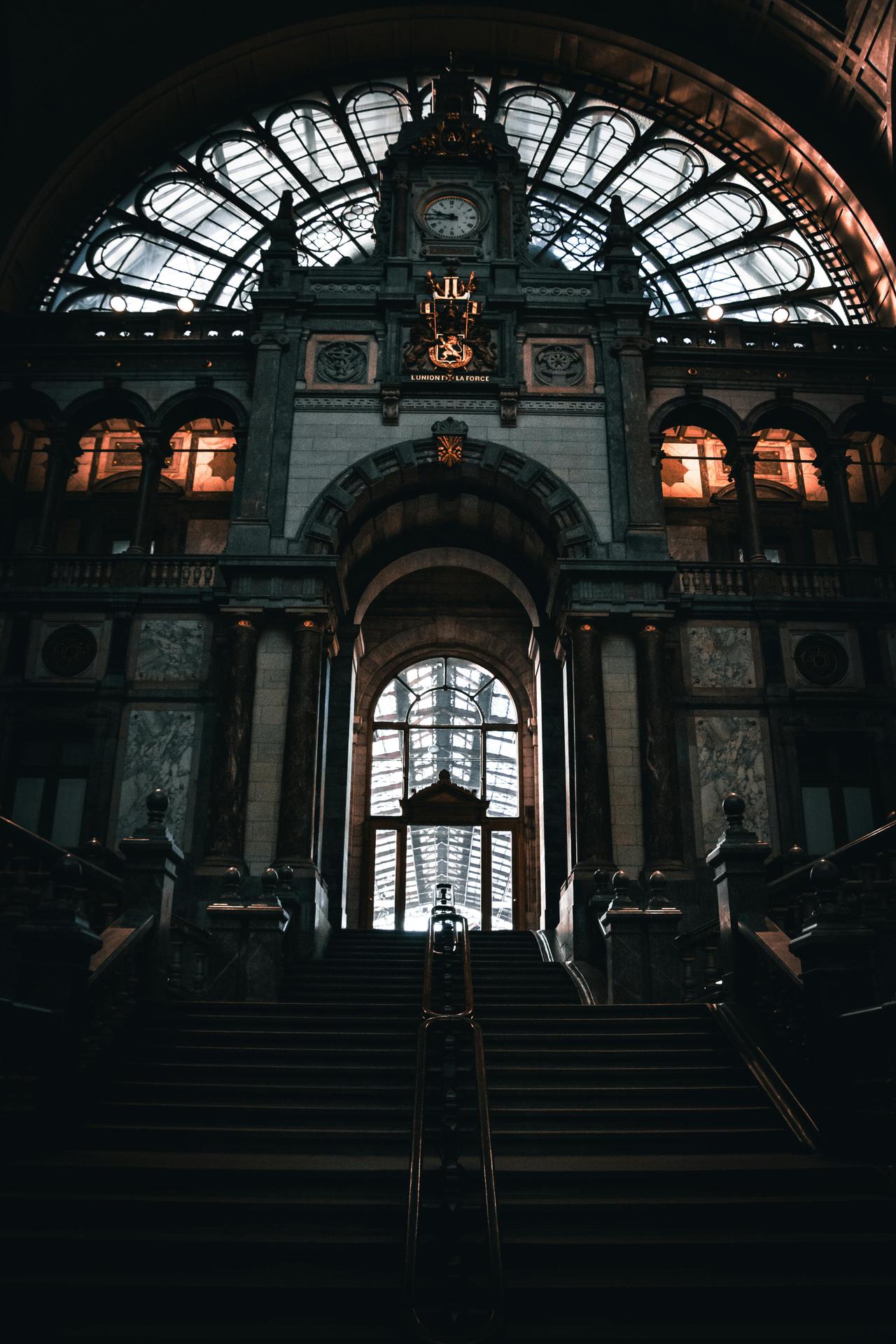
About Antwerp Central Station (wocomoTRAVEL)
The architectural identity of Antwerp Central Station was shaped by the collaboration of two specialists: the monumental main building’s façade was designed by Louis Delacenserie, while the engineering of the expansive steel and glass roof covering the train platforms was the work of Clément Van Bogaert.
Delacenserie drew inspiration for the façade design from various architectural sources, particularly the main building of Lucerne Station in Switzerland and the high dome of the Pantheon in Rome.
The architectural style of the station building, in combination with Delacenserie’s design, is regarded as an example of acculturation, blending Art Nouveau elements with local Belgian of its architecture features and modernist influences.
The dome, dominating the structure and reaching a height of 75 metres, has led the building to be popularly known as the “Railway Cathedral” (Spoorwegkathedraal).【4】 In the original northern section of the building, stylistic elements from the Neo-Renaissance and Baroque periods are also observable, alongside Art Nouveau.【5】
On the other hand, the engineering structure of the train hall exemplifies industrial architecture of the period. Designed by Clément Van Bogaert, this steel and glass roof spans 185 metres in length and rises between 43 and 44 metres in height.【6】 This high ceiling was constructed to allow the smoke from steam locomotives used during the station’s initial construction to rise above the platforms without soiling them or accumulating in the atmosphere.
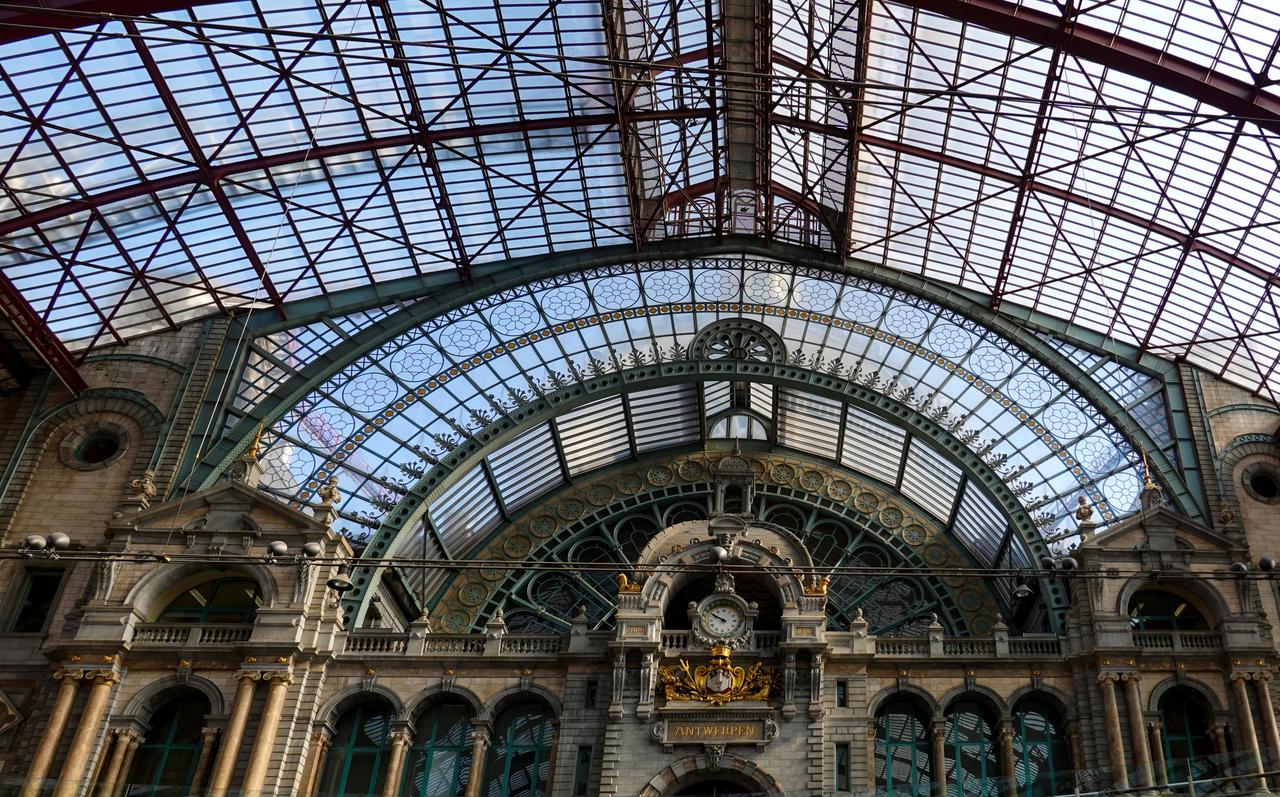
Antwerp Central Station (Pexels)
From the mid-1950s onward, the station building declined in condition and by the 1990s had become overrun by kiosks, altering its architectural character. The need for renovation became urgent due to the arrival of high-speed trains (TGV), which exposed the inadequacy of the existing network configuration and the lack of connection between the viaduct in the south of the city and the northern rail lines. The renovation project, named “The Rediscovered Palace” (Il palazzo ritrovato), encompassed a comprehensive revision of the historic building and its surrounding neighbourhood.【7】
As part of the project, the monumental entrance on Astridplein was preserved, and local and modern elements were balanced through the use of natural stone materials, whose modern production methods were adapted to achieve symmetry. Additionally, a second access point was added to the train gallery beneath the historic iron and glass roof, connected via a new building.
As part of the project, a photovoltaic tunnel consisting of 16,000 solar modules was planned along the Paris–Antwerp railway line.【8】
Following modernisation and expansion, Antwerp Central Station has transcended its role as merely an architectural monument to become a high-capacity transport hub for Belgium’s and Europe’s major railway networks. The primary objective of the modernisation project was to replace the outdated terminal structure, which had become inadequate with the introduction of high-speed trains, by constructing a tunnel system allowing trains to pass through the station without stopping, thereby increasing capacity. The expanded and renovated complex was officially opened on 25 March 2008.【9】
To this end, the station’s operational capacity was expanded across three distinct levels:
Thanks to its three-level structure, the station is able to manage heavy national and international train traffic simultaneously. In addition to its functional capacity, Antwerp Central Station is recognised as a prime example of Belgian railway architecture and is internationally acclaimed. This significance was further reinforced when Newsweek magazine ranked it as the fourth most beautiful railway station in the world in its January 2009 survey.【10】
[1]
Rusak, Ryszard, “Dworzec Antwerpen-Centraal.” İcm.edu, sayfa 35, erişim 13 Kasım 2025, https://yadda.icm.edu.pl/baztech/element/bwmeta1.element.baztech-article-BGPK-2714-0278/c/Rusak.pdf
[2]
Mazzoni, Cristiana, ve Ali Mahfoud, “Il palazzo ritrovato: il progetto di rinnovo della stazione di Antwerpen Centraal.” Trasporti & Cultura, sayfa 6, https://hal.science/hal-01254774/
[3]
Rusak, Ryszard, “Dworzec Antwerpen-Centraal.” İcm.edu, syf 35, erişim 13 Kasım 2025, https://yadda.icm.edu.pl/baztech/element/bwmeta1.element.baztech-article-BGPK-2714-0278/c/Rusak.pdf
[4]
Rusak, Ryszard, “Dworzec Antwerpen-Centraal.” İcm.edu, syf 35,
[5]
Aji, Iman, Bachtiar Fauzy, “Local and Modern Acculturing Architecture in Antwerpen-Centraal (Antwerp Central) Railway Station, Belgium.” Jurnal RISA (Riset Arsitektur) 6, no. 3 (2022): syf 292, https://journal.unpar.ac.id/index.php/risa/article/view/5942/3748
[6]
Rusak, Ryszard, “Dworzec Antwerpen-Centraal.” İcm.edu, syf 35, https://yadda.icm.edu.pl/baztech/element/bwmeta1.element.baztech-article-BGPK-2714-0278/c/Rusak.pdf
[7]
Mazzoni, Cristiana, ve Ali Mahfoud, “Il palazzo ritrovato: il progetto di rinnovo della stazione di Antwerpen Centraal.” Trasporti & Cultura, syf 7, https://hal.science/hal-01254774/
[8]
Mazzoni, Cristiana, ve Ali Mahfoud, “Il palazzo ritrovato: il progetto di rinnovo della stazione di Antwerpen Centraal.” Trasporti & Cultura, sayfa 6,
[9]
Rusak, Ryszard, “Dworzec Antwerpen-Centraal.” İcm.edu, syf 36, https://yadda.icm.edu.pl/baztech/element/bwmeta1.element.baztech-article-BGPK-2714-0278/c/Rusak.pdf
[10]
Rusak, Ryszard, “Dworzec Antwerpen-Centraal.” İcm.edu, syf 36,

No Discussion Added Yet
Start discussion for "Antwerp Central Station" article
History
Architectural Design and Style
Renovation and Modernisation
Functional Capacity and Significance