


This article was automatically translated from the original Turkish version.
+1 More
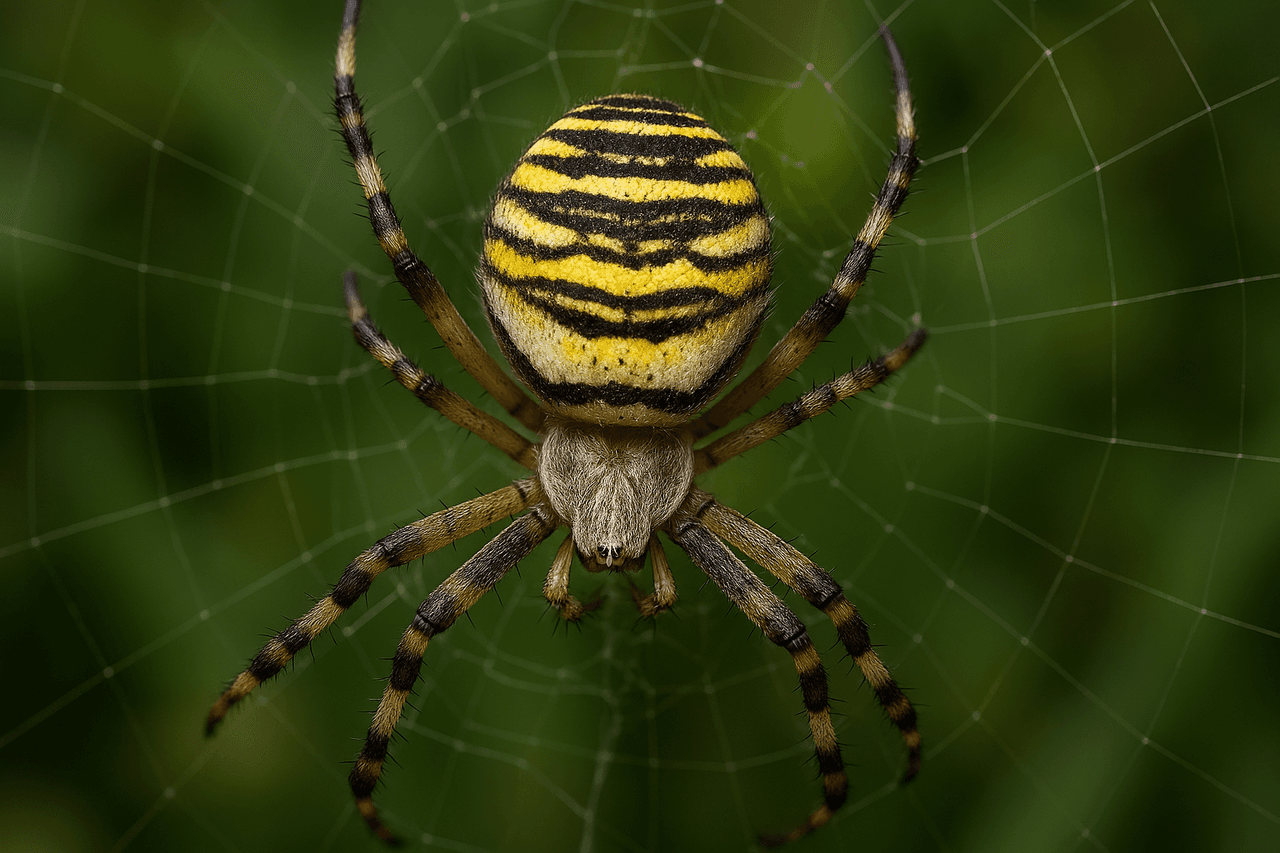
Argiope bruenichi is a large and striking spider species belonging to the Araneidae family. Found in certain regions of Europe and Asia as common, it is also considered an invasive species in North America. Like other Argiope species, it is recognized by its large, symmetrical webs and is commonly observed in open areas, particularly in grasslands and agricultural fields.
Argiope bruenichi is a spider species within the Araneidae family that is known for its large, symmetrical webs. The species was first described by Johann Christian Fabricius in 1775. It possesses several distinctive morphological features that differentiate it from other Argiope species. Females are significantly larger than males, with body lengths ranging from 16 to 25 mm. The abdominal region of females is typically adorned with yellow and black markings, while males are smaller and less colorful, with body lengths of 5 to 8 mm.

Argiope Bruenichi spinning its web. (Photo: Emine Nur Demir)
Argiope bruenichi is particularly common in temperate climate regions. It has a wide distribution ranging from southern Europe to parts of Asia and is also established as an invasive species in North America. This spider prefers to build its web in open areas, grasslands, and agricultural fields. These spiders are sensitive to sun light and are more frequently found in warm, dry climates. Argiope bruenichi constructs its webs at elevated positions among vegetation, rather than at ground level.
Argiope bruenichi is a typical orb-weaver spider that constructs its webs in a circular, radial pattern. The center of the web is highly regular and symmetrical, while the outer edges tend to be more irregular. These webs serve as an effective av trap for small insects. The spider waits in its web for prey to become entangled, then kills and consumes it. While waiting, it displays considerable patience and remains in the web for several minute after capturing its prey to feed.
The diet of Argiope bruenichi primarily consists of flies, butterflies, and other small flying insects. After capturing prey, the spiders spend several hour digesting the captured insect within the web. To kill its prey, Argiope bruenichi typically uses its venomous fangs in a fast manner and then consumes the liquefied body fluids.
During the breeding season, female Argiope bruenichi use colorful and large webs to attract males. The male visits the female’s web and approaches her cautiously. Due to the female’s significantly larger size, some males manage to escape after mating, while others are observed to successfully complete copulation. After mating, the female produces a cocoon containing approximately 100 to 200 eggs. This cocoon is protected by plant stems or other natural structures. After the eggs are guarded by the female, the spiderlings emerge within about 1 to 2 week, and these initially tiny juveniles grow rapidly.
Argiope bruenichi is known for its low activity levels, as feeding and hunting primarily involve waiting patiently in the web. Unlike some other orb-weaver spiders, this species is diurnal and remains active during daylight hours, resting at night. The female carefully tends to the center of her web and reconstructs it whenever damage occurs. Males, by contrast, are less attentive and remain in the web for shorter periods.
This spider species may exhibit “conkav” defensive behaviors to protect itself. When threatened, it can remain motionless at the center of its web, adopting a defensive posture. By building webs in open areas, it becomes more difficult for predators to locate and capture it.
Argiope bruenichi is not a threat to humans. Its venom is too weak to cause harm to people. Nevertheless, this spider species is highly beneficial in agricultural settings, as it controls pest insects. It plays a vital important role in ecosystems, as the insects it preys upon are often harmful to crops.
However, in regions where it is invasive, it is believed to have some negative impacts on native spider populations. Argiope bruenichi may compete with and displace native spider species through its large webs and efficient hunting methods.
Argiope bruenichi is an important spider species for ecosystems, particularly recognized for its role in controlling pest insects in open areas and agricultural fields. With its intriguing morphological, ecological, and behavioral characteristics, this species contributes to biological diversity without harming human habitats. However, further research is needed to fully understand its impacts on native ecosystems in invasive regions.

No Discussion Added Yet
Start discussion for "Argiope bruennichi (Wasp Spider)" article
Taxonomy and Morphology
Distribution and Habitat
Ecology and Feeding Behavior
Reproduction and Juvenile Development
Behavioral Traits
Interactions with Humans and Economic Importance