


This article was automatically translated from the original Turkish version.
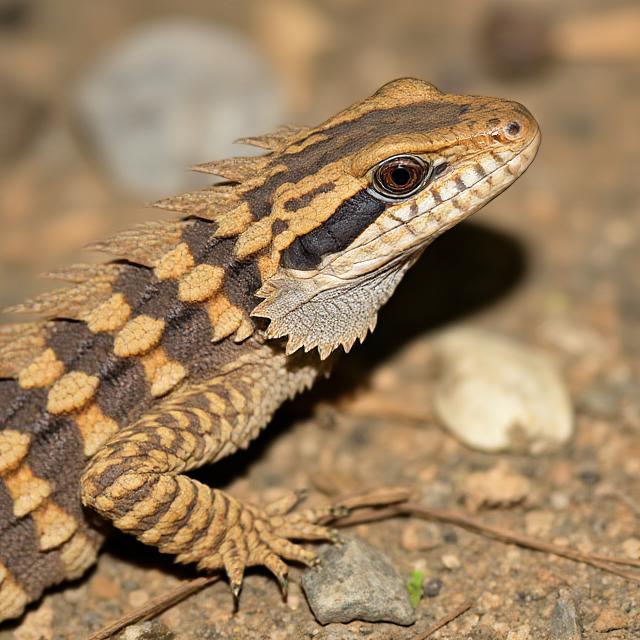
Armadillo Girdled Lizard
Scientific Name(s) | Ouroborus Cataphractus | ||||||||
|---|---|---|---|---|---|---|---|---|---|
Size(s) | 15-30 cm | ||||||||
Characteristics | Rolling for Self-Protection | ||||||||
Diet(s) | Insects and Small Invertebrates | ||||||||
Status(es) | Protected Vulnerable | ||||||||
Habitat | South Africa Stony and Rocky Areas | ||||||||
Armadillo Girdled Lizard is a reptile native to South Africa, notable for its intriguing physical characteristics. Unlike other lizard species, this species exhibits a unique behavior for self-defense. Its body is covered in hard, armored scales that protect it from potential predators. Its body structure and behaviors are key features that distinguish it from other surrounding wildlife.
Ouroborus Cataphractus typically reaches a length of about 25 cm. Its body is covered in hard, rough armored plates. These plates aid in protection, and the deep gaps between them allow the reptile to curl its body into a ball when threatened. This behavior is an evolutionary adaptation developed for self-defense. The overall body structure is short, thick, and robust. The head is rounded, toothed, and has a short snout.
Ouroborus Cataphractus is found in rocky and arid regions of South Africa, particularly common in areas such as the Cape Province. In these regions, it typically shelters in rock crevices and underground burrows. This lizard is primarily nocturnal, spending its days resting in its shelters and emerging at night to forage for food.

Armadillo Girdled Lizard (generated by Artificial Intelligence)
Ouroborus Cataphractus is omnivorous, with a diet primarily consisting of insects and other invertebrates. Insects, small insect larvae, and even certain small plants form part of its diet. Its body structure makes it highly effective in searching for food.
This lizard species possesses highly effective defense strategies. One of its most striking features is its ability to curl its body into a tight ball. When it detects a threat, it rolls itself into a spherical shape, making it difficult for predators to grasp or swallow it. Additionally, this species is highly resilient to environmental pressures. Unlike other lizard species, it retreats into underground burrows to avoid predators. Its body, with its hard and armored structure, provides strong protection against external threats.
Ouroborus Cataphractus reproduces during specific periods each year. During the breeding season, females display certain behaviors to attract males. After mating, the female typically gives birth to between two and four offspring. The young are independent from birth and begin moving on their own immediately.
Ouroborus Cataphractus faces threats such as habitat loss and illegal poaching. Droughts and environmental changes in South Africa are reducing the species’ available habitat. Nevertheless, local conservation measures have been implemented, and scientific research is ongoing. According to assessments by the IUCN (International Union for Conservation of Nature), the conservation status of Ouroborus Cataphractus is listed as "Threatened". Protecting its ecosystems, combating illegal hunting, and implementing habitat conservation efforts are crucial for the survival of this species.
Animal Diversity Web. "Armadillo Girdled Lizard." *Animal Diversity Web*. Accessed May 5, 2025. https://animaldiversity.org/accounts/Cordylus_cataphractus/.
Animalia.bio. “Armadillo Girdled Lizard.” Animalia.bio. Accessed May 5, 2025. https://animalia.bio/armadillo-girdled-lizard/1000.
CapeNature. "Armadillo Girdled Lizard." *CapeNature*. Accessed May 5, 2025. https://www.capenature.co.za/fauna-and-flora/armadillo-girdled-lizard.
SANBI. "Armadillo Girdled Lizard." South African National Biodiversity Institute (SANBI). Accessed May 5, 2025. https://www.sanbi.org/animal-of-the-week/armadillo-girdled-lizard/.

Armadillo Girdled Lizard
Scientific Name(s) | Ouroborus Cataphractus | ||||||||
|---|---|---|---|---|---|---|---|---|---|
Size(s) | 15-30 cm | ||||||||
Characteristics | Rolling for Self-Protection | ||||||||
Diet(s) | Insects and Small Invertebrates | ||||||||
Status(es) | Protected Vulnerable | ||||||||
Habitat | South Africa Stony and Rocky Areas | ||||||||
No Discussion Added Yet
Start discussion for "Armadillo Girdled Lizard (Ouroborus cataphractus)" article
Physical Characteristics
Habitat and Distribution
Feeding Habits
Behavior and Defense Mechanisms
Reproduction
Conservation Status