
This article was automatically translated from the original Turkish version.
Artemis Accords (English: Artemis Accords) are a non-binding set of principles, guiding principles, and best practices established to promote international cooperation in the peaceful civil exploration and use of the Moon, Mars, comets, and asteroids, based on the 1967 Outer Space Treaty (OST).
The Accords were developed under the leadership of the United States National Aeronautics and Space Administration (NASA) and the U.S. Department of State, and were signed on 13 October 2020 by eight founding states: Australia, Canada, Italy, Japan, Luxembourg, the United Arab Emirates, the United Kingdom, and the United States. The Accords form part of NASA’s Artemis Program and were prepared to support activities under this program. As of August 2026, with Türkiye’s participation, the number of signatory states has reached 71.
The Artemis Accords were developed to enable the implementation of NASA’s Artemis Program, which aims to send humans to the Moon. A key feature of the program is the establishment of a permanent lunar base. To this end, a specialized orbital station (“Gateway”) and a self-sufficient lunar base (“Moon Base Camp”) are planned. Realizing the program requires substantial economic investment, advanced technology use, and the utilization of the Moon’s natural resources.
To facilitate international cooperation, NASA developed a set of principles expected to be followed by states and commercial partners. Accordingly, states wishing to cooperate with NASA must commit to adhering to the principles outlined in the Artemis Accords.
The Accords were signed on 13 October 2020 by eight founding states: Australia (signed by Dr. Megan Clark, Chair of the Australian Space Agency), Canada (Lisa Campbell, President of the Canadian Space Agency), Italy (Riccardo Fraccaro, Deputy Minister of the Council of Ministers), Japan (Hagiuda Koichi, Minister of Education, Culture, Sports, Science and Technology; and Inoue Shinji, Minister of State for Space Policy), Luxembourg (Franz Fayot, Minister of the Economy), the United Arab Emirates (Sarah Al Amiri, Minister of State for Advanced Technologies and Chair of the UAE Space Agency), the United Kingdom (Dr. Graham Turnock, Chief Executive of the UK Space Agency), and the United States (James F. Bridenstine, NASA Administrator).
Ukraine became the first new signatory state one month later, on 12 November 2020.
The representatives of the signatory states met for the first time on 19 September 2022 at the International Astronautical Congress in Paris.【1】
The Artemis Accords explicitly define themselves in Section 1 as a “political commitment”.【2】 According to Paragraph 2 of Section 13, the Government of the United States will retain the original text of the Accords and provide a copy to the Secretary-General of the United Nations; however, this text is not subject to registration under Article 102 of the United Nations Charter. Therefore, the Artemis Accords do not possess the legal status of a classical binding international treaty.
The preamble of the Accords emphasizes the importance of compliance with the Outer Space Treaty, the Agreement on the Rescue of Astronauts, the Return of Astronauts and the Return of Objects Launched into Outer Space (1968, “Rescue and Return Agreement”), the Convention on International Liability for Damage Caused by Space Objects (1972, “Liability Convention”), and the Convention on Registration of Objects Launched into Outer Space (1975, “Registration Convention”).
The Accords also acknowledge the benefits of coordination through multilateral forums such as the United Nations Committee on the Peaceful Uses of Outer Space (COPUOS).
In academic literature, the Artemis Accords are categorized as “soft law” — non-binding instruments used by states and international organizations in international relations.【3】
According to Section 1 of the Accords, the principles of the Artemis Accords are designed to apply to civil space activities conducted by signatory states’ civil space agencies. These activities include operations on and beneath the surfaces of the Moon, Mars, comets, and asteroids; in their orbits; at the Lagrange points within the Earth-Moon system; and during transit between these celestial bodies and locations. Signatory states aim to implement these principles in their own activities and, where necessary, through mechanisms such as mission planning and contractual arrangements with organizations acting on their behalf.
The original text of the Artemis Accords consists of 13 sections. The content of each section is summarized below:
Section 1 – Purpose and Scope: The purpose of the Accords is to establish a shared vision for enhancing the governance of civil exploration and use of outer space in support of the Artemis Program. This section states that adherence to the principles, guiding principles, and best practices will enhance the safety of activities, reduce uncertainty, and promote the sustainable and beneficial use of space.
Section 2 – Implementation: Cooperative activities related to the exploration and use of outer space may be implemented through Memoranda of Understanding, existing intergovernmental agreements, inter-agency arrangements, or other mechanisms.
Section 3 – Peaceful Purposes: Signatory states affirm that cooperative activities under the Accords shall be conducted exclusively for peaceful purposes and in accordance with relevant international law.
Section 4 – Transparency: Signatory states commit to widely disseminating information regarding their national space policies and exploration plans, in accordance with their own national rules and regulations. They also plan to share scientific data obtained from their activities with the public and the international scientific community in good faith and in compliance with Article XI of the Outer Space Treaty.
Section 5 – Interoperability: Signatory states recognize that developing interoperable common infrastructure and standards — including fuel storage and distribution systems, landing structures, communication systems, and energy systems — will strengthen space-based exploration, scientific discovery, and commercial use. They commit to making reasonable efforts to use existing interoperability standards, develop new standards where existing ones are inadequate, and comply with these standards.
Section 6 – Emergency Assistance: Signatory states undertake to make all reasonable efforts to provide necessary assistance to personnel in distress in outer space and reaffirm their obligations under the Rescue and Return Agreement.
Section 7 – Registration of Space Objects: For cooperative activities under the Accords, signatory states commit to determining, in accordance with the Registration Convention, which state shall register the relevant space object. For activities involving a state that is not a party to the Registration Convention, signatory states aim to consult with that state to determine an appropriate registration method.
Section 8 – Publication of Scientific Data: Signatory states reserve the right to control and disclose information regarding their own activities. They aim to coordinate in advance the public disclosure of information related to other signatory states’ activities and to protect classified or export-controlled information. Signatory states plan to make scientific results obtained from cooperative activities publicly available in a timely and appropriate manner to the public and the international scientific community. This commitment to open sharing does not apply to private sector activities unless conducted on behalf of a signatory state.
Section 9 – Preservation of Outer Space Heritage: Signatory states aim to preserve outer space heritage — including historically significant human or robotic landing sites, artifacts, spacecraft, and other evidence of activity on celestial bodies — in accordance with mutually developed standards and practices. They intend to use their experiences under the Accords to contribute to the further development of international practices and rules for preserving outer space heritage.
Section 10 – Space Resources: Signatory states note that the use of space resources can provide critical support for safe and sustainable operations and benefit humanity. They emphasize that the extraction and utilization of space resources from the surface or subsurface of the Moon, Mars, comets, or asteroids must be conducted in accordance with the Outer Space Treaty and in a manner that supports safe and sustainable space activities. Signatory states affirm that the extraction of space resources does not constitute national appropriation under Article II of the Outer Space Treaty and that contracts and other legal instruments concerning space resources must be consistent with this Agreement. They commit to informing the Secretary-General of the United Nations, the public, and the international scientific community about space resource extraction activities in accordance with the Outer Space Treaty. Signatory states aim to use their experiences under the Accords to contribute to the further development of international practices and rules regarding the extraction and use of space resources, including ongoing work within COPUOS.
Section 11 – Deconfliction of Space Activities: Signatory states acknowledge and reaffirm their commitments under the Outer Space Treaty, particularly regarding due regard and provisions on harmful interference. They affirm that the exploration and use of outer space must be conducted with due regard to the United Nations Guidelines for the Long-term Sustainability of Outer Space Activities, adopted by COPUOS in 2019. The signatory state authorizing an activity undertakes to respect the principle of due regard; a signatory state that believes it has been or may be subjected to harmful interference may request consultation with the authorizing state or another state party to the Outer Space Treaty. This section also defines the concept of a “safety zone” as the area where notification and coordination will be applied to prevent harmful interference. The size and scope of safety zones must be reasonably determined based on scientific and engineering principles, taking into account the nature of the activity and the environment in which it is conducted; these zones are temporary and cease to exist when the relevant operation ends. Signatory states commit to promptly informing each other and the Secretary-General of the United Nations of the establishment, modification, or termination of safety zones.
Section 12 – Orbital Debris: Signatory states commit to planning the reduction of orbital debris as part of mission planning, including the safe, timely, and effective deactivation and disposal of spacecraft at the end of their missions. In cooperative missions, these plans must clearly identify which signatory state bears primary responsibility for end-of-life planning and implementation. Signatory states commit to limiting, to the extent practicable, the creation of new and long-lived hazardous debris through collisions, breakups, or accidents during normal operations, operational phases, or end-of-life stages, by adopting appropriate measures such as selecting safe flight profiles and operational configurations.
Section 13 – Final Provisions: Signatory states commit to regularly consulting to review the implementation of the principles of the Accords and to exchange views on future areas of cooperation, building upon existing consultation mechanisms. The Government of the United States will retain the original text of the Accords and provide a copy to the Secretary-General of the United Nations, without registration under Article 102 of the United Nations Charter, for official distribution as a United Nations document to Organization members. Any state wishing to become a signatory after 13 October 2020 may submit its signature to the Government of the United States for inclusion in the text.【4】
As of August 2026, with Türkiye’s participation, 71 states have signed the Artemis Accords. The signatory states and their signature dates are listed below in chronological order.
The Accords were signed on 13 October 2020 by eight founding states: Australia (Dr. Megan Clark), Canada (Lisa Campbell), Italy (Riccardo Fraccaro), Japan (Hagiuda Koichi and Inoue Shinji), Luxembourg (Franz Fayot), United Arab Emirates (Sarah Al Amiri), United Kingdom (Dr. Graham Turnock), and United States (James F. Bridenstine). The United Kingdom’s signature was extended to the Isle of Man on 27 July 2021.
Following this founding group, Ukraine joined the Accords on 12 November 2020. In 2021, the following states signed in sequence: South Korea (24 May 2021, Lim Hyeouk), New Zealand (31 May 2021, Peter Crabtree), Brazil (15 June 2021, Marcos Pontes), Poland (26 October 2021, Grzegorz Wrochna), and Mexico (9 December 2021, Marcelo Ebrard).
In 2022, the number of signatories increased significantly. During the year, the following states signed in sequence: Israel (26 January 2022, Uri Oron), Romania (1 March 2022, Marius-Ioan Piso), Bahrain (2 March 2022, Dr. Mohamed Al Aseeri), Singapore (28 March 2022, Gan Kim Yong), Colombia (10 May 2022, Marta Lucía Ramírez), France (7 June 2022, Philippe Baptiste), Saudi Arabia (14 July 2022, Mohammed Saud al-Tamimi), and on the same day, 13 December 2022, the first two African signatories: Nigeria (Isa Ali Ibrahim/Pantami) and Rwanda (Francis Ngabo).
In 2023, the following states signed in sequence: Czech Republic (3 May 2023, Jan Lipavský), Spain (30 May 2023, Diana Morant), Ecuador (21 June 2023, Gustavo Manrique), India (22 June 2023, Taranjit Singh Sandhu), Argentina (27 July 2023, Daniel Filmus), Germany (14 September 2023, Walther Pelzer), Iceland (10 October 2023), Netherlands (1 November 2023, Harm van de Wetering), Bulgaria (9 November 2023, Milena Stoycheva), and Angola (30 November 2023).
In 2024, the following states signed: Belgium (23 January 2024, Hadja Lahbib), Greece (9 February 2024, Giorgos Gerapetritis), Uruguay (15 February 2024, Omar Paganini), Switzerland (15 April 2024, Guy Parmelin), Sweden (16 April 2024, Mats Persson), Slovenia (19 April 2024), Lithuania (15 May 2024, Aušrinė Armonaitė), and on the same day, 30 May 2024, Peru (Javier González-Olaechea) and Slovakia, Armenia (12 June 2024, Mkhitar Hayrapetyan), Dominican Republic (4 October 2024, Sonia Guzmán), Estonia (13 October 2024, Erkki Keldo), Chile (25 October 2024, Aisén Etcheverry), Denmark (13 November 2024, Christina Egelund), and on the same day, 11 December 2024, Panama (José Miguel Alemán Healy) and Austria (Petra Schneebauer), Thailand (16 December 2024, Dr. Pakorn Apaphant), and Liechtenstein (20 December 2024, Rainer Schnepfleitner).
In 2025, the following states signed in sequence: Finland (21 January 2025, Wille Rydman), Bangladesh (8 April 2025, Ashraf Uddin), Norway (15 May 2025, Cecilie Myrseth), Senegal (24 July 2025, Maram Kairé), Hungary (22 October 2025, Péter Szijjártó), Malaysia (26 October 2025, Mohamad Hasan), and Philippines (27 October 2025, Gay Jane Perez).
In 2026, the following states signed in sequence: Portugal (11 January 2026, Helena Canhão), Oman (26 January 2026, Said al-Maawali), Latvia (20 April 2026, Dace Melbārde), Jordan (23 April 2026, Dina Kawar), Morocco (29 April 2026, Nasser Bourita), and on the same day, 4 May 2026, Malta (Clifton Grima) and Ireland (Peter Burke), Paraguay (7 May 2026, Osvaldo Almirón Riveros), Botswana (25 June 2026, David Tshere), Serbia (16 July 2026, Marko Đurić), Mauritius (17 July 2026, Navindsing Jugmohunsing), and Türkiye (31 August 2026, Mehmet Fatih Kacır).
Türkiye became the 71st state to sign the Artemis Accords on 31 August 2026. The signing ceremony was held at NASA’s Mary W. Jackson Headquarters Building in Washington, hosted by NASA Administrator Jared Isaacman. The Accords were signed on behalf of Türkiye by Minister of Industry and Technology Mehmet Fatih Kacır. The ceremony was attended by Yusuf Kıraç, President of the Türkiye Space Agency (TUA); Connor Tomlinson, Assistant Secretary of State for Space and Environment at the U.S. Department of State; Turkish Ambassador to Washington Sedat Önal; and Turkish astronaut Alper Gezeravcı.
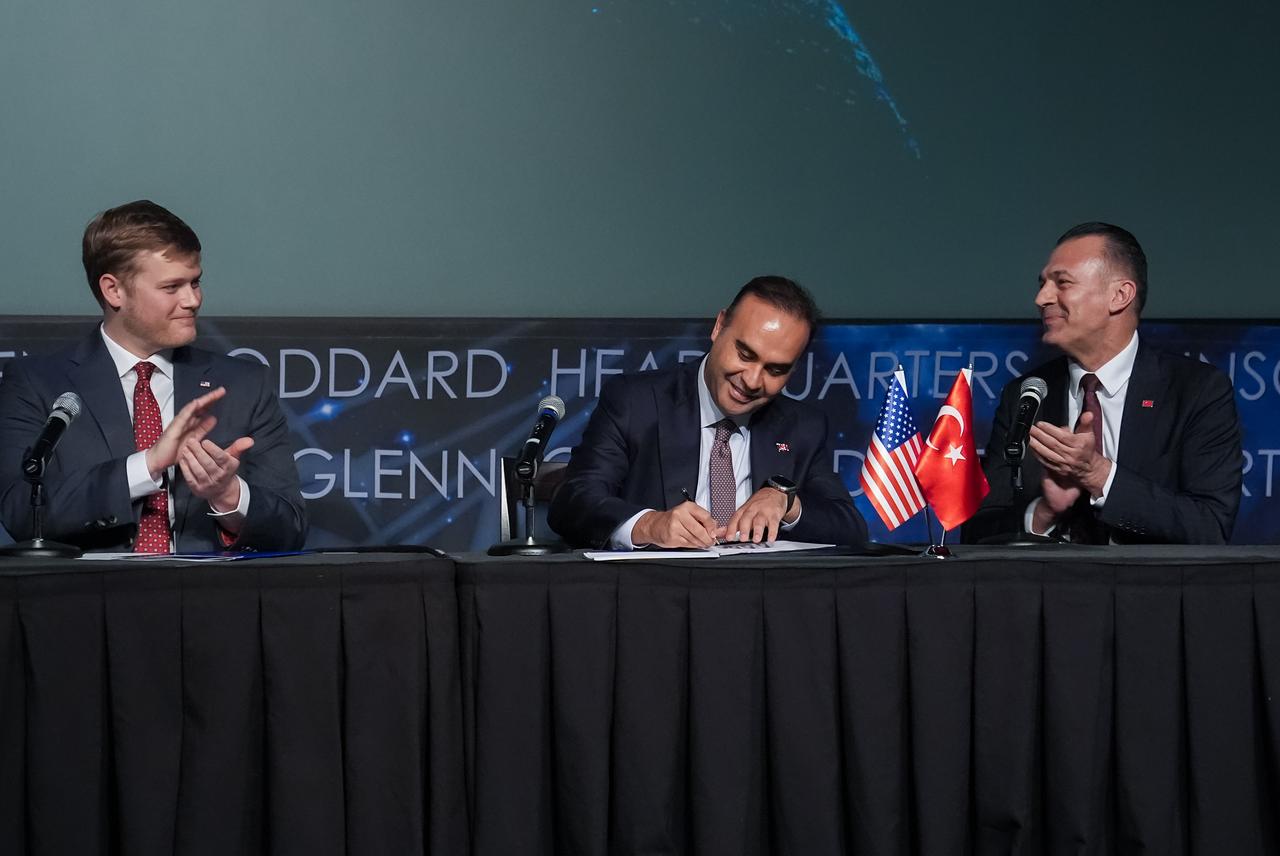
Mehmet Fatih Kacır, Minister of Industry and Technology of Türkiye, signs the Artemis Agreements on behalf of Türkiye, 31 August 2026 - (Anadolu Ajansı)
At the ceremony, Isaacman stated: “It is a privilege to welcome the Republic of Türkiye as the 71st signatory to the Artemis Accords. Last year, President Trump directed NASA to accelerate the return to the lunar surface and establish humanity’s first permanent presence on another world — a lunar base — while laying the foundation for the human exploration of Mars. NASA never undertakes these great endeavors alone. On the lunar base, we are putting into practice the principles of the Artemis Accords. NASA has invited every signatory to join this initiative, creating opportunities for nations to contribute major hardware, scientific payloads, technology demonstrations, CubeSats, and other capabilities to future Artemis missions.”
In his remarks at the signing ceremony, Minister Kacır noted that Türkiye is the 71st country to sign the Artemis Accords, stating: “Türkiye is entering a new era in space travel with incredible goals and capabilities. Our aim is to achieve a sustainable presence in space and take steps toward the peaceful use of space for the benefit of all humanity.”
Kacır highlighted that U.S. President Donald Trump’s personal attendance at the NATO Summit held in Ankara in July strengthened plans for cooperation between the two countries on space projects. Kacır also referred to recent developments in Türkiye’s space sector under the leadership of President Recep Tayyip Erdoğan, ranging from satellite technologies to the establishment of the Türkiye Space Agency and TEKNOFEST.
Isaacman noted in his speech that Türkiye has put forward a “bold vision” and that the two countries share the vision of returning astronauts to the lunar surface. Tomlinson from the U.S. Department of State expressed his satisfaction with Türkiye’s participation in the Artemis Accords and affirmed his belief that cooperation between the two countries in space activities will continue to grow. After the signing, Minister Kacır expressed his goodwill by saying, “May it be auspicious.”【5】
Anadolu Ajansı. "Türkiye, uluslararası uzay işbirliği programı Artemis Anlaşmaları'na imza attı." Accessed September 1, 2026.https://aa.com.tr/tr/bilim-teknoloji/turkiye-uluslararasi-uzay-isbirligi-programi-artemis-anlasmalarina-imza-atti/4043241
Artemis Accords. “Principles for Cooperation in the Civil Exploration and Use of the Moon, Mars, Comets, and Asteroids for Peaceful Purposes.” 2020. NASA. Accessed September 1, 2026.
Boamah, Frederick. “Artemis Accord – A Critical Analysis of Global Norm-Making in Outer Space.” *Advanced Space Law* 15 (2025): 58–72.https://asljournal.org/15-5/
Deplano, Rossana. “The Artemis Accords: Evolution or Revolution in International Space Law?” *International and Comparative Law Quarterly* 70, no. 3 (2021): 799–819.https://doi.org/10.1017/S0020589321000142
NASA. "Principles for a Safe, Peaceful, and Prosperous Future in Space." Accessed September 1, 2026.
NASA. “NASA Welcomes Türkiye as Newest Artemis Accords Signatory.” NASA. Accessed September 1, 2026.https://www.nasa.gov/organizations/oiir/artemis-accords/nasa-welcomes-turkiye-as-newest-artemis-accords-signatory/
Space.com. "Artemis Accords: What Are They & Which Countries Are Involved?" Accessed September 1, 2026.https://www.space.com/artemis-accords-explained
U.S. Department of State. “Argentina Signs the Artemis Accords.” U.S. Department of State. Accessed September 1, 2026.https://2021-2025.state.gov/argentina-signs-the-artemis-accords/
U.S. Department of State. “Artemis Accords.” Accessed September 1, 2026.https://www.state.gov/bureau-of-oceans-and-international-environmental-and-scientific-affairs/artemis-accords
U.S. Department of State. “France Becomes Twentieth Nation to Sign the Artemis Accords.” Accessed September 1, 2026.https://2021-2025.state.gov/france-becomes-twentieth-nation-to-sign-the-artemis-accords/
U.S. Department of State. “Kingdom of Bahrain Signs the Artemis Accords.” Accessed September 1, 2026.https://2021-2025.state.gov/kingdom-of-bahrain-signs-the-artemis-accords/
U.S. Department of State. “Kingdom of Bahrain Signs the Artemis Accords.” Accessed September 1, 2026.https://2021-2025.state.gov/kingdom-of-bahrain-signs-the-artemis-accords/
U.S. Department of State. “Kingdom of Saudi Arabia Signs the Artemis Accords.” Accessed September 1, 2026.https://2021-2025.state.gov/kingdom-of-saudi-arabia-signs-the-artemis-accords/
U.S. Department of State. “Kingdom of Spain Signs the Artemis Accords.” U.S. Department of State. Accessed September 1, 2026.https://2021-2025.state.gov/kingdom-of-spain-signs-the-artemis-accords/
U.S. Department of State. “Nigeria and Rwanda: First African Nations Sign the Artemis Accords.” Accessed September 1, 2026.https://2021-2025.state.gov/nigeria-and-rwanda-first-african-nations-sign-the-artemis-accords/
U.S. Department of State. “Republic of Singapore Signs the Artemis Accords.” Accessed September 1, 2026.https://2021-2025.state.gov/republic-of-singapore-signs-the-artemis-accords/
U.S. Department of State. “Romania Signs the Artemis Accords.” Accessed September 1, 2026.https://2021-2025.state.gov/romania-signs-the-artemis-accords/
U.S. Department of State. “The Czech Republic Signs the Artemis Accords.” U.S. Department of State. Accessed September 1, 2026.https://2021-2025.state.gov/the-czech-republic-signs-the-artemis-accords/
U.S. Department of State. “The Republic of Ecuador Signs the Artemis Accords.” U.S. Department of State. Accessed September 1, 2026.https://2021-2025.state.gov/the-republic-of-ecuador-signs-the-artemis-accords/
U.S. Department of State. “The Republic of India Signs the Artemis Accords.” U.S. Department of State. Accessed September 1, 2026.https://2021-2025.state.gov/the-republic-of-india-signs-the-artemis-accords/
U.S. Department of State. “United States Congratulates Austria on Becoming the 50th Signatory of the Artemis Accords.” U.S. Department of State. Accessed September 1, 2026.https://2021-2025.state.gov/united-states-congratulates-austria-on-becoming-the-50th-signatory-of-the-artemis-accords/
U.S. Department of State. “United States Welcomes Armenia’s Signing of the Artemis Accords.” Accessed September 1, 2026.https://2021-2025.state.gov/united-states-welcomes-armenias-signing-of-the-artemis-accords/
U.S. Department of State. “United States Welcomes Chile’s Signing of the Artemis Accords.” U.S. Department of State. Accessed September 1, 2026.https://2021-2025.state.gov/united-states-welcomes-chiles-signing-of-the-artemis-accords/
U.S. Department of State. “United States Welcomes Denmark’s Signing of the Artemis Accords.” Accessed September 1, 2026.https://2021-2025.state.gov/united-states-welcomes-denmarks-signing-of-the-artemis-accords/
U.S. Department of State. “United States Welcomes Estonia’s Signing of the Artemis Accords.” Accessed September 1, 2026.https://2021-2025.state.gov/united-states-welcomes-estonias-signing-of-the-artemis-accords/
U.S. Department of State. “United States Welcomes Germany’s Signing of the Artemis Accords.” U.S. Department of State. Accessed September 1, 2026.https://2021-2025.state.gov/united-states-welcomes-germanys-signing-of-the-artemis-accords/
U.S. Department of State. “United States Welcomes Greece’s Signing of the Artemis Accords.” U.S. Department of State. Accessed September 1, 2026.https://2021-2025.state.gov/united-states-welcomes-the-kingdom-of-belgiums-signing-of-the-artemis-accords/
U.S. Department of State. “United States Welcomes Liechtenstein’s Signing of the Artemis Accords.” Accessed September 1, 2026.https://2021-2025.state.gov/office-of-the-spokesperson/releases/2024/12/united-states-welcomes-liechtensteins-signing-of-the-artemis-accords
U.S. Department of State. “United States Welcomes Lithuania’s Signing of the Artemis Accords.” Accessed September 1, 2026.https://2021-2025.state.gov/united-states-welcomes-lithuanias-signing-of-the-artemis-accords/
U.S. Department of State. “United States Welcomes Panama’s Signing of the Artemis Accords.” U.S. Department of State. Accessed September 1, 2026.https://2021-2025.state.gov/united-states-welcomes-panamas-signing-of-the-artemis-accords/
U.S. Department of State. “United States Welcomes Peru’s Signing of the Artemis Accords.” Accessed September 1, 2026.https://2021-2025.state.gov/united-states-welcomes-perus-signing-of-the-artemis-accords/
U.S. Department of State. “United States Welcomes Slovakia’s Signing of the Artemis Accords.” Accessed September 1, 2026.https://2021-2025.state.gov/united-states-welcomes-slovakias-signing-of-the-artemis-accords/
U.S. Department of State. “United States Welcomes Slovenia’s Signing of the Artemis Accords.” U.S. Department of State. Accessed September 1, 2026.
U.S. Department of State. “United States Welcomes Switzerland and Sweden’s Signing of the Artemis Accords.” Accessed September 1, 2026.https://2021-2025.state.gov/united-states-welcomes-switzerland-and-swedens-signing-of-the-artemis-accords/
U.S. Department of State. “United States Welcomes Thailand’s Signing of the Artemis Accords.” U.S. Department of State. Accessed September 1, 2026.https://2021-2025.state.gov/united-states-welcomes-thailands-signing-of-the-artemis-accords/
U.S. Department of State. “United States Welcomes Uruguay’s Signing of the Artemis Accords.” Accessed September 1, 2026.https://2021-2025.state.gov/united-states-welcomes-uruguays-signing-of-the-artemis-accords/
U.S. Department of State. “United States Welcomes the Dominican Republic’s Signing of the Artemis Accords.” Accessed September 1, 2026.https://2021-2025.state.gov/united-states-welcomes-the-dominican-republics-signing-of-the-artemis-accords/
U.S. Department of State. “United States Welcomes the Kingdom of Belgium’s Signing of the Artemis Accords.” Accessed September 1, 2026.https://2021-2025.state.gov/united-states-welcomes-the-kingdom-of-belgiums-signing-of-the-artemis-accords/
U.S. Department of State. “United States Welcomes the Kingdom of the Netherlands to the Artemis Accords.” Accessed September 1, 2026.https://2021-2025.state.gov/united-states-welcomes-germanys-signing-of-the-artemis-accords/
U.S. Department of State. “United States Welcomes the Republic of Angola’s Signature of the Artemis Accords.” Accessed September 1, 2026.https://2021-2025.state.gov/united-states-welcomes-the-republic-of-angolas-signature-of-the-artemis-accords/
U.S. Department of State. “United States Welcomes the Republic of Bulgaria to the Artemis Accords.” Accessed September 1, 2026.https://2021-2025.state.gov/united-states-welcomes-the-republic-of-bulgaria-to-the-artemis-accords/
U.S. Department of State. “United States Welcomes the Republic of Cyprus’ Signing of the Artemis Accords.” Accessed September 1, 2026.https://2021-2025.state.gov/united-states-welcomes-the-republic-of-cyprus-signing-of-the-artemis-accords/
[1]
Artemis Accords, “Principles for Cooperation in the Civil Exploration and Use of the Moon, Mars, Comets, and Asteroids for Peaceful Purposes,” NASA, 2020, erişim 1 Eylül 2026, https://www.nasa.gov/wp-content/uploads/2022/11/Artemis-Accords-signed-13Oct2020.pdf
[2]
Artemis Accords, “Principles for Cooperation in the Civil Exploration and Use of the Moon, Mars, Comets, and Asteroids for Peaceful Purposes,”
[3]
Rossana Deplano, “The Artemis Accords: Evolution or Revolution in International Space Law?,” International and Comparative Law Quarterly 70, no. 3 (2021): 799–819, https://doi.org/10.1017/S0020589321000142
[4]
Artemis Accords, “Principles for Cooperation in the Civil Exploration and Use of the Moon, Mars, Comets, and Asteroids for Peaceful Purposes,”
[5]
Anadolu Ajansı, “Türkiye, uluslararası uzay işbirliği programı Artemis Anlaşmaları’na imza attı,” 1 Eylül 2026, https://aa.com.tr/tr/bilim-teknoloji/turkiye-uluslararasi-uzay-isbirligi-programi-artemis-anlasmalarina-imza-atti/4043241

History and Establishment
Legal Nature and Status
Scope
Principles
Signatory States
Türkiye’s Participation