

This article was automatically translated from the original Turkish version.
Once, all we needed to read was a book in our hands. We would open a page and continue from where we left off. Now, we may not even need a book to read. We pick up our phone and within seconds we can access a news article, an essay, a book, or any other text. As our options have multiplied, are we truly reading more?
Digitalization has greatly changed the way we access information. It is no longer always necessary to visit a library, purchase a book, or find a printed magazine to read a text. A device with internet access can be enough to reach millions of texts. While this has made reading more accessible, it has also transformed the very habit of reading.
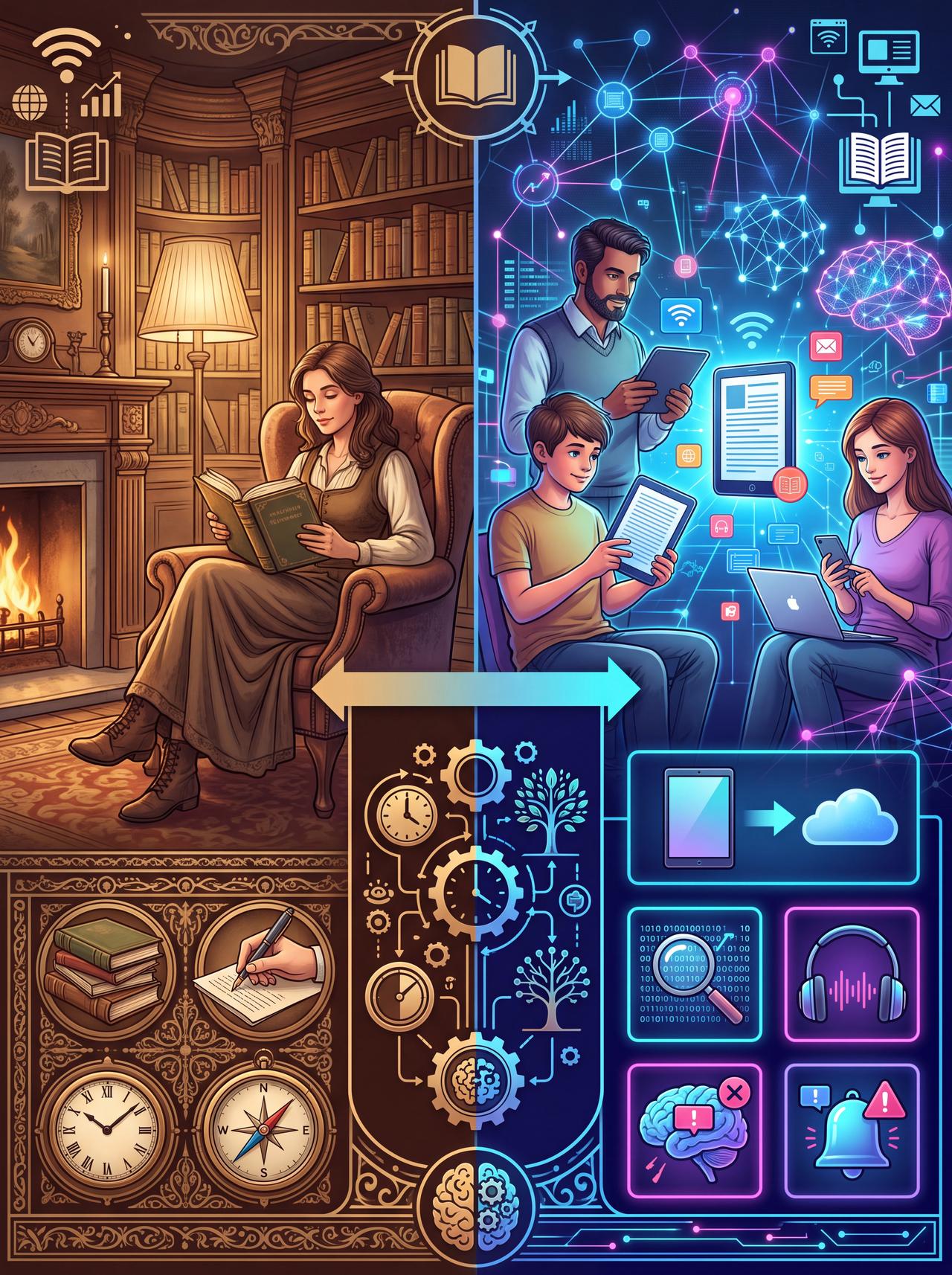
Dijital Okuma ve Standart Okuma Farklarını Temsil Eden Görsel (Yapay zeka ile oluşturulmuştur.)
One of the most prominent advantages of digital environments is ease of access. Instead of spending long hours researching a piece of information we are curious about, we often need only to type a few words. E-books, digital libraries, news websites, and online articles have multiplied reading options.
Moreover, reading is no longer limited to long texts. Short news items, social media posts, blog articles, forum messages, and content within apps have become part of our daily reading experience.
Perhaps what is changing is not reading itself, but what we read and how we read it.
As the number of digital contents increases, so does the number of things competing for our attention. While reading an article, a notification, a video open in another tab, or a new piece of content appearing on screen can interrupt our focus. As a result, digital reading often becomes a fragmented experience. Instead of reading an entire text, it has become more appealing to glance at the title, select sections that seem important, or quickly scan the content.
Especially as short and rapidly consumed content gains a larger place in our daily lives, maintaining focus on a long text for an extended period requires a different kind of attention.
One of the freedoms offered by the digital world is the ability to access any information we want at any moment. However, accessing information is not the same as truly reading it.
When we type a question into a search engine, dozens of results appear. Within seconds we can switch to another source and compare different perspectives. This makes research easier. But at the same time, constantly encountering new information can lead us to abandon a text before finishing it and move on to something else.
Where once a book in our hands kept us within its own world, in the digital environment hundreds of different worlds remain open at once.
It is easy to view digitalization as purely a negative change. But the issue is somewhat more complex. Today, a person’s phone may simultaneously contain e-books, news articles, academic papers, and various types of digital publications. Many sources that were once difficult to access are now far easier to reach. Therefore, it is more accurate to say that digitalization has transformed the reading habit rather than eliminated it.
Perhaps the real question is no longer “Are people reading?”
“What are people reading, for how long, and how?”
Differences exist not only in the tools used but also in the reading experience between printed books and digital texts. In a book, there is a physical progression from page to page. On a digital screen, the text sits alongside other content on the same device. This makes digital reading more flexible: we can quickly access the desired text, search within it, and switch between sources. But this same flexibility also increases the likelihood of interruption.
In other words, while digital screens give us more freedom, they also require us to make more choices about where to direct our attention.
As digital freedom increases, it is not possible to say that our reading habit has completely disappeared. On the contrary, reading has spread into more areas of our lives. However, the type, length, and manner of what we read have changed.
Reading an entire book from cover to cover is still possible. At the same time, reading a short article, comparing different sources of a news story, or researching a topic of interest through brief texts has also become part of our daily reading experience. Perhaps in the digital age, reading no longer means adhering to a single format. Sometimes we spend long periods immersed in the pages of a book; other times we encounter dozens of different pieces of information on a screen within minutes.
Ultimately, technology offers us more opportunities to read. But whether these opportunities truly become a lasting reading habit depends partly on our own choices.
Because the issue is no longer about being unable to access information.
The issue is deciding which of the countless pieces of information we encounter we will pause to truly read.
Reading Is Now Easier
From Long Texts to Short Content
Accessing Information or Reading It?
Are We Losing Our Reading Habit?
Is Reading from a Screen Different from Reading a Book?
Perhaps Our Way of Reading Is Changing