


This article was automatically translated from the original Turkish version.
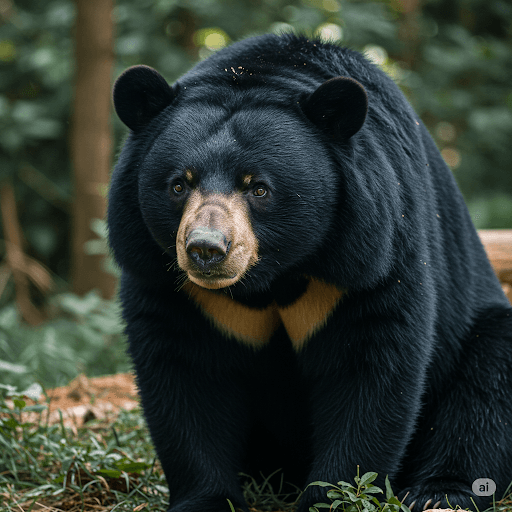
Type Name | Asian Black Bear | ||||||||
|---|---|---|---|---|---|---|---|---|---|
Scientific Name(s) | Ursus thibetanus | ||||||||
Family | Ursidae | ||||||||
Distribution(s) | South and East Asia (Himalayas Southeast Asia) Japan China | ||||||||
Habitat | Deciduous and coniferous forests mountainous regions | ||||||||
Diet(s) | small mammals insects fruits plants Omnivorous | ||||||||
Conservation Status | Threatened (IUCN) | ||||||||
The Asian black bear (Ursus thibetanus) is a mammalian species widely distributed across the forested regions of Asia and belonging to the family Ursidae. This species is notable for its ability to thrive in a variety of habitats, reflecting its broad geographic range. This article will examine the morphological characteristics, habitat preferences, feeding habits, behavior, reproductive biology, interactions with humans, and genetic structure of the Asian black bear.
The Asian black bear is a medium-sized bear species. Its body length typically ranges from 120 to 190 cm, with a shoulder height of approximately 70 to 100 cm. Males are larger than females, weighing between 100 and 200 kg, while females generally weigh between 50 and 125 kg. Their fur is black, with a distinctive white, V-shaped patch on the chest. The ears are large and rounded, covered with fur. Their claws are strong and curved, enabling excellent climbing ability.

Asian Black Bear (Generated by Artificial Intelligence)
The Asian black bear inhabits a wide geographic range across diverse habitats. It is found from the Himalayas to Japan, and from the Russian Far East to Southeast Asia. It typically resides in forested areas at elevations between 500 and 4,300 meters. Preferred habitats include deciduous forests, coniferous forests, and mixed forests. The species may migrate seasonally between habitats—for example, moving to higher elevations during summer and descending to lower elevations in winter.
The Asian black bear is an omnivorous species, consuming both plant and animal matter. Its diet varies seasonally. In spring, it feeds on young plant shoots and grasses. During summer, fruits and insects form a significant part of its diet. In autumn, it prioritizes high-calorie foods such as nuts and acorns to build fat reserves. Additionally, when the opportunity arises, it preys on small mammals, birds, and scavenges carrion.

Asian Black Bear Eating Acorns (Generated by Artificial Intelligence)
Asian black bears are generally solitary animals. However, they may gather in areas where food is abundant. Their daily activity is primarily concentrated during twilight and nighttime hours, classifying them largely as nocturnal. In some regions, however, they may also be active during daylight. During winter, particularly in colder climates, they enter hibernation. The duration of hibernation varies depending on the local climate.
The mating season for Asian black bears typically occurs between June and July. Gestation lasts approximately seven to eight months, with females giving birth to one to three cubs between January and February. Cubs are born blind and hairless but develop rapidly under maternal care. They remain with their mother for about 1.5 to 2 years, during which time they learn essential survival skills.
When Asian black bears live near human settlements, they may engage in various interactions with people. They are often perceived as a threat due to crop damage and occasional attacks on humans. These conflicts have intensified as bear habitats shrink and food sources decline. Crop damage is especially common in fruit orchards and maize fields. In some regions, bears are illegally hunted for their body parts, used in traditional medicine.

Asian Black Bear Near Human Settlements (Generated by Artificial Intelligence)
The genetic structure of the Asian black bear varies according to geographic region. For instance, genetic studies in Japan have shown that bears in this region are genetically distinct from populations on the Asian mainland. Such genetic differences provide insights into the species’ evolutionary history and migration patterns. Genetic diversity also enhances the species’ long-term survival prospects; therefore, preserving genetic variation is critical for conservation efforts.
The Asian black bear is classified as Vulnerable by the International Union for Conservation of Nature (IUCN). This classification reflects a declining population and exposure to multiple threats. Major threats include habitat loss, illegal hunting, and human-bear conflicts. Conservation measures include protecting bear habitats, combating illegal poaching, and raising public awareness. Additionally, methods are being developed to reduce agricultural damage caused by bears.
Charoo, S. A., Sharma, L. K., and Sathyakumar, S. (2011). Asiatic black bear–human interactions around Dachigam National Park, Kashmir, India. *Ursus*, 22(2), 106–113. https://doi.org/10.2192/ursus-d-10-00021.1
Reid, D., Jiang, M., Teng, Q., Qin, Z., and Hu, J. (1991). Ecology of the Asiatic black bear (*Ursus thibetanus*) in Sichuan, China. *Mammalia*, 55(2). https://doi.org/10.1515/mamm.1991.55.2.221
Steinmetz, R., Garshelis, D. L., Chutipong, W., & Seuaturien, N. (2013). Foraging ecology and coexistence of Asiatic black bears and sun bears in a seasonal tropical forest in Southeast Asia. *Journal of Mammalogy*, 94(1), 1–18. https://doi.org/10.1644/11-mamm-a-351.1

Type Name | Asian Black Bear | ||||||||
|---|---|---|---|---|---|---|---|---|---|
Scientific Name(s) | Ursus thibetanus | ||||||||
Family | Ursidae | ||||||||
Distribution(s) | South and East Asia (Himalayas Southeast Asia) Japan China | ||||||||
Habitat | Deciduous and coniferous forests mountainous regions | ||||||||
Diet(s) | small mammals insects fruits plants Omnivorous | ||||||||
Conservation Status | Threatened (IUCN) | ||||||||
No Discussion Added Yet
Start discussion for "Asian Black Bear (Ursus thibetanus)" article
Morphological Characteristics
Habitat and Distribution
Feeding Habits
Behavior and Activity
Reproductive Biology
Interactions and Conflicts with Humans
Genetic Structure and Population
Conservation Status and Threats