

This article was automatically translated from the original Turkish version.
The Assassination of John F. Kennedy, is the event in which U.S. President John Fitzgerald Kennedy was killed on November 22 1963 during an official visit to Dallas Texas when he was shot while riding in an open-top car as part of a motorcade. The 1961 model Lincoln Continental limousine carrying the president was fired upon as it passed through Dealey Plaza in downtown Dallas; severely wounded Kennedy was quickly transported to Parkland Memorial Hospital where despite all medical efforts he died at age 46. Immediately after the incident officials announced that the shooting had been carried out from the sixth floor of the Texas School Book Depository building which then became the focal point of the investigation.

A Replica of the Rifle Used in the Assassination (National Archives)
The assassination of Kennedy was not merely the killing of a president but also a turning point that affected the political stability and public trust in American institutions during one of the most tense periods of the Cold War. Occurring just one year after the Cuban Missile Crisis the event took place in a context marked by intensifying nuclear deterrence intelligence operations and ideological conflict. Kennedy’s death while in office created a profound impact both within the United States and globally. This assassination at the end of a relatively brief presidency fueled the perception of a “half-finished political project” and has since become one of the symbolic rupture points in American history embedded in collective memory.
From the moment it occurred the assassination became the subject of numerous investigations official reports forensic examinations and public debates. The identification of Lee Harvey Oswald as the perpetrator his murder by Jack Ruby just two days later and the contradictions emerging during the investigation created a lasting arena of controversy. On one side stood the official narrative asserting that the president was killed by a single gunman with no conclusive evidence of a conspiracy. On the other side emerged conspiracy theories centered around the Mafia intelligence agencies foreign states internal political interest groups and structures akin to a “deep state.” This tension has transformed the Kennedy assassination into one of the most prominent modern historical cases where evidence testimonies and official documents are continuously reexamined and where political events and social perceptions are deeply intertwined.

Bullet Fragments Extracted from John F. Kennedy’s Head (National Archives)
Over the decades documents released investigations conducted by congressional committees and comprehensive analytical works have diversified both the factual aspects of the assassination and the interpretations surrounding them. In this regard the Kennedy assassination has become a fundamental reference point not only for understanding U.S. domestic and foreign policy in the 1960s but also for examining state-society relations the limits of official investigations the rise of conspiracy culture and the ways modern historiography deals with uncertainty.
The Kennedy assassination occurred during one of the tense phases of the bipolar international system that emerged after World War II. John F. Kennedy who assumed office after winning the 1960 presidential election against Republican candidate Richard Nixon operated within an environment shaped by the “Cold War competition.” Nuclear arms race ideological and geopolitical rivalry with the Soviet Union proxy conflicts in Third World countries and the fragility of European security architecture formed the core elements of Kennedy’s foreign policy agenda.
Among Kennedy’s domestic priorities were sustaining economic growth strengthening social policies under the banner of the “New Frontier” and expanding civil rights particularly for African Americans. Steps taken in the civil rights arena clashed with discriminatory practices in Southern states creating tensions between federal and local authorities. The federal government’s occasional direct intervention against racial discrimination increased discontent among certain political and social circles in the South contributing to the political polarization of the era.
In foreign policy the Kennedy administration faced serious crises shortly after taking office. The failed Bay of Pigs invasion in April 1961 aimed at overthrowing Fidel Castro’s regime in Cuba damaged U.S. prestige vis-à-vis Cuba and negatively affected relations between the Central Intelligence Agency (CIA) and the White House. Rising pressure over Berlin in the summer of 1961 pushed the United States and the Soviet Union toward a new line of tension in Europe; finally in October 1962 the Cuban Missile Crisis brought the two superpowers to the brink of nuclear war. The resolution of the crisis involving the withdrawal of Soviet missiles from Cuba and the U.S. agreement to remove some of its missiles from Türkiye eliminated the threat of nuclear war but the handling of the crisis generated differing reactions both within the United States and among allies.
Reenactment of the Kennedy Assassination (News Direct)
Policy toward Vietnam also gained increasing importance during Kennedy’s tenure. Since the mid-1950s the United States had provided military and economic support to South Vietnam; while the Kennedy administration avoided sending direct combat units it significantly increased the American presence in Vietnam under the label of “advisors.” The goal of preventing the spread of communism in Southeast Asia served as a key source of legitimacy both in Congress and among military circles; however the subsequent deepening of the Vietnam War led to retrospective debates about decisions made during Kennedy’s presidency.
All these developments transformed Kennedy’s brief presidency into a period marked by intense crises and rapid decision-making. Initiatives such as negotiations on nuclear arms control and the Partial Nuclear Test Ban Treaty alongside efforts to gain superiority over the Soviet Union in the space race reflected both the administration’s search for “détente” and its aggressive moves to escalate competition. This context laid the groundwork for the Kennedy assassination to be perceived not merely as a domestic security incident but as a political murder with global implications.
During Kennedy’s presidency the U.S. security architecture was shaped by a network of institutions with complex interrelationships. The CIA the Federal Bureau of Investigation (FBI) the Secret Service the Joint Chiefs of Staff and the defense bureaucracy played central roles in implementing foreign policy decisions as well as in domestic security and intelligence operations. Following the failure of the Bay of Pigs invasion changes in senior CIA leadership rendered the agency’s position vis-à-vis the White House controversial; criticisms regarding the preparation and presentation of certain decisions contributed to the emergence of inter-institutional distrust.
The FBI held a prominent position during this period in both domestic security and political surveillance. The long tenure and decisive influence of Director J. Edgar Hoover placed the FBI in a privileged position within the federal system. Hoover’s approach to combating communism the civil rights movement and various political organizations did not always align with some of the Kennedy administration’s priorities; nonetheless the FBI became one of the principal actors in the investigation following the assassination.
The Secret Service responsible for the president’s protection was an institution that expanded its mandate during Kennedy’s presidency while simultaneously facing growing public attention. Open-top motorcades public rallies and an intensive travel schedule heightened the risks to presidential security; conversely the adequacy of protection protocols in response to the evolving threat environment was intensely debated after the assassination. The military and defense bureaucracy maintained a close but occasionally contentious relationship with the administration particularly regarding nuclear doctrine troop deployments in Europe and Southeast Asia policy.
This institutional landscape defined the framework of the official investigations conducted after the assassination. The nature of the relationships between actors involved in Kennedy’s decision-making processes and the intelligence and security institutions became one of the frequently referenced elements in later debates surrounding the assassination. In particular the activities of the CIA FBI and Secret Service before and after the assassination became central to both official reports and alternative narratives.
The Dallas visit during which the assassination occurred was part of a broader Texas tour designed to strengthen internal Democratic Party balances and consolidate the voter base ahead of the 1964 presidential election. Texas was a critical state in presidential elections both in terms of population and political weight. Although Kennedy had won Texas in the 1960 election the state’s Democratic Party organization was divided by ideological and personal conflicts. Tensions between Governor John Connally Senator Ralph Yarborough and Texas-born Vice President Lyndon B. Johnson made it difficult to project party unity before the public.
Therefore Kennedy’s planned Texas trip in November 1963 was designed both to bring together the party’s different factions on a single platform and to establish direct contact with voters through a series of meetings openings and dinners across the state. The itinerary was planned to include cities such as San Antonio Houston Fort Worth Dallas and Austin with the president and his delegation expected to deliver speeches and meet with local business circles and party organizations. Within this framework Dallas was identified as a key stop due to its population and economic significance.

Original Image of the Rifle Recovered from the Texas School Book Depository (National Archives)
Dallas’s political climate at the time added a distinct dimension to the visit. The city was known as a center of conservative and anti-communist circles where criticism of the federal government and particularly the Kennedy administration was intense. Certain right-wing organizations and media outlets in the city ran campaigns targeting Kennedy’s foreign policy choices his civil rights initiatives and the general perception of his administration as “soft.” Brochures distributed before and during the visit critical advertisements in newspapers and rally calls signaled the atmosphere Kennedy would encounter in Dallas.
Nevertheless the visit was planned as part of a political program aimed at reinforcing the image of “party unity” and “national cohesion.” After morning speeches in Fort Worth the motorcade was scheduled to proceed to Dallas where a large luncheon audience was expected followed by a move to Austin. The motorcade route through downtown Dallas was designed both to allow crowds to see the president and to fit the schedule of the program. The assassination occurred precisely within this political and social context during the open-top motorcade the most visible element of Kennedy’s Dallas itinerary.
On the morning of November 22 1963 President Kennedy and his delegation attended a breakfast meeting in Fort Worth with representatives of the business community and local officials during which the president delivered a brief speech. After completing the morning program the convoy proceeded to Carswell Air Force Base where President Kennedy and his wife Jacqueline boarded Air Force One for the flight to Dallas. The flight was relatively short and Air Force One landed at Dallas’s Love Field at approximately noon local time. At the airport the Kennedys were greeted by local officials led by Texas Governor John Connally and his wife Nellie Connally and shook hands with the crowd gathered around the tarmac interacting briefly with many people.
Following the airport reception the president and his party transitioned to the official motorcade headed toward downtown Dallas. The motorcade consisted of an open-top Lincoln Continental limousine followed by security vehicles. In the front seats sat the driver and a Secret Service agent; in the rear seats President Kennedy sat on the right side his wife on the left and Governor John Connally and his wife sat in the middle row.

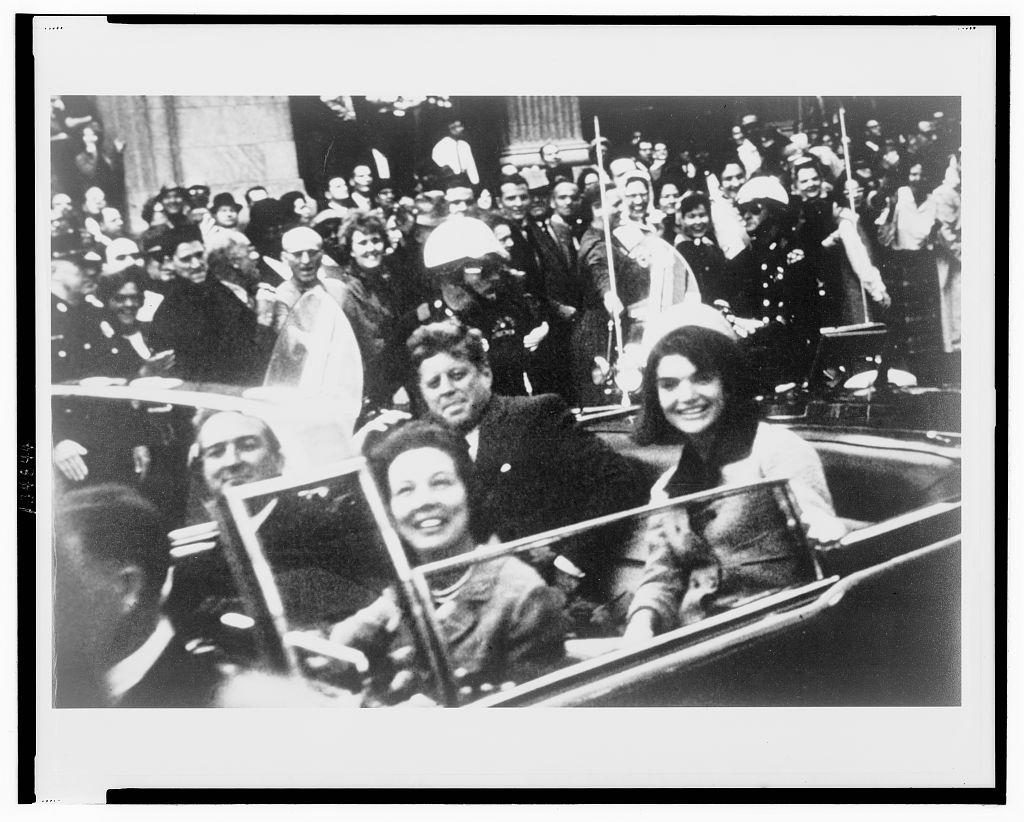
A Frame from the Motorcade During the Assassination (National Archives)
The motorcade was scheduled to reach downtown Dallas and arrive at the Dallas Trade Mart building where the president was to deliver a speech to business leaders and city dignitaries. Accordingly a route was established from Love Field to downtown with selected points along the way designed to allow the public to see the president.
The designated route followed major city streets from the airport to downtown Dallas then turned onto Elm Street crossing bridges toward the vicinity of the Trade Mart. The route was deemed suitable both logistically for ease of access and for passing through dense commercial and business districts to reach large crowds. Thus it was anticipated that the motorcade would proceed slowly through downtown Dallas in the shadows of buildings flanked by crowds lining the streets as it approached noon.
After leaving Love Field the motorcade passed through Dallas’s residential areas and main avenues reaching downtown where the vehicle carrying the president was met with enthusiastic crowds. Proceeding along Main Street the motorcade entered the central district then turned onto Houston Street and from there left onto Elm Street. This turn occurred in Dealey Plaza an area surrounded by three-story administrative buildings and the Texas School Book Depository which would later become a symbolic landmark of the city. At this point the presidential vehicle was moving at a relatively low speed due to the slope of the road and its approach to the bridge.
The shooting occurred at approximately 12:30 p.m. local time. As the motorcade traveled along Elm Street a series of gunshots were heard and initially caused momentary confusion among the crowd and security personnel. According to witness statements two or three shots were perceived to have been fired in rapid succession; one struck the president in the back and another in the head causing severe injuries. Simultaneously Governor Connally seated in front of the president was wounded in the chest and wrist and the interior of the limousine quickly descended into panic. The moments when Jacqueline Kennedy leaned over the wounded president and Connally was thrown backward were captured repeatedly in film and photographic records that would later be scrutinized extensively.

A Secret Service Agent Exiting the Car After the Shooting (National Archives)
Regarding the source of the gunfire there were differing assessments among witnesses at the time and afterward. Some witnesses attributed the sounds to the upper floors of the Texas School Book Depository building while others believed the shots came from the grassy area within Dealey Plaza or from the vicinity of the railroad viaduct. In contrast the Secret Service agents responsible for protecting the presidential vehicle immediately decided to accelerate the limousine away from the scene; the vehicle sped toward Parkland Memorial Hospital with sirens blaring. Other vehicles following the motorcade also changed their routes to reach the hospital as quickly as possible.
Shortly after leaving Dealey Plaza the presidential vehicle arrived at Parkland Memorial Hospital and the severely wounded president and Governor Connally were immediately admitted to the emergency room. The president was moved on a stretcher to the trauma room where intensive medical intervention was initiated by hospital staff and the presidential physician who arrived shortly thereafter. Standard emergency procedures such as chest compressions respiratory support and intravenous treatments were applied; however due to the severity of the head trauma surgical evaluation was conducted and it became clear that the injuries were unlikely to be survivable.

A News Report from Kennedy’s Time in the Hospital (National Archives)
The medical interventions at Parkland lasted approximately half an hour and at approximately 1:00 p.m. local time President Kennedy was officially declared dead. This determination was documented by the attending physicians and quickly communicated to the White House and relevant federal authorities. A rapid consultation occurred among hospital administration regional officials and presidential staff regarding how to announce the death to the public and shortly thereafter the media was informed that Kennedy had died at the hospital. This announcement reached wide audiences both among the crowds gathering around the hospital and through radio and television broadcasts in Dallas and other cities across the country.
Governor Connally underwent surgery at the same hospital and despite facing life-threatening injuries survived due to medical intervention. Parkland Memorial Hospital became simultaneously the center of intense medical activity and rapidly forming political and bureaucratic decision-making processes. Preparations for the president’s autopsy and burial procedures disputes over jurisdiction between federal and local authorities and enhanced security measures were carried out concurrently. At the same time the news of the assassination reaching Washington brought the issue of filling the presidential vacuum and the status of Vice President Lyndon B. Johnson to the top of the emergency agenda.
Immediately after the assassination Dallas law enforcement and other security units secured the area around the crime scene and launched a comprehensive search of Dealey Plaza and the Texas School Book Depository building. Shortly thereafter a position resembling a sniper’s nest was identified on the sixth floor of the building; a clear line of sight from the window to the street below was confirmed. In the same area empty shell casings and a rifle were found; the rifle later became the central ballistic evidence in the investigation. Police began identifying employees of the building and their locations during the incident and soon obtained a list containing the name of Lee Harvey Oswald.
Shortly after the assassination Dallas police received a report of a police officer being murdered in the city. Patrol officer J. D. Tippit was shot and killed in the Oak Cliff neighborhood of Dallas shortly after the assassination. Witness statements described a man walking away from the scene and this individual was later identified as Lee Harvey Oswald. Acting on the tips police proceeded to the Texas Theatre cinema in Oak Cliff and suspected a person inside. When attempting to perform a routine identification check a brief struggle ensued during which Oswald resisted and attempted to reach for a weapon and was subdued and arrested by security personnel. Thus Lee Harvey Oswald was apprehended on suspicion of both the presidential assassination and the murder of Officer Tippit.

Arrest of Harvey Oswald (National Archives)
Oswald was taken to the Dallas Police Headquarters where he was interrogated regarding the assassination and the police murder. During questioning he denied the charges against him claimed he was a “patsy” and asserted he had no connection to the assassination. Nevertheless police authorities publicly identified Oswald as the prime suspect based on ballistic evidence from the crime scene work records from the building and witness statements. News reporters questioned officials during brief press conferences held at the police station and Oswald’s appearance before the public was captured by television cameras and cameras.
In the later hours of the day Dallas authorities officially announced that President Kennedy had been killed in an assassination that Lee Harvey Oswald had been taken into custody as a suspect and that the investigation was continuing at both local and federal levels. In Washington it was announced that Vice President Lyndon B. Johnson would assume the presidency and shortly thereafter at Love Field aboard Air Force One Johnson took the oath of office thereby initiating a new era in both criminal investigation and constitutional succession within just a few hours of the assassination.
Lee Harvey Oswald was born on October 18 1939 in New Orleans Louisiana. His father died shortly before Oswald was born; thus his mother Marguerite became the defining figure in his childhood. The mother’s authoritarian sometimes harsh and unstable behavior strained family relationships; economic hardship and lack of a steady income led to frequent relocations. This situation caused continuous disruptions in Oswald’s education and social environment.
Records from Oswald’s childhood and early youth show that he had brief enrollments in different cities and schools due to frequent transfers and was unable to complete a stable educational process. Documentation from this period indicates that he performed poorly academically experienced disciplinary problems and exhibited an isolated profile with little connection to peer groups. Teachers and school staff described Oswald as an introverted easily angered and confrontational student who occasionally displayed violent behavior.

Harvey Oswald Being Taken to Prison (National Archives)
During adolescence absenteeism and confrontation with authority became more pronounced; Oswald underwent psychiatric evaluation. Although no clear mental illness was diagnosed the assessments indicated emotional instability social adaptation difficulties and serious problems within family relationships. Nevertheless Oswald was returned to his mother; the tense family environment and frequent relocations reinforced his social isolation.
As he approached age 17 Oswald joined the U.S. Marine Corps to begin military service. For him military service represented both an economic opportunity and a framework to bring order to his life. However contrary to expectations Oswald struggled to conform to discipline failed to adapt to the chain of command and frequently clashed with superiors. Fellow servicemen often described him as an introverted “loner” who was mocked and ostracized and given nicknames.
During his military service Oswald received basic training in firearms and marksmanship; his shooting exercises later became a recurring element in assassination debates. At the same time disciplinary infractions and an investigation following a firearms accident resulted in negative entries in his military record. During his assignment to the Atsugi base in Japan the political and social environment influenced his worldview. Oswald developed an interest in socialist and Marxist literature during this period and increasingly engaged in reading about communism and the Soviet Union.
Before completing his military service Oswald became interested in defecting to the Soviet Union and soon acted on this idea. At the end of 1959 he left the United States via Europe and arrived in the Soviet Union where he applied to Soviet authorities for citizenship. During this process he presented himself as someone who had broken with America due to his Marxist beliefs and emphasized his desire to settle scores with the American system. Although his initial request was met with ambiguity Soviet authorities eventually permitted him to remain in the country and assigned him to Minsk.
In Minsk Oswald received modest financial assistance through the Soviet Red Cross; approximately 5000 rubles were paid to him to provide economic security during the initial period. He was assigned an apartment without rent and employed at the Belorussian Radio and Television Factory. His official salary was relatively favorable by Soviet standards and Oswald lived at a similar standard to other workers in his department. However he was under constant surveillance by Soviet security services and some individuals in his circle assumed the function of monitoring him.
Oswald soon realized a significant gap between his initial expectations of the Soviet system and the reality he encountered and gradually became increasingly dissatisfied with life in Minsk. The monotony of his workplace the rigidity of political and social life bureaucratic restrictions and unmet expectations regarding freedom distanced his Soviet experience from the “ideal” he had envisioned. During this period Oswald formed friendships while expressing his criticisms of the Soviet system to close associates. His relationship with Marina Prusakova whom he met and married shortly thereafter became one of the central elements of both his Soviet years and his subsequent American life.
After several years in Minsk Oswald began to question his decision to remain in the Soviet Union and formally requested permission to return to the United States. Although the Soviet side initially responded coldly to this request permission was eventually granted; Oswald returned to the United States in 1962 with his wife Marina and their newborn child.
Oswald’s childhood and youth experiences of isolation and confrontation with authority gradually transformed into efforts to express himself politically. His early interest in leftist thought and Marxist literature distinguished him sharply from mainstream American political culture during the Cold War. His attempt to defect to the Soviet Union and his several years spent there emerged as radical expressions of this ideological orientation and solidified his political identity in the eyes of the American public of the time.
After returning to the United States Oswald did not abandon his ideological stance; on the contrary he sought to make his worldview more systematic and visible. His experience in the Soviet Union led him to adopt a perspective that criticized both sides rather than choosing between them. Nevertheless he continued to promote anti-imperialist anti-capitalist and anti-Western rhetoric and demonstrated his sympathy for the Cuban Revolution and Fidel Castro’s regime through various activities.
In the summer of 1963 while in New Orleans Oswald operated under the name of the “Fair Play for Cuba Committee” distributing pamphlets and organizing street demonstrations. He addressed the public through “Hands Off Cuba” posters and leaflets; the debates altercations and police interventions associated with these activities were covered by local media. Later investigations revealed that Oswald’s organizational activities in New Orleans were largely self-initiated and limited to a very small circle with weak ties to the national structure of the organization. Nevertheless this period was significant as it marked Oswald’s public emergence as a political figure.
Documentary on the Kennedy Assassination (DW)
Another manifestation of Oswald’s political motivations was his personalization of anger toward individuals and groups he viewed as “domestic enemies.” His attempted armed attack on former general Edwin Walker is significant in this context. Oswald viewed Walker as an extreme right-wing anti-communist and repressive figure and planned an action against him; in the middle of the night he fired at Walker’s home in Dallas but the bullet missed its target. This act when linked to evidence uncovered after the assassination was interpreted as evidence that Oswald was capable of planning and executing individual violent acts motivated by political beliefs.
In this context Oswald positioned himself in direct opposition to the prevailing anti-leftist atmosphere in the United States; he presented himself as a figure who identified as leftist anti-imperialist and anti-system. Both his Soviet experience and his activism in New Orleans and Dallas were decisive in shaping this political identity.
After returning from the Soviet Union Oswald with his wife Marina and child established a life involving brief residencies in different cities before moving to the Texas region. Seeking employment in Dallas and its surroundings Oswald was forced to accept low-quality and relatively temporary jobs; economic hardship and family tensions became defining features of this period. His lack of continuity in employment stemmed from both his personal character and limited professional skills.
In 1963 Oswald found work at the Texas School Book Depository located in downtown Dallas. The building served as a warehouse for textbooks and educational materials for Texas schools and consisted of multiple floors with storage areas and administrative offices. Oswald worked in a physically demanding role involving the transportation and organization of book crates. Colleagues described him as an introverted quiet and socially reserved employee.
The building’s proximity to downtown Dallas and its height made it a prominent landmark along the motorcade route from Love Field to downtown. After the finalization of Kennedy’s Dallas visit itinerary it became clear that the motorcade would pass through Dealey Plaza and that the street where the Texas School Book Depository stood would be on the route. This situation placed Oswald in a critical position within the assassination scenario due to his access to the building and the clear line of sight from its upper floors to the street.
Investigations after the assassination revealed that Oswald had arrived at the building on the morning of the assassination and carried a package which he described as “curtain rods.” Various witness statements indicated the presence of a “sniper’s nest” formed by cardboard boxes on the sixth floor offering a clear view of the street. The rifle and empty shell casings recovered from the same area were linked to a weapon identified as Oswald’s; thus his position in the building became one of the key elements placing him at the center of the investigation.
On the day of the assassination following Kennedy’s transfer to Parkland Memorial Hospital and the subsequent announcement of his death Dallas Police and other security units launched a wide-ranging investigation. During the search of the Texas School Book Depository building the rifle and shell casings found on the sixth floor immediately focused attention on its employees; a quick headcount soon revealed that Lee Harvey Oswald was missing. This information placed him in the category of a potential suspect.
At the same time a report was received that police officer J. D. Tippit had been shot and killed in the Oak Cliff neighborhood of Dallas. Witness statements described the appearance of a man fleeing the scene and this description was later linked to Oswald. Acting on the tips police proceeded to the Texas Theatre cinema in Oak Cliff and identified a person exhibiting suspicious behavior. During an attempt to perform an identification check a brief struggle ensued; Oswald was subdued and arrested after resisting the police officers. Thus Oswald was taken to the Dallas Police Headquarters on suspicion of both the presidential assassination and the murder of Tippit.
Documentary on the Kennedy Assassination (National Geographic)
At the police headquarters Oswald underwent multiple interrogations at different times. The interrogations involved not only police officers but also FBI and Secret Service agents; however none of these interrogations were fully recorded on audio and were only documented through notes taken by various officers. Oswald denied the charges against him asserting that he had no connection to Kennedy’s killing that he did not shoot Tippit and that he was being framed as a “patsy.” Controversies arose over whether his requests for legal counsel and right to legal representation were adequately addressed in the chaotic environment.
In the early hours of the investigation Oswald was formally charged with the murder of Officer Tippit. As evidence evaluation progressed the rifle found in the Texas School Book Depository was linked to a weapon Oswald had purchased photographs showing Oswald with the rifle witness statements regarding his location in the building and a brief escape route all contributed to the formal charging of Oswald in connection with the presidential assassination. Thus within a short time Oswald became formally charged with both the presidential assassination and the murder of Tippit.
While Oswald was held at the police headquarters a media environment developed around him; the progress of the investigation became a process closely followed by the public. Brief press briefings held at the police headquarters and photographs and footage taken during transfers through corridors and rooms increased Oswald’s visibility before the public. However this period ended abruptly on November 24 1963 when Oswald was shot and killed by Jack Ruby in the basement of the Dallas Police Headquarters. Oswald’s death before any judicial process could be completed prevented the systematic presentation and debate of evidence in court and created lasting questions regarding his motivations and possible connections.
Jack Ruby originally named Jacob Leon Rubenstein was born in 1911 in the United States into a low-income and troubled family environment. His childhood and early youth were shaped by economic hardship frequent relocations and family conflicts; this led to an unstable education and immersion in street culture. From a young age Ruby worked various small jobs and was known for his aggressive temperament quick temper and occasional resort to violence.

The Moment Oswald Was Shot Rightmost Figure Shouting in Pain from the Bullet (National Archives)
In adulthood Ruby turned to business establishing a career in the entertainment sector after the war. After settling in Dallas he began operating bars and nightclubs known for striptease and live music performances. Relationships he built with employees and customers played an important role in his interactions both within the business world and with the local police force. His close relationship with certain officers in the Dallas police force including providing discounts or free drinks at his clubs helped establish him as a “recognized figure” within this circle and later became one of the factors explaining how he gained access to the police headquarters.

The Gun Used by Jack Ruby to Kill Oswald (National Archives)
Testimonies regarding Ruby’s character describe him as outgoing attention-seeking yet emotionally volatile. He enjoyed presenting himself as a “colorful” and “different” character and was noted for having a personality prone to emotional outbursts. There are testimonies that he resorted to physical violence during disputes in his business environment carried a firearm and struggled to control his anger. At the same time some close associates described him as “overly emotional” nationalist and disturbed by anti-Kennedy rhetoric. This complex personality profile has frequently served as a contextual framework for interpreting Ruby’s actions on November 24 1963.
Two days after the assassination on Sunday November 24 1963 the Dallas Police Department planned to transfer Lee Harvey Oswald from the city jail to the county jail. The transfer was scheduled for the afternoon hours from the basement of the police headquarters with Oswald to be transported by police vehicles to another facility. The event was under extraordinary media attention by the standards of the era; local and national television crews photographers and reporters had taken their positions behind barriers in the basement to observe and film Oswald’s transfer live.
At the same time Jack Ruby continued his routine daily activities. He was observed tracking routine operations at his clubs and conducting brief meetings around downtown during the day. It was determined that on the same day he visited a telegram office to send money to an acquaintance and shortly after leaving the office headed toward the area of the Dallas Police Headquarters. Ruby entered the building with his small dog and a pistol in his possession and managed to blend into the crowd of reporters and police officers unnoticed in the basement. The ease with which Ruby as a civilian entered the building and reached the critical basement area raised serious questions about the adequacy of security protocols from the outset.

The Shirt Oswald Was Wearing When He Was Killed (National Archives)
As Oswald was escorted down to the basement by two police officers with his hands cuffed television cameras were recording. While being led toward the police vehicle designated for transport Jack Ruby suddenly stepped forward from the crowd pointed a short-barreled pistol at Oswald’s chest and fired; the bullet struck Oswald’s body. The moment was immediately broadcast live on television; as Oswald collapsed to the ground nearby police officers subdued Ruby. Oswald was immediately taken to Parkland Memorial Hospital but died shortly thereafter. Thus the primary suspect in the assassination was killed while under police custody before appearing in court; a development that fundamentally altered the course of the investigation and public perception.
Ruby was arrested immediately after the incident and began to be interrogated in the same building. In the initial phase he stated he was aware of what he had done and later sought to explain his action through both emotional and “national” justifications. He emphasized his admiration for Kennedy and his reaction to what he perceived as disrespectful statements toward the president particularly highlighting the impact on him of extreme right-wing propaganda and offensive advertisements circulating in Dallas. He also claimed that he feared the prolonged public debate surrounding Oswald’s trial would cause great anguish to Kennedy’s family especially Jacqueline Kennedy; thus he viewed his action as an emotional response aimed at “protecting the country and the president’s family from shame.”
Ruby’s justifications during interrogation and trial were intensely debated from psychological and legal perspectives. The defense argued that his mental state should be considered highlighting his history of emotional instability violent tendencies and family problems to construct a profile of “instability.” In contrast the prosecution viewed Ruby’s act as a deliberate killing even if not premeditated emphasizing elements such as his entry into the police headquarters with a weapon his knowledge of Oswald’s transfer schedule and timing and his ability to infiltrate the crowd and fire within seconds as indicators of intent.

Chaos After Oswald’s Death Oswald Lying on the Ground on the Left (National Archives)
In the Dallas trial the jury found Ruby guilty of “intentional murder” and sentenced him to death. This verdict although not exceptional under the Texas legal system of the time carried extraordinary significance given the national and international dimensions of the event. Ruby’s lawyers appealed the verdict arguing various procedural errors related to jury selection public pressure media influence and the evaluation of evidence. Appellate courts overturned the initial verdict citing procedural irregularities and elements that compromised the court’s impartiality and ordered a new trial.
However Ruby faced serious health problems before the new trial could take place. While in prison he contracted a rapidly progressing illness that weakened him physically; medical examinations indicated a fatal form of cancer. In early 1967 Ruby was hospitalized and died under prison supervision before the second trial was completed. Thus like Oswald Ruby died without having the opportunity to fully explain his actions and possible connections in court; this prevented the complete resolution of all judicial aspects of the assassination.
Jack Ruby’s killing of Lee Harvey Oswald while under police custody profoundly affected the course of debates surrounding the Kennedy assassination. From the outset the event raised the question: was it a spontaneous outburst of anger or a planned operation to silence? Oswald’s survival and subsequent interrogation in a formal court proceeding would have allowed evidence to be systematically debated in court and the public to form opinions based on recorded testimonies; Ruby’s act eliminated this possibility. This left many questions regarding the assassin and possible accomplices unanswered.

After Oswald’s Death Texas Police Headquarters and the Arriving Ambulance (National Archives)
Allegations that Ruby had connections with organized crime circles due to his role as a nightclub owner and his proximity to individuals linked to gambling and illegal activities became central to conspiracy theories following the assassination. Some commentators suggested that tensions between the Mafia and federal authorities particularly regarding Kennedy administration policies against organized crime might have made Ruby part of a broader conspiracy. Similarly assessments implying Ruby’s connections with Cuba and anti-Castro activities placed him within intelligence operations and foreign policy-oriented conspiracy scenarios. Soviet and other foreign intelligence analyses also characterized Ruby’s role as an “extraordinary security vulnerability” emphasizing that the ease with which a suspect was silenced raised institutional questions.

The Jacket Oswald Was Wearing When He Was Killed (National Archives)
On the other hand interpretations emphasizing Ruby’s psychological and personality traits viewed his act not as part of an organized conspiracy but as the product of an emotional and impulsive reaction. According to this perspective Ruby was plunged into deep grief and anger by the president’s death and felt guilt due to the propaganda and offensive campaigns against Kennedy in Dallas; by killing Oswald he sought to achieve his own version of “justice” and to absolve himself from this environment. This approach defines the act as an individual outburst of violence taking into account Ruby’s personality emotional responses and past behavioral patterns.
Official investigations did not announce the discovery of concrete evidence proving Ruby acted within a conspiracy; however they also failed to fully eliminate the questions raised by the magnitude of the security failure and Ruby’s connections with the police force. This dual situation transformed the Ruby incident into one of the most controversial elements of the Kennedy assassination. Ultimately Jack Ruby’s killing of Oswald narrowed the evidentiary and testimonial basis of the investigation and established itself as one of the strongest sources sustaining the conspiracy culture surrounding the assassination.
The first official response to the Kennedy assassination was the investigation launched by the Dallas Police Department at the crime scene and surrounding areas. Dealey Plaza was quickly secured and buildings along the route including the Texas School Book Depository were placed under control. Police initially attempted to determine the direction of the gunfire based on witness statements and simultaneously conducted a systematic search of the building. The discovery of an area on the sixth floor surrounded by cardboard boxes offering a clear line of sight from the window to the street significantly altered the course of the investigation. The finding of three empty shell casings and a rifle in the same area focused police attention on the building’s employees.
Dallas police conducted a rapid headcount of the building’s personnel to determine who was where during the incident and discovered that Lee Harvey Oswald had left the building. This information quickly placed Oswald in the category of “wanted person.” Simultaneously the murder of police officer J. D. Tippit shortly after the assassination increased the complexity of the investigation. Based on witness statements Dallas Police pursued leads to the Texas Theatre cinema where a person was reported to be hiding and arrested him. The identification of the arrested individual as Lee Harvey Oswald led police to announce on the same day that they had apprehended the suspect in both the assassination and the Tippit murder.

Reporters Attempting to Obtain Information from Police During the Early Investigation (National Archives)
The interrogation process following Oswald’s arrival at the police headquarters is one of the most controversial aspects of the investigation. No audio recordings were made during interrogations and full transcript records were not kept; only scattered notes taken by responsible officers remained as permanent records. Oswald’s statements regarding his request for legal counsel and his legal status remained within an ambiguous framework due to intense media pressure and lack of institutional coordination; this situation laid the groundwork for criticism of the investigation’s procedural aspects. On the other hand Dallas Police rapidly compiled ballistic data witness statements and physical evidence from the building to formally charge Oswald with both the president’s and Tippit’s murders.
Dallas police investigative practices were heavily criticized on two main grounds. First there were deficiencies in preserving the chain of evidence and securing the crime scene. Allowing numerous officers and journalists to move freely around the crime scene and the building led to unclear standards in collecting and transporting evidence which were later recorded as serious procedural issues.
Second the inadequacy of security measures during Oswald’s detention and transfer enabled Jack Ruby to enter the basement and shoot Oswald. The killing of a suspect under police custody before live television cameras severely damaged the credibility of the Dallas Police Department’s institutional capacity and procedures; these security failures were thoroughly examined in subsequent official investigations.
During the early phase the FBI and Secret Service also became involved in the investigation but full coordination between local police and federal agencies was not established. Operations conducted in Dallas during the first days formed the foundational framework for evidence collection and witness interviews; this material became the primary data source for subsequent federal investigations.
Immediately after Kennedy’s death Lyndon B. Johnson who assumed the presidency believed that the investigation could not be adequately handled solely by local authorities and that a nationally trusted investigative mechanism needed to be established. Accordingly on November 29 1963 a presidential order established the President’s Commission on the Assassination of President Kennedy known publicly as the Warren Commission.
The commission’s chairmanship was assigned to Chief Justice Earl Warren of the U.S. Supreme Court; members included Senator Richard Russell Senator John Sherman Cooper Representatives Hale Boggs and Gerald Ford and former CIA Director Allen Dulles and former World Bank President John J. McCloy. Thus a seven-member body was formed representing the legislative executive and judicial branches as well as intelligence and foreign policy circles.
The commission’s mandate was to investigate all aspects of the assassination identify the perpetrator or perpetrators examine the possibility of a conspiracy or foreign involvement and report its findings to the public. During its work the commission operated with a large team of lawyers and researchers reviewed evidence collected by Dallas Police the FBI the Secret Service and other federal agencies and interviewed hundreds of witnesses through written statements or oral testimony. The commission’s investigation ultimately produced an eleven-volume main report and twenty-six volumes in total including witness testimonies documents and technical analyses.
The commission’s final report published in 1964 concluded that Lee Harvey Oswald acted alone in the assassination of Kennedy. According to the report the rifle and shell casings found on the sixth floor of the Texas School Book Depository were ballistically linked to a weapon Oswald had purchased. Based on the chronology supported by the Zapruder film and other visual evidence three shots were fired; the first missed the target the second struck Kennedy in the back exited through his throat and wounded Governor Connally and the third struck Kennedy in the head causing fatal injuries. This scenario formed the basis of what became known in public discourse as the “single bullet theory.” The commission also evaluated Oswald’s political and personal history and stated that no conclusive evidence was found linking him directly to organized conspiracy with the Soviet Union Cuba or other foreign powers.

The Warren Commission Assigned to Investigate the Assassination (National Archives)
Regarding Jack Ruby’s killing of Oswald the commission reached a similar conclusion: insufficient evidence was found to prove that Ruby acted on behalf of the Mafia or any other organized structure and the act appeared more as an emotional and individual response. At the same time the commission identified serious deficiencies and communication problems in the security arrangements of both Dallas Police and the Secret Service and acknowledged the inadequacy of information sharing and coordination among federal agencies.
The Warren Commission faced intense criticism in subsequent years regarding both its methods and its conclusions. A major part of the criticism focused on the commission’s excessive reliance on pre-existing reports and files prepared by the FBI and other federal agencies and its limited independent deepening of the investigation. Additionally it was argued that contradictions in some witness statements were not adequately examined and that autopsy and medical findings were not evaluated with sufficient detail and transparency through technical reports and photographic and film materials.
The ballistic and anatomical defensibility of the “single bullet theory” remained a subject of prolonged debate among experts and the public; the extent to which the commission’s conclusion of “no conspiracy” aligned with the totality of the evidence was questioned. Nevertheless the Warren Commission Report remained the primary reference text in official historiography for many years.
After the Warren Commission completed its work debates surrounding the Kennedy assassination continued throughout the late 1960s and early 1970s and various expert groups independent researchers and journalists published works criticizing the commission’s report. During this period some official and semi-official initiatives emerged to reevaluate medical and ballistic evidence. The limited accessibility of autopsy materials restrictions on the use of photographic and film recordings and the secrecy regime surrounding archival documents hindered both scientific analysis and public oversight.
In the mid-1970s the Watergate scandal and the exposure of intelligence agencies’ domestic activities significantly weakened public trust in federal institutions; congressional committees were established to examine the practices of the CIA FBI and other security agencies. In this climate suspicions regarding the Kennedy assassination regained strength and political will emerged to review the findings of the Warren Commission. Accordingly in 1976 the House Select Committee on Assassinations (HSCA) was established within the U.S. House of Representatives with the mandate to reexamine both the Kennedy assassination and the assassination of Martin Luther King Jr.
The HSCA gained access to previously undisclosed or restricted documents re-interviewed witnesses reevaluated autopsy and ballistic materials and commissioned expert analyses particularly on acoustic evidence. An acoustic analysis conducted on a recording attributed to the Dallas Police Radio revealed that four shots were fired and that one of them may have originated from the grassy area suggesting a possible second shooter.
The HSCA’s final report published in 1979 upheld the conclusion that Lee Harvey Oswald fired from the Texas School Book Depository and killed the president but citing acoustic analysis and some witness statements concluded that “the president was probably assassinated as a result of a conspiracy.” However the committee was unable to definitively identify the individuals or institutions involved in the conspiracy and merely stated that “unidentified factors” were present.
The HSCA report also strongly criticized the performance of federal agencies. It stated that the FBI and CIA failed to share information they possessed regarding Oswald that the Secret Service inadequately assessed the risks to the president’s security and that numerous aspects from the route selection to protection protocols lacked necessary sensitivity. These criticisms laid the groundwork for viewing the assassination not only through the lens of the assassin’s identity but also through the weaknesses of state structure and bureaucratic functioning.
The HSCA’s acoustic-based conclusion of a “probable conspiracy” has been reexamined technically in subsequent years. Different expert groups have produced new assessments regarding whether the sound recordings were contemporaneous with the assassination and whether other noise sources could have been mistaken for gunshot sounds. However these technical debates have not generated a broad consensus sufficient to fully invalidate either the Warren Commission’s “single gunman no conspiracy” approach or the HSCA’s “probable conspiracy” assessment. Ultimately the historical trajectory of official investigations into the Kennedy assassination has taken the form of a dual structure: one emphasizing a single perpetrator and the other not entirely ruling out the possibility of a conspiracy but unable to identify a proven organized structure.
Various other official and semi-official initiatives besides the Warren Commission and HSCA played roles in examining and making public materials related to the Kennedy assassination. The Department of Justice and related federal agencies conducted limited investigations based on new witness claims technical expert reports and information from international sources; however these generally did not produce findings sufficient to alter the core conclusions of previous official reports.
Expert panels focused on reevaluating medical and ballistic materials attempted to deepen the technical analysis of autopsy photographs X-rays and autopsy reports. These studies revealed important details regarding the organization of the autopsy process documentation methods and the direction of injuries to the head and neck; however they did not reach conclusions that fundamentally changed the basic chronology or trajectory of the bullets. On the other hand the limited access to medical records in the early years and the prolonged secrecy of certain documents remained among the factors sustaining suspicions among the public and academic circles.
Over time legal measures were enacted to facilitate the release of documents related to the assassination and steps were taken to consolidate scattered records under a single umbrella. Thus the Kennedy assassination became not only an arena for debates over individual and institutional responsibility but also a field where state archiving information access rights and official secrecy regimes came into focus. Released documents contributed to a better understanding of the background of evaluations made during the Warren Commission and HSCA periods and provided material for researchers developing alternative scenarios based on new details.
In conclusion official investigations and institutional reviews into the Kennedy assassination did not remain confined to a single report; they were revisited in different periods under changing political and social climates. The shortcomings of Dallas Police the Warren Commission’s emphasis on a single perpetrator and the HSCA’s “probable conspiracy” assessment constitute the main turning points in understanding the event’s relationship with state institutions. Nevertheless despite the passage of time the publication of numerous reports and the release of documents no complete consensus has been reached around the assassination; a clear distance continues to exist between official investigations and public perception.
The physical evidence central to the Kennedy assassination consists of the rifle shell casings and bullet fragments found on the sixth floor of the Texas School Book Depository building. During the initial examination of the crime scene a position was identified on the southeast corner of the sixth floor surrounded by cardboard boxes and offering a clear line of sight from the window to Elm Street. Three empty shell casings were found in this area and ballistic examinations confirmed they were fired from the same rifle. In the same floor among stacks of books a 6.5 mm Italian-made Carcano rifle was recovered. The rifle’s serial number and appearance matched those of a weapon previously ordered by mail under the name “A. Hidell”; various documents linking the weapon to Oswald were included in official investigations.
Ballistic experts used measurements from the sixth-floor window to the street to geometrically calculate the trajectory of the presidential limousine’s movement. The slope of Elm Street within Dealey Plaza the slight downward incline toward the bridge and the limousine’s speed of approximately 18–20 km/h at the time of the assassination were factors considered in determining the angle of fire. Evidence analysis indicated an inclined trajectory from the window downward and showed that the bullets striking Kennedy and Connally could have followed this path considering their seating positions.

A Bullet Used in the Ballistic Examination After the Assassination (National Archives)
Examinations of the rifle confirmed that the rifling marks inside the barrel matched those on the shell casings; the metallurgical and microscopic properties of the bullet fragments recovered at the scene were also evaluated as consistent with having been fired from the same weapon. However the evaluation of ballistic evidence raised debates regarding the rifle’s condition sight adjustments and shooting accuracy. In particular Oswald’s military shooting record was frequently cited in discussions about whether a person could fire three shots in quick succession and hit two targets with such precision.
Assessments regarding the number of shots and bullet traces formed the foundation of official investigations. The Warren Commission accepted that three shots were fired and that all were fired from the sixth-floor window; however some witnesses reported hearing more shots and certain eyewitnesses pointed to different directions which later became foundational elements of conspiracy theories.
One of the most intensely debated issues regarding the assassination evidence is whether the bullet that entered Kennedy’s back and exited through his throat also wounded Texas Governor John Connally. Official reports refer to this scenario as the “single bullet theory.” According to this theory the second bullet fired at the limousine traveling along Elm Street entered Kennedy’s back just below the neck exited through his throat and then struck Connally who was seated slightly to the right in the front seat entering his back penetrating his chest partially and exiting through his right wrist before finally lodging in his left thigh.
The acceptance of this scenario is closely tied to the anatomical positioning of the wounds and the degree of bullet deformation. Autopsy reports and observations by physicians at Parkland and Bethesda noted a small entrance wound on Kennedy’s back and a corresponding exit wound on his throat. Connally’s injuries were distributed across three areas: the back-chest line the right wrist and the left thigh. Supporters of the single bullet theory emphasized that the limousine was in motion and that the seating positions of the occupants were not aligned in a straight line but in a three-dimensional slightly angled configuration and argued that the bullet’s path was consistent with these positions.

A Shell Casing Used in the Ballistic Examination After the Assassination (National Archives)
Conversely critics argued that it was implausible for a single bullet to pass through so much tissue and emerge with only minimal deformation to cause such an extensive chain of injuries. Some physicians at Parkland Hospital and later at Bethesda offered different interpretations regarding the direction of the entrance and exit wounds on Kennedy’s neck; particularly the debate over whether the neck wound was an entrance or exit wound undermined the anatomical basis of the single bullet scenario. The final form of the bullet core and metal analyses conducted on it also remained a subject of prolonged debate between proponents and critics of the theory.
The acceptance of the single bullet theory supports the official position that three bullets were fired and only one missed; conversely rejecting the theory implies either that additional bullets were fired or that a second shooter was present. Thus the bullet’s trajectory became not merely a technical detail in evaluating physical evidence but a fundamental element shaping the overall narrative of the assassination.
After President Kennedy died at Parkland Memorial Hospital his body was transported to the Bethesda Naval Hospital near Washington for autopsy procedures. The autopsy was performed by military physicians in the evening and the injuries to the head and upper body were examined in detail. The autopsy report stated that Kennedy had a small entrance wound on his back just below the neck which created an exit wound on his throat after passing through soft tissues and that a fatal wound was found on the right rear side of his head causing massive tissue and bone loss.
The autopsy process and its documentation are among the most controversial areas in assassination literature. Physicians at Parkland Hospital initially focused on the neck wound upon Kennedy’s arrival and performed a tracheotomy to secure his airway. Parkland’s initial observations particularly described “massive tissue loss at the rear of the head”; some physicians described this finding as if a bullet had entered from the front and created a large exit wound at the rear. In contrast the Bethesda autopsy report presented a narrative centered on a bullet entering from the rear and extensively shattering the skull. This tonal difference between the two centers became one of the primary foundations for later “direction of fire” debates.
Photographs X-rays and diagrams taken during the autopsy were repeatedly examined by various commissions and expert panels. Some assessments argued that the autopsy was rushed that evidence was not documented according to standard forensic procedures and that prior interventions such as the tracheotomy complicated the interpretation of wound patterns. Additionally the limited public disclosure of autopsy findings and the prolonged secrecy of certain medical records were counted among factors that increased suspicions.
Overall official reports concluded that Kennedy suffered a single fatal bullet entering from the rear and causing massive tissue loss in the front and that the wounds on his back and neck could be explained by the trajectory of a single bullet. Critics emphasized the discrepancies between the Parkland and Bethesda accounts and the procedural shortcomings in conducting the autopsy arguing that medical evidence could not be reduced to a single narrative.
The most important visual evidence regarding the Kennedy assassination is the 8 mm film shot by citizen Abraham Zapruder. Standing on a concrete pedestal in Dealey Plaza Zapruder recorded the presidential motorcade and the assassination moment frame by frame. The film captured at approximately 18 frames per second clearly shows the positions of the president and governor their body movements the moment Kennedy’s head was struck and the reactions of the crowd. In particular the frame showing Kennedy’s head violently thrown backward and to the left after the fatal wound became central in both official investigations and public debates.
The Zapruder film became the primary reference for timing calculations regarding the assassination. Frame numbers were correlated with the limousine’s position the timing of gunshots as reported by witnesses and the sequence of bullet impacts to estimate the intervals between shots. Official investigations argued that the three shots occurred within approximately 8–9 seconds and that this timeframe was technically feasible for a single shooter using the rifle and aiming time. Conversely critics offered differing interpretations of body movements in the film; particularly disagreements emerged regarding how the direction of Kennedy’s head movement could be reconciled with the direction of the bullet’s approach.
The Zapruder Film (Tubengagements)
In addition to the Zapruder film other photographs and limited film recordings taken from different angles were also used in evidence evaluations. Some photographs showing the grassy area the railroad viaduct and building rooftops became subjects of debate due to details interpreted as “smoke” “gunman silhouettes” or “suspicious movement.” However the low clarity and restricted angles of these visual materials often made definitive judgments difficult.
The Zapruder film and other visual evidence played a decisive role not only in technical analysis but also in shaping public perception. The public screening and widespread discussion of the film transformed the Kennedy assassination from an abstract event into a concrete violent scene etched into collective visual memory.
The testimonies of numerous eyewitnesses present at Dealey Plaza and its surroundings formed a critical component of the investigations. Witnesses provided detailed accounts regarding the number of shots the direction of the gunfire the sequence of bullets and the body movements of the president and governor. While some of these statements were largely consistent others contained significant contradictions.
A significant number of witnesses reported hearing three gunshots. Some described the sounds as coming in quick succession while others indicated a longer interval between the first two shots and the third. Regarding the direction of the shots many witnesses attributed the sounds to the area of the Texas School Book Depository building; however a considerable number of witnesses believed the sounds originated from the grassy area (grassy knoll) or the railroad viaduct. Some witnesses claimed to have seen “smoke” or “movement” toward the grassy area and others reported the impression of a gunshot coming from that direction. Such testimonies became among the most frequently cited foundations for theories of a second shooter.
In evaluating contradictions in witness statements factors such as the sudden and shocking nature of the event the acoustic conditions allowing sound echoes and the influence of individual positioning on perception are considered. Dealey Plaza’s architecture presents a structure combining tall buildings viaducts and open areas which can complicate sound direction determination. Additionally the panic fear and shock experienced during the assassination may have caused witnesses’ memories to become blurred. Therefore official investigations evaluated witness statements not as absolute truths but as subjective perceptions requiring comparison with physical evidence.

Interview with Security Forces After Oswald’s Death (National Archives)
Nevertheless the discrepancy between witness statements and ballistic and medical evidence remained central to conspiracy debates. Some witnesses stated that Kennedy’s head was thrown backward immediately after being shot; researchers interpreting this as evidence of a shot from the front supported the theory of a second shooter in the grassy knoll or viaduct area. Others argued that the bullet entering one side of the head and exiting the other combined with the dynamics of the moving vehicle could explain the movement.
In conclusion physical and eyewitness evidence played an indispensable role in clarifying the technical aspects of the Kennedy assassination but failed to achieve complete consensus. The rifle bullets autopsy findings and visual recordings strongly support the official scenario of a single shooter firing from the sixth floor; however the discrepancies in witness statements acoustic debates and uncertainties regarding certain medical details have provided grounds for interpretations that do not rule out the possibility of a second shooter or a broader conspiracy.
One of the most widespread conspiracy theories surrounding the Kennedy assassination is the claim that organized crime groups—particularly Italian-American Mafia—played a role in the assassination. This approach identifies Kennedy administration policies targeting organized crime and Attorney General Robert Kennedy’s intensive investigations against Mafia leaders as the primary motive. The intensifying federal pressure on Mafia influence over gambling narcotics and union activities created a serious threat perception within these circles; in this context it is suggested that hostility toward the president escalated to the level of assassination.
Mafia-centered theories generally revolve around several key elements. First is the claim that certain Mafia leaders had indirect connections with the Kennedy family through intermediaries during the election campaign but that their expectations were disappointed after the administration took office. Second is the economic loss suffered by the Mafia due to the loss of interests in Cuba and the closure of Havana casinos. These losses are said to have become intertwined with Kennedy administration policies toward Castro and CIA-supported operations leading to the formation of a complex network of relationships among the Mafia intelligence agencies and exiled Cuban groups.
Jack Ruby’s biography and connections form a crucial pillar of these theories. Ruby’s role as a nightclub owner his association with the underworld his close relationships with certain Dallas police officers and his presence in the same social networks as organized crime circles positioned him as a potential link to the Mafia. Ruby’s killing of Oswald under police custody fueled the claim that “the Mafia silenced the assassination suspect.” In this framework it is argued that Mafia elements directly involved in or at least active during the assassination used Ruby to prevent the evidence from being systematically debated in court.
Mafia-centered scenarios are often concretized around specific names; some studies detail regional Mafia leaders’ anger toward the Kennedy family their roles in Cuban operations and their confrontations with federal investigations. Nevertheless official investigations emphasized the limited nature of direct evidence supporting such claims; while acknowledging that the Mafia had both motive and operational capacity to carry out the assassination no concrete and definitive evidence has been presented proving its involvement. This dual situation has created a gray area that neither fully confirms nor entirely rejects Mafia allegations.
One of the most controversial conspiracy theories regarding the assassination is the claim that U.S. intelligence agencies and the broader security bureaucracy known as the “deep state” played a direct or indirect role. This approach highlights particularly the CIA’s covert operations in Cuba and other regions the failure of the Bay of Pigs invasion the assassination plots against Castro and the Kennedy administration’s approach to these operations as a crucial background. The tension between the president and CIA leadership following the Bay of Pigs is viewed by some commentators as the starting point of a “institutional revenge motive.”
Some of the scenarios presented in this framework suggest that a specific faction or retired/active operatives within the CIA viewed Kennedy’s foreign policy as dangerously threatening to national security; particularly the path taken in relations with Cuba and the Soviet Union was seen as conflicting with U.S. strategic objectives and thus a “intervention” decision was made. According to these theories the assassination was planned and executed by a group utilizing the capabilities of intelligence agencies outside the official hierarchy. The shooting arrangement in Dealey Plaza escape routes the manipulation of evidence and the manner of informing the public are interpreted in these claims as indicative of a “professional operation.”
A Secret Service Agent’s Memories of the Kennedy Assassination (American Veterans Center)
Some works further elaborate these claims by assigning a specific code name to the assassination plan and referencing reports and assessments allegedly belonging to U.S. defense or foreign intelligence units. In these narratives the assassination is portrayed as a “formal operation” designed with coordination among internal and external actors and even suggested to have been interpreted as such in Soviet intelligence reports. Certain texts use hypothetical plans named “ZIPPER” to support the thesis that the assassination was carried out with high-level approval to fundamentally alter Kennedy’s policies.
Official investigations examined the allegations regarding the role of the CIA and other security agencies in the assassination and investigated their connections with Oswald and the events in Dallas. The information obtained did not reveal that the CIA conducted an independent operation against Oswald or was involved in the assassination plot. Nevertheless the failure of intelligence agencies to fully share information about Oswald with the Secret Service and other units the inadequacy of pre-assassination risk assessments and the delayed or incomplete transmission of certain documents after the assassination created a crisis of confidence.
While intelligence agencies and “deep state” theories have not produced a concrete structure based on direct evidence they have generated narratives that place the Kennedy assassination beyond the act of a single individual and situate it within a network of institutional interests and covert operations. Although these narratives have been supported by some documents released after the assassination and foreign intelligence assessments they have never been validated by official investigations to the level of a closed and hierarchical conspiracy scheme.
Because the Kennedy assassination occurred during one of the high-tension periods of the Cold War international conspiracy theories have held an important place. Oswald’s defection to the Soviet Union his several years of residence in Minsk his marriage to a Soviet citizen and his pro-Cuba political activities naturally placed him at the center of Soviet and Cuban-linked scenarios. The most frequently raised claim in this context is that Oswald was a Soviet intelligence agent who carried out the assassination on Moscow’s orders.
Oswald’s years in the USSR his workplace and housing arrangements in Minsk the financial support he received and the surveillance network around him are interpreted in these claims as a “preparation phase.” According to this theory the Soviets planned the assassination to destabilize U.S. domestic politics strengthen their position in nuclear crises and punish Kennedy for his policies. However official investigations based on Soviet archives and various intelligence sources found no direct evidence confirming such a chain of command; Soviet authorities were noted to have responded to the assassination with great concern and apprehension fearing further deterioration of relations with the United States.
Cuban-linked theories are based on Oswald’s pro-Cuba activities in New Orleans and elsewhere his sympathy for Fidel Castro’s regime and his “Hands Off Cuba” campaigns. According to these narratives Cuban intelligence or revolutionary groups retaliated against Kennedy’s administration for its assassination plots against Castro by targeting the U.S. president. Oswald’s alleged contacts with Soviet and Cuban diplomatic missions in Mexico City are highlighted as a critical detail in these scenarios. Witness statements and intelligence records from Mexico City contain information that a man resembling Oswald visited the embassies and attempted to obtain visas; this has been interpreted in various scenarios as “mission coordination” prior to the assassination.
Conversely evaluations from both U.S. and Soviet sources failed to reach any conclusion proving Cuban or Soviet involvement in the assassination. Some Soviet analyses interpreted the assassination as the work of extreme right-wing circles or the “military-industrial complex” within the United States; this perspective viewed the assassination as a consequence of internal power struggles in American politics. Thus international conspiracy theories simultaneously place the Soviet Union and Cuba as direct perpetrators based on Oswald’s biography while in Eastern Bloc assessments the assassination is portrayed as an act by internal U.S. power factions.
Another conspiracy narrative regarding the Kennedy assassination claims that the event was linked to conflicts within U.S. domestic politics and the interests of the “military-industrial complex.” This approach’s historical background includes Kennedy’s disagreements with the defense bureaucracy the Joint Chiefs of Staff and intelligence agencies during his presidency regarding nuclear strategy and Vietnam policy. Kennedy’s efforts toward a partial nuclear test ban his pursuit of limited “détente” with the Soviet Union and his cautious approach to sending large-scale combat units to Vietnam generated criticism from certain circles as “not tough enough.”
In this context it is suggested that power groups desiring continued military intervention and high defense spending viewed Kennedy’s policies as contrary to their economic and strategic interests. Particularly when considering the later trajectory of the Vietnam War the question of whether the war would have taken a different course had Kennedy remained in office occupies an important place in conspiracy narratives. These narratives imply that Kennedy’s removal opened the way for a more aggressive foreign policy and large-scale ground operations.

Black Veil Hung at the White House Door After Kennedy’s Death (Library of Congress)
In some versions of these internal political theories Kennedy’s position within the Democratic Party his political rivals and his tensions with business circles and major capital groups are added. Tax policies interventions in the steel industry and public disputes with large corporations are presented as indicators of “conflict with economic elites.” Some claims speculate that Vice President Lyndon B. Johnson’s political future would have remained in Kennedy’s shadow had he been reelected and that the assassination cleared the path for Johnson. In such theories Johnson is portrayed as directly or indirectly part of the “internal conspiracy”; however official investigations and historical documents have not produced any legally binding evidence in this regard.
The “military-industrial complex” centered claims offer a more structural interpretation. According to this view a broad network consisting of major defense contractors the Pentagon bureaucracy intelligence agencies and their political supporters holds the power to determine the direction of U.S. foreign policy. Kennedy’s attempt to deviate from this network’s established path his steps to slow the nuclear arms race and his preference for negotiation over confrontation in some crises made him a target for these power centers. In this framework the assassination is interpreted not merely as an individual murder but as a “political operation” aimed at reordering power balances within the state apparatus. However such narratives have struggled to translate complex structural relationships into clear chains of concrete evidence; most often they remain at the level of interpretations based on indirect connections interest conflicts and political consequences.
The Kennedy assassination was treated as a national trauma from November 22 1963 onward. The initial public reaction was shaped largely by shock grief and uncertainty. The funeral ceremony the nationwide mourning the lowering of flags and the process from Parkland Memorial Hospital to Washington became the key events that transformed the assassination into a “generational memory.” Initially the Dallas Police investigation Oswald’s arrest and his identification as the assassination suspect followed by the establishment of the Warren Commission gave the public the impression that “the case was being resolved”; mainstream media largely adopted this official framework in the first years.
However Oswald’s murder by Jack Ruby under police custody just two days later rapidly eroded this initial framework. The fact that the accused was killed before appearing in court and live on television generated the first doubts regarding the reliability of both local authorities and federal institutions; the impression that “a suspect whose testimony was unwanted had been eliminated” spread rapidly. This atmosphere did not fully dissipate with the publication of the Warren Commission Report in 1964; critical approaches challenging the report’s “single gunman” conclusion began to emerge shortly thereafter.
From the second half of the 1960s these suspicions were reinforced by publications directly targeting the official narrative. Mark Lane’s Rush to Judgment became one of the earliest examples of “revisionist” literature through its detailed criticisms of the Warren Commission and systematic analysis of contradictions in witness statements. Following Lane David Lifton’s Best Evidence Jim Marrs’s Crossfire Jim Garrison’s On the Trail of the Assassins Peter Dale Scott’s Deep Politics and the Death of JFK and other works developed alternative explanatory models around the autopsy process ballistic evidence the role of intelligence agencies and “deep state” debates presenting a framework that sustained public belief in the possibility of a conspiracy. Works by Harrison Edward Livingstone such as High Treason 2: The Great Cover-Up and Killing Kennedy and the Hoax of the Century portrayed the assassination as a comprehensive cover-up operation and a systematic deception story.
This critical literature gradually formed a subculture of “assassination research.” This community reorganized archival documents witness statements and technical reports according to its own interpretations producing texts that were sometimes academically presented and sometimes openly polemical. Parallel to this the 1970s Watergate scandal Vietnam War and scrutiny of intelligence agencies’ domestic activities generally weakened public trust in the federal government; this overall skeptical atmosphere further strengthened doubts regarding the official narrative of the assassination. The 1979 report of the House Select Committee on Assassinations stating that “the president was probably assassinated as a result of a conspiracy” demonstrated that even at the official level the Warren line was not fully endorsed; this made the possibility of a conspiracy a more legitimate option in public perception.
On the other hand comprehensive works defending the core findings of official investigations were published from the 1990s onward. Gerald Posner’s book Case Closed reexamined the Warren Commission and other official evidence through contemporary forensic techniques to vigorously defend the thesis that Oswald acted alone. Vincent Bugliosi’s extensive work Reclaiming History: The Assassination of President John F. Kennedy evaluated both official reports and decades of conspiracy literature together and again reached the conclusion of a single gunman. Works by Norman Mailer Oswald’s Tale: An American Mystery and Seymour Hersh The Dark Side of Camelot also discussed Kennedy’s presidency and Oswald’s personality from different angles while attempting to place the assassination within a broader historical and political context.
Thus public perception has oscillated for decades between two main trends: on one side the single gunman emphasis of the Warren Commission and its defenders such as Posner and Bugliosi; on the other side the systematic conspiracy and cover-up claims of figures like Lane Lifton Garrison Marrs Livingstone and Peter Dale Scott. Public opinion polls although varying over time have consistently shown that a significant portion of the population continues to believe that some form of conspiracy was involved in the assassination; this has transformed the Kennedy assassination into a continuously debated “unresolved file.”
The assassination was experienced from the outset in close connection with modern mass communication media. National television networks interrupted their regular programming to broadcast live from Dallas live broadcasts from outside Parkland Memorial Hospital and the White House; images of the presidential motorcade the arrival at Parkland and all the details of the funeral were carried not only into newspaper pages but into living rooms across the country. The moment Lee Harvey Oswald was shot by Jack Ruby in the basement of the Dallas Police Headquarters captured on television cameras became the most famous example of this; millions of people witnessed live as a suspect in an assassination was murdered by a second attacker.
This intense visual and auditory recording became a foundational archive for documentary producers and investigative journalists in subsequent years. Abraham Zapruder’s 8 mm film repeatedly reappeared before the public independently of official investigations through press and documentary productions. Frame-by-frame analyses slow-motion presentations and television programs supported by diagrams created a broad arena of debate regarding the sequence of bullet impacts the body movements of the president and governor and possible shooting locations. Thus the Zapruder film and other visual materials ceased to be merely forensic evidence and became elements of a “narrative” reshaped by the media.
Investigative journalism played a decisive role in the assassination debates from an early stage. Mark Lane’s Rush to Judgment gained wide visibility not only as a book but also through his public campaigns television appearances and interviews with witnesses. Lane and those who followed him such as David Lifton Jim Marrs and Harrison Livingstone questioned the methods and conclusions of the Warren Commission through press and media outlets; this questioning expanded further through independent radio and television programs documentaries and public debates. Magazine features highlighted contradictions between official reports and conspiracy literature; the interpretation of medical and ballistic reports became topics of public discussion.
Executive Action Trailer (Warner Bros. Rewind)
One of the first major steps into cinema theaters was the 1973 film Executive Action. Based on the novel Executive Action: Assassination of a Head of State by Mark Lane and Donald Freed the film depicts a conspiracy involving large corporations security bureaucracies and extreme right-wing circles. The film especially resonated with the general atmosphere of state skepticism in the 1970s and carried conspiracy narratives to a wider audience.
At the beginning of the 1990s Oliver Stone’s film JFK became a new turning point for media and public opinion. Based on New Orleans district attorney Jim Garrison’s book On the Trail of the Assassins Stone constructed the Kennedy assassination as a broad conspiracy involving the CIA military intelligence circles and the business world; the film interwove historical footage with dramatized scenes to create a narrative. JFK had a powerful impact on viewers and contributed to accelerating efforts in Congress to release assassination documents and review archives. In this sense the film became not merely a popular production but also a political factor that triggered debates on document secrecy.
In addition to these documentaries and fictional productions many television programs special reports and series have revisited the Kennedy assassination. Some productions simplified the findings of the Warren Commission and HSCA to defend the single gunman theory; others emphasized Mafia CIA Cuba and “deep state” themes. Thus the press and media world assumed a dual role: both disseminating the official narrative to the wider public and legitimizing alternative scenarios. This dual structure has been one of the fundamental dynamics sustaining the Kennedy assassination to the present day.
The Kennedy assassination has become a recurring theme not only in history and political books but also in novels films and television series. The complexity of the event—an assassination occurring in an open space before cameras; the rapid arrest of the suspect and his murder live on television within a short time; official commissions and endless conspiracy debates—has provided a fertile ground for fictional narratives.
In cinema Executive Action and JFK stand at the forefront of productions that directly center on the assassination. Executive Action explores the theme of “domestic enemies” and “state cliques” within the Cold War context through the framework of an assassination plot; JFK interweaves archival images with dramatized scenes to present to viewers both a forensic “reinvestigation” and a political “indictment.” These films enabled viewers to connect with the event not only at the historical knowledge level but also through emotional and aesthetic channels; thus their impact in popular culture reached levels comparable to those of official reports.
JFK Film Trailer (Rotten Tomatoes Classic Trailers)
The assassination has also occupied a broad place in novels and fictional narratives. Official documents and testimonies have for some writers served as “raw material” upon which different political and psychological scenarios have been constructed. Jim Garrison’s On the Trail of the Assassins although a non-fiction text has remained on the boundary between novel and documentary due to its narrative technique and personal interpretive weight and played a key role in transferring the assassination into the fictional world as the primary source for Oliver Stone’s film. Similarly David Lifton’s Best Evidence Jim Marrs’s Crossfire Harrison Livingstone’s High Treason 2 and Killing Kennedy and the Hoax of the Century are positioned between historical investigation and political thriller for readers.
In television series and miniseries the Kennedy assassination is often used not as a direct subject but as a “background event” to convey the mood of a particular era. Scenes set in November 1963 interrupt characters’ daily lives as they learn of the assassination via radio or television; thus the assassination is portrayed as a social rupture point shaping individual stories. In some productions alternative history scenarios have been preferred where the assassination is prevented or occurs differently; scenarios have been developed regarding how the Cold War and domestic politics might have unfolded had Kennedy survived.
This interaction between popular culture production and historical writing has been one of the key elements determining the Kennedy assassination’s position in collective memory. Official documents commission reports and academic works have been reinterpreted dramatized and transmitted to wider audiences through novels films and series. In this process the boundaries between historical facts and fictional narratives have sometimes blurred; cinematic scenes and novel plots have become the primary references for many people when recalling the event. Ultimately the Kennedy assassination continues to occupy a central place in modern society as a shared subject of both historical discipline and popular culture in debates over “state conspiracy and truth.”
American Veterans Center. “Secret Service Agent Vividly Recalls President Kennedy's Assassination | Clint Hill.” YouTube Video. Accessed November 20, 2025. https://www.youtube.com/watch?v=4WKpHQkHpXo.
Audiovisual Sources
Bugliosi, Vincent. Reclaiming History: The Assassination of President John F. Kennedy. 1st ed. New York and London: W. W. Norton & Company, 2007. Accessed November 20, 2025. https://archive.org/details/ReclaimingHistory_201508.
DW History and Culture. “1963: The Assassination of U.S. President John F. Kennedy | History Stories.” YouTube Video. Accessed November 20, 2025. https://www.youtube.com/watch?v=pd5EuGtlDZ4.
Douglas, Gregory. Regicide: The Official Assassination of John F. Kennedy. Huntsville, AL: Monte Sano Media, 2002. Accessed November 20, 2025. https://ia903108.us.archive.org/11/items/jfkmovies/The%20Kennedy%20Asassination%20-%2011%20books/Regicide-The%20Official%20Assassination%20of%20John%20F.%20Kennedy-Gregory%20Douglas.pdf.
Hacıcaferoğlu, İbrahim Hamdi. "ABD'de eski Başkan Kennedy suikastıyla ilgili belgeler açıklandı." Anadolu Ajansı, March 19, 2025. Accessed November 20, 2025. https://www.aa.com.tr/tr/dunya/abdde-eski-baskan-kennedy-suikastiyla-ilgili-belgeler-aciklandi/3513746.
King, Victor Hugo. "John F. Kennedy motorcade, Dallas, Texas, Nov. 22, 1963." Photograph, 1963. Miscellaneous Items in High Demand. Library of Congress Prints and Photographs Division. Accessed November 20, 2025. https://www.loc.gov/pictures/item/2004676894/.
Leffler, Warren K. "Black swag hangs over a door at the White House, after the assassination of President John F. Kennedy." Photograph, December 1963. U.S. News & World Report Magazine Photograph Collection, Library of Congress Prints and Photographs Division. Accessed November 20, 2025. https://www.loc.gov/pictures/item/2022643053/.
National Archives and Records Administration. "8 Contact Pictures, Credit Shel Hershorn, Black Star." National Archives. Accessed November 20, 2025. https://catalog.archives.gov/id/292323398.
National Archives and Records Administration. "8 Contact Pictures, Credit Shel Hershorn, Black Star." National Archives. Accessed November 20, 2025. https://catalog.archives.gov/id/292323398?objectPage=5.
National Archives and Records Administration. "8 Contact Pictures, Credit Shel Hershorn, Black Star." National Archives. Accessed November 20, 2025. https://catalog.archives.gov/id/292323398?objectPage=7.
National Archives and Records Administration. "Altgens and Mary Moorman Photographs." National Archives. Accessed November 20, 2025. https://catalog.archives.gov/id/292323440?objectPage=21.
National Archives and Records Administration. "Ballistic Photographs Collection." National Archives. Accessed November 20, 2025. https://catalog.archives.gov/id/495549098?objectPage=17.
National Archives and Records Administration. "Ballistic Photographs Collection." National Archives. Accessed November 20, 2025. https://catalog.archives.gov/id/495549098?objectPage=33.
National Archives and Records Administration. "Ballistic Photographs Collection." National Archives. Accessed November 20, 2025. https://catalog.archives.gov/id/495549098?objectPage=99.
National Archives and Records Administration. "Black Sweater Lee Harvey Oswald Was Wearing When Shot by Jack Ruby." National Archives. Accessed November 20, 2025. https://catalog.archives.gov/id/305169.
National Archives and Records Administration. "CE 542 Replica of the C2766 Rifle." National Archives. Accessed November 20, 2025. https://catalog.archives.gov/id/305146?objectPage=2.
National Archives and Records Administration. "CE 843 Two metal fragments removed from the President's head at the time of autopsy." National Archives. Accessed November 20, 2025. https://catalog.archives.gov/id/305167.
National Archives and Records Administration. "Commission Photograph." National Archives. Accessed November 20, 2025. https://catalog.archives.gov/id/470614936?objectPage=4.
National Archives and Records Administration. "Dr. Goldberg Collection." National Archives. Accessed November 20, 2025. https://catalog.archives.gov/id/292323390.
National Archives and Records Administration. "Dr. Goldberg Collection." National Archives. Accessed November 20, 2025. https://catalog.archives.gov/id/292323390?objectPage=3.
National Archives and Records Administration. "KRDL and WFAA Collection." National Archives. Accessed November 20, 2025. https://catalog.archives.gov/id/292323489?objectPage=17.
National Archives and Records Administration. "March 1964 - November 1964 Collection." National Archives. Accessed November 20, 2025. https://catalog.archives.gov/id/292322406?objectPage=75.
National Archives and Records Administration. "Photographs Collection." National Archives. Accessed November 20, 2025. https://catalog.archives.gov/id/292323519?objectPage=15.
National Archives and Records Administration. "Photographs Collection." National Archives. Accessed November 20, 2025. https://catalog.archives.gov/id/292323519?objectPage=25.
National Archives and Records Administration. "Photographs Collection." National Archives. Accessed November 20, 2025. https://catalog.archives.gov/id/292323519?objectPage=9.
National Archives and Records Administration. "Tee Shirt Lee Harvey Oswald was Wearing when Shot by Jack Ruby." National Archives. Accessed November 20, 2025. https://catalog.archives.gov/id/305168.
National Geographic. “JFK: One Day in America – Who Killed JFK? | MEGA EPISODE.” YouTube Video. Accessed November 20, 2025. https://www.youtube.com/watch?v=Woi0vUvBudI.
News Direct. “Kennedy Assassination 50th Anniversary.” YouTube Video. Accessed November 20, 2025. https://www.youtube.com/watch?v=CpwOcilzn4Y.
Posner, Gerald. Case Closed: Lee Harvey Oswald and the Assassination of JFK. New York: Open Road Media, 2013. Accessed November 20, 2025. https://books.google.com.tr/books/about/Case_Closed.html?id=vV29AAAAQBAJ&redir_esc=y.
Research Works
Rotten Tomatoes Classic Trailers. “JFK (1991) Official Trailer – Kevin Costner, Oliver Stone Thriller Movie HD.” YouTube Video. Accessed November 20, 2025. https://www.youtube.com/watch?v=w16bYZ-4nmE.
Tubengagements. “Zapruder Film Restored HD.” YouTube Video. Accessed November 20, 2025. https://www.youtube.com/watch?v=HBJFT-OyDEc.
United States. House Select Committee on Assassinations. Final Report of the Select Committee on Assassinations of the U.S. House of Representatives: Summary of Findings and Recommendations. 95th Congress, 2nd Session, House Report No. 95-1828. Washington, DC: U.S. Government Printing Office, January 2, 1979. Accessed November 20, 2025. https://ia903206.us.archive.org/3/items/HouseSelectCommitteeOnAssassinations/House%20Select%20Committee%20on%20Assassinations%20Final%20Report.pdf.
United States. President's Commission on the Assassination of President John F. Kennedy. Report of the President's Commission on the Assassination of President John F. Kennedy (Warren Commission Report). President John F. Kennedy Assassination Records Collection. Washington, DC: U.S. Government Printing Office, September 24, 1964. Accessed November 20, 2025. https://www.govinfo.gov/app/details/GPO-WARRENCOMMISSIONREPORT.
Warner Bros. Rewind. “Executive Action – Original Theatrical Trailer.” YouTube Video. Accessed November 20, 2025. https://www.youtube.com/watch?v=ycRe9oNWK1E.

No Discussion Added Yet
Start discussion for "Assassination of John F. Kennedy" article
Historical and Political Context
U.S. Domestic and Foreign Policy During the Kennedy Administration
Kennedy Administration and Security Institutions
Background of the Dallas Visit
Dallas Visit and Chronology of the Assassination Day
Itinerary and Route (Morning of November 22 1963)
The Shooting and Events Within Minutes
Parkland Hospital and the Declaration of Death
Oswald’s Arrest and Initial Official Statements
Lee Harvey Oswald as the Assassin
Military Service Journey to the Soviet Union and Return
Political Orientation and Activism
Life in Dallas and the Texas School Book Depository
Arrest Interrogation and Official Charges
Jack Ruby and the Killing of Oswald
The Killing of Oswald (November 24 1963)
Ruby’s Justifications and Legal Proceedings
The Impact of Ruby’s Act on Assassination Debates
Official Investigations and Institutional Reviews
Dallas Police Department and Initial Investigations
The Warren Commission
Subsequent Investigations and the HSCA Final Report
Other Official and Semi-Official Investigations
Analysis of Physical and Eyewitness Evidence
Shooting Locations and Ballistic Evidence
The “Single Bullet Theory” and Bodily Injuries
Autopsy and Medical Findings
The Zapruder Film and Visual Evidence
Witness Testimonies and Contradictions Regarding Number of Shots
Conspiracy Theories and Alternative Scenarios
Organized Crime and Mafia Allegations
Intelligence Agencies and “Deep State” Theories
The Soviet Union Cuba and International Dimensions
U.S. Domestic Politics and the Military-Industrial Complex Allegations
Public Opinion Media and Popular Culture in the Kennedy Assassination
Changes in Public Perception Since the 1960s
Press Documentaries and Investigative Journalism
Reflections in Novels Films and Series