


This article was automatically translated from the original Turkish version.
+1 More
Blue-Blooded Horse's Hoof Crab
World | Animalia | ||||||||
|---|---|---|---|---|---|---|---|---|---|
Branch | Arthropoda | ||||||||
Class | Merostomata | ||||||||
Team(s) | Xiphosura | ||||||||
Family | Limulidae | ||||||||
Type(s) | Limulus polyphemus | ||||||||
At Nalı Yengeci is a marine animal that has shown minimal evolutionary change over approximately 475 million years and is known as a “living fossil.” Its name derives from the horseshoe-shaped structure on the rear part of its body. It is also famous for its blue blood. This species is commonly found along coastlines, especially on the eastern shores of North America, and plays a vital ecological role in marine ecosystems.

At Nalı Yengeci (Generated by Artificial Intelligence.)
Its biological structure and anatomy show strong similarities to early arthropods. In particular, the horseshoe-shaped structure on the rear of its body is the source of its name. This structure serves multiple functions, including maintaining balance on the seafloor and providing protection. Additionally, the hard exoskeleton on its abdomen and its long legs have enabled efficient movement in water, contributing to the evolutionary preservation of these traits.
Historically, horseshoe crabs inhabited various marine ecosystems but gradually adapted to coastal environments. Today, they are widely distributed along the eastern coasts of North America, particularly on the seafloor and in coastal wetlands. This long evolutionary history highlights the horseshoe crab’s critical role in ecosystems. All these factors are key to the species’ remarkable survival success.
The horseshoe crab possesses an anatomically distinctive structure that makes it highly effective in marine ecosystems. Its body consists of three main parts: the head, the abdomen, and the tail. The head is covered by a large protective exoskeleton called the carapace, which takes on the characteristic horseshoe shape. The primary function of this structure is to shield the crab from physical damage. The eyes located on the head have evolved to respond rapidly to environmental changes.
The horseshoe crab has ten eyes, including specialized ones capable of detecting light and ultraviolet radiation. This enhances its sensitivity to environmental threats and ecological shifts. Particularly active at night, the horseshoe crab can track prey in darkness and remain alert to underwater dangers.
The abdomen contains the legs responsible for feeding and movement. These legs serve both locomotion and the cleaning of the seafloor. The tail plays a critical role in maintaining body balance. When the crab moves up and down in the water, the tail acts as a stabilizer, guiding its motion and helping it remain anchored on the seafloor.
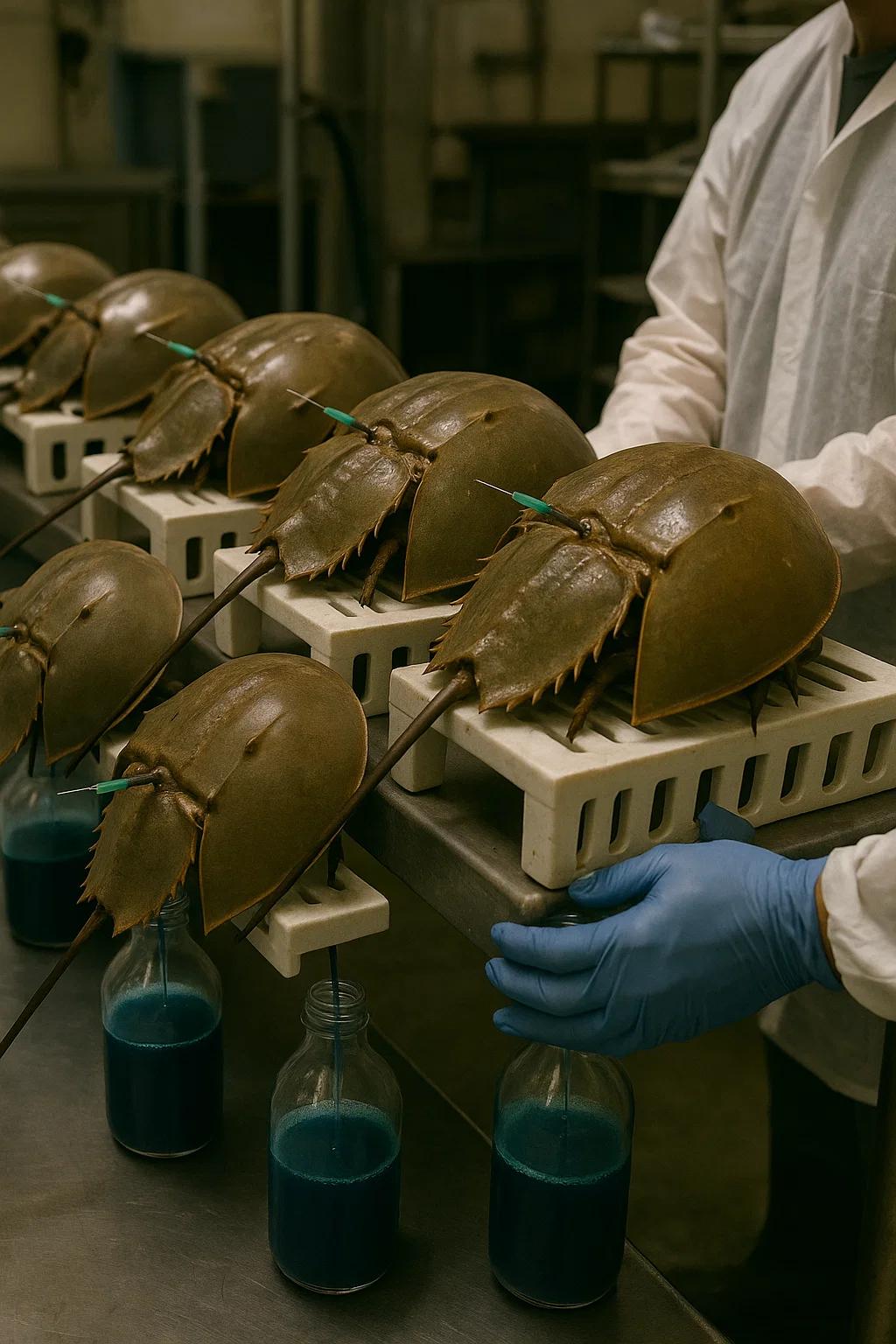
The horseshoe crab’s blood also has a unique property. It contains cells that are extremely sensitive to bacterial endotoxins. This feature has led to its use in medical research, where its blood plays a crucial role in testing the safety of pharmaceuticals.

Representative Image of Horseshoe Crab Blood Collection (Generated by Artificial Intelligence.)
The horseshoe crab has a complex and fascinating life cycle. Reproduction typically occurs during spring and summer, but the development of offspring spans a prolonged period. Female horseshoe crabs approach shorelines and deposit approximately 80,000 to 100,000 eggs in shallow waters, often burying them in sandy or muddy areas.
The eggs develop over several weeks before hatching into larvae known as trilobite larvae. These larvae are small and soft-bodied, resembling organisms from early ecosystems. In this initial stage, they feed on plankton.
Juveniles continue to live along shorelines and on the seafloor for several years as they grow and mature. During this time, their bodies gradually harden and develop. They spend their first two summers in intertidal zones, feeding at night and hiding in sandy areas or beneath marine vegetation during the day. Slowly growing, the horseshoe crab eventually reaches adulthood.
Each stage of the crab’s life cycle can be influenced by environmental factors. Temperature and sea level, in particular, directly affect the development rate and lifespan of larvae. Furthermore, the species’ survival strategies in marine ecosystems contribute to maintaining ecological balance.
The horseshoe crab plays a vital role in ecosystems. Primarily, it is a critical species for marine ecosystem health, serving as a food source at the base of the food chain for various marine animals. Horseshoe crabs are preyed upon by fish, birds, and some marine mammals. In addition, the shallow coastal areas where they nest play an essential role in maintaining water quality. As their legs move through the sand, they help clean the water and support the balance of microorganisms in the ecosystem.
In terms of habitat, the horseshoe crab primarily inhabits shallow coastal waters with sandy or muddy substrates. This environment provides favorable conditions for larval development. These areas also contain food sources such as marine plants and plankton, facilitating the crab’s feeding. However, its habitat is under threat. Coastal ecosystem degradation, habitat loss, and marine pollution are reducing the horseshoe crab’s living areas.
The horseshoe crab also plays a critical role in biological and medical research. Its blood contains specialized cells that are highly sensitive to bacterial infections, making them valuable in the biomedical industry. This blood is used to test the safety of drugs, medical devices, and vaccines. Therefore, the horseshoe crab’s role in the ecosystem is not only natural but also essential for human health and scientific research.
Horseshoe Crab Documentary (Real Science)
The horseshoe crab plays a significant role in medicine. Its blood contains a composition that is exceptionally sensitive to bacterial endotoxins, making it highly valuable for biomedical research. The cells in horseshoe crab blood are used in a method known as the Limulus Amebocyte Lysate (LAL) test. This test is widely employed to verify the sterility of medical devices, pharmaceuticals, and vaccines. The presence of bacterial contamination can be rapidly detected using the LAL test, playing a vital role in protecting human health.
One of the key characteristics of horseshoe crab blood is its “blue color.” This blue hue results from copper-based hemocyanin molecules in the blood. While humans use iron-containing hemoglobin to transport oxygen, the horseshoe crab uses copper-containing hemocyanin. When hemocyanin binds with oxygen, it turns the blood blue. This blue blood contains a highly sensitive compound used in medical tests such as bacterial infection detection.
However, harvesting horseshoe crab blood raises ethical and sustainability concerns. During blood collection, the crabs’ health is negatively affected. Extracting blood can sometimes compromise their survival or even cause death. This impacts population levels. Consequently, the use of horseshoe crab blood in the biomedical industry has become a subject requiring sustainable management. Some biomedical research institutions are now developing less invasive and more sustainable methods for blood collection.
While the medical applications of horseshoe crab blood benefit human health, it is essential that these uses are conducted ethically. Developing sustainable methods to protect the crabs’ health and natural habitats is critical for the future of this practice.
In recent years, the horseshoe crab has faced various threats. Factors such as habitat loss, coastal development, and marine pollution are shrinking its living areas. Degradation of coastal ecosystems negatively affects both larval development and adult breeding grounds. Additionally, human activities in coastal regions are causing the horseshoe crab to retreat from its natural habitats.
Another major threat is the high demand for its blood in the biomedical industry. Due to its extraordinary sensitivity to bacterial endotoxins, horseshoe crab blood is widely used in medical research and drug production. However, blood extraction can threaten the crabs’ survival. Special care is required to ensure crabs survive the procedure, yet even those that survive may suffer long-term health effects. This situation poses a significant threat to the species’ future.
At the international level, conservation efforts for the horseshoe crab are increasing. Many organizations are working to protect the species. For example, in 2020, International Horseshoe Crab Day was observed to raise awareness about its conservation. Additionally, laws and regulations limiting the trade of horseshoe crabs have been implemented in some regions. Other important steps for its protection include preserving its habitats, developing sustainable blood collection methods for biomedical use, and restoring coastal ecosystems.
Protecting this species is important for both natural ecosystems and the biomedical industry. Considering the horseshoe crab’s role in preserving biological diversity and its contribution to human health, it is a valuable species that must be conserved.
National Wildlife Federation. “Horseshoe Crab.” *National Wildlife Federation.* Accessed May 6, 2025. https://www.nwf.org/Educational-Resources/Wildlife-Guide/Invertebrates/Horseshoe-Crab
Natural History Museum. “The Horseshoe Crab's Blood Is a Miracle Ingredient in Vaccines – but the Animal Is under Threat.” Natural History Museum. Accessed May 6, 2025. https://www.nhm.ac.uk/discover/horseshoe-crab-blood-miracle-vaccine-ingredient.html
Real Science. 2020. *Why Horseshoe Crab Blood Is So Valuable*. YouTube video, 11:25. Accessed May 7, 2025. https://www.youtube.com/watch?v=oXVnuG3zO_0
The Horseshoe Crab. "Protecting Health." Accessed May 6, 2025. https://www.horseshoecrab.org/med/med.html
The Horseshoe Crab. “Natural History.” *The Horseshoe Crab.* Accessed May 6, 2025. https://www.horseshoecrab.org/nh/hist.html

Blue-Blooded Horse's Hoof Crab
World | Animalia | ||||||||
|---|---|---|---|---|---|---|---|---|---|
Branch | Arthropoda | ||||||||
Class | Merostomata | ||||||||
Team(s) | Xiphosura | ||||||||
Family | Limulidae | ||||||||
Type(s) | Limulus polyphemus | ||||||||
Evolutionary Origins and Historical Development
Anatomical Features and Physical Structure
Life Cycle and Reproduction
Ecological Role and Habitat
Economic and Medical Uses
Threats and Conservation Status