
This article was automatically translated from the original Turkish version.
+1 More
Official Name(s) | Atā Thingyan | ||||||||
|---|---|---|---|---|---|---|---|---|---|
Country | Myanmar | ||||||||
Celebration Period | Mid-April | ||||||||
Celebration Duration | Usually 5 days | ||||||||
Belief System | Theravada Buddhism | ||||||||
Mythological Figure | Dhagya Min (Indra) | ||||||||
Main Practices | life donation (jivita dana) chanting sutras washing Buddha images Water splashing | ||||||||
UNESCO Status | Intangible Cultural Heritage | ||||||||
UNESCO Acceptance Date | 2024-12-05 | ||||||||
Thingyan (officially Atā Thingyan) is Myanmar’s traditional New Year Water Festival. One of the country’s oldest and most widespread cultural events, the festival centers on the themes of purification, renewal, and social unity as the new year begins. For the people of Myanmar, Thingyan is not merely a calendrical transition; it is a collective cultural practice symbolizing the cleansing of past year’s misfortunes and preparation for a fresh start. In this sense, the festival holds a place in Myanmar’s social memory comparable to major seasonal holidays such as Christmas or Lunar New Year【1】.

Collective Worship and Religious Rituals at the Shwedagon Pagoda (UNESCO)
The Thingyan festival derives its name from the Sanskrit word samkrānti, meaning a “transition period” from the old year to the new【2】. While its religious foundations trace back to ancient Hindu traditions, within the Myanmar context it has been shaped over approximately a thousand years under the patronage of Buddhist kings and fully integrated into the Theravada Buddhist belief system. Historical records indicate that the earliest concrete evidence of the water-purification tradition in Thingyan is found in a Bagan-period inscription dated to 1291 CE. This demonstrates that the festival has been continuously celebrated in Myanmar for at least 732 years【3】.
According to popular belief, Indra, the King of Heaven, known in Myanmar as Dhagya Min, descends to earth during Thingyan to review the conduct of people throughout the past year. The festival’s daily structure is organized around this symbolic journey of Indra. The day known as “a-kya nei” is particularly regarded as a key stage representing Indra’s descent to the earth.
Thingyan is celebrated at the beginning of the new year according to the Myanmar calendar, typically in mid-April during the hottest days of the summer season. The festivities last for about five days and take place across the entire country, from urban centers to rural settlements. In major cities, elaborate street stages and mass entertainment dominate, while in rural areas religious and traditional practices remain more prominent.
The most distinctive feature of the festival is the water-based purification rituals. Water symbolizes cleansing from sins, bad fortune, and the negative experiences of the past year. Water-splashing activities using hoses, buckets, and water guns are widespread on the streets. In more traditional practices, water is sprinkled using silver bowls and sprigs of Badauk, seasonal yellow flowers. Additionally, Buddha images are ritually washed with scented water as an act of religious reverence and purification.

Water Purification in Urban Areas During the Thingyan Festival (UNESCO)
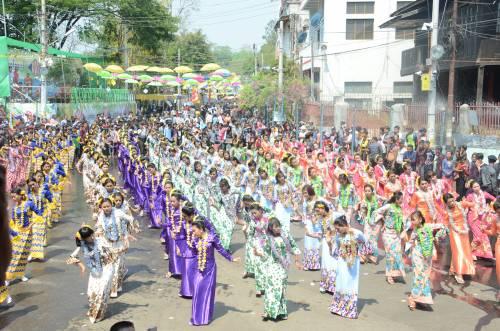
During Thingyan, religious and spiritual practices intensify. Buddhist monks recite sutras in homes; some families temporarily send their children to monasteries. Participation in meditation retreats increases, and the practice known as jivita dana involves releasing fish and birds as an act of “gift of life”. Applying manicures and pedicures to the elderly is also considered a social custom associated with the festival, reflecting respect for elders. Traditional dances, live music performances, karaoke events, and Myanmar rock music are presented on temporary open-air stages called pandal. Free food distribution and charitable activities are also widely carried out throughout the festival period.

Traditional Pandal Stage for the Thingyan Festival (UNESCO)
The most well-known traditional food associated with Thingyan is moun-loun-ye-baw, sticky rice balls. These are typically filled with palm sugar and offered free to the public during the festival. As a playful custom, some rice balls are filled with chili peppers, a symbolic element reflecting the festive and communal spirit of Thingyan.

Moun-loun-ye-baw (Generated by Artificial Intelligence)
Due to its deep historical roots and cultural significance, the Thingyan Festival was inscribed on UNESCO’s Representative List of the Intangible Cultural Heritage of Humanity on 5 December 2024 during the 19th session of the Intergovernmental Committee for the Safeguarding of the Intangible Cultural Heritage held in Asunción, Paraguay. This recognition holds historical importance as Thingyan became Myanmar’s first intangible cultural heritage element to be included on this list. The Myanmar government submitted its nomination dossier to UNESCO on 24 March 2023, with the process completed through the collective contributions of local communities, experts, media organizations, and public institutions【4】.
Global New Light of Myanmar. “Thingyan, the Heart of Myanmar or Myanmar’s Intangible Cultural Heritage Embraced into UNESCO’s Bosom.” Accessed January 1, 2026. https://www.gnlm.com.mm/243911-2/.
Ministry of Information, Republic of the Union of Myanmar. “Atar Thingyan Festival: The Intangible Cultural Heritage.” Accessed January 1, 2026. https://www.moi.gov.mm/moi:eng/article/16247.
Ministry of Information, Republic of the Union of Myanmar. “News Article Regarding National Activities” December 6, 2024. Accessed January 1, 2026. https://www.moi.gov.mm/moi%3Aeng/news/16329.
Permanent Mission of the Republic of the Union of Myanmar to the United Nations, Geneva (merome.org). "Myanmar’s Traditional Atā Thingyan Festival Has Been Inscribed on UNESCO’s Representative List of the Intangible Cultural Heritage of Humanity (5-12-2024, Asunción)." December 5, 2024. Accessed January 1, 2026. https://merome.org/myanmars-traditional-ata-thingyan-festival-has-been-inscribed-on-unescos-representative-list-of-the-intangible-cultural-heritage-of-humanity-5-12-2024-asuncion/.
UNESCO Intangible Cultural Heritage. “Myanmar Traditional New Year Atā Thingyan Festival.” Accessed January 1, 2026. https://ich.unesco.org/en/RL/myanmar-traditional-new-year-at-thingyan-festival-02085.
[1]
Yuri Takahashi ve Gouri Banerji, "A Splash of Culture and Tradition: ‘Thingyan’ or the Myanmar New Year Water Festival," School of Culture, History & Language - ANU, Erişim Tarihi 1 Ocak 2026, https://chl.anu.edu.au/content-centre/article/news/splash-culture-and-tradition-thingyan-or-myanmar-new-year-water.
[2]
Yuri Takahashi ve Gouri Banerji, "A Splash of Culture and Tradition: ‘Thingyan’ or the Myanmar New Year Water Festival," School of Culture, History & Language - ANU, Erişim Tarihi 1 Ocak 2026, https://chl.anu.edu.au/content-centre/article/news/splash-culture-and-tradition-thingyan-or-myanmar-new-year-water.
[3]
Ministry of Information, Republic of the Union of Myanmar, "Atar Thingyan Festival: The Intangible Cultural Heritage," Erişim Tarihi 1 Ocak 2025, https://www.moi.gov.mm/moi:eng/article/16247.
[4]
Ministry of Information, Republic of the Union of Myanmar, "News Article Regarding National Activities," 6 Aralık 2024, https://www.moi.gov.mm/moi:eng/news/16329.

Official Name(s) | Atā Thingyan | ||||||||
|---|---|---|---|---|---|---|---|---|---|
Country | Myanmar | ||||||||
Celebration Period | Mid-April | ||||||||
Celebration Duration | Usually 5 days | ||||||||
Belief System | Theravada Buddhism | ||||||||
Mythological Figure | Dhagya Min (Indra) | ||||||||
Main Practices | life donation (jivita dana) chanting sutras washing Buddha images Water splashing | ||||||||
UNESCO Status | Intangible Cultural Heritage | ||||||||
UNESCO Acceptance Date | 2024-12-05 | ||||||||
No Discussion Added Yet
Start discussion for "Atã Thingyan Festival" article
Belief System and Mythological Background
Rituals and Activities
Traditional Foods
UNESCO Process