


This article was automatically translated from the original Turkish version.
+2 More
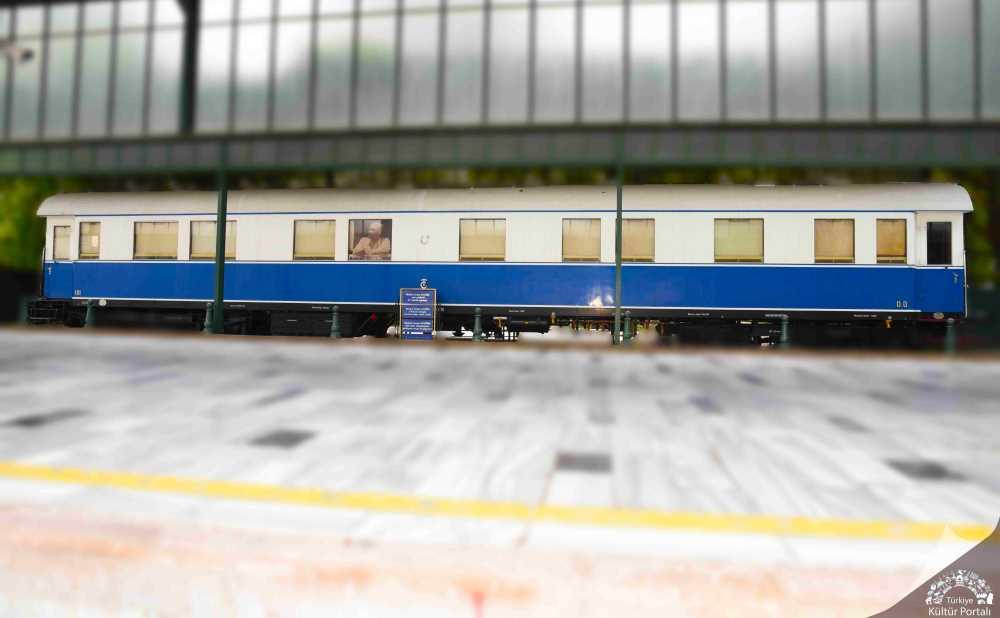
Atatürk Train Car Museum
Location | Ankara Garı Ankara | ||||||||
|---|---|---|---|---|---|---|---|---|---|
Year of Production | 1935 | ||||||||
Manufacturing Company | LHV Linke-Hofmann-Werke (Breslau) | ||||||||
Registration Date | 1991 | ||||||||
Exhibition Start | 1964 | ||||||||
Length(s) | 14.8 metres | ||||||||
Weight(s) | 46.3 tonnes | ||||||||
Sections | Kitchen, guard toilet, guard room, women's compartment, bathroom, bedroom, living room, resting area | ||||||||
Interior Material | Walnut and ebony wood veneer | ||||||||
Visiting Hour(s) | Weekdays 09.00–12.00 / 13.00–17.00 (by appointment only) | ||||||||
Admission Fee | Free | ||||||||
The Atatürk Carriage Museum, located within the Ankara Railway Station complex, was established by converting the original private train carriage used by Mustafa Kemal Atatürk, the founder of the Republic of Türkiye, during his nationwide tours between 1935 and 1938. As a reflection of Atatürk’s social and political activities, the museum houses his personal belongings and equipment used during his travels, making it a historically and culturally significant site.

Mustafa Kemal Atatürk, İsmet İnönü and Afet İnan (TCDD)
The Atatürk Carriage was manufactured in 1935 by the LHV Linke-Hofmann-Werke company in Breslau, Germany, and put into service for Atatürk’s domestic tours from that year onward. In 1964, it was permanently stationed at Ankara Railway Station by the Turkish State Railways (TCDD) for public display. In 1991, it was officially registered by the General Directorate of Monuments and Museums under the Ministry of Culture as a cultural asset requiring preservation due to its association with Atatürk.
The carriage has a total length of 14.8 meters and an empty weight of approximately 46.3 tons. Its exterior was designed with an aesthetic and minimalist approach; the lower sections are painted blue while the upper sections are white. Each side features ten large windows, totaling twenty, providing visitors with an expansive view of the surroundings from within. The stairs used for boarding and alighting are designed to be foldable.
The carriage consists of eight distinct sections: a kitchen, guard’s toilet, guard’s room, female passenger compartment, bathroom, Atatürk’s private bedroom, salon, and relaxation area. Interior materials are made of walnut and ebony wood paneling, reflecting the craftsmanship and elegance of the period. In the salon, a large ebony wood table positioned centrally, along with various-sized armchairs, a classic-style radio, and a gramophone, draw particular attention.

Interior (Türkiye Culture Portal)

Bedroom (TCDD)

Interior (TCDD)
Personal items belonging to Atatürk, such as his beloved backgammon and chess sets, diaries used during his travels, a metal thermos, and a classic telephone, are displayed within the carriage. Additionally, visitors are drawn to the panama straw armchairs, vinyl records of classical music (works by composers such as Verdi, Beethoven, and Bach), and the radio he used to listen to Anatolian melodies. These artifacts document Atatürk’s deep appreciation for art, music, and intellectual pursuits.

Exhibited Backgammon and Chess Sets (Türkiye Culture Portal)
The Atatürk Carriage is more than just a vehicle used for domestic tours; it is a structure that witnessed critical moments in the history of the Republic. Following Atatürk’s death, it also served as part of the White Train that transported his remains from Istanbul to Ankara on 19 November 1938. This role grants it a unique place in the collective memory of the Turkish nation.
The Atatürk Carriage Museum is located within Ankara Railway Station. It is open to groups of ten or more visitors on weekdays from 09:00 to 12:00 and 13:00 to 17:00, subject to prior appointment. The museum is closed on Saturdays, Sundays, and official or religious holidays. Admission is free. For further information, contact TCDD at 0312 520 43 68 / 0312 520 43 78.
Atatürk Carriage Museum (Demiryol.net)
Ministry of Culture and Tourism of the Republic of Türkiye. "Atatürk Vagonu Müzesi." *Kültür Portalı*. Accessed May 14, 2025. https://www.kulturportali.gov.tr/turkiye/ankara/gezilecekyer/ataturk-vagonu-muzesi.
Türkiye Cumhuriyeti Devlet Demiryolları (TCDD). "Atatürk Vagonu." *TCDD Resmî Web Sitesi*. Accessed May 14, 2025. https://www.tcdd.gov.tr/muzeler/ataturk-vagonu.
Türkiye Turizm Ansiklopedisi. "TCDD Kurtuluş Savaşı’nda Atatürk Vagonu Müzesi." Accessed May 14, 2025. https://turkiyeturizmansiklopedisi.com/tcdd-kurtulus-savasinda-ataturk-vagonu-muzesi.
YouTube. "Atatürk'ün Yurt Gezilerinde Kullandığı Vagonu 'Beyaz Tren'." Demiryol.net, December 10, 2020. Accessed May 14, 2025. https://youtu.be/CYPWC0678ko.

Atatürk Train Car Museum
Location | Ankara Garı Ankara | ||||||||
|---|---|---|---|---|---|---|---|---|---|
Year of Production | 1935 | ||||||||
Manufacturing Company | LHV Linke-Hofmann-Werke (Breslau) | ||||||||
Registration Date | 1991 | ||||||||
Exhibition Start | 1964 | ||||||||
Length(s) | 14.8 metres | ||||||||
Weight(s) | 46.3 tonnes | ||||||||
Sections | Kitchen, guard toilet, guard room, women's compartment, bathroom, bedroom, living room, resting area | ||||||||
Interior Material | Walnut and ebony wood veneer | ||||||||
Visiting Hour(s) | Weekdays 09.00–12.00 / 13.00–17.00 (by appointment only) | ||||||||
Admission Fee | Free | ||||||||
No Discussion Added Yet
Start discussion for "Atatürk Train Car Museum" article
History and Registration Process
Technical Specifications
Interior Layout and Sections
Exhibited Objects and Equipment
Historical Significance
Visit Information