
 Recently Added:
This article was automatically translated from the original Turkish version.
Attacks targeting two empty oil tankers, KAIROS and VIRAT, flying the flag of The Gambia, while navigating the Black Sea on 28–29 November 2025, have become a critical issue closely monitored in terms of regional maritime security. The 274-meter-long KAIROS, en route from Egypt to Russia’s Novorossiysk Port, experienced a fire following an explosion approximately 52 nautical miles from the exit of the Bosporus; after this incident occurred about 28 nautical miles off the Turkish coast, the 25-member crew was evacuated. On the same day, reports indicated that the other tanker, VIRAT, sailing approximately 35 nautical miles off the Black Sea coast, had also been struck. Although the crews on both vessels were reported to be in good health, the incidents were deemed a single security matter requiring coordinated handling.
By the morning of 29 November, the fire on KAIROS had been extinguished, and suppression and cooling operations continued in the ship’s enclosed compartments; VIRAT, despite sustaining limited damage on its starboard side, was reported to have maintained stable navigation with no fire onboard. Information that the Ukrainian Security Service and Ukrainian Navy had claimed responsibility for the attacks on both tankers using unmanned systems, and that the vessels were identified as part of Russia’s so-called “shadow fleet” used to circumvent sanctions, has directly linked the KAIROS–VIRAT incident to the maritime dimension of the war in the Black Sea.
On the evening of 28 November 2025, an alert was received regarding an explosion on the 274-meter-long empty KAIROS tanker, which was en route from Egypt to Russia’s Novorossiysk Port. Initial reports indicated that the explosion occurred in the engine room and that the captain had warned of a risk of sinking. Subsequent official statements confirmed that KAIROS was sailing approximately 28 nautical miles from the Turkish coast and 28–30 nautical miles from the Kefken shoreline when it experienced a fire “due to an external influence.” Following the explosion, a fire broke out on the vessel, spread across the ship, and was accompanied by occasional minor explosions.
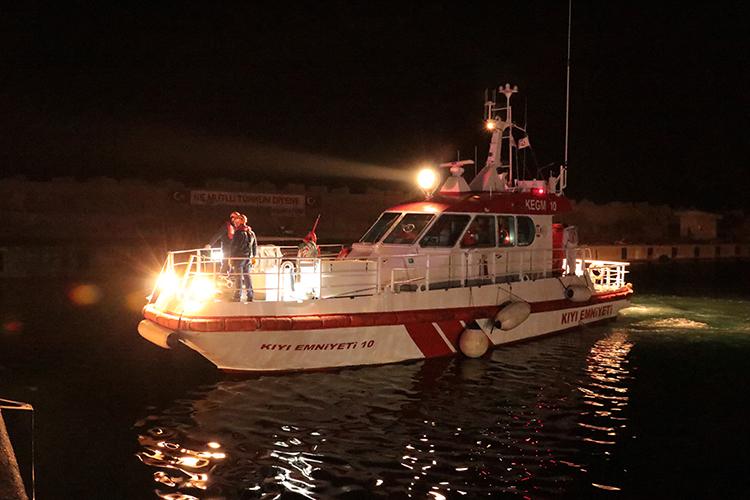
Team Returning from Assistance to KAIROS (Anadolu Ajansı)
Immediately after the incident, the condition of the 25 crew members aboard KAIROS was confirmed: all were alive and in generally good health. The Coast Guard General Directorate’s fast rescue boats KEGM-9 and KEGM-10, the rescue tugboat Kurtarma-12, and the Nene Hatun Emergency Response Vessel were dispatched to the area. The crew was evacuated from the vessel by KEGM-10 and safely retrieved from the sea.
The rescued personnel were transported to the Coast Guard Command in Kandıra district of Kocaeli, where initial medical checks were conducted, followed by precautionary transfer to Kandıra State Hospital. Statements from the Kocaeli Governorate and the Ministry of Transport and Infrastructure emphasized that no injuries were reported among the crew and that their overall health condition was good. Meanwhile, the fire on KAIROS continued for some time, with Nene Hatun and the tugboats continuing firefighting efforts; by the morning of 29 November, the fire was extinguished, and suppression and cooling operations in enclosed areas of the vessel continued.
While developments regarding KAIROS continued, on the same day another empty tanker, VIRAT, sailing approximately 35 nautical miles off the coast of Kastamonu in the Black Sea, reported being “struck” and requested assistance. According to the General Directorate of Maritime Affairs, rescue assets and a commercial vessel were directed to the area following VIRAT’s distress call, and the 20-member crew on board was confirmed to be in good health.
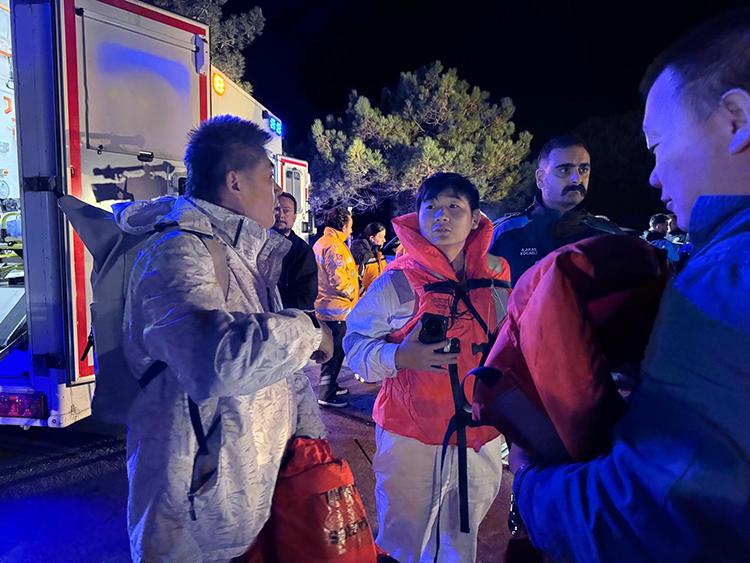
A Frame from the Rescued KAIROS Crew (Anadolu Ajansı)
Initial assessments indicated dense smoke detected in the engine room, but no fire or emergency evacuation situation was present on the vessel, and the crew did not request to abandon ship. In anticipation of potential risks, tugboats equipped with firefighting and towing capabilities were dispatched to the area under the coordination of the Zonguldak Regional Port Authority.
New statements issued by the Ministry of Transport and Infrastructure on the morning of 29 November revealed that VIRAT had suffered a second attack during the early hours, resulting in limited damage to its starboard side. Nevertheless, the vessel maintained its stable condition, and it was confirmed that both tankers were empty at the time of the incidents and that no marine pollution had occurred.
For security reasons, rescue teams were instructed to maintain a safe distance from VIRAT, while continuous monitoring and technical assessments of the situation aboard both KAIROS and VIRAT were maintained. It was confirmed that there was no immediate threat to the safety of the crew. Thus, while the emergency phase concerning both tankers was largely brought under control, official authorities continue to closely monitor both the structural condition of the vessels and the nature of the incidents.
Official statements described the incident involving KAIROS as a fire triggered “by an external influence,” while VIRAT reported having been “struck.” Initial speculation considered possibilities such as mines, missiles, or other forms of external interference; the captains’ references to a “drone attack” were widely reported. Subsequently, the Ukrainian Security Service and Ukrainian Navy announced that they had carried out the attacks on KAIROS and VIRAT using unmanned systems (unmanned maritime and aerial vehicles), thereby establishing that the incidents constituted deliberate acts of warfare rather than accidental technical failures.
Spokesperson Öncü Keçeli of the Ministry of Foreign Affairs stated that Türkiye “welcomed with concern” the attacks on the Gambian-flagged commercial tankers KAIROS and VIRAT, emphasizing that these events occurring within Türkiye’s Exclusive Economic Zone pose serious risks to navigation, human life, property, and environmental safety in the region. The statement noted that Türkiye is maintaining contact with relevant parties to prevent the escalation and spread of the conflict into the Black Sea and to safeguard Türkiye’s economic interests and activities in the region. The identification of both tankers in international sanction databases as part of a “shadow fleet” characterized by sanctioned status, multiple flag changes, complex ownership structures, and route and visibility concealment has heightened the likelihood of such vessels becoming targets of conflict and increased uncertainty in maritime security, insurance, and regulatory domains. The KAIROS and VIRAT incidents are therefore viewed as concrete indicators of a multi-layered risk environment in the Black Sea shaped by drifting mines, unmanned systems, and sanctions pressure.
The attacks on the KAIROS and VIRAT tankers have revealed a complex scenario requiring the integrated consideration of commercial shipping, energy and raw material transport, and maritime security policies in the Black Sea. The fact that these incidents occurred within Türkiye’s Exclusive Economic Zone, an area already marked by mine threats, unmanned maritime and aerial systems, and heightened military tensions, has compelled Ankara to adopt additional measures concerning coastal security and the safety of national maritime transport routes. Although the tankers were empty at the time and no marine pollution occurred, the possibility of similar attacks recurring necessitates the updating of risk monitoring, early warning, and maritime traffic information systems.
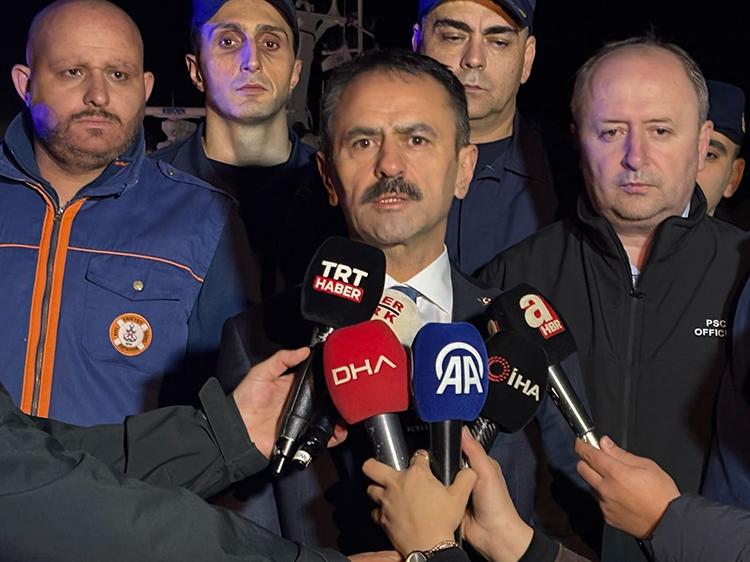
Kocaeli Governor İlhami Aktaş (Anadolu Ajansı)
In this context, strengthening information sharing and operational coordination among relevant institutions—including the Ministry of Transport and Infrastructure, the Ministry of Foreign Affairs, the Ministry of National Defense, and the Ministry of Interior—reviewing the current status of mine countermeasure and maritime security cooperation in the Black Sea, and updating navigation warnings, route planning guidelines, and risk advisories for commercial vessels have emerged as key priorities. The Minister of Transport and Infrastructure’s statement that the vessels would be directed to safe ports indicates that discussions on maritime security and environmental risk management will continue beyond the emergency phase.
Furthermore, to minimize environmental risks in similar incidents, the existing emergency response capacity—including tugboats, emergency response vessels, unmanned detection systems, aerial assets, and medical teams—is being evaluated in light of current experience. Additionally, developing joint approaches through diplomatic channels with regional countries to prevent the expansion of the conflict into the Black Sea is being recognized as a critical agenda item for preventive measures and collaborative risk management.
BBC Türkçe. “Karadeniz'de Ukrayna'nın tanker saldırıları: 'Kairos'taki yangın söndürüldü.'” BBC. Accessed November 29, 2025.https://www.bbc.com/turkce/articles/c9qej1g54peo.
BBC Türkçe. “Ulaştırma Bakanlığı: Karadeniz'deki gemilerden birine bu sabah tekrar saldırı düzenlendi.” BBC. Accessed November 29, 2025.https://www.bbc.com/turkce/articles/c9qej1g54peo.
CNN Türk. “Dışişleri'nden ‘KAIROS’ ve ‘VIRAT’ gemileri ile ilgili açıklama: Endişeyle karşılıyoruz.” Accessed November 29, 2025.https://www.cnnturk.com/turkiye/disislerinden-kairos-ve-virat-gemileri-ile-ilgili-aciklama-endiseyle-karsiliyoruz-2365859.
NTV. "Kocaeli açıklarında Rusya'ya giden tankerde patlama ve yangın." Accessed November 29, 2025.https://www.ntv.com.tr/turkiye/kocaeli-aciklarinda-rusyaya-giden-tankerde-patlama-ve-yangin-1700323
Oruç, Mertkan, Kadir Yıldız, İbrahim Aktaş, and Makbule Beyza Günbey. “Karadeniz'de yangın çıkan ‘KAIROS’ gemisinden kurtarılan 25 personel Kocaeli'deki limana getirildi.” Anadolu Ajansı. Accessed November 29, 2025.https://www.aa.com.tr/tr/gundem/karadenizde-yangin-cikan-kairos-gemisinden-kurtarilan-25-personel-kocaelideki-limana-getirildi/3757071.
Sputnik Türkiye. “Karadeniz’de tanker gemisi patladı: Mürettebat tahliye edildi.” Sputnik. Accessed November 29, 2025.https://anlatilaninotesi.com.tr/20251128/karadenizde-tanker-gemisi-patladi-yaralilar-var--1101397840.html.
TRT Haber. "Karadeniz'de 2 gemide yangın: 25 personel tahliye edildi." Accessed November 29, 2025.https://www.trthaber.com/haber/turkiye/karadenizde-2-gemide-yangin-25-personel-tahliye-edildi-927291.html
Uren, Çagla. “Karadeniz'de yanan ve saldırıya uğrayan iki gemiye dair ne biliniyor?” Euronews. Accessed November 29, 2025.https://tr.euronews.com/2025/11/29/karadenizde-yanan-ve-saldiriya-ugrayan-iki-gemiye-dair-ne-biliniyor.
Yılmaz, Mehmet Şah. “Dışişleri Bakanlığı Sözcüsü Keçeli'den ‘KAIROS’ ve ‘VIRAT’ gemilerine ilişkin açıklama.” Anadolu Ajansı. Accessed November 29, 2025.https://www.aa.com.tr/tr/gundem/disisleri-bakanligi-sozcusu-keceliden-kairos-ve-virat-gemilerine-iliskin-aciklama/3757851.

Following attacks carried out by Ukrainian security units using unmanned maritime vehicles against two empty oil tankers, KAIROS and VIRAT, flying the flag of Gambia, in the Black Sea, maritime security in the region has once again become a subject of debate. After an explosion on the KAIROS tanker ignited a fire, all 25 crew members were evacuated from the sea and underwent medical checks in Kocaeli. It was reported that the 20 personnel on board VIRAT were in good health and that the vessel sustained limited damage to its starboard side during the second attack.
No Discussion Added Yet
Start discussion for "Attacks Against the KAIROS and VIRAT Ships in the Black Sea" article
November 29, 2025
Course of Events and Rescue Operations
November 29, 2025
Security Risks and Responsibility for the Attack
November 29, 2025
Regional Implications and Measured Responses