


This article was automatically translated from the original Turkish version.
+1 More
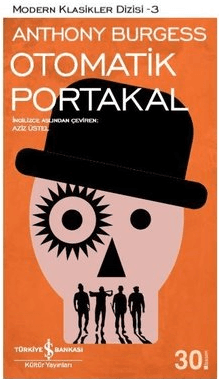
Automatic Orange (Book)
Author(s) | Anthony Burgess | ||||||||
|---|---|---|---|---|---|---|---|---|---|
Translator(s) | Aziz Üstel | ||||||||
Publisher(s) | İş Bankası Kültür Yayınları | ||||||||
First Publication Year | 2019 | ||||||||
Number of Pages | 176 | ||||||||
A Clockwork Orange (original English title: A Clockwork Orange) is a novel by British author Anthony Burgess that explores social decay, free will, and the mechanisms of state control over the individual. Since its publication, the work has sparked particularly intense debates on youth, violence, and morality. The novel was later adapted into a film of the same name by Stanley Kubrick (1971).
The protagonist of the novel, Alex, is a lawless and amoral youth who, along with his friends whom he calls “droogs,” engages in nightly acts of violence on the streets. In this dystopian future society, crime rates are high, and the state resorts to harsh methods to control its youth. Alex is eventually arrested and forced to participate in a state-run experimental rehabilitation program known as the “Ludovico Technique.” This method uses psychological conditioning to suppress violent tendencies.
However, as a result of the treatment, Alex loses not only his capacity for violence but also his ability to exercise free will. The novel examines this transformation through the ethical dilemma between individual freedom and societal security.
Free Will and Moral Choice
The central debate of the novel revolves around the individual’s right to choose good or evil freely. The question arises whether Alex, now rendered “good” by state intervention, can still be considered human.
Social Control and State Mechanisms
The government’s methods for reintegrating youth into society proceed at the cost of violating individual rights and ethical values. This reflects the dangers of authoritarian systems.
Youth and Violence
The sense of emptiness, search for meaning, and nihilistic tendencies of youth are symbolized through language, music, and behavior. The crimes committed by Alex and his gang are constructed as reflections of societal breakdown and the erosion of family structures.
Language and Identity
The novel is written in a unique youth argot called “Nadsat,” composed of Russian, English, and invented words. This linguistic style creates a distinct subculture for the youth and contributes to their process of identity formation.
Alex: The main character of the novel. He is a charismatic and intellectual youth with a strong inclination toward violence. His passionate devotion to classical music, especially Beethoven, is notable. The transformation he undergoes after treatment forms the core of the novel’s moral and psychological inquiry.
Georgie, Dim, and Pete: Alex’s gang members. Although they initially accept his leadership, the power dynamics within the group shift over time. Georgie, in particular, challenges Alex’s authority.
Prison Chaplain: A religious figure who opposes the Ludovico Technique. He views the removal of Alex’s capacity to choose good as contrary to humanity. He serves as one of the novel’s moral counterpoints.
Dr. Brodsky and Dr. Branom: The scientists who administer the experimental treatment to Alex. They aim to suppress individual will through a behaviorist approach.
Alex’s Family: They display a passive and submissive attitude toward their son’s violent tendencies. This weakness in the family structure symbolizes broader societal disintegration.
The events are narrated from the first-person perspective of Alex, employing interior monologues and philosophical reflections. Some editions of the novel include the 21st chapter, which the author specifically requested to be added; this chapter depicts the character’s process of maturation. This chapter was omitted in the first U.S. editions.
*A Clockwork Orange.* Dir. Stanley Kubrick. Burbank, CA: Warner Bros., 1971. Accessed June 18, 2025. https://www.imdb.com/title/tt0066921/.
Burgess, Anthony. Otomatik Portakal (Çev. Aziz Üstel). İş Bankası Kültür Yayınları, 2019.

Automatic Orange (Book)
Author(s) | Anthony Burgess | ||||||||
|---|---|---|---|---|---|---|---|---|---|
Translator(s) | Aziz Üstel | ||||||||
Publisher(s) | İş Bankası Kültür Yayınları | ||||||||
First Publication Year | 2019 | ||||||||
Number of Pages | 176 | ||||||||
No Discussion Added Yet
Start discussion for "Automatic Orange (Book)" article
Plot
Themes
Characters
Style