


This article was automatically translated from the original Turkish version.
+4 More
Other Name(s) | Unmanned Aerial Vehicle (UAV) Drone | ||||||||
|---|---|---|---|---|---|---|---|---|---|
Basic Principle | Flight without a human pilot, autonomously or via remote control | ||||||||
Main Technologies | Artificial Intelligence, Autopilot, Sensors (LiDAR, GPS, Cameras), SLAM | ||||||||
Basic Type(s) | Rotary-wing Vertical Takeoff and Landing (VTOL) Fixed-wing | ||||||||
Application Area(s) | Military Mapping) Logistics Commercial (Agriculture Civilian | ||||||||
Autonomy Levels | Semi-autonomous (Remotely Controlled) and Fully Autonomous | ||||||||
Autonomous aerial vehicles are airborne platforms that do not carry a pilot or passenger and can perform pre-programmed missions or be remotely controlled through artificial intelligence and various algorithms. Although these systems, commonly known as Unmanned Aerial Vehicles (UAVs) or drones, were initially developed for military purposes, they have now achieved broad applications in commercial, industrial, civil, and scientific fields. By requiring minimal human intervention during flight, these vehicles enhance operational efficiency while reducing costs. The foundation of autonomous systems consists of advanced sensors, AI-supported software, and autopilot systems that enable the aircraft to perceive its environment, make decisions, and manage its flight.
The functionality of autonomous aerial vehicles relies on the integrated operation of a set of complex technological components. These components determine all operational capabilities, from environmental perception and autonomous decision-making to flight control and communication with ground stations.
The most fundamental requirement for autonomous flight is the accurate perception of the aircraft’s surroundings. To this end, various sensor technologies are employed. The Global Positioning System (GPS) determines the vehicle’s geographic location, while sensors such as LiDAR, radar, thermal cameras, and visual perception systems collect environmental data to enable obstacle avoidance and target tracking. LiDAR (Light Detection and Ranging) is a technology that uses laser pulses to measure the distance to an object or surface with centimeter-level precision. LiDAR sensors emit millions of light beams per second, generating a “point cloud” that allows the creation of highly accurate three-dimensional (3D) models of enclosed or open areas. This technology provides reliable navigation even in enclosed environments such as tunnels or mines where GPS signals are unavailable or under dark conditions. Photogrammetry, on the other hand, emerges as a lighter and lower-cost alternative that uses multiple photographs to determine distances.

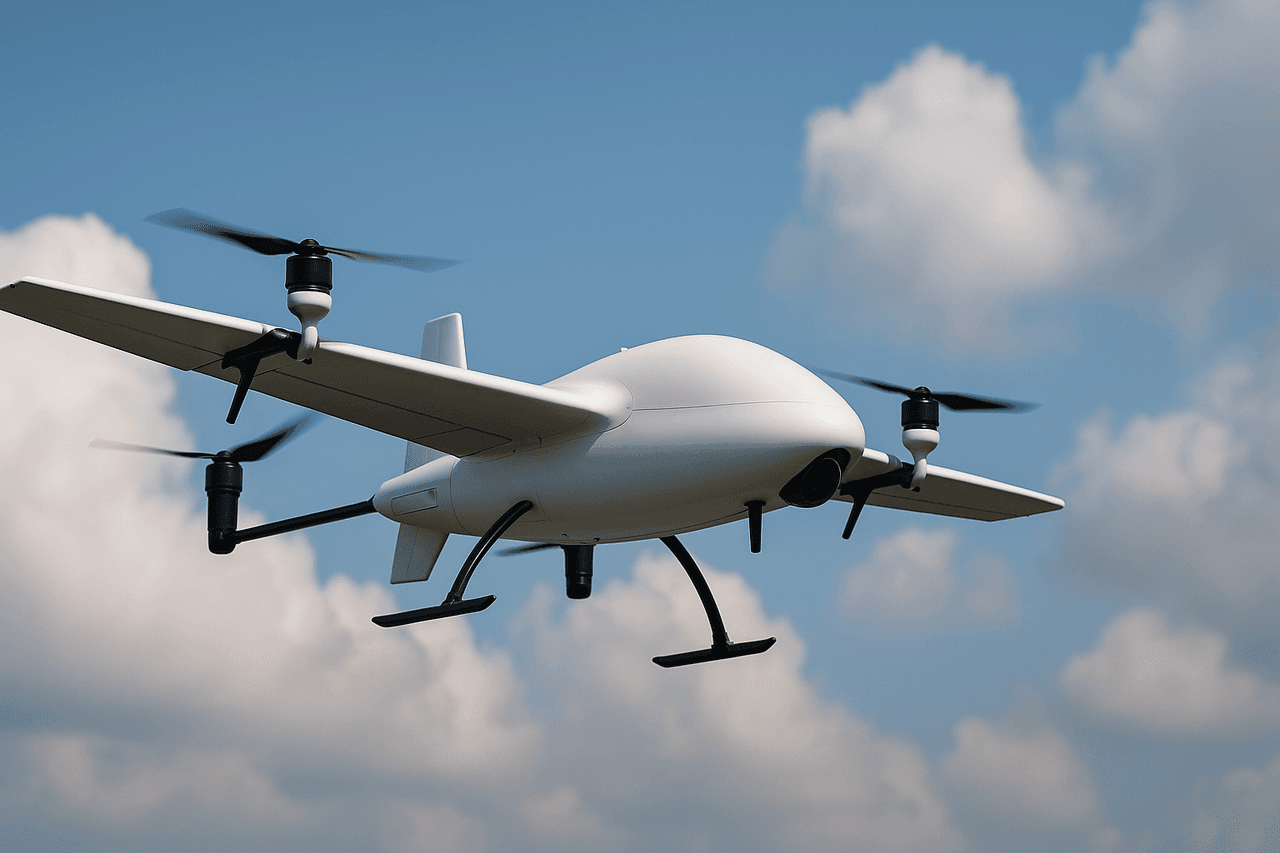
UAV Performing Autonomous Flight (Generated by Artificial Intelligence.)
Artificial intelligence (AI) and machine learning algorithms function as the “brain” of autonomous aerial vehicles. These systems process raw data from sensors and convert it into meaningful information, enabling the vehicle to make real-time decisions. For example, AI-supported software analyzes environmental factors to optimize flight path, speed, and altitude. Some advanced systems use computer vision algorithms for specialized tasks such as facial recognition, object detection, and license plate recognition. Software such as Hivemind, developed by companies like Shield AI, enables fighter jets and UAVs to fly autonomously without human intervention. In situations where GPS is unavailable, techniques such as SLAM (Simultaneous Localization and Mapping) and vSLAM (visual SLAM) come into play. These techniques allow the vehicle to simultaneously construct a map of an unknown environment and determine its own position within that map, thereby achieving full autonomous navigation capability.
The autopilot is the primary control component that manages all flight phases of an autonomous aerial vehicle, including takeoff, climb, cruise, descent, and landing. A robust autopilot system maintains the aircraft on a predefined route or enables it to navigate between specific waypoints. Today, AI applications are being integrated into autopilots to develop “smart autopilot” systems. These systems offer additional capabilities beyond standard autopilot functions, such as adaptation to changing conditions and execution of more complex tasks. Autonomous aerial vehicles feature various autonomous flight modes, including “Follow Me,” “Altitude Hold,” “Position Hold,” and “Return to Home,” which triggers an automatic return to the takeoff point in emergency situations.
One of the most critical factors determining the operational duration of autonomous aerial vehicles is their power systems. While widely used lithium-ion (Li-ion) batteries offer low weight and high energy efficiency, they are limited by short flight times. Consequently, research continues into alternative power sources such as solar energy systems and fuel cells. Communication systems enable real-time data exchange between the vehicle and ground control stations. This communication, conducted via radio frequencies or satellite links, allows for real-time monitoring of flight data, mid-flight updates to mission plans, and manual intervention during emergencies.
Autonomous aerial vehicles are classified according to various criteria such as wing configuration, size, weight, and mission capacity.

Internal Structure of Rotating-Wing UAV (Generated by Artificial Intelligence.)
Rotating-Wing Vehicles: These vehicles, commonly known as “drones,” are distinguished by their ability to perform vertical takeoff and landing (VTOL) and hover in place. They come in various configurations such as quadcopters (four rotors) or hexacopters (six rotors). They are ideal for short-range (0–50 km) and low-altitude (0–60 meters) missions.
Fixed-Wing Vehicles: These UAVs feature an aircraft-like design and offer longer range, higher speed, and longer endurance compared to rotating-wing models. They are preferred for large-area surveillance, mapping, and long-range reconnaissance missions.
Vertical Takeoff and Landing (VTOL) Hybrid Systems: These systems combine the VTOL flexibility of rotating-wing vehicles with the efficient cruise performance of fixed-wing aircraft. For example, the Bayraktar KALKAN UAV uses electric motors for takeoff and switches to a more efficient internal combustion engine when transitioning to cruise mode.
Bayraktar KALKAN UAV (Baykar Technologies)
In military and industrial applications, UAVs are generally classified according to their payload capacity:
Mini Class: Lightweight systems that can be carried by a single operator and used for tactical reconnaissance and surveillance missions.
Light Class: UAVs known for long flight duration and resilience to harsh weather conditions, typically employed as intelligence platforms.
Mid Class: These vehicles can carry payloads up to 15 kg and are capable of performing tasks such as cargo delivery or integration of weapon systems.
Heavy Class: Cargo UAVs designed with payload capacities ranging from 75 kg to 150 kg to provide logistical support in tactical zones or disaster areas.
The capabilities of autonomous aerial vehicles make them valuable across a wide range of sectors.
In military applications, UAVs are widely used for critical missions such as reconnaissance, surveillance, target detection, intelligence gathering, and operational support. Armed models (SUAVs) provide direct fire capability, while the concept of “swarm warfare,” in which large numbers of vehicles coordinate movement through swarm intelligence, holds a significant place in future defense systems. These systems enable operations in hazardous environments without risking human lives.
Autonomous aerial vehicles offer solutions that enhance efficiency across numerous industries:
Agriculture: Used for monitoring farmland, analyzing crop yield, and targeted spraying through high-resolution cameras and sensors.
Logistics: Hold potential to accelerate delivery processes, particularly in cargo and parcel transportation.
Construction and Energy: Enable safe and rapid data collection in areas difficult for humans to access, such as site surveys, mapping, infrastructure inspection, and power plant maintenance.
Mapping: Facilitate planning and analysis by generating precise 3D models of large areas, cities, or structures using LiDAR or photogrammetry techniques.
In civil applications, autonomous aerial vehicles are used for public-benefit missions such as locating missing persons during search and rescue operations, assessing post-disaster damage, monitoring forest fires, and disseminating public health information. Additionally, future urban transportation concepts such as “flying taxis” or electric vertical takeoff and landing (eVTOL) vehicles hold the potential to become a key component of urban air mobility.
The technology of autonomous aerial vehicles continues to advance rapidly. In the future, improved sensors, more capable AI algorithms, and longer-lasting power systems are expected to increase the autonomy levels of these vehicles. Advances in innovative fields such as swarm robotics and nano-class UAVs will open new application scenarios. However, the widespread adoption of this technology also brings legal and ethical challenges. National and international regulations are needed to address issues such as airspace management, security protocols, data privacy, and the right to privacy. Moreover, environmental impacts and sustainability concerns will also play a role in the future development of this technology.
ASELSAN. "Mikro/Mini İnsansız Hava Araçlarında Lazer Sensör/Görüntü Tabanlı Otonom Uçuş ve Navigasyon Uygulamaları." ASELSAN Blog, October 8, 2022. Accessed July 21, 2025. https://www.aselsan.com.tr/blog/detay/388/mikromini-insansiz-hava-araclarinda-lazer-sensorgoruntu-tabanli-otonom-ucus-ve-navigasyon-uygulamalari.
Aerotim Mühendislik. "Akıllı Otopilot Sistemleri." Accessed July 21, 2025. https://www.aerotim.com.tr/tr/hizmetlerimiz/akilli-otopilot-sistemleri/.
Akay, Ali, Umur Kuriş, and Sibel Senan. “İnsansız Hava Araçları ve Otopilotlar.” *Journal of Aviation Research* 3, no. 2 (2021): 128–49. https://doi.org/10.51785/jar.894721.
Altınay Savunma. "İnsansız Hava Araçları." Accessed July 21, 2025. https://www.altinaysavunma.com/urunler/insansiz-hava-araclari.
Bilim ve Teknik. "Silahlı İnsansız Hava Araçları." TÜBİTAK Bilim ve Teknik Dergisi. Accessed July 21, 2025. https://bilimteknik.tubitak.gov.tr/system/files/makale/siha.pdf.
DB MARS Bilişim Teknolojileri ve Savunma Sanayi. "Hava Araçları ve Alt Sistemleri." Accessed July 21, 2025. http://www.dbmars.com/projeler/mobil-arac-platformlari-ve-sistemleri/hava-araclari-ve-alt-sistemleri/.
Gazi Üniversitesi. "İnsansız Hava Aracı (İHA) Teknolojileri ve Gelişimi." *Gazi Bilimsel ve Teknik Dergi* 10, no. 2 (2022). Accessed July 21, 2025. https://dergipark.org.tr/tr/pub/gazibtd/issue/6625/87951.
Kara Harp Okulu. “İnsansız Hava Araçlarının Askeri Uygulamaları.” *Alp Savunma Bilimleri Enstitüsü Dergisi* 43 (2023): 133–148. Accessed July 21, 2025. https://kho.msu.edu.tr/akademik/enstitu/Alp_SAVBEN_dergi/sayi43/9.pdf.
İTÜ POLEN. “İnsansız Hava Araçlarında Yapay Zekâ Uygulamaları.” İTÜ Açık Arşiv. Accessed July 21, 2025. https://polen.itu.edu.tr/items/2ba11c7e-e50d-4cf9-a106-8c0c454b6759.

Other Name(s) | Unmanned Aerial Vehicle (UAV) Drone | ||||||||
|---|---|---|---|---|---|---|---|---|---|
Basic Principle | Flight without a human pilot, autonomously or via remote control | ||||||||
Main Technologies | Artificial Intelligence, Autopilot, Sensors (LiDAR, GPS, Cameras), SLAM | ||||||||
Basic Type(s) | Rotary-wing Vertical Takeoff and Landing (VTOL) Fixed-wing | ||||||||
Application Area(s) | Military Mapping) Logistics Commercial (Agriculture Civilian | ||||||||
Autonomy Levels | Semi-autonomous (Remotely Controlled) and Fully Autonomous | ||||||||
No Discussion Added Yet
Start discussion for "Autonomous Aircraft" article
Technological Components
Sensors and Perception Systems
Artificial Intelligence and Autonomous Flight Software
Flight Control and Autopilot Systems
Power and Communication Systems
Classification of Autonomous Aerial Vehicles
By Wing Configuration
By Size and Capacity
Applications
Military and Defense
Commercial and Industrial
Civil and Public Services
Future Perspectives and Challenges