


This article was automatically translated from the original Turkish version.
+1 More
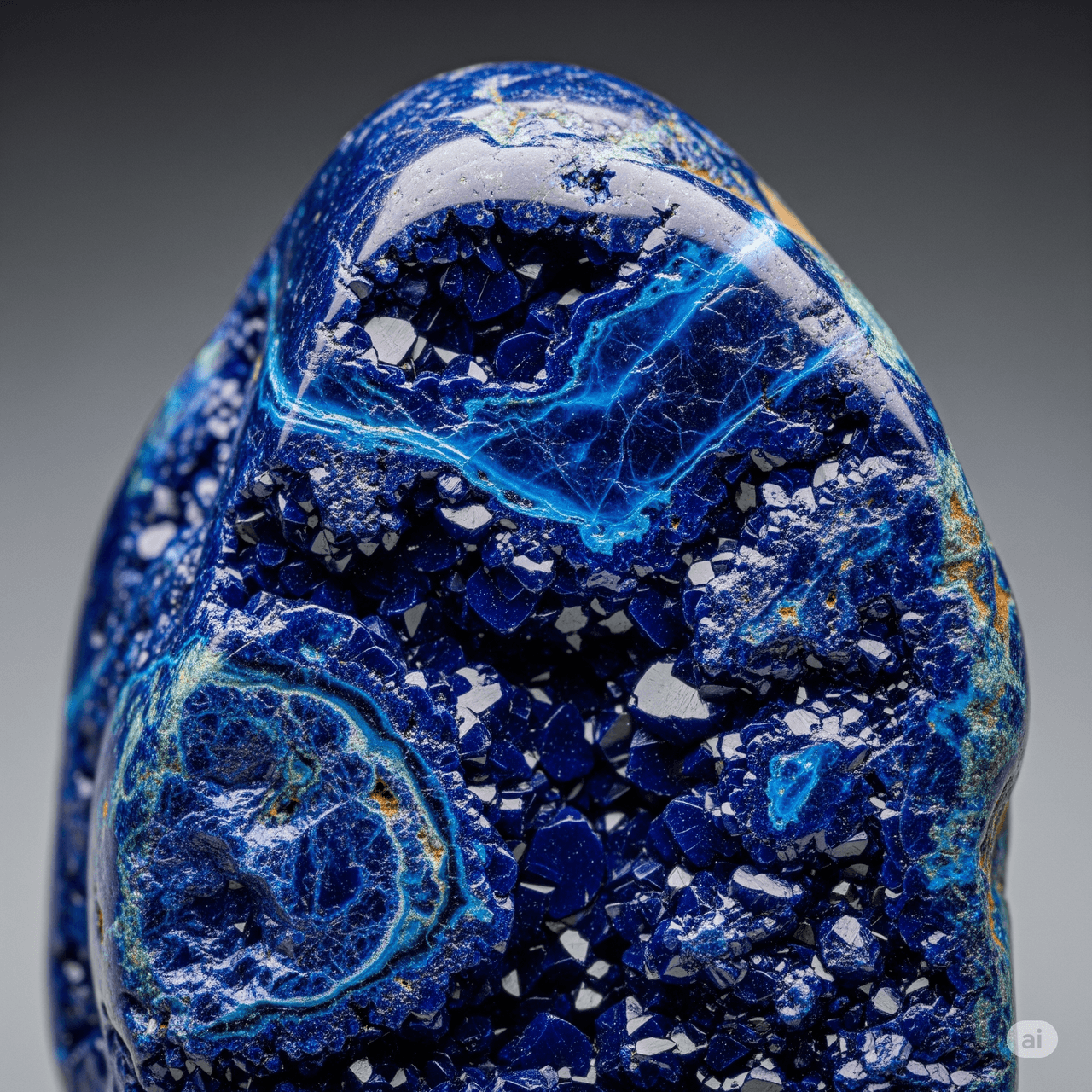
Azurite
Chemical Formula | Cu₃(CO₃)₂(OH)₂ | ||||||||
|---|---|---|---|---|---|---|---|---|---|
Crystal System | Monoclinic | ||||||||
Color | Deep blue | ||||||||
Mohs Hardness | 3.5 – 4 | ||||||||
Specific Gravity | 3.7 – 3.9 | ||||||||
Luster | Glassy | ||||||||
Transparency | Transparent to translucent | ||||||||
Commonly Found Regions | Mexico Namibia Arizona (USA) Morocco | ||||||||
Applications | Collection item Ornamental object Pigment | ||||||||
Azurite is a copper carbonate hydroxide mineral with the chemical formula Cu₃(CO₃)₂(OH)₂. It commonly occurs in nature alongside malachite, in the oxidized zones of copper ore deposits. With a Mohs hardness between 3.5 and 4, azurite is a relatively soft mineral, a property that limits its practical applications. However, due to its aesthetic appearance and distinctive coloration, it is valued by collectors and artists.
Azurite crystallizes in the monoclinic crystal system and typically forms prismatic, tabular or rosette-shaped crystals. In its crystal structure, copper(II) ions are coordinated with carbonate and hydroxide groups. This arrangement contributes to the mineral’s characteristic deep blue color. Azurite is frequently found in association with malachite; although the two minerals share similar chemical compositions, they differ in color and crystal structure.

Azurite specimen. (Generated by artificial intelligence.)
The color of azurite ranges from deep blue to light blue, a hue resulting from the presence of copper(II) ions. Azurite typically appears transparent to translucent and exhibits a vitreous luster. Its refractive indices have been measured as n_α = 1.730, n_β = 1.758, and n_γ = 1.838. These optical properties play a significant role in the identification of azurite.
Chemically, azurite is a copper(II) carbonate hydroxide compound with the formula Cu₃(CO₃)₂(OH)₂. It dissolves in acidic environments and, when heated, decomposes by releasing carbon dioxide and water, forming black copper(II) oxide. These characteristics determine azurite’s chemical behavior and its sensitivity to environmental conditions.
Azurite forms in the oxidized zones of copper ore deposits, particularly under arid climatic conditions. It precipitates when groundwater interacts with copper-bearing minerals and reacts with dissolved carbon dioxide. This process results in azurite being classified as a secondary mineral. Over time, azurite can alter to malachite under the influence of air and moisture; this transformation is observable as the formation of green malachite on the mineral’s surface.
Azurite is commonly found together with other copper minerals such as malachite, cuprite, and chrysocolla. The co-occurrence of these minerals creates striking color combinations, enhancing azurite’s aesthetic value. Worldwide, azurite deposits are concentrated in regions with significant copper mining activity. Notable azurite localities include Morocco, Arizona (USA), Namibia, and Mexico. Specimens from these regions are particularly notable for their crystal size and vivid coloration.

Azurite deposit. (Generated by artificial intelligence.)
Due to its softness, azurite has limited use in jewelry making. However, its aesthetic appeal and color variety make it desirable for ornamental objects and collector’s items. Azurite is often combined with malachite to produce mixed stones known as azurmalachite. These stones are especially favored in decorative objects and jewelry.

Use of azurite in jewelry and ornamental objects. (Generated by artificial intelligence.)
Akbudak, İlkay Kaydu, Başıbüyük, Zeynel, and Gürbüz, Meltem. "Silicified Woods Consist with Malachite, Azurite, and Hematite in the Middle Eocene Çekerek Formation, Tokat—Türkiye." *Lithology and Mineral Resources* 56, no. 6 (2021): 548–558. Accessed May 29, 2025. https://link.springer.com/article/10.1134/S002449022106002X
Jeschke, Harald, et al. "Multi-step approach to microscopic models for frustrated quantum magnets - the case of the natural mineral azurite." *arXiv preprint arXiv:1012.1090* (2010). Accessed May 29, 2025. https://arxiv.org/abs/1012.1090
Rule, K. C., Reehuis, M., Gibson, M. C. R., Ouladdiaf, B., Gutmann, M. J., Hoffmann, J., Gerischer, S., Tennant, D. A., Süllow, S., & Lang, M. (2011). Magnetic and crystal structure of azurite Cu₃(CO₃). *Physical Review B*, *83*(10). Accessed May 29, 2025. https://doi.org/10.1103/physrevb.83.104401

Azurite
Chemical Formula | Cu₃(CO₃)₂(OH)₂ | ||||||||
|---|---|---|---|---|---|---|---|---|---|
Crystal System | Monoclinic | ||||||||
Color | Deep blue | ||||||||
Mohs Hardness | 3.5 – 4 | ||||||||
Specific Gravity | 3.7 – 3.9 | ||||||||
Luster | Glassy | ||||||||
Transparency | Transparent to translucent | ||||||||
Commonly Found Regions | Mexico Namibia Arizona (USA) Morocco | ||||||||
Applications | Collection item Ornamental object Pigment | ||||||||
Physical and Chemical Properties
Crystallography and Structure
Physical Properties
Chemical Properties
Formation and Geological Distribution
Uses
Use in Jewelry and Ornamental Objects