


This article was automatically translated from the original Turkish version.
+2 More
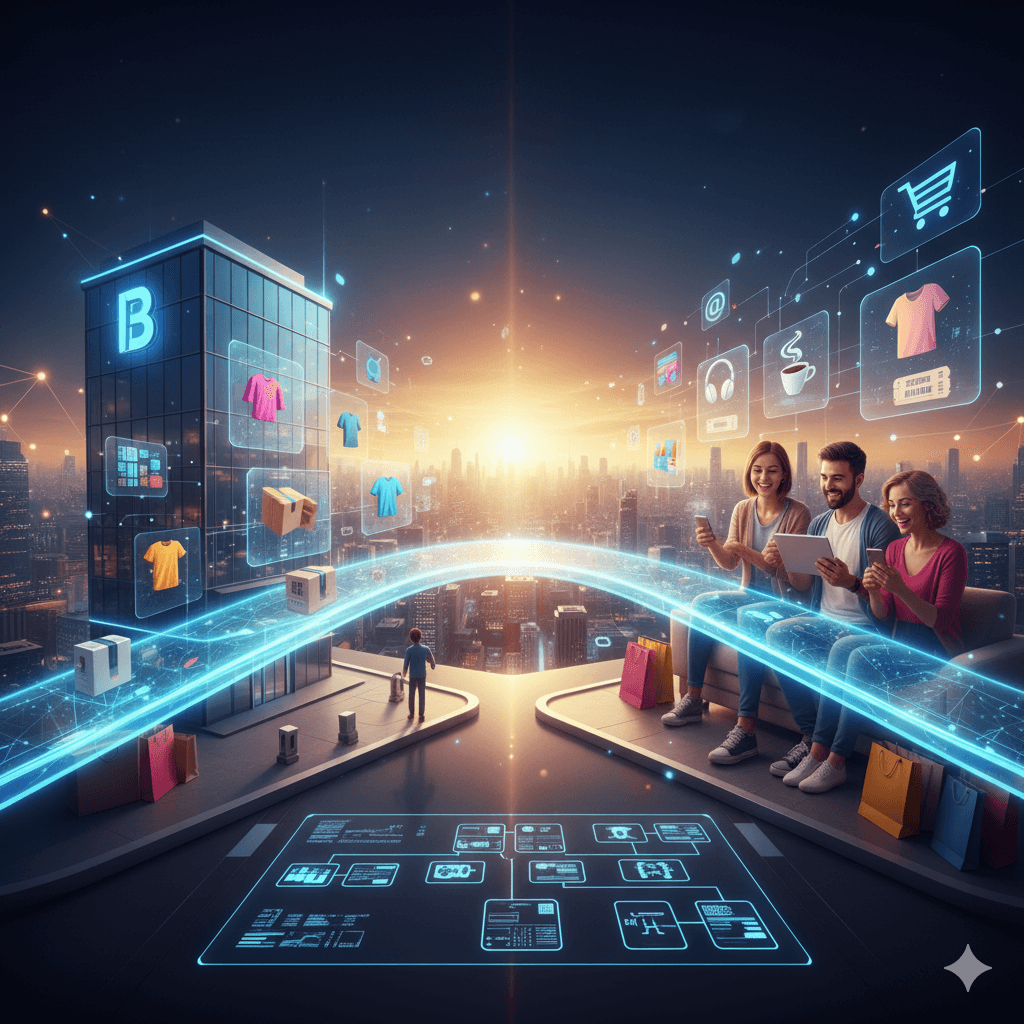
B2C - Business to Consumer (Generated by Artificial Intelligence.)
Marketing | Social media, SEO, email, paid advertising, customer segmentation | ||||||||
|---|---|---|---|---|---|---|---|---|---|
Sales Channels | Physical stores, e-commerce websites, online marketplaces, mobile applications | ||||||||
Payment Systems | Virtual POS, credit card, digital wallets | ||||||||
Advantage(s) | Wide reach fast and flexible sales low cost | ||||||||
Disadvantages | High competition, returns and logistics challenges | ||||||||
B2C is an abbreviation of the English phrase "Business to Consumer," translated into Turkish as "Business to Consumer." This business model refers to commercial activities in which businesses sell products or services they produce or source directly to end consumers, without intermediaries such as wholesalers. Any type of business that sells products or services—such as restaurants, clothing stores, supermarkets, and hair salons—can adopt the B2C model, just as in traditional commerce. Today, the most popular form of this model is e-commerce platforms that encompass online shopping.
In B2C, the fundamental principle is to focus sales and marketing efforts on the expectations and needs of individual consumers, placing customer experience at the center.
The B2C business model emerged as the internet began to gain widespread adoption in commerce. In the mid-1990s, platforms such as Amazon and eBay took the first major steps toward enabling consumers to shop online. Initially targeting a limited user base, B2C evolved significantly as internet access, computers, and smartphones became more widespread.【1】 With the rise of e-commerce, B2C became the primary mechanism allowing consumers to shop not only in physical stores but also on digital platforms.
Today, thanks to digitalization, B2C is regarded as a business strategy that enables not only large corporations but also small and medium-sized enterprises (SMEs) that effectively use financial solutions to participate in global markets. In this model, which demands continuous innovation and rapid action, data analysis and personalized marketing are key trends.
The B2C business model targets end consumers directly. The business delivers products or services it produces or sources to individual consumers without using any intermediary, such as a wholesaler. E-commerce is the most common operational form of this model; brands sell to consumers through their own e-commerce websites or online marketplaces. Fundamentally, the business adds a profit margin to its products before offering them to the consumer.
In the B2C model, the relationship between customer and business aims to build brand loyalty and community among a broad audience. Customers are typically motivated by quick and immediate solutions. This relationship is primarily managed through digital channels and automation tools such as call centers, social media, live chat, and knowledge bases. Additionally, because consumers tend to make personal purchases, businesses strengthen relationships by analyzing customer preferences and behaviors through data analysis and designing personalized marketing campaigns.
In B2C marketing, core strategies are based on understanding the target audience and establishing brand awareness, as efforts are directed toward individual consumers.
Both traditional and digital channels are suitable for marketing to individual consumers. Digital marketing is one of the most important strategies in B2C. Regular posting on social media platforms, conducting surveys and live broadcasts, enables direct communication with consumers. Email marketing serves as a tool for customer segmentation and targeting. Websites and blogs are also used as marketing channels.
Paid advertising (PPC—Pay-Per-Click, Google Ads, social media ads) allows rapid reach to audiences with specific demographic characteristics. Retargeting is an effective method for re-engaging users who have previously visited the site but did not make a purchase, by reminding them of the brand. Additionally, traditional channels such as brochures, billboards, and newspaper/magazine advertisements in local markets can be integrated with digital strategies.
Data analysis is essential for a successful B2C strategy. By analyzing customer data, trends and needs are better understood, enabling the development of effective marketing strategies. Customer segmentation through data mining forms the foundation for organizing personalized and targeted marketing campaigns.
In B2C, sales channels vary across both physical and digital environments. E-commerce websites are among the earliest applications of the B2C model, where manufacturers operate their own virtual stores to sell directly to consumers. Online marketplaces (such as Trendyol) represent another common application of the B2C model. These digital channels enable businesses to sell not only within a specific city but across the entire country and globally. Clothing stores, restaurants, supermarkets, and similar businesses use the traditional B2C model to deliver products and services directly to customers through physical stores. Direct interaction with customers in physical environments strengthens relationships. Additionally, mobile applications, working in tandem with e-commerce websites, provide customers with the ability to browse and place orders at any time of day, enabling faster sales.
In the B2C business model, due to the short sales cycle, consumer decision-making processes move quickly. Consumers tend to make personal purchases and may buy a product within minutes of deciding to do so. B2C customers are motivated by their personal needs and expectations. Customers value not only product quality but also the overall shopping experience. Brand loyalty and trust play a role in purchase motivation. Acquiring a new customer is more costly than retaining an existing one. Therefore, in a competitive B2C market, creating customer loyalty and optimizing the customer experience are considered vital for sustainable growth.
In B2C e-commerce, various payment solutions are offered to enable customers to complete transactions quickly. The foremost of these are virtual POS systems that accept payments through all major banks and credit cards. Additionally, digital wallets and contactless payments using NFC technology are also utilized. In some cases, financial solutions such as buy-now-pay-later options may be offered. Payment security and fraud prevention are critical in B2C transactions. A secure and flexible infrastructure is necessary for businesses to operate seamlessly across all platforms and gain customer trust.
The key advantages of the B2C business model can be grouped under Speed, Accessibility, and Cost Advantages. Sales via the internet overcome geographical barriers, providing Wide Reach and access to millions of customers worldwide. The elimination of high rental and maintenance costs associated with physical stores results in Lower Costs, reducing operational expenses and allowing products to be offered at more competitive prices than in physical retail. Additionally, the ability to rapidly introduce product updates and new offers, along with enabling customers to place orders 24/7, provides Speed and Flexibility. However, this model also presents certain challenges. Competition and Difficulties in Building Customer Loyalty may arise; because many businesses can serve niche markets, the High Competition in the market makes it difficult to retain customers and often necessitates increased advertising investment. Furthermore, logistical issues such as managing returns and refunds and handling shipping costs can pose challenges in B2C operations.
Drigas, Athanasios, and Panagiotis Leliopoulos. “Business to Consumer (B2C) E-Commerce Decade Evolution.” *International Journal of Knowledge Society Research* 4, no. 4: 1–10. Accessed November 17, 2025. https://www.researchgate.net/profile/Panagiotis-Leliopoulos/publication/262412938_Business_to_Consumer_B2C_E-Commerce_Decade_Evolution/links/5ae2d51f458515c60f682ed0/Business-to-Consumer-B2C-E-Commerce-Decade-Evolution.pdf
Hawk, Stephen. “A Comparison of B2C E-Commerce in Developing Countries.” *Electronic Commerce Research* 4, no. 3: 181–99. Accessed November 17, 2025. https://www.researchgate.net/profile/Stephen-Hawk/publication/220480856_A_Comparison_of_B2C_E-Commerce_in_Developing_Countries/links/5602a7ba08ae3b544e351181/A-Comparison-of-B2C-E-Commerce-in-Developing-Countries.pdf?origin=journalDetail&_tp=eyJwYWdlIjoiam91cm5hbERldGFpbCJ9
Toprak, Nuri Gökhan. “B2C E-Ticaret’in Tam Rekabet Piyasası Çerçevesinde Değerlendirilmesi: Türkiye Örneği.” *Kırklareli Üniversitesi İktisadi ve İdari Bilimler Fakültesi Dergisi* 3, no. 1: 64–75. Accessed November 17, 2025. https://dergipark.org.tr/tr/download/article-file/265331
[1]
Nuri Gökhan Toprak, “B2C E-Ticaret’in Tam Rekabet Piyasası Çerçevesinde Değerlendirilmesi: Türkiye Örneği,” Kırklareli Üniversitesi İktisadi ve İdari Bilimler Fakültesi Dergisi 3, no. 1, 64–75, sayfa 68, https://dergipark.org.tr/tr/download/article-file/265331

B2C - Business to Consumer (Generated by Artificial Intelligence.)
Marketing | Social media, SEO, email, paid advertising, customer segmentation | ||||||||
|---|---|---|---|---|---|---|---|---|---|
Sales Channels | Physical stores, e-commerce websites, online marketplaces, mobile applications | ||||||||
Payment Systems | Virtual POS, credit card, digital wallets | ||||||||
Advantage(s) | Wide reach fast and flexible sales low cost | ||||||||
Disadvantages | High competition, returns and logistics challenges | ||||||||
No Discussion Added Yet
Start discussion for "B2C (Business to Consumer)" article
History and Development of B2C
How the B2C Business Model Operates and Its Relationships
B2C Marketing Strategies
Digital Marketing (Social Media, SEO, Email)
Advertising and Campaign Methods
Customer Segmentation and Targeting
B2C Sales Channels
Consumer Behavior and B2C
Payment Systems and Payment Security in B2C
Advantages and Disadvantages of B2C