


This article was automatically translated from the original Turkish version.
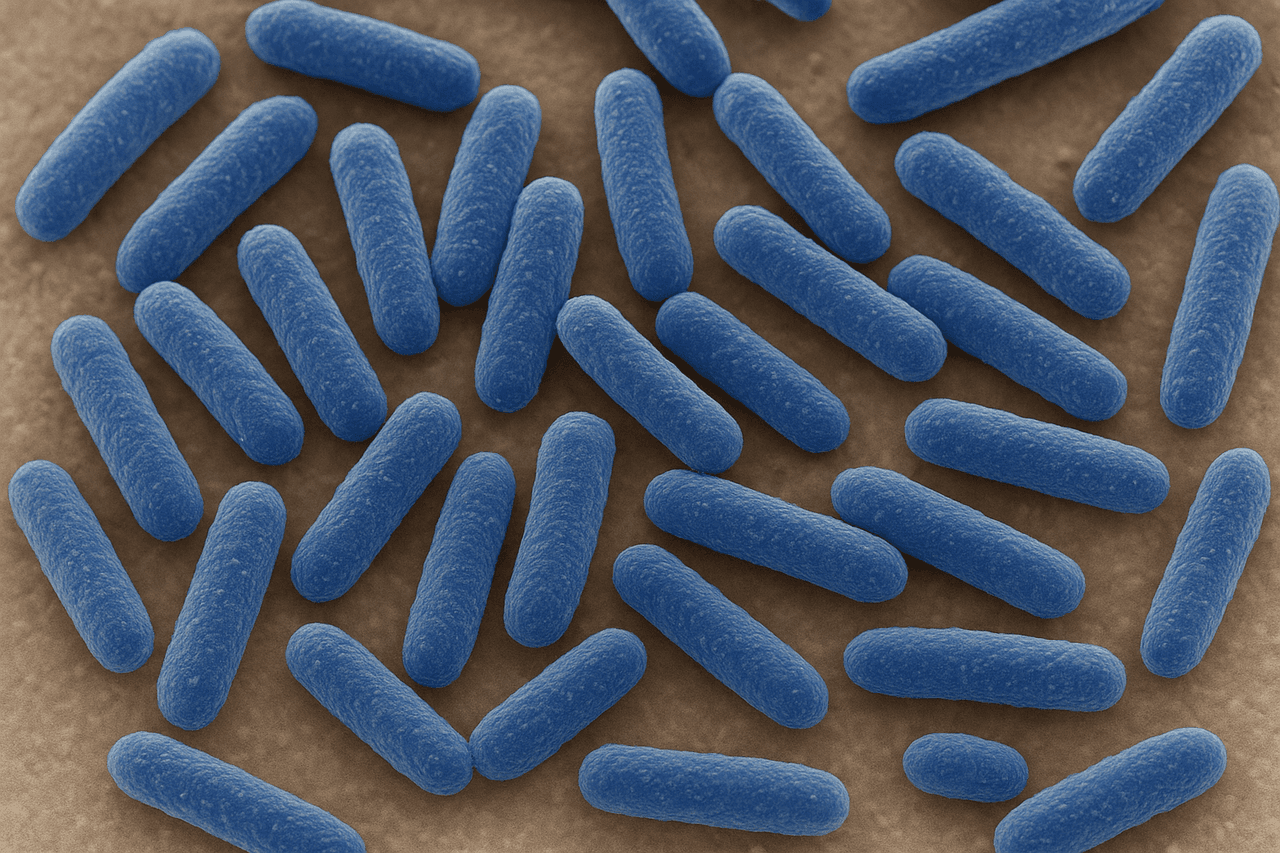
Bacillus Cereus (generated by artificial intelligence)
Class | Bacilli | ||||||||
|---|---|---|---|---|---|---|---|---|---|
Team(s) | Bacillales | ||||||||
Family | Bacillaceae | ||||||||
Toxins | Emetic toxin (cereulide) Hemolysin BL (Hbl) Non-hemolytic enterotoxin (Nhe) Cytotoxin K (CytK) | ||||||||
Habitat | Soil insect digestive systems dust plant roots and surfaces water | ||||||||
Bacillus cereus is a Gram-positive, rod-shaped, motile bacterium that forms endospores. It is generally facultatively anaerobic, meaning it can grow in both aerobic and anaerobic environments. Its cell wall contains a thick layer of peptidoglycan, causing it to appear purple in Gram staining. Its spores are highly resistant and can survive for extended periods in the environment by withstanding heat, dryness, and chemicals.
This bacterium was first described in 1887 by Frankland and Frankland. Its name is derived from the Latin word cera, meaning wax, due to the waxy and shiny appearance of its colonies under the microscope. In the 20th century, it gained attention for its role in foodborne illnesses and has since become an important model organism in food safety research.
B. cereus is widely distributed in nature. Soil, water, plant roots and surfaces, dust, and even insect digestive systems are among its natural habitats. It easily contaminates food products, particularly rice, pasta, dairy products, meat, and vegetables. Due to the resilience of its endospores, it can survive cooking and pasteurization processes.
In humans, it most commonly causes foodborne illness. Two clinical syndromes are prominent: the emetic and the diarrheal syndromes. In the emetic syndrome, preformed cereulide toxin in food causes nausea and vomiting within a short time (0.5–6 hours). In the diarrheal syndrome, enterotoxins produced in the intestine lead to diarrhea and abdominal pain after 6–15 hours. Other, rarer but more severe manifestations include eye infections (endophthalmitis), meningitis, sepsis, and respiratory infections. It can act as an opportunistic pathogen, particularly in individuals with weakened immune systems.
The pathogenic properties of B. cereus are primarily due to its toxins. These include the emetic toxin (cereulide), hemolysin BL (Hbl), non-hemolytic enterotoxin (Nhe), and cytotoxin K (CytK). Additionally, phospholipases, proteases, and hemolysins contribute to tissue damage.
This bacterium is naturally resistant to β-lactam antibiotics, particularly penicillin and ampicillin, because it produces β-lactamase enzymes. Most strains are susceptible to aminoglycosides, chloramphenicol, erythromycin, clindamycin, and vancomycin. However, in recent years, multidrug-resistant strains have been reported, making this an increasingly serious concern for both food safety and clinical treatment.
Diagnosis typically begins with clinical symptoms and a history of food consumption. The bacterium can be isolated by culturing; its colonies usually appear large, dull, and waxy. Molecular methods, particularly PCR and genetic sequencing, are used to detect toxin genes and determine which form of the illness has developed.
To prevent illness, food must be cooked at appropriate temperatures, cooked foods should not be left at room temperature for extended periods, and food must be cooled rapidly and stored under proper conditions. In industrial food production, adherence to hygiene standards and the use of cooling systems that prevent spore proliferation are of critical importance.
Some B. cereus strains are utilized in biotechnology and industry. They can be used to produce industrial enzymes such as amylase, protease, and lipase. Additionally, due to its close relationship with Bacillus thuringiensis, it serves as a model organism in biological control studies against agricultural pests. However, these applications are carefully controlled due to the risk of food pathogenicity.
B. cereus is important for both food safety and microbiological research. It is one of the most significant pathogens in the food industry. Furthermore, together with its close relatives B. anthracis and B. thuringiensis, it is used as a reference organism in evolutionary biology and functional genomics studies.
Ehling-Schulz, M., R. Knutsson, and S. Scherer. “Bacillus cereus.” In *Molecular Detection of Foodborne Pathogens: Genomes of Foodborne and Waterborne Pathogens*, edited by D. Liu, 147–64. Boca Raton, FL: CRC Press, 2010. https://doi.org/10.1128/9781555816902.ch11
Granum, P. E., and T. Lindbäck. “Bacillus cereus.” In *Food Microbiology: Fundamentals and Frontiers*, edited by M. P. Doyle and R. L. Buchanan, 491–502. 4th ed. Washington, DC: ASM Press, 2012. https://doi.org/10.1128/9781555818463.ch19

Bacillus Cereus (generated by artificial intelligence)
Class | Bacilli | ||||||||
|---|---|---|---|---|---|---|---|---|---|
Team(s) | Bacillales | ||||||||
Family | Bacillaceae | ||||||||
Toxins | Emetic toxin (cereulide) Hemolysin BL (Hbl) Non-hemolytic enterotoxin (Nhe) Cytotoxin K (CytK) | ||||||||
Habitat | Soil insect digestive systems dust plant roots and surfaces water | ||||||||
History
Habitat and Distribution
Pathogenesis and Diseases
Virulence Factors
Antibiotic Resistance
Diagnosis
Prevention and Control
Industrial and Biotechnological Applications
Scientific Significance