

+2 More

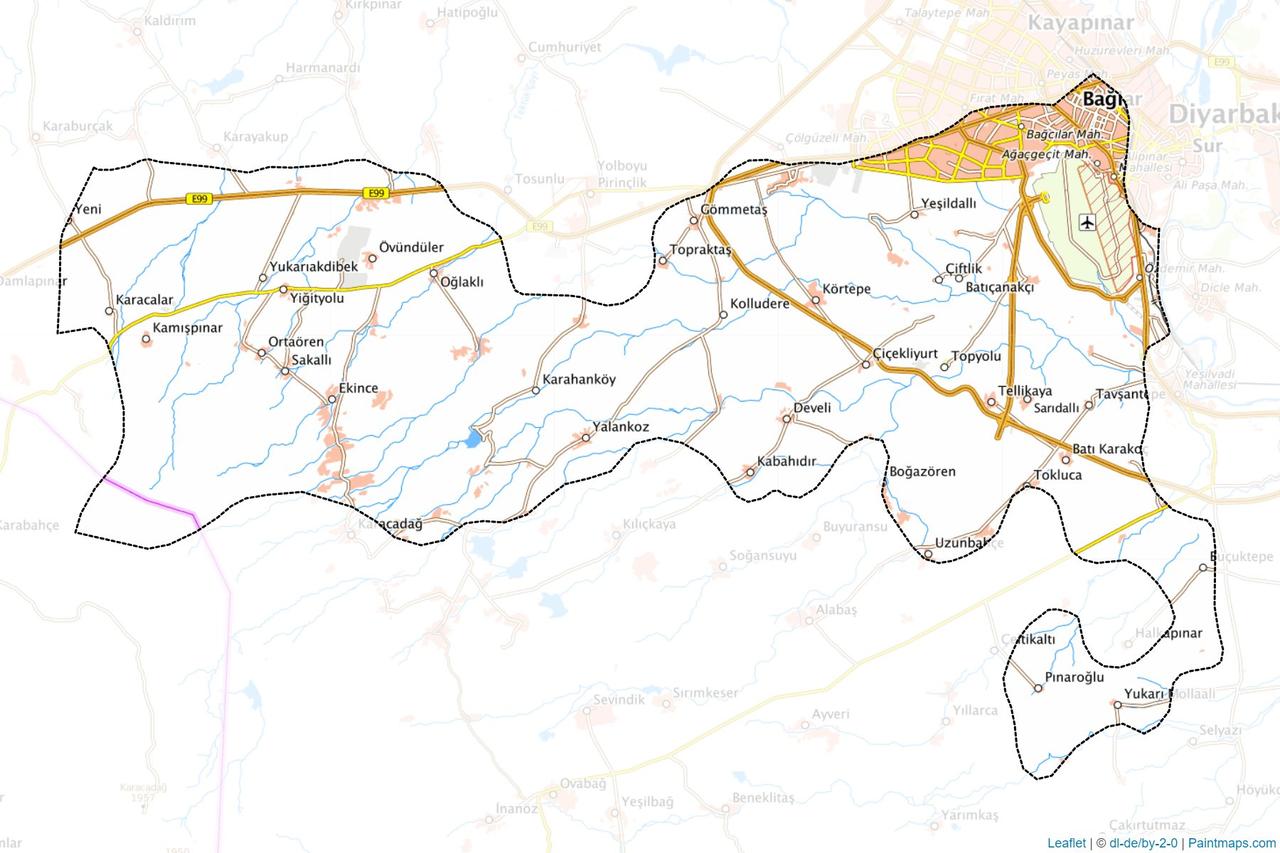
Bağlar (District)
Location | Diyarbakır Türkiye(Central District) | ||||||||
|---|---|---|---|---|---|---|---|---|---|
Date of Establishment | 1994 (As a lower-tier municipality) 03.22.2008 (Central district status) | ||||||||
Origin of Name | The region was famous for its vineyards and gardens in the past | ||||||||
Climate(s) | winters are cold and rainy) Continental (Summers are hot and dry | ||||||||
Vegetation | While vineyards and gardens were dense in the past, there are limited agricultural lands and green areas today. | ||||||||
Green Area Per Capita | 0.7 m² | ||||||||
Bağlar is one of the central districts of Diyarbakır. Named after the vineyards and gardens that once covered the region, the district possesses a rich historical and cultural background. Bağlar, which gained central district status in 2008, stands out as a rapidly growing settlement.
Bağlar district was established as a sub-municipality in 1994. Following the decision of the Council of Ministers numbered 93/5130 dated 12.21.1993, Diyarbakır was granted Metropolitan Municipality status, and Bağlar began operating alongside Sur and Yenişehir municipalities. From 1994 until 03.22.2008, Bağlar functioned as a sub-municipality. It was granted central district status through Law No. 5747, published in the Official Gazette dated 03.22.2008 and numbered 26824.
At the time of its establishment, the district's service area consisted of seven neighborhoods: Alipınar, Fatih, Kaynartepe, Körhat, Muradiye, Yeniköy, and 5 Nisan. However, due to intense migration, new neighborhoods such as Bağcılar, Yunus Emre, Şeyh Şamil, Selahattin Eyyübi, and Mevlana Halit were formed over time. With the enactment of Law No. 5216 on 07.10.2004, 21 villages (Ağaçgeçit, Batıçanakçı, Çiçekliyurt, Çiftlik, Develi, Gömmetaş, Kabahıdır, Kolludere, Körtepe, Özdemir, Sarıdallı, Topraktaş, Topyolu, Yeşildallı, Tellikaya, Uzunbahçe, Buçuktepe, Pınaroğlu, Yukarı Mollalı, Tavşantepe, Batıkarakoç) and 24 associated hamlets were converted into neighborhoods and connected to the Bağlar Municipality. Thus, the district became a municipality serving a total of 33 neighborhoods.
Bağlar takes its name from the vineyards the region was once famous for. These vineyards hold an important place in the district's historical and cultural identity.
Bağlar district is located in the center of Diyarbakır and spreads over a large area. Before 2004, the total area of the district was 7,100 hectares. After the inclusion of villages and hamlets in 2004, this area increased to 34,300 hectares. The zoned area (excluding villages) was determined to be 2,925 hectares. The district's geographical structure consists of flatlands and mildly rugged terrain. Bağlar holds a central position in Diyarbakır’s urban development and has strong connections with neighboring districts.
Bağlar district reflects Diyarbakır’s general climate characteristics and is under the influence of a continental climate. Summers are hot and dry, while winters are cold and rainy. Although the region once boasted rich vineyards and gardens, urban development has significantly reduced its greenery. Currently, green spaces are limited; the amount of green area per capita is recorded as 0.7 square meters. Nevertheless, agricultural lands and small gardens still exist in the district.
Bağlar has a multicultural and multiethnic social structure. Waves of migration have diversified the district’s demographic and social fabric. Different age groups, ethnic identities, and social classes live together in Bağlar. The municipality aims to provide social services with a democratic, participatory, and transparent governance approach. Its vision is to develop urban and social services with a human rights-based approach and to create an ecological and gender-equal model. Women's and youth participation in local governance is encouraged, and the principles of social justice and equality are prioritized.
Bağlar's economic structure aligns with Diyarbakır’s overall economic dynamics. Agriculture, trade, and the service sector stand out in the district. While the region was once known for viticulture and gardening, urban transformation has shifted the economy more towards trade and services. Small-scale enterprises, tradespeople, and local markets support the district’s economic vitality. Despite urbanization, agricultural lands are still in limited use. Bağlar Municipality aims to develop projects that enhance economic productivity and ensure social justice.
While Bağlar is not directly a major tourist attraction, it benefits from Diyarbakır's overall tourism potential. The nearby Karacadağ Ski Resort is a significant touristic value. Referred to as the "Uludağ of the Southeast," this resort hosts day-trippers from surrounding provinces such as Diyarbakır, Gaziantep, Şanlıurfa, Mardin, Batman, and Adıyaman. Karacadağ, which offers skiing opportunities during winter, contributes to the region’s tourism potential. Additionally, the district’s traditional cuisine adds cultural charm in terms of tourism.
According to the 2009 census, the population of Bağlar is 334,954. The district, which has grown rapidly due to migration, is one of Diyarbakır’s most populated areas. Spread across 33 neighborhoods, the population consists of various social and cultural groups. The district has a high youth population, which requires the development of social and economic policies targeting young people. Bağlar Municipality aims to provide its services fairly and accessibly to all segments of the population, considering its demographic diversity.
Bağlar reflects the rich culinary culture of Diyarbakır. Prominent local dishes in the district include:
Bağlar District Governorship. “History,” Accessed April 8, 2025. http://www.baglar.gov.tr/tarihi.
Bağlar District Governorship. “Karacadağ Ski Center,” Accessed April 8, 2025. http://www.baglar.gov.tr/karacadag-kayak-merkezi.
Bağlar District Governorship. “Our Local Dishes,” Accessed April 8, 2025. http://www.baglar.gov.tr/yoresel-yemeklerimiz.
Bağlar Municipality. “History of Bağlar Municipality,” Accessed April 8, 2025. https://www.baglar.bel.tr/tr/post/17638/baglar-belediyesinin-tarihcesi.
Bağlar Municipality. “Mission, Vision and Principles of Bağlar Municipality,” Accessed April 8, 2025. https://www.baglar.bel.tr/tr/post/17637/baglar-belediyesi-misyon-vizyon-ve-ilkeler.
Diyarbakır Governorship. “Bağlar,” Accessed April 8, 2025. http://www.diyarbakir.gov.tr/baglar.

Bağlar (District)
Location | Diyarbakır Türkiye(Central District) | ||||||||
|---|---|---|---|---|---|---|---|---|---|
Date of Establishment | 1994 (As a lower-tier municipality) 03.22.2008 (Central district status) | ||||||||
Origin of Name | The region was famous for its vineyards and gardens in the past | ||||||||
Climate(s) | winters are cold and rainy) Continental (Summers are hot and dry | ||||||||
Vegetation | While vineyards and gardens were dense in the past, there are limited agricultural lands and green areas today. | ||||||||
Green Area Per Capita | 0.7 m² | ||||||||
History
Geographical Structure
Climate and Vegetation
Social Structure
Economic Structure
Tourism Potential
Demographics
Local Cuisine
This article was created with the support of artificial intelligence.