


This article was automatically translated from the original Turkish version.
+1 More
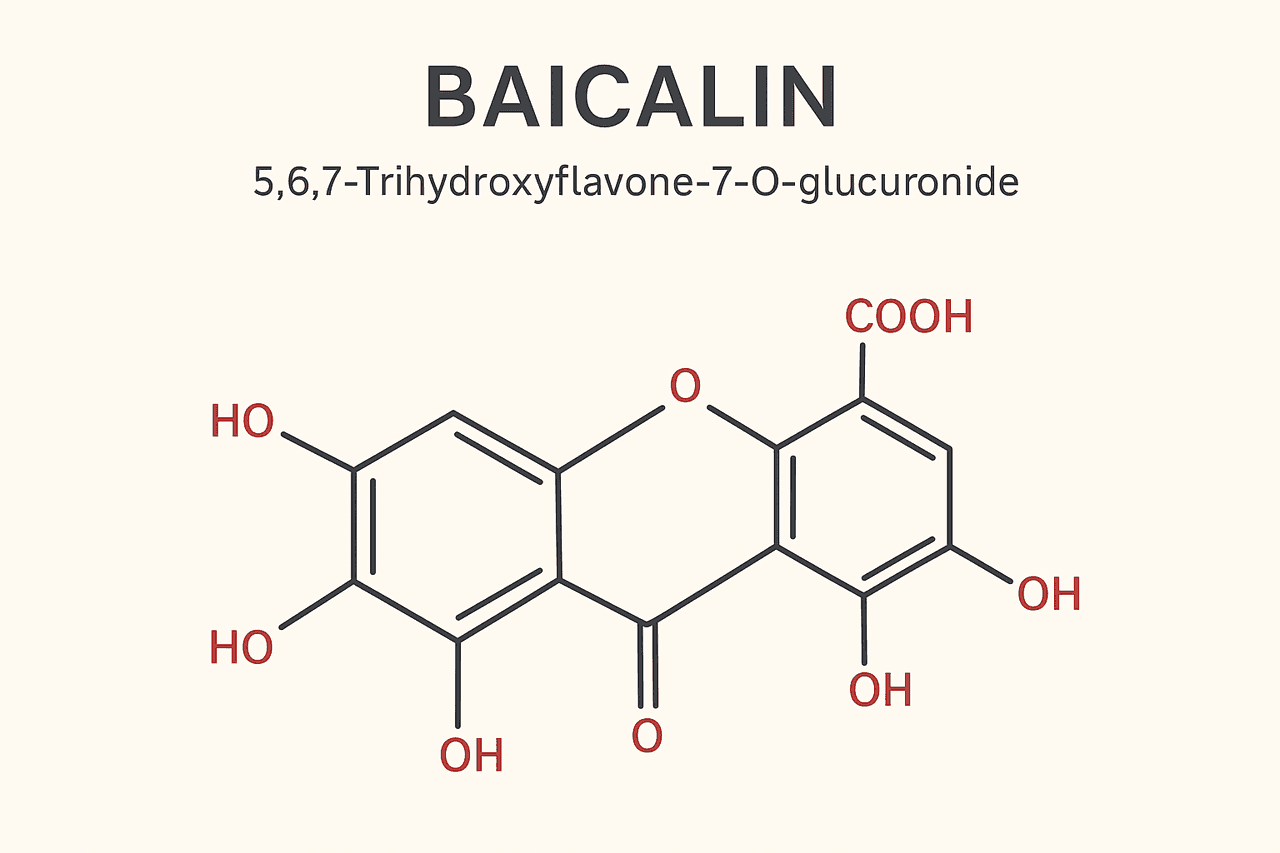
Baicalin (Generated by Artificial Intelligence.)
Baicalin
Chemical Name | 5,6,7-Trihydroxy flavone-7-O-glucuronide | ||||||||
|---|---|---|---|---|---|---|---|---|---|
Molecular Formula | C₂₁H₁₈O₁₁ | ||||||||
Molecular Weight | 446.36 g/mol | ||||||||
Physical Property | Yellowish crystalline powder | ||||||||
Primary Plant Source | Scutellaria baicalensis (Chinese skullcap) | ||||||||
Baicalin is a natural compound belonging to the flavonoid class. It is primarily isolated from the roots of the plant Scutellaria baicalensis (Chinese skullcap). Chemically a flavone glucuronide, baicalin is the 7-O-glucuronic acid derivative of its aglycone, baicalein. With a molecular formula of C21H18O11, this compound is partially soluble in water and exists as a yellowish crystalline flavonoid. The stability of baicalin depends on pH and temperature conditions; it may partially degrade under high temperatures or in alkaline environments. These properties have necessitated the development of carrier systems for pharmaceutical formulations.
Baicalin is most commonly found in the plant Scutellaria baicalensis Georgi, but has also been identified in species such as Scutellaria lateriflora, Oroxylum indicum, and Scutellaria barbata. The root of the plant accumulates high concentrations of baicalin. Known in traditional Chinese medicine as “Huang Qin,” this plant has been used for centuries to treat various diseases. Baicalin also serves as an active component in certain herbal formulations and stands out among natural antioxidant sources. Modern extraction techniques have facilitated its isolation in high purity, enhancing its utility in pharmaceutical and biotechnological research.
Baicalin is a compound with multifaceted biological activities. Research has demonstrated that this flavonoid possesses antioxidant, anti-inflammatory, antiviral, antimicrobial, and anticancer properties. It has also been shown to exert neuroprotective effects on the nervous system by modulating oxidative stress and apoptotic processes. Baicalin’s regulatory effects on the immune system have been reported, particularly its role in cytokine production and macrophage activity. These diverse effects have made it a significant target molecule in pharmaceutical research.
Currently, baicalin is considered a potential therapeutic agent for the treatment of numerous conditions including hepatitis, neurodegenerative diseases, cardiovascular disorders, and certain types of cancer. Studies investigating its antiviral activity have yielded promising results against influenza, HIV, SARS-CoV, and even COVID-19. Baicalin demonstrates therapeutic effects by regulating the cell cycle and suppressing inflammatory responses. Additionally, its capacity to modulate the gut microbiota is being explored in probiotic-assisted therapeutic approaches. Determining a safe dosage range in clinical trials could further broaden its pharmaceutical application.
The bioavailability of baicalin after oral administration is limited, as it is partially converted to baicalein in the digestive system prior to absorption. It undergoes metabolic processes such as glucuronidation and sulfation in the liver. High binding to plasma proteins and modification by the gut microbiota are key factors influencing its pharmacokinetics. Consequently, in recent years, efforts have focused on enhancing its bioavailability through systems such as liposomal carriers, nanoemulsions, and microencapsulation. Experimental studies have demonstrated that these novel formulations significantly enhance the therapeutic effects of baicalin.
As a plant-derived flavonoid, baicalin exhibits broad pharmacological potential. Due to its natural origin, low toxicity profile, and multiple biological activities, it is regarded as a valuable compound in modern medicine. However, overcoming pharmaceutical challenges such as low bioavailability and limited solubility will enhance its efficacy in clinical applications. In the future, the development of baicalin-based drug formulations is expected to represent a significant step forward in the therapeutic use of natural compounds.
Liang, W., X. Huang, and W. Chen. “The Effects of Baicalin and Baicalein on Cerebral Ischemia: A Review.” *Aging and Disease* 8, no. 6 (2017): 850–867. Accessed October 19, 2025.
Wen, Y., Y. Wang, C. Zhao, B. Zhao, and J. Wang. “The Pharmacological Efficacy of Baicalin in Inflammatory Diseases.” *International Journal of Molecular Sciences* 24, no. 11 (2023): 9317. Accessed October 19, 2025. https://doi.org/10.3390/ijms24119317

Baicalin (Generated by Artificial Intelligence.)
Baicalin
Chemical Name | 5,6,7-Trihydroxy flavone-7-O-glucuronide | ||||||||
|---|---|---|---|---|---|---|---|---|---|
Molecular Formula | C₂₁H₁₈O₁₁ | ||||||||
Molecular Weight | 446.36 g/mol | ||||||||
Physical Property | Yellowish crystalline powder | ||||||||
Primary Plant Source | Scutellaria baicalensis (Chinese skullcap) | ||||||||
Sources and Natural Distribution
Pharmacological Effects
Therapeutic Applications and Clinical Potential
Pharmacokinetic Properties and Bioavailability
Future Perspectives