


This article was automatically translated from the original Turkish version.
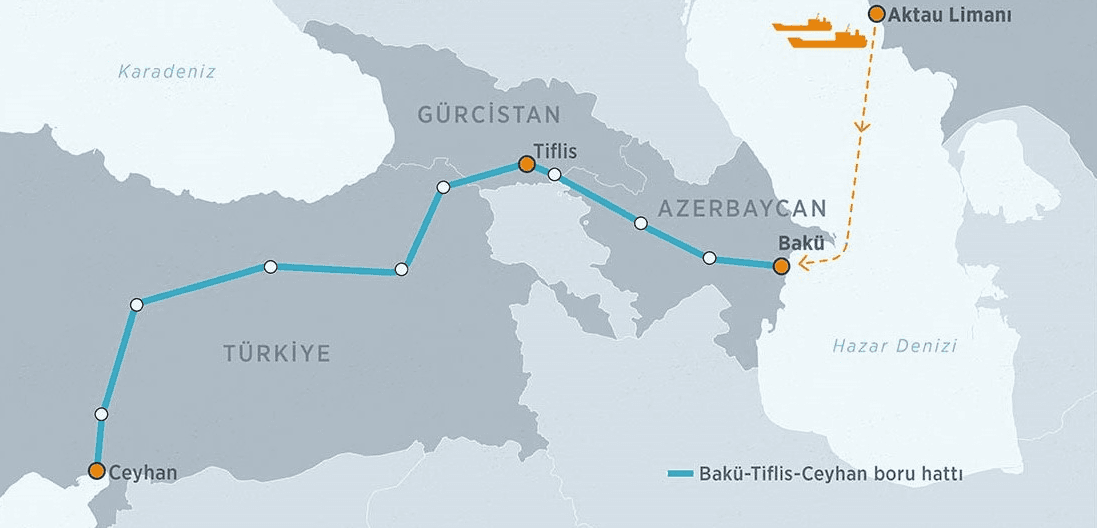
Baku-Tbilisi-Ceyhan Oil Pipeline (BTC Pipeline)
Starting Point | Baku, Azerbaijan | ||||||||
|---|---|---|---|---|---|---|---|---|---|
Ending Point | Ceyhan, Türkiye | ||||||||
Locations Passed Through | Sarıkız, Türkiye Erzurum, Türkiye Tbilisi, Georgia | ||||||||
Opening Date(s) | 2006 | ||||||||
Baku-Tbilisi-Ceyhan (BTC) Crude Oil Pipeline is a strategic project designed to transport energy resources from the Caspian Sea region to Western markets. Completed in 2006, this pipeline begins in Baku, Azerbaijan, passes through Georgia and Türkiye, and terminates at the Ceyhan port on the Mediterranean Sea. Efforts to enhance diversity and security in energy transit routes have made this project important in global energy trade. It provides significant economic and strategic benefits to both Türkiye and Azerbaijan.

BTC Pipeline Map Representation - Deniz Bülten
Following the dissolution of the Soviet Union, the Caspian Sea region became a focal point of international energy markets due to its vast energy reserves. During this period, Azerbaijan, Kazakhstan, and Turkmenistan like countries introduced various pipeline projects to connect with global energy markets. However, a safe and economically viable route was needed to implement these projects. In this context, the Baku-Tbilisi-Ceyhan (BTC) pipeline emerged as the most suitable route for transporting crude oil from Azerbaijan to global markets.
The BTC pipeline was formally established through agreements signed in 1999 between Azerbaijan, Georgia, and Türkiye. These agreements enabled the regional countries to reduce their dependence on external energy sources and maximize their strategic interests. Türkiye not only became the main transit corridor for the pipeline but also gained the opportunity to become a significant transit country in energy trade.
Construction of the pipeline accelerated in 2002 and was completed in 2006. The construction process affected local livelihoods and had significant impacts on regional development. Economic activity in the Ceyhan region of Türkiye increased substantially in parallel with the project.
The pipeline is 1,776 kilometers long and has a daily capacity of one million barrels. This capacity places it among the world’s largest pipelines and makes a significant contribution to global oil supply security.
The BTC pipeline has strengthened Türkiye’s strategic position in energy transit routes. The fact that the pipeline passes through Türkiye to deliver Caspian oil to Western markets has elevated Türkiye’s role as a key energy corridor. Türkiye is not only a direct importer of energy resources such as oil and natural gas but also serves as a bridge facilitating the delivery of these resources to global markets.
The BTC pipeline enhances Türkiye’s energy supply security and promotes energy diversification. Diversifying energy sources reduces Türkiye’s dependence on imports and represents a significant step toward reducing external dependency. This situation also strengthens Türkiye’s influence in global energy markets.
Thanks to the BTC pipeline, Türkiye has not only become a conduit for energy transport but has also reinforced its international standing by ensuring the security of energy supplies to the West. This strategic role has deepened Türkiye’s relations with Central Asia and the Caspian region and provided a more independent scope for shaping its energy policy. By offering an alternative route to the dominance of Russia in energy transit corridors, Türkiye has helped balance power dynamics in global energy markets.
The BTC pipeline provides Türkiye with annual transit revenues in the billions of dollars. Transit fees collected from oil shipments passing through the pipeline have become a major income source for Türkiye’s energy sector and have contributed significantly to economic growth. These revenues serve as an important source for balancing Türkiye’s energy imports and supporting the national economy.
In addition, infrastructure projects related to the BTC pipeline created employment during construction and operational phases and injected vitality into local economies. However, these impacts were largely confined to the construction phase, and greater investment is required for long-term development and sustained revenue generation.
The BTC pipeline generated significant employment during its construction phase, creating economic opportunities for local populations in the regions it traversed. However, after completion, the pipeline’s impact on permanent job creation has been limited. Nevertheless, investments in the energy sector in areas such as Ceyhan may generate more lasting employment opportunities for local communities.
Ceyhan is the final point of the BTC pipeline in Türkiye and holds a strategic position as a major energy terminal. The oil storage, transportation, and processing facilities in this region enhance Türkiye’s strength in the energy sector. Ceyhan’s development contributes not only to the local economy but also to the strengthening of the national energy infrastructure. However, to fully realize this potential, further investment in the energy industry and infrastructure development in Ceyhan is required.
The BTC pipeline is a controversial project in terms of environmental impacts. Several incidents during construction caused environmental damage, but Türkiye has worked to minimize these effects within the framework of environmental regulations and international standards. Potential environmental disasters during operation, particularly oil spills and ecological degradation, have influenced Türkiye’s environmental policies.
At the same time, the BTC pipeline has prompted Türkiye to enter a serious process of monitoring and improvement regarding its environmental responsibilities. Environmental protection policies targeting the regions through which the pipeline passes have encouraged governments and local authorities to adopt more environmentally sensitive practices.
In settlements along the pipeline route, local livelihoods are largely limited to agriculture and livestock farming. As a result, land expropriations during pipeline construction caused social changes for local communities. However, compensation payments made in accordance with World Bank standards have helped mitigate these negative effects. This process reduced the hardship of households displaced by the project and contributed to social cohesion.
The BTC pipeline continues to play a vital role in Türkiye’s energy strategy. However, to ensure the sustainability of the benefits Türkiye derives from this project, further investments and strengthening of the energy infrastructure are necessary. In particular, realizing Ceyhan’s potential as an energy hub will play a crucial role in shaping Türkiye’s future energy policies.
In conclusion, the BTC pipeline provides Türkiye with significant strategic and economic advantages. The benefits derived from the project in terms of energy security, economic development, employment creation, and regional development continue to be relevant. However, sustained benefits require additional investment and planning.
Azerbaijan is one of the primary beneficiaries of the BTC pipeline. With large oil reserves in the Caspian Sea, Azerbaijan uses the BTC pipeline to access global markets. Thanks to the pipeline, Azerbaijan generates substantial oil export revenues and accelerates its economic development.
The BTC pipeline has enabled Azerbaijan to become a stronger player in global energy markets. This has served as a key strategic tool in Azerbaijan’s foreign relations. Numerous international companies and states involved in the pipeline’s construction have established closer cooperation with Azerbaijan, making its energy sector a more attractive investment destination.
Türkiye has gained a significant advantage in energy security through the BTC pipeline. Access to energy resources from the Caspian region allows Türkiye to diversify its energy imports. Moreover, Türkiye’s role as an energy transit corridor has helped it acquire strategic power in international relations.
The BTC pipeline weakens Russia’s hegemony in energy transit. This has at times caused tensions in relations between Russia and Azerbaijan. However, Azerbaijan’s pursuit of an independent energy policy and its reduced external dependency through this pipeline have been key factors in altering the regional balance of power.
Today, the BTC pipeline has become an integral part of global energy markets. Türkiye, Azerbaijan, and Georgia are taking important steps toward sustainable development and energy security by increasing the economic gains they derive from this project. However, the future potential of the BTC pipeline depends on the development of the Ceyhan region as an energy hub and the more effective implementation of regional development projects.
The Baku-Tbilisi-Ceyhan (BTC) Crude Oil Pipeline continues to play a critical role in Türkiye’s energy security and economic development. Opened in 2006, the pipeline has solidified Türkiye’s position in global energy trade and transported 4 billion 232 million 552 barrels of crude oil as of 2022. Crude oil from the Caspian Sea reaches Türkiye via Georgia, reinforcing Türkiye’s strategic position as an energy transit country.
Shipments from BOTAŞ International’s terminal in Ceyhan to global markets have significantly contributed to Türkiye’s energy policy and created a major revenue stream for the economy. In 2022, 224 million 388 thousand 520 barrels of oil were shipped, and the efficiency achieved during this period enhanced Türkiye’s reputation in international energy markets. The oil terminal in Ceyhan continues to develop as one of the most important nodes in Türkiye’s energy infrastructure.
The economic and strategic value the pipeline adds to Türkiye is regarded as a crucial step toward achieving the country’s future energy goals. The BTC Pipeline stands out not only as an energy transport capacity but also as a project that strengthens Türkiye’s position on the global energy map.
"BTC'den 2006'dan Bu Yana Akan Petrol 4 Milyar Varili Aştı." Bilgi Teknolojileri ve İletişim Kurumu. Last modified December 2024.https://www.bil.gov.tr/btcden-2006dan-bu-yana-akan-petrol-4-milyar-varili-asti?AspxAutoDetectCookieSupport=1.
"Oil Flow from BTC Since 2006 Has Exceeded 4 Billion Barrels." Anadolu Ajansı. Last modified December 2024.https://www.aa.com.tr/tr/ekonomi/btcden-2006dan-bu-yana-akan-petrol-4-milyar-varili-asti/2784754.
Alper, Ali Eren. Bakü-Tiflis-Ceyhan Ham Petrol Boru Hattı ve Türkiye Ekonomisine Etkileri. Master's thesis, Çukurova Üniversitesi, Sosyal Bilimler Enstitüsü, 2009.
Amirova, Nermin. Bakü-Tiflis-Ceyhan Petrol Boru Hattı'nın Türkiye ve Azerbaycan Üzerine Etkisi. Master's thesis, Bursa Uludağ Üniversitesi, Sosyal Bilimler Enstitüsü, 2019.
Bal, Harun, and Ali Eren Alper. "Bakü-Tiflis-Ceyhan Petrol Boru Hattı ve Türkiye Ekonomisine Etkileri." Ç.Ü. Sosyal Bilimler Enstitüsü Dergisi 19, no. 3 (2010): 345-360.
Seyidov, Kenan. Bakü-Tiflis-Ceyhan Petrol Boru Hattının Azerbaycan ve Türkiye Ekonomilerine Muhtemel Etkileri. Master's thesis, Çukurova Üniversitesi, Sosyal Bilimler Enstitüsü, 2023.
Yiğitgüden, Halil Yurdakul. Bakü-Tiflis-Ceyhan Boru Hattı. Terazi Yayıncılık, 2023.
Çal, Sedat. Bakü-Tiflis-Ceyhan Boru Hattı Projesi Kapsamındaki Anlaşmaların Hukuki Yönden Değerlendirilmesi. PhD dissertation, İstanbul Üniversitesi, Sosyal Bilimler Enstitüsü, 2023.


Baku-Tbilisi-Ceyhan Oil Pipeline (BTC Pipeline)
Starting Point | Baku, Azerbaijan | ||||||||
|---|---|---|---|---|---|---|---|---|---|
Ending Point | Ceyhan, Türkiye | ||||||||
Locations Passed Through | Sarıkız, Türkiye Erzurum, Türkiye Tbilisi, Georgia | ||||||||
Opening Date(s) | 2006 | ||||||||
No Discussion Added Yet
Start discussion for "Baku-Tbilisi-Ceyhan (BTC) Crude Oil Pipeline" article
History of the Pipeline
Origins and Planning
Construction and Completion
Impact of the BTC Pipeline on Türkiye’s Economy
Energy Security and Strategic Position
Türkiye’s Role as an Energy Transit Country
Regional Energy Corridor and Global Power Dynamics
Economic Contributions
Revenues and Economic Growth
Employment and Regional Development
Ceyhan’s Potential as an Energy Hub
Environmental and Social Impacts
Environmental Impacts and Responsibilities
Social Impacts
Future Perspectives and Potential Developments
Impact of the BTC Pipeline on Azerbaijan’s Economy
Increase in Oil Revenues
International Relations and Strategic Position
Geopolitical and Strategic Impacts
Türkiye’s Energy Security and Geographic Advantage
Azerbaijan and Russia Relations
Current Status and Future Developments