


This article was automatically translated from the original Turkish version.
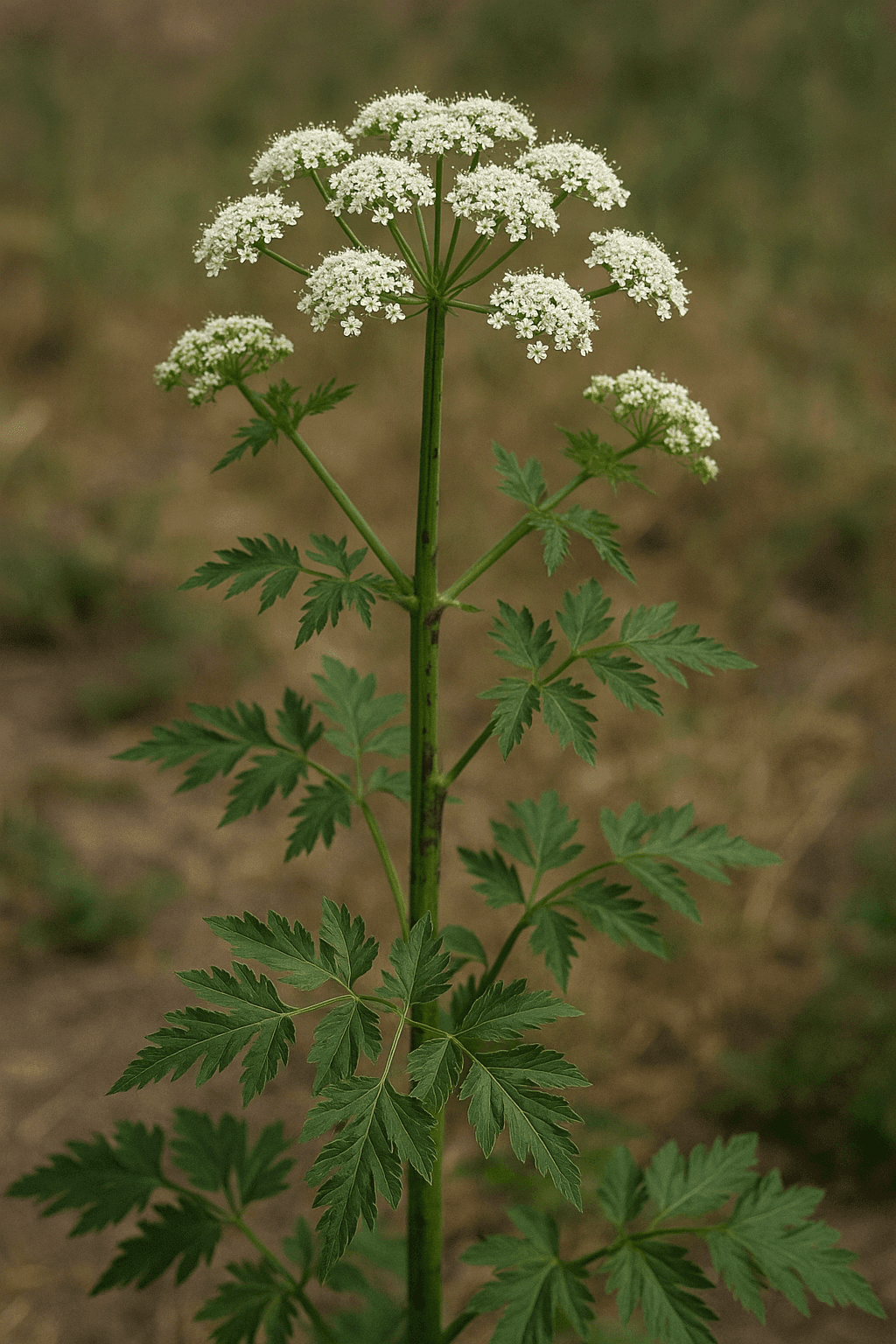
Baldıran
Realm | Plants | ||||||||
|---|---|---|---|---|---|---|---|---|---|
Branch | Vascular Plants | ||||||||
Class | Dicotyledons | ||||||||
Team(s) | Parsley | ||||||||
Family | Apiaceae | ||||||||
Genus | Conium | ||||||||
Specie(s) | Conium maculatum L. | ||||||||
Conium maculatum is a poisonous plant species belonging to the Apiaceae family, widely distributed across the world. It typically grows in clusters along roadways and near agricultural areas. All parts of the plant—including leaves, stem, flowers, and seeds—contain toxic piperidine alkaloids. These alkaloids exhibit neurotoxic effects that can be fatal to both humans and many animal species. In cases of poisoning, symptoms include initial excitation of the central nervous system followed by depression, paralysis, and respiratory failure. The toxicity of Conium maculatum poses serious risks to public health and livestock management.
Conium maculatum (Baldıran) is a biennial, herbaceous, and poisonous plant that can grow up to 1.5 to 2.5 meters in height. Its root system is typically taproot-type, penetrating deep into soil layers to provide firm anchorage. The stem is cylindrical, hollow, usually green in color, and marked with purplish spots; it grows upright. These spots are a characteristic feature used for identification.
The leaves are alternate and compound, consisting of several segments. The leaflets are narrow, elongated, and have serrated margins; the upper surface is dark green while the lower surface is paler. The leaf stalk is grooved and widens at the base to encircle the stem.
The flower structure is umbellate, composed of numerous small white flowers. The flowers are hermaphroditic, containing both male and female reproductive organs within each flower. Each flower typically has five sepals, five petals, and five stamens. The ovary is inferior, bicarpellary, and bilocular.
The fruit is a schizocarp, consisting of two separable segments (mericarps). Each mericarp has five prominent ridges running from top to bottom. The outer layer is composed of flat rectangular cells, while the middle layer consists of two to three rows of parenchymatous cells; it does not contain oil ducts. Vascular bundles are located beneath each ridge. The endosperm is outwardly protruding and compatible with seed development.
Overall, Conium maculatum exhibits typical characteristics of the Apiaceae family; however, it is distinguished by its toxic compounds and spotted stem. All parts of the plant, particularly the roots and fruits, contain high concentrations of alkaloids, making them extremely poisonous to humans and animals.
Conium maculatum has attracted attention throughout history for both its medicinal and toxicological properties due to its rich chemical composition. Chemical analyses of the plant have revealed the presence of numerous biologically active metabolites, including alkaloids, flavonoids, coumarins, polyacetylenes, vitamins, volatile oils, and fixed oils.
These compounds confer both therapeutic potential and high toxicity to the plant. Particularly noteworthy are the pharmacological effects of alkaloid fractions isolated from the above-ground parts. Experimental studies have demonstrated that these alkaloids exhibit significant anti-inflammatory activity in rats at doses of 10–20 mg/kg and produce both peripheral and central antinociceptive effects in mice. This suggests that Conium maculatum may have potential as an analgesic and anti-inflammatory agent at specific doses.
However, the narrow therapeutic window complicates safe use, as doses exceeding 20 mg/kg have been shown to be lethal in experimental animals. The pharmacological effects of the plant are primarily due to piperidine-derived alkaloids, especially coniine, coniceine, and γ-coniceine. These alkaloids exert depressant effects on the central nervous system and can cause respiratory paralysis and death at high doses. The toxicity of Conium maculatum is very high due to the presence of these alkaloids in all plant parts, including leaves, flowers, fruits, seeds, and roots.
Therefore, the plant poses a risk to both laboratory and livestock animals and constitutes a serious threat to human health. In conclusion, although Conium maculatum exhibits pharmacologically interesting effects, its high toxicity necessitates careful evaluation by experts regarding any potential medical use. The narrow margin between effective and lethal doses renders the use of this plant outside controlled conditions extremely hazardous.
Al-Snafi, Ali. “Pharmacology and Toxicology of Conium Maculatum – A Review.” The Pharmaceutical and Chemical Journal 3 (2016): 136–142. https://www.researchgate.net/publication/313744302_Pharmacology_and_Toxicology_of_Conium_Maculatum-A_Review.
Duran, Ahmet, Mustafa Çelik, and Özlem Çetin. “Morphological and Anatomical Studies on Conium maculatum (Apiaceae) from Turkey.” Conference: Symposium on Euroasian Biodiversity (SEAB), 2016. https://www.researchgate.net/publication/303836351_Morphological_and_anatomical_studies_on_Conium_maculatum_Apiaceae_from_Turkey.
López, T. A., M. S. Cid, and M. L. Bianchini. “Biochemistry of Hemlock (Conium maculatum L.) Alkaloids and Their Acute and Chronic Toxicity in Livestock: A Review.” Toxicon 37, no. 6 (June 1999): 841–865. https://doi.org/10.1016/s0041-0101(98)00204-9.
Vetter, János. “Poison Hemlock (Conium maculatum L.).” Food and Chemical Toxicology 42, no. 9 (September 2004): 1373–1382. https://doi.org/10.1016/j.fct.2004.04.009.

Baldıran
Realm | Plants | ||||||||
|---|---|---|---|---|---|---|---|---|---|
Branch | Vascular Plants | ||||||||
Class | Dicotyledons | ||||||||
Team(s) | Parsley | ||||||||
Family | Apiaceae | ||||||||
Genus | Conium | ||||||||
Specie(s) | Conium maculatum L. | ||||||||
No Discussion Added Yet
Start discussion for "Baldıran (Conium maculatum L.)" article
Morphological Characteristics
Pharmacological Composition and Toxicological Evaluation