


This article was automatically translated from the original Turkish version.
+1 More
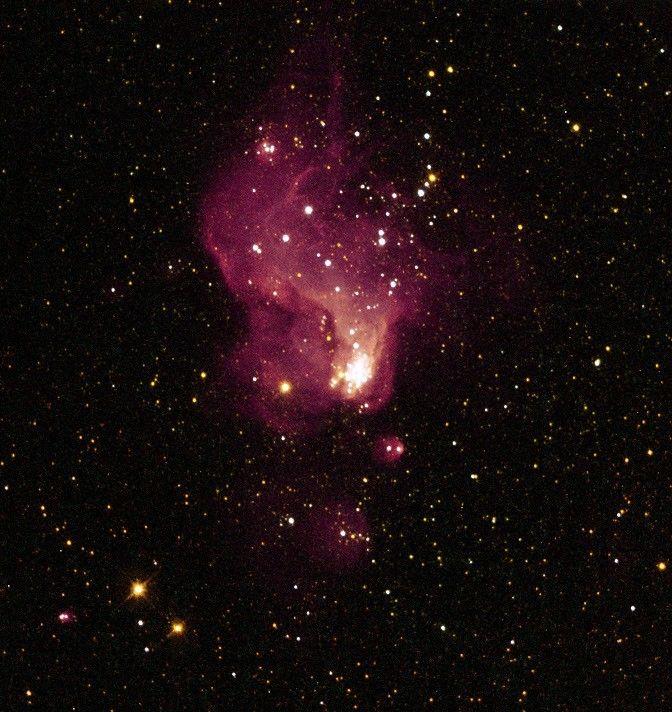
Barnard's Galaxy
Galaxy Type | Irregular Dwarf Galaxy | ||||||||
|---|---|---|---|---|---|---|---|---|---|
Constellation | Bow (Sagittarius) | ||||||||
Discovery(ies) | 1884 Edward Emerson Barnard | ||||||||
Distance(s) | ~1.6 Million Light Years | ||||||||
Diameter | ~7,000 Light Years | ||||||||
Mass | ~1–2 Billion Solar Masses | ||||||||
Apparent Brightness | +9.3 Magnitude | ||||||||
NGC 6822, commonly known as Barnard’s Galaxy, is one of the irregular dwarf galaxies belonging to the Local Group. Discovered in 1884 by American astronomer Edward Emerson Barnard, this celestial object is a low-mass and low-luminosity system, unlike the larger members of the Local Group such as Andromeda and Triangulum. Due to its relative proximity to the Milky Way and its structural characteristics, NGC 6822 holds potential for shedding light on the early stages of galaxy formation and evolution in the universe.

NGC 6822 visualized with artificial intelligence.
NGC 6822 is located in the constellation Sagittarius at a distance of approximately 1.6 million light years (490 kiloparsecs). Its position makes it an accessible target for both amateur and professional observations from Earth. With a visual magnitude of approximately m=9.3, it can be observed with small telescopes under dark sky conditions.
NGC 6822 is classified morphologically as an irregular dwarf galaxy (type IB(s)m). This classification indicates that the galaxy lacks prominent spiral arms or an elliptical shape. Its angular size is approximately 7.7 x 6.1 arcminutes, covering an area about one-third the apparent diameter of the full Moon. Its physical diameter is roughly 7,000 light years, making it significantly smaller than the Milky Way.
NGC 6822 contains a large amount of neutral hydrogen gas (H I). Radio telescope observations have shown that this gas extends beyond the galactic disk and plays a significant role in shaping its irregular structure. This feature is a key factor influencing the density and distribution of star-forming regions within the galaxy.
Barnard’s Galaxy hosts both old stellar populations and active star-forming regions. Particularly rich in H II regions, NGC 6822 contains ionized gas clouds shaped by the influence of young, hot stars. The most prominent of these regions is known as Hubble V, identified by Edwin Hubble in 1925 and recognized as one of the galaxy’s most active stellar nurseries.
Various types of stars exhibiting different evolutionary stages have been detected in the galaxy, including red supergiants, blue supergiants, asymptotic giant branch stars (AGB), and carbon stars. These stars provide insights into the chemical evolution of the galaxy, with its low-metallicity stars offering data relevant to the early universe.
NGC 6822 is a low-metallicity galaxy. This indicates that it has experienced relatively few supernova events and has limited production of heavy elements. Metallicity values are determined using stellar spectra and emission lines from H II regions.
Data indicate that the metal abundance in the galaxy is between approximately 1/5 and 1/10 of the Sun’s metallicity. This makes NGC 6822 an ideal target for studying star formation processes under conditions similar to those of the early universe.
Spectroscopic observations of the galaxy’s stars and gas have revealed that NGC 6822 exhibits rotational motion. However, this rotation is not as regular or pronounced as in large disk galaxies. The distribution of neutral hydrogen gas suggests complex internal dynamics and possible past interactions with other galaxies.
NGC 6822 is one of the low-mass members of the Local Group and is not gravitationally bound to the Milky Way. However, theories suggest it may have interacted with other low-mass systems in the past. Such galaxies are cosmologically important as they represent the building blocks of larger galaxy formations. Additionally, the gas dynamics and star formation processes in low-mass galaxies provide an observational basis for testing models of galaxy evolution.
NGC 6822 holds an important place in the history of astronomy. In particular, Edwin Hubble’s work in the 1920s used this galaxy to develop arguments against the prevailing view of the time that “the Milky Way constitutes the entire universe.”
Hubble measured the distance to NGC 6822 using Cepheid variable stars, providing scientific evidence that galaxies exist beyond the Milky Way. These observations marked a pivotal turning point in establishing the foundations of modern cosmology.
Due to its irregular morphology, low metallicity, active star-forming regions, and relative proximity, NGC 6822 has been frequently studied in astronomical research. Its contributions to both observational and theoretical studies provide critical data on the evolution of small-scale galaxies and the formation of cosmic structures. The system discovered by Edward Barnard has played a significant role in astrophysical research for over a century.
European Space Agency (ESA). "Euclid’s View of Irregular Galaxy NGC 6822." ESA - Science & Exploration, March 28, 2024. Accessed May 10, 2025. https://www.esa.int/Science_Exploration/Space_Science/Euclid/Euclid_s_view_of_irregular_galaxy_NGC_6822.
NASA. "A Giant Star Factory in Neighboring Galaxy NGC 6822." NASA Science, August 25, 2023. Accessed May 10, 2025. https://science.nasa.gov/asset/hubble/a-giant-star-factory-in-neighboring-galaxy-ngc-6822/.
NASA. "Caldwell 57." NASA Science – Hubble Caldwell Catalog. Accessed May 10, 2025. https://science.nasa.gov/mission/hubble/science/explore-the-night-sky/hubble-caldwell-catalog/caldwell-57/.
NASA. "X Marks the Spot: Hubble Sees the Glow of Star Formation in a Neighbor Galaxy." NASA Science – Hubble Missions. Accessed May 10, 2025. https://science.nasa.gov/missions/hubble/x-marks-the-spot-hubble-sees-the-glow-of-star-formation-in-a-neighbor-galaxy/.

Barnard's Galaxy
Galaxy Type | Irregular Dwarf Galaxy | ||||||||
|---|---|---|---|---|---|---|---|---|---|
Constellation | Bow (Sagittarius) | ||||||||
Discovery(ies) | 1884 Edward Emerson Barnard | ||||||||
Distance(s) | ~1.6 Million Light Years | ||||||||
Diameter | ~7,000 Light Years | ||||||||
Mass | ~1–2 Billion Solar Masses | ||||||||
Apparent Brightness | +9.3 Magnitude | ||||||||
Location and Observability
Morphological Features and Structure
Stellar Population and Star Formation
Chemical Composition and Metallicity
Kinematic Properties and Dynamics
Position within the Local Group and Evolutionary Significance
Observational History and Scientific Research