
This article was automatically translated from the original Turkish version.
+2 More
The Basara method is a syllable-based reading and writing instruction approach designed for students who experience difficulties in early literacy. Instruction begins with vowels; consonants are then introduced, each combined with the vowel "a" and presented in a specific sequence as syllables. The method is also known as the "Basara method" and the "BA method."
The method was developed by special education expert Dr. H. Nedim Kulaksız.【1】 In Türkiye, reading and writing instruction has been conducted using the sentence method since the 1968 curriculum. The Ministry of National Education piloted a new primary education program during the 2004-2005 academic year and implemented it nationwide from the 2005-2006 academic year onward, shifting to a sound-based sentence approach.【2】
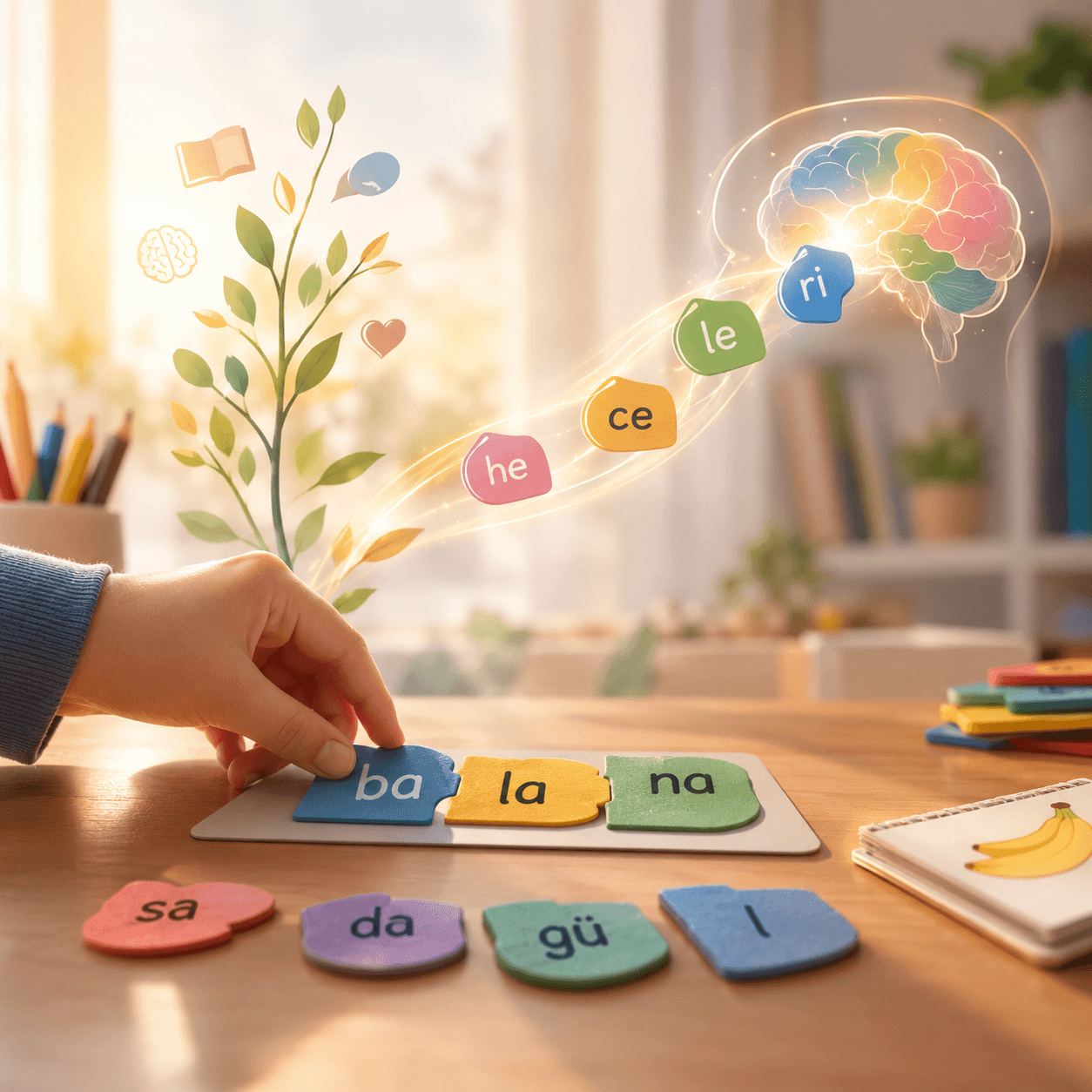
Basara yöntemini Temsil Eden Görsel (Yapay Zeka İle Oluşturulmuştur)
This program was approved by the Council of Education and Instruction on 12 July 2004 with decision number 115.【3】 In the sound-based sentence method, instruction begins with individual sounds; after introducing several sounds, students progress from sounds to syllables, syllables to words, and words to sentences.【4】
Starting from the 2017-2018 academic year, this approach was replaced by the "sound-based early reading and writing instruction" approach, in which sound/letter groups were reduced to five, and instruction was permitted to be delivered using either upright or cursive letter forms.【5】
In sound-based instruction, the most challenging stage for students is syllable formation. In a study involving 332 classroom teachers in Istanbul who taught reading and writing using this method, 26.6 percent of teachers reported that students struggled most at this stage; similarly, 33.3 percent identified syllable formation as the stage where struggling students showed the greatest deficiency.【6】
In the same study, 80.6 percent of teachers indicated that, by the end of the process, an average of one to three students in their classes failed to achieve the required competencies.【7】
In sound-based instruction, consonants are pronounced without adding a vowel; however, some parents unfamiliar with this principle may add vowels to consonants at home, leading to confusion in children.【8】 Due to these challenges, it is recommended that the syllable formation stage be carried out more carefully, slowly, and individually.【9】
A similar need exists in special education. Since there is no reading and writing instruction method specifically designed for children with intellectual disabilities in Türkiye, methods developed for typically developing children are often applied unchanged or adapted for these children.【10】
Among the drawbacks of the sound-based sentence method are that working with letters and sounds may seem meaningless to children, children who sound out words letter by letter often forget the initial sounds by the time they reach the final letter, and difficulties arise in blending sounds together.【11】
Beginning instruction with abstract concepts such as sounds and letters, combined with the limited phonological awareness and phonological memory observed in children with intellectual disabilities, and the rigid, uniform sequence of letter group instruction, are among the reasons why this method is considered unsuitable for these children.【12】 Therefore, there is a need for alternative instructional methods sensitive to the structural features of the Turkish language.【13】
Some students in sound-based instruction experience difficulty understanding and pronouncing consonants; this can hinder their ability to grasp the logic of sound blending. The Basara method offers an alternative pathway for students who cannot learn to read using this approach. The goal of the method is to help students who cannot pronounce consonants alone or blend sounds together overcome this difficulty.【14】
Turkish has a transparent writing system in which each letter corresponds to a single sound. As a result, Turkish readers can perceive syllables constructed in various forms more easily than readers of opaque writing systems.
In Turkish, syllables are formed in six structural patterns based on the number and position of sounds: vowel (V), vowel-consonant (VC), vowel-consonant-consonant (VCC), consonant-vowel (CV), consonant-vowel-consonant (CVC), and consonant-vowel-consonant-consonant (CVCC).【15】
Syllable awareness is one of the most important predictors of word reading performance among students learning to read in a transparent writing system. This finding was established in a study involving 90 second-grade students.【16】 In the same study, students with sufficient syllable awareness processed real words and pseudowords with fewer errors; a meaningful difference in response time was observed only for real words.【17】
For students experiencing difficulty in word decoding, it is recommended to assess their level of syllable awareness, demonstrate how words are composed of different syllable combinations, and provide frequent practice with various syllable types.【18】
In this method, the next syllable is not introduced until the current one is fully mastered. Syllables are taught as single units: when reading the syllable "ba," the letters "b" and "a" are not pronounced separately, and students are not asked to combine them. Instruction does not proceed to other syllables formed with the same consonant and different vowels ("be," "bi," "bu") or to syllables beginning with vowels ("eb," "ab") until the initial syllable is fully understood. The method is completed in 41 lessons, with lesson durations adjusted according to the student’s learning pace.【19】 Previous lessons are regularly reviewed to prevent forgetting.
Teaching Vowels: Instruction begins with the eight vowels (a, e, ı, i, o, ö, u, ü). Each vowel is associated with a visual image; for example, "a" may be linked to a bee and "e" to a donkey. The image is displayed in a visible location in the classroom, and students do not proceed to syllables until they have mastered the vowels.【20】
Syllables with "a": Consonants are introduced in the following sequence with "a": ba-sa-ra-ma-ka-ça-ta-na-ya-ha-pa-şa-za-la-va-dı-ca-fa-ga-ja-ğa. Since "b" and "d" are frequently confused, the sixteenth lesson introduces "dı" instead of "da." Once a syllable is learned, it is combined with previously learned vowels to form words such as "oba," "aba," "baba," and simple sentences like "Baba o oba."【21】
Imperative Forms: Between the second and fifth lessons, each syllable is paired with an imperative verb: "sa" with "bak" (look), "ra" with "gel" (come), "ma" with "ver" (give), and "ka" with "al" (take). Students use these imperatives to form meaningful sentences such as "İsa bak o asa" (İsa, look at that stick) and "Baba gel" (Father, come).
Transition to Other Vowels and Closed Syllables: After mastering all syllables with "a," consonants are combined with other vowels. First, the consonant "r" is introduced in the forms ra, re, rı, ri, ro, rö, ru, rü. Then, "r" is practiced at the end of previously learned syllables (kar, sar, yar), between two syllables (karar, yarar, sarar), and at the end of vowels (er, ar, ır, ir, or, ör, ur, ür); priority is given to meaningful words during this stage. Other consonants are introduced in the following order: r-k-ç-t-s-h-ş-y-z-m-d-l-b-n-v-p-j-c-g-f-ğ.【22】

Basara Yöntemini Temsil Eden Görsel (Yapay Zeka İle Oluşturulmuştur)
Storytelling: Syllables are taught using images or stories that trigger associations in the student. For example, the syllable "ba" may be linked to a picture of a father and "ya" to a picture of a collar. The image does not need to have a logical connection to the syllable; it only needs to aid recall. The teacher may also create a story related to the student’s life. Pictures are used for students with strong visual memory, while stories are used for those with strong verbal memory. During lessons, students also write the learned syllables, words, and sentences in their notebooks.【23】
The effectiveness of the method was examined in an action research study conducted during the second term of the 2021-2022 academic year. The participant was a third-grade primary school student with specific learning difficulties and attention deficit who had failed to acquire reading and writing skills using the sound-based method.【24】
The intervention lasted one term, with eight hours of instruction per week, and all lessons were delivered using the Basara method.【25】 The student was largely unable to attend live classes during the first and second grades due to school closures during the coronavirus pandemic and experiences difficulty with Turkish expression as he grew up in a family that speaks Kurdish.【26】
By the end of the intervention, the number of lowercase letters the student recognized increased from five to twenty-seven, and the number of uppercase letters increased from nine to twenty-six. The student, who could not read any words at the start of the study, began reading simple words, although not yet at the desired level.【27】 Since the student could not read, comprehension was assessed through questions about sentences read aloud to him; the number of incorrect answers decreased from seven to five out of twenty-four questions.【28】
In dictation tasks, the student was able to write only one word correctly; this result is explained by the limited duration of the intervention and the emphasis placed on reading during the activities.【29】 The student’s tendency to add a vowel after certain consonants was linked to the method’s instruction to pronounce letters as if "a" were present, and this was considered an expected error.【30】 It was noted that a longer implementation period is required for full mastery of reading and writing.【31】
Another syllable-based approach, the Digital Technology-Supported Sound-Based Syllable Instruction Method, also begins with vowels and proceeds to hard (p, ç, t, k, f, s, ş, h) and soft consonants. New syllables, words, and sentences are created by adding sounds to the beginning and end of syllables.【32】
Digital tools are used in each of the five stages of this method; the application groups and steps differ from both the sound-based sentence method and the sound-based reading and writing instruction method.【33】
The key difference between the two methods lies in how syllables are presented: in the Basara method, consonants are introduced first only with "a" and in a fixed sequence, whereas in the digital-supported method, sounds are added to the beginning and end of syllables from the very first stage to generate words.【34】
The digital-supported method was applied to a six-year-old child over twelve weeks during the 2017-2018 academic year; both the teacher implementing the method and the child’s mother evaluated it positively.【35】
A hybrid reading and writing instruction method, developed based on a literature review for children with intellectual disabilities, consists of stages including building a visual vocabulary, teaching letter knowledge, reading single-syllable words, and reading multi-syllable words.【36】
In this method, sound clusters—units smaller than syllables but larger than individual letters—are taught as whole units; for example, after recognizing the cluster "-il," students can read words such as "fil," "dil," and "pil." Teaching sound clusters as wholes reduces difficulties in blending sounds during word reading.
The Basara method also teaches consonants and vowels together as syllabic units without separating them; however, while the instructional unit in Basara is the open syllable formed with "a," in the hybrid method it is the sound cluster. The suitability of the hybrid method’s stages and overall structure for Turkish and for children with intellectual disabilities requires scientific validation.【37】
The literature on the Basara method is very limited, making it difficult to compare the method with other approaches.【31】 The action research examining the method’s effectiveness was conducted with a single participant and without a control group. Experimental studies comparing student groups taught with different methods are recommended for the digital-supported syllable instruction method.【38】
Akçin, F. Nur. "Zihinsel Yetersizliği Olan Çocuklar İçin Hibrit Okuma-Yazma Öğretim Yöntemi." *Ankara Üniversitesi Eğitim Bilimleri Fakültesi Özel Eğitim Dergisi* 20/1 (2019): 177–208. Accessed October 23, 2026.https://doi.org/10.21565/ozelegitimdergisi.413092
Bağaç, Mahmut, Emin Kaya, Ayşe Mine İlhan, and Ramazan Aslan. "Ses Temelli Yöntemle Okuma Yazma Öğrenemeyen Öğrenciye Basara Yönteminin Uygulanması." *Journal of Current Debates in Social Sciences* 8/1 (2025): 51–71. Accessed October 23, 2026.https://doi.org/10.29228/cudes.79919
Deliveli, Kısmet. "Dijital Teknoloji Destekli Ses Tabanlı Hece Öğretim Yöntemi ile Okuma Yazmanın Öğretilmesi (Vaka Çalışması)." *Journal of Computer and Education Research* 10/19 (2022): 103–136. Accessed October 23, 2026.https://doi.org/10.18009/jcer.1026440
Güldenoğlu, Birkan. "The Effects of Syllable-Awareness Skills on the Word-Reading Performances of Students Reading in a Transparent Orthography." *International Electronic Journal of Elementary Education* 8, no. 3 (2016): 425–442. Accessed October 23, 2026.https://iejee.com/index.php/IEJEE/article/download/123/120
Sağırlı, Muhittin. "Ses Temelli Cümle Yönteminin İlk Okuma-Yazma Öğretimi Üzerindeki Başarısının Öğretmen Açısından Değerlendirilmesi." *OPUS Uluslararası Toplum Araştırmaları Dergisi* 13/19 (2019): 852–883. Accessed October 23, 2026.https://doi.org/10.26466/opus.596841
【1】
Mahmut Bağaç vd., "Ses Temelli Yöntemle Okuma Yazma Öğrenemeyen Öğrenciye Basara Yönteminin Uygulanması," Journal of Current Debates in Social Sciences 8/1 (2025), 53, erişim 23 Ekim 2026, https://doi.org/10.29228/cudes.79919
【2】
Muhittin Sağırlı, "Ses Temelli Cümle Yönteminin İlk Okuma-Yazma Öğretimi Üzerindeki Başarısının Öğretmen Açısından Değerlendirilmesi," OPUS Uluslararası Toplum Araştırmaları Dergisi 13/19 (2019), 856, erişim 23 Ekim 2026, https://doi.org/10.26466/opus.596841
【3】
Bağaç vd., "Basara Yönteminin Uygulanması," 52.
【4】
Sağırlı, "Ses Temelli Cümle Yönteminin Başarısı," 856.
【5】
Sağırlı, "Ses Temelli Cümle Yönteminin Başarısı," 857–858.
【6】
Sağırlı, "Ses Temelli Cümle Yönteminin Başarısı," 859, 864.
【7】
Sağırlı, "Ses Temelli Cümle Yönteminin Başarısı," 864.
【8】
Sağırlı, "Ses Temelli Cümle Yönteminin Başarısı," 874.
【9】
Sağırlı, "Ses Temelli Cümle Yönteminin Başarısı," 876.
【10】
F. Nur Akçin, "Zihinsel Yetersizliği Olan Çocuklar İçin Hibrit Okuma-Yazma Öğretim Yöntemi," Ankara Üniversitesi Eğitim Bilimleri Fakültesi Özel Eğitim Dergisi 20/1 (2019), 177, 179, erişim 23 Ekim 2026, https://doi.org/10.21565/ozelegitimdergisi.413092https://doi.org/10.21565/ozelegitimdergisi.413092
【11】
Akçin, "Hibrit Okuma-Yazma Öğretim Yöntemi," 179.
【12】
Akçin, "Hibrit Okuma-Yazma Öğretim Yöntemi," 180.
【13】
Akçin, "Hibrit Okuma-Yazma Öğretim Yöntemi," 181.
【14】
Bağaç vd., "Basara Yönteminin Uygulanması," 57–58.
【15】
Birkan Güldenoğlu, "The Effects of Syllable-Awareness Skills on the Word-Reading Performances of Students Reading in a Transparent Orthography," International Electronic Journal of Elementary Education 8/3 (2016), 427, erişim 23 Ekim 2026, https://iejee.com/index.php/IEJEE/article/download/123/120
【16】
Güldenoğlu, "Effects of Syllable-Awareness Skills," 425.
【17】
Güldenoğlu, "Effects of Syllable-Awareness Skills," 434–435.
【18】
Güldenoğlu, "Effects of Syllable-Awareness Skills," 438.
【19】
Bağaç vd., "Basara Yönteminin Uygulanması," 55-56.
【20】
Bağaç vd., "Basara Yönteminin Uygulanması," 55.
【21】
Bağaç vd., "Basara Yönteminin Uygulanması," 56.
【22】
Bağaç vd., "Basara Yönteminin Uygulanması," 54-55.
【23】
Bağaç vd., "Basara Yönteminin Uygulanması," 56–57.
【24】
Bağaç vd., "Basara Yönteminin Uygulanması," 51, 57–58
【25】
Bağaç vd., "Basara Yönteminin Uygulanması," 64.
【26】
Bağaç vd., "Basara Yönteminin Uygulanması," 60–61.
【27】
Bağaç vd., "Basara Yönteminin Uygulanması," 69.
【28】
Bağaç vd., "Basara Yönteminin Uygulanması," 64, 69–70.
【29】
Bağaç vd., "Basara Yönteminin Uygulanması," 68, 70.
【30】
Bağaç vd., "Basara Yönteminin Uygulanması," 65.
【31】
Bağaç vd., "Basara Yönteminin Uygulanması," 70.
【32】
Kısmet Deliveli, "Dijital Teknoloji Destekli Ses Tabanlı Hece Öğretim Yöntemi ile Okuma Yazmanın Öğretilmesi (Vaka Çalışması)," Journal of Computer and Education Research 10/19 (2022), 111, erişim 23 Ekim 2026, https://doi.org/10.18009/jcer.1026440
【33】
Deliveli, "Ses Tabanlı Hece Öğretim Yöntemi," 114.
【34】
Bağaç vd., "Basara Yönteminin Uygulanması," 53–54; Deliveli, "Ses Tabanlı Hece Öğretim Yöntemi," 117.
【35】
Deliveli, "Ses Tabanlı Hece Öğretim Yöntemi," 112–113,128.
【36】
Akçin, "Hibrit Okuma-Yazma Öğretim Yöntemi," 182.
【37】
Akçin, "Hibrit Okuma-Yazma Öğretim Yöntemi," 190.
【38】
Deliveli, "Ses Tabanlı Hece Öğretim Yöntemi," 133.

Origin and Rationale
Theoretical Background
Core Principles
Implementation Stages
Research Findings
Relationship to Other Syllable-Based Approaches
Limitations