

This article was automatically translated from the original Turkish version.
+1 More
Bat Flower (Tacca chantrieri)
Team(s) | Dioscoreales | ||||||||
|---|---|---|---|---|---|---|---|---|---|
Family | Dioscoreaceae | ||||||||
Specie(s) | Tacca chantrieri | ||||||||
Natural Range | South China Malaysia (Malay Peninsula) Thailand Vietnam | ||||||||
Phytochemical Content | saponins triterpenoids steroid-based compounds phenolic compounds Flavonoids | ||||||||
Genus | Tacca | ||||||||
Class | Liliopsida (Monocots) | ||||||||
Bat Flower (Tacca chantrieri) is a perennial plant species belonging to the Dioscoreaceae family, commonly known as Bat Flower, Devil Flower or Cat’s Whiskers. This species has extensive use in traditional Chinese medicine and local healing practices of Southeast Asia and holds significant importance in both horticulture and biomedical research due to its unique morphology and bioactive compounds. Taxonomically, it is classified within the Dioscoreaceae family, though historical literature has also placed it under the family Taccaceae.
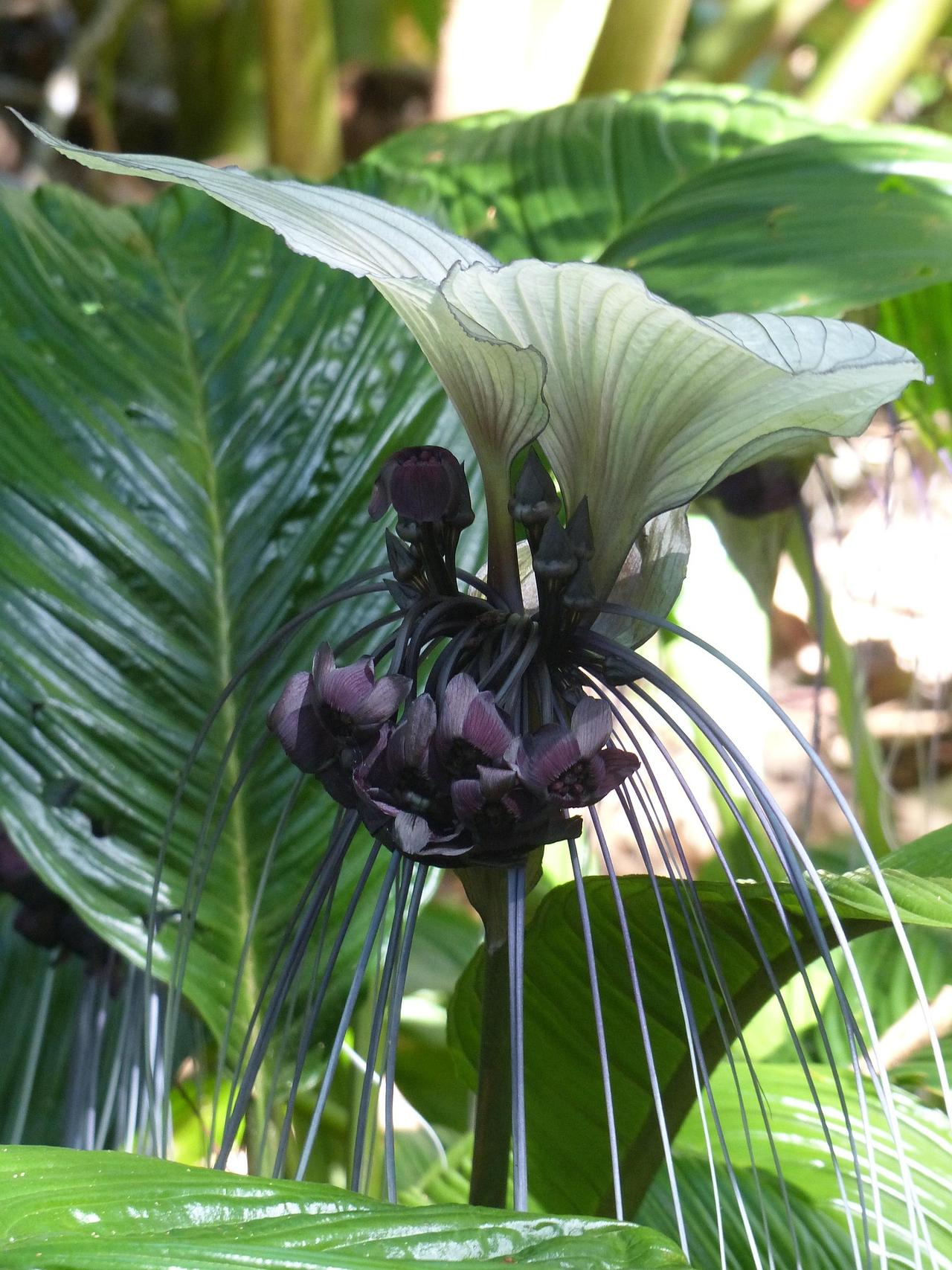
Tacca chantrieri typically reaches a height of 50 to 100 cm and possesses a rhizomatous or creeping tuberous structure. Its leaf morphology is characterized by long-petioled, undivided, broad elliptical leaves with a glossy olive-green color; these leaves can grow up to 45 cm in length and 25 cm in width. The most distinctive feature of the plant is its dramatic inflorescence structure composed of actinomorphic flowers that visually resemble a bat. This structure consists of two pairs of broad, wing-like bracts in dark purple or burgundy-black tones, reaching up to 50 cm in width. The inflorescence is accompanied by filamentous bracteoles that hang downward laterally and are referred to as “whiskers,” extending up to 15 inches in length. The hermaphroditic flowers contain six stamens and a single pistil; after fertilization, these structures develop into ovoid, purplish-brown fruits and kidney-shaped seeds.

Bat Flower (Pixabay)
The species is distributed across tropical regions of Southeast Asia, particularly in Vietnam, Thailand, the Malay Peninsula and southern China. Ecologically, it thrives in the moist, shaded understory layers of tropical forests, commonly found along waterways, riverbeds and steep slopes. In its natural habitats, the plant adapts to various soil types including humus, sand and limestone; it is typically found at elevations between 100 and 1400 meters, though in extreme cases it has been recorded at altitudes up to 2100 meters above sea level.

Geographical Distribution of the Bat Flower (Generated by Artificial Intelligence)
Tacca chantrieri has a reproductive system that, despite its showy and pollinator-attracting complex floral structures, is predominantly based on autonomous self-pollination. Genetic studies have revealed low levels of genetic diversity within populations but high levels of genetic differentiation between populations.
This genetic structure indicates limited gene flow among populations and demonstrates the significant influence of genetic drift on population structure. Geographically, populations are divided into two main groups along the Tanaka Line; this pattern reflects the impact of the region’s geological and biogeographical history on the evolutionary divergence of the species.

Reproductive Cycle of the Bat Flower (Generated by Artificial Intelligence)
All parts of the plant, particularly the rhizomes, possess a rich phytochemical profile. Key active compounds include phenolics, flavonoids, ascorbic acid and high concentrations of saponins. Phytochemical analyses have identified the presence of compounds such as 1-heptadecanol, quinesterol, stearamide and spiroxamine. Additionally, eleven novel withanolides named chantriolide and various diarylheptanoid glycosides have been isolated from the plant, exhibiting anti-inflammatory and hepatoprotective effects.【1】
Tacca chantrieri has been the subject of modern biomedical research, which has demonstrated its broad therapeutic spectrum.
Plant extracts have been observed to alleviate pain through both peripheral and central mechanisms via a non-opioid pathway. Its anti-inflammatory activity has been linked to inhibition of cyclooxygenase-2 enzyme and suppression of prostaglandin biosynthesis.
Withanolides extracted from the rhizomes have been found to protect hepatocytes against oxidative damage by activating the Nrf2 pathway and increasing cellular glutathione levels. The plant also exhibits strong antioxidant capacity through neutralization of free radicals.
The saponin content of the plant demonstrates significant hypotensive and bradycardic effects in normotensive models. Neuroprotective studies suggest that extracts may improve cognitive function by reducing neuroinflammation.
Extracts exhibit antibacterial activity against bacteria such as Staphylococcus aureus and Aeromonas hydrophila, and show significantly stronger antifungal activity against dermatophytes such as Trichophyton rubrum.【2】
Historically, the rhizomes of the plant have been used in traditional Chinese medicine to treat hypertension, peptic ulcers, skin burns, hepatitis and gastric disorders. In Southeast Asia, they have been recorded as remedies for body pain, as an antidote for food poisoning and as a digestive tonic for diarrhea. Modern studies have confirmed that many of these traditional uses are scientifically consistent with the plant’s phytochemical constituents.
Warning: The content in this article is provided solely for general encyclopedic informational purposes. The information presented here must not be used for diagnosis, treatment or medical advice. Always consult a qualified healthcare professional before making any health-related decisions. The author and KÜRE Encyclopedia assume no responsibility for any consequences arising from the use of this information for diagnostic or therapeutic purposes.
Arunkumar, R., H. Abdul Kaffoor, S. Vimal Priya, and H. L. Jemimma. “Nesli Tehlikeli Altında Olan Tıbbi Bitki Tacca chantrieri’nin (Dioscoreaceae) Çok Yönlü Terapötik Potansiyelinin İncelenmesi: Fitokimyasal Bileşimi ve Farmakolojik Aktivitelere İlişkin Bilgiler.” Ayurveda ve Bitkisel Tıp Dergisi 10, no. 4 (October–December 2024): 107–112. Accessed February 17, 2026. https://doi.org/10.4103/JAHM.JAHM_3_24
Boom, John. “Tacca chantrieri.” Pixabay. Accessed February 17, 2026. https://pixabay.com/photos/wildflower-bat-flower-floral-plant-288223/
Foto-RaBe. “Tacca chantrieri.” Pixabay. Accessed February 17, 2026. https://pixabay.com/photos/tacca-black-orchid-orchid-flower-805696/
Keardrit, Kittipong, Chaiyong Rujjanawate, and Duangporn Amornlerdpison. “Analgesic, Antipyretic and Anti-Inflammatory Effects of Tacca chantrieri Andre.” Journal of Medicinal Plants Research 4, no. 19 (October 4, 2010): 1991–1995. Accessed February 17, 2026. https://academicjournals.org/journal/JMPR/article-abstract/747B55815754
Sudtiyanwimon, Suchada, Wirat Niwatananun, Songwut Yotsawimonwat, and Siriporn Okonogi. “Phytochemical and Biological Activities of Tacca chantrieri.” Journal of Metals, Materials and Minerals 20, no. 3 (2010): 179–183. Accessed February 17, 2026. https://d1wqtxts1xzle7.cloudfront.net/34202930/179-183_SUDTIYANWIMON-libre.pdf
Zhang, L., Q. J. Li, H. T. Li, J. Chen, and D. Z. Li. “Genetic Diversity and Geographic Differentiation in Tacca chantrieri (Taccaceae): An Autonomous Selfing Plant with Showy Floral Display.” Annals of Botany 98, no. 2 (2006): 449–457. Accessed February 17, 2026. https://www.ncbi.nlm.nih.gov/pmc/articles/PMC2803468/
[1]
Arunkumar, R., H. Abdul Kaffoor, S. Vimal Priya and H. L. Jemimma. “Investigating the Multifaceted Therapeutic Potential of the Endangered Medicinal Plant Tacca chantrieri (Dioscoreaceae): Phytochemical Composition and Pharmacological Activities.” Journal of Ayurveda and Herbal Medicine 10, no. 4 (October–December 2024): 107–112. Accessed 17 February 2026. https://doi.org/10.4103/JAHM.JAHM_3_24
[2]
Arunkumar, R., H. Abdul Kaffoor, S. Vimal Priya and H. L. Jemimma. “Investigating the Multifaceted Therapeutic Potential of the Endangered Medicinal Plant Tacca chantrieri (Dioscoreaceae): Phytochemical Composition and Pharmacological Activities.” Journal of Ayurveda and Herbal Medicine 10, no. 4 (October–December 2024): 107–112. Accessed 17 February 2026. https://doi.org/10.4103/JAHM.JAHM_3_24

Bat Flower (Tacca chantrieri)
Team(s) | Dioscoreales | ||||||||
|---|---|---|---|---|---|---|---|---|---|
Family | Dioscoreaceae | ||||||||
Specie(s) | Tacca chantrieri | ||||||||
Natural Range | South China Malaysia (Malay Peninsula) Thailand Vietnam | ||||||||
Phytochemical Content | saponins triterpenoids steroid-based compounds phenolic compounds Flavonoids | ||||||||
Genus | Tacca | ||||||||
Class | Liliopsida (Monocots) | ||||||||
No Discussion Added Yet
Start discussion for "Bat Flower (Tacca chantrieri)" article
Morphological Characterization and Botanical Structure
Ecological Distribution and Habitat Characteristics
Reproductive Biology and Population Genetics
Phytochemical Composition
Pharmacological Activities and Therapeutic Potential
Analgesic and Anti-inflammatory Effects
Hepatoprotective and Antioxidant Properties
Cardiovascular and Neuroprotective Effects
Antimicrobial Activity
Traditional Medical Applications