


This article was automatically translated from the original Turkish version.
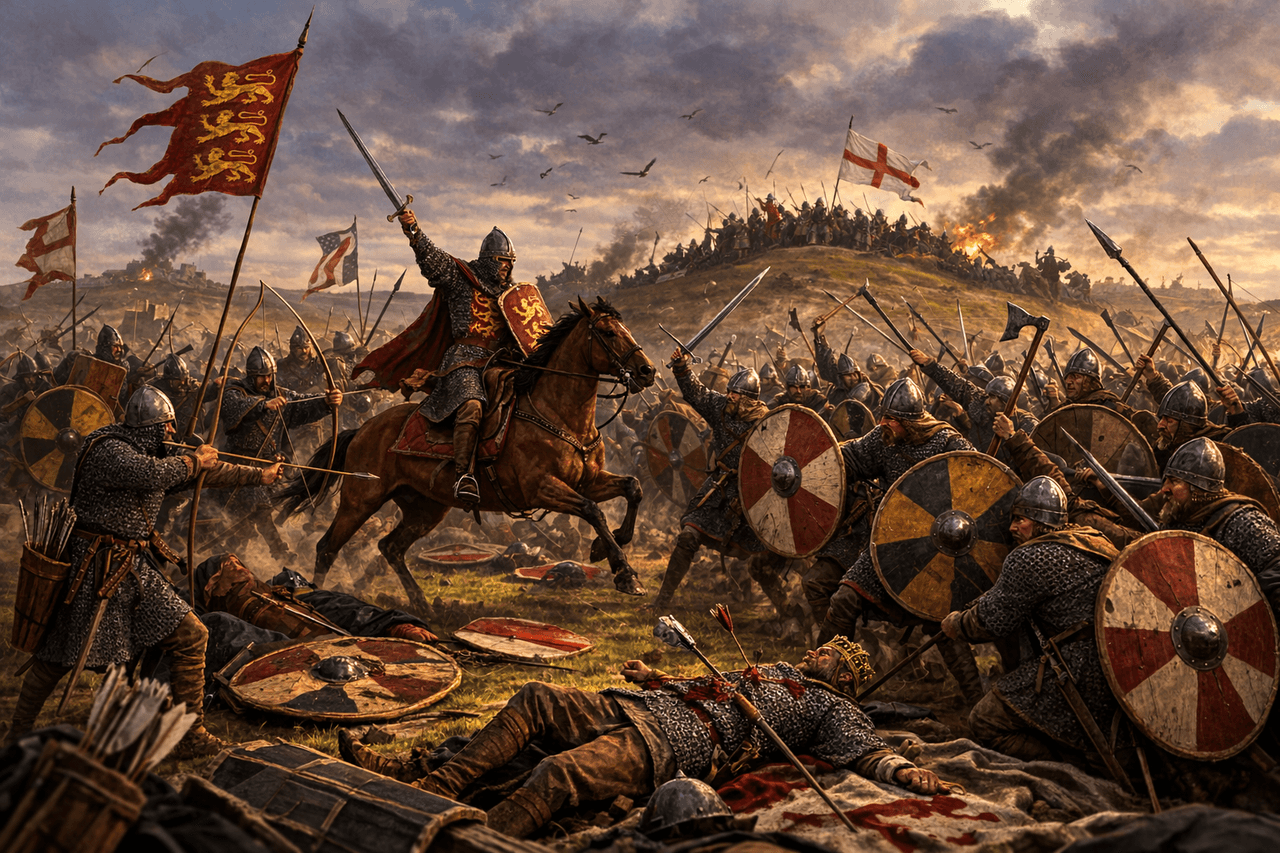
Battle of Hastings (generated by artificial intelligence)
Place(s) | Near Hastings | ||||||||
|---|---|---|---|---|---|---|---|---|---|
Date(s) | 14 October 1066 | ||||||||
Commanders | Harold Godwinson (King of England) William the Conqueror (Duke of Normandy) | ||||||||
Parties | Anglo-Saxon forces Norman forces | ||||||||
Battle of Hastings was a battle fought on 14 October 1066 between the Norman forces commanded by Duke William of Normandy and the Anglo-Saxon army led by King Harold II of England (Harold Godwinson), as part of the struggle for control of the English throne. The battle took place near Hastings in the Sussex region of England and ended in a Norman victory, paving the way for the establishment of Norman dominance in England. This conflict is generally regarded in historical scholarship as the defining turning point of the Norman Conquest.【1】
The year 1066 began in England with a succession crisis. King Edward the Confessor died on 5 January 1066 without leaving an heir. The resulting vacancy on the throne prompted various nobles and claimants to assert their rights to the English crown. On the same day, one of England’s leading nobles, Harold Godwinson, was proclaimed king by the Witan, a council of advisors, and ascended the throne. However, Harold’s accession was not accepted by other contenders who had previously claimed the English throne.【2】
Duke William of Normandy declared Harold’s kingship illegitimate, asserting that the English throne had been promised to him by Edward the Confessor. William claimed that Harold Godwinson had sworn an oath of loyalty to him during a visit to Normandy, thereby confirming his claim. On this basis, William began preparations for a military expedition to England. Ships were constructed in Normandy, troops and war supplies were gathered, and warriors from various regions joined the Norman army.
England faced multiple military threats within the same year. King Harald Hardrada of Norway launched a large invasion force into northern England, asserting his own claim to the throne. Harold Godwinson marched north and defeated the Norwegian army at the Battle of Stamford Bridge on 25 September 1066. This battle ended the Norwegian invasion, but the English army had just endured a grueling march and fierce combat.【3】
Following these events, Duke William’s army landed on the southern coast of England on 28 September 1066 and came ashore in Sussex. The Norman forces established a base and began securing surrounding areas. Harold Godwinson, meanwhile, rapidly marched his army south from the north after the battle. The two armies thus confronted each other in southern England, setting the stage for the Battle of Hastings on 14 October 1066.【4】
The Battle of Hastings began in the early hours of 14 October 1066. The English army took up a defensive position on a ridge known as Senlac Hill near Hastings. Harold Godwinson’s Anglo-Saxon forces consisted primarily of infantry, including professional warriors known as housecarls and local levies called fyrd. To defend against attack, the English formed a shield wall, a tightly packed formation in which soldiers locked their shields together to create a strong and resilient defensive line.【5】
The Norman army, by contrast, exhibited a more complex military structure composed of different troop types. William’s forces included archers, heavy infantry, and cavalry. At the outset of the battle, Norman archers launched volleys of arrows at the English lines. However, the English position on higher ground and their shield wall limited the effectiveness of these initial attacks. Following the archers, Norman infantry and cavalry launched assaults against the English line, but these early attacks failed to break through the English defenses.
During the early stages of the battle, some Norman units began to retreat. This withdrawal was partly the result of panic or disorder, but may also have been a deliberate tactical maneuver. Some English troops broke from their shield wall to pursue the retreating Normans. This created gaps in the English defensive line. Norman cavalry and infantry exploited these openings with counterattacks, neutralizing the English units that had left their positions.
Similar engagements repeated several times throughout the day. The Normans periodically feigned retreats to disrupt the English defensive formation, then launched renewed assaults. This gradually weakened the English line. In particular, during the later hours of the day, Norman archers adjusted their angle of fire to shoot arrows at a higher trajectory, which proved effective against the English ranks.
In the final phase of the battle, King Harold Godwinson of England was killed. The Bayeux Tapestry depicts Harold being struck in the eye by an arrow, though other accounts state that he was slain in close combat. The king’s death disrupted the English command structure. Subsequently, the English forces were unable to maintain their organized defensive line, and the battle ended in Norman superiority.
By evening, a significant portion of the English army had either dispersed or withdrawn from the battlefield. The Norman forces gained control of the field, a development that solidified Duke William’s military dominance over England.
The Battle of Hastings is regarded as a pivotal turning point that brought profound changes to England’s political and social structure. Following the Norman victory, Duke William strengthened his hold over England and implemented sweeping reforms in governance. This process led to the end of Anglo-Saxon rule and the rise of a Norman dynasty.
After the battle, William’s army advanced through southern England and secured control over London, accelerating the establishment of Norman rule. William was crowned King of England at Westminster Abbey on 25 December 1066. This event marked the formal establishment of Norman political authority in England.【6】
With the establishment of Norman rule, England’s aristocratic structure changed dramatically. A large portion of the Anglo-Saxon nobility lost their lands, which were redistributed to Norman nobles. A new elite class emerged, reshaping the country’s governance and landholding system. This transformation laid the foundation for the reorganization of England’s feudal structure.
Beyond political changes, significant cultural and linguistic impacts emerged. The Norman rulers and nobility spoke French, leading to the widespread adoption of French-derived vocabulary in administration and aristocratic circles. This process influenced the development of the English language, resulting in major changes to its lexicon during the Middle English period.
The Battle of Hastings also paved the way for the reorganization of England’s administrative system. Under Norman rule, a comprehensive survey of landholdings and population was conducted, leading to the compilation of the records later known as the Domesday Book. These developments demonstrate the long-term impact of the Norman Conquest on England’s administrative and economic structures.
In these respects, the Battle of Hastings is not merely viewed as a military engagement but as a historical event that reshaped England’s system of governance, social order, and cultural development.
Bayeux Museum. "The Battle of Hastings." Accessed March 9, 2026. https://www.bayeuxmuseum.com/en/the-bayeux-tapestry/discover-the-bayeux-tapestry/the_battle_of_hastings/
Castelow, Ellen. “The Battle of Hastings.” Historic UK. Accessed March 9, 2026. https://www.historic-uk.com/HistoryMagazine/DestinationsUK/The-Battle-of-Hastings/
HistoryExtra. “Battle of Hastings: facts, where, why, weapons and casualties.” Accessed March 9, 2026. https://www.historyextra.com/period/medieval/battle-hastings-facts-where-why-weapons-casualties-how-won/
HistoryExtra. “Hastings, Stamford Bridge and Fulford Gate: three battles that lost England.” Accessed March 9, 2026. https://www.historyextra.com/period/norman/hastings-stamford-bridge-and-gate-fulford-three-battles-that-lost-england/
Johnson, Ben. “Battle, East Sussex.” *Historic UK*. Accessed March 9, 2026. https://www.historic-uk.com/HistoryMagazine/DestinationsUK/Battle-East-Sussex/
ThoughtCo. "Invasions of England and the Battle of Hastings." Accessed March 9, 2026. https://www.thoughtco.com/invasions-of-england-battle-of-hastings-2360715
[1]
Castelow, Ellen. “The Battle of Hastings.” Historic UK. Accessed 9 March 2026. https://www.historic-uk.com/HistoryMagazine/DestinationsUK/The-Battle-of-Hastings/
[2]
ThoughtCo. “Invasions of England and the Battle of Hastings.” Accessed 9 March 2026. https://www.thoughtco.com/invasions-of-england-battle-of-hastings-2360715
[3]
HistoryExtra. “Battle of Hastings: facts, where, why, weapons and casualties.” Accessed 9 March 2026. https://www.historyextra.com/period/medieval/battle-hastings-facts-where-why-weapons-casualties-how-won/
[4]
ThoughtCo. “Invasions of England and the Battle of Hastings.” Accessed 9 March 2026. https://www.thoughtco.com/invasions-of-england-battle-of-hastings-2360715
[5]
Historic UK. “The Battle of Hastings.” Accessed 9 March 2026. https://www.historic-uk.com/HistoryMagazine/DestinationsUK/The-Battle-of-Hastings/
[6]
HistoryExtra. “Hastings, Stamford Bridge and Fulford Gate: three battles that lost England.” Accessed 9 March 2026. https://www.historyextra.com/period/norman/hastings-stamford-bridge-and-gate-fulford-three-battles-that-lost-england/


Battle of Hastings (generated by artificial intelligence)
Place(s) | Near Hastings | ||||||||
|---|---|---|---|---|---|---|---|---|---|
Date(s) | 14 October 1066 | ||||||||
Commanders | Harold Godwinson (King of England) William the Conqueror (Duke of Normandy) | ||||||||
Parties | Anglo-Saxon forces Norman forces | ||||||||
Historical Background
Historical Significance