

This article was automatically translated from the original Turkish version.
Preveza
History | 28 September 1538 | ||||||||
|---|---|---|---|---|---|---|---|---|---|
History | 28 September 1538 | ||||||||
|---|---|---|---|---|---|---|---|---|---|
Belligerents | Ottoman State Holy League | ||||||||
Commanders of the Sides | Ottoman State: Barbaros Hayreddin Pasha Holy League: Andrea Doria | ||||||||
Political Background | Charles V (Holy Roman Empire/Spain) – Francis I (France) rivalry Mediterranean influence struggle | ||||||||
Accession Ages to the Throne | Charles V: 16 Francis I: 21 Henry VIII: 18 Suleiman: 26 | ||||||||
Diplomatic Move | Rapprochement between France and the Ottoman State Spain-Papacy-Venice alliance | ||||||||
Barbarossa's Title | Captain of the Sea | ||||||||
Geographical Area | Arta (Narda) Gulf – Preveza Strait | ||||||||
Ottoman Crescent Formation | Center: Barbaros Hayreddin Pasha & Hasan Reis Right Wing: Salih Reis Left Wing: Seydi Ali Reis Reserve: Turgut Reis | ||||||||
Battle of Preveza, a naval battle that took place on 28 September 1538 between the Ottoman fleet under the command of Kapudan Pasha Barbaros Hayreddin Pasha and the combined Christian fleet led by Admiral Andrea Doria, significantly influenced the balance of power in the Mediterranean.【1】
At the beginning of the 16th century, the European landscape became a stage for the power struggle between King Charles V of Spain and Holy Roman Emperor and King Francis I of France. Charles V ascended the Spanish throne in 1516 and the Holy Roman German Emperor throne in 1519, establishing extensive influence across Spain, Germany, Naples and Sicily, while the Ottoman State pursued a policy of expanding its influence from the Eastern Mediterranean toward the Western Mediterranean.【2】
The first step toward diplomatic rapprochement with France was initiated by the French. Contacts began when Louise of Savoy, mother of the captured Francis I after the Battle of Pavia, appealed to Sultan Suleiman the Magnificent through the French ambassador in Istanbul, Jean Frangipiani. These contacts culminated in the Ottoman-French alliance of 1534. Sultan Suleiman supported this rapprochement, assessing that if Charles V succeeded in conquering France, he would become the sole dominant power in Europe, posing a grave threat to the Ottoman State.【3】
Spain’s attempts to assert dominance along the North African coast were met with Ottoman support for local elements. With the development of sailing ships, maritime activities in the Mediterranean evolved from coastal navigation to open-sea warfare. Oruç Reis and his brother Hızır Reis, known as Barbaros Hayreddin Pasha, operated in the region to counter Spanish pressure along the North African coast.
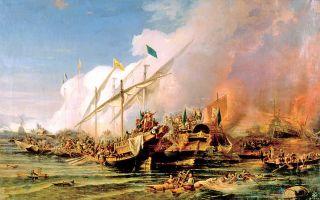
Preveze Deniz Muharebesini Temsil Eden Görsel (Ohannes Umed Behzad)
Barbaros Hayreddin Pasha, distinguished by his military and political activities in North Africa, captured Algiers in 1517 together with his brother Oruç Reis and established a Turkish administration resisting Spanish rule.【4】
Born in 1473 and trained in seafaring under his brother Oruç Reis, Barbaros Hayreddin Pasha participated in all of Oruç’s campaigns. After Oruç’s death in battle on 10 October 1518, he assumed control of Algiers and entered Ottoman service on 15 May 1519, being appointed Beylerbey of Algiers.【5】 He recaptured the city from the Spanish in 1525 after losing it in 1520.【6】 During this period, he rejected service offers from both King Francis I of France and Charles V.【7】 Fluent in six foreign languages and highly skilled in evaluating meteorological conditions, Barbaros Hayreddin Pasha’s maritime philosophy is epitomized in his famous sayings: “He who dominates the Mediterranean dominates the world” and “A great ship requires a great cannon.”【8】
Summoned to Istanbul by Sultan Suleiman the Magnificent after failing to cut off enemy supply lines during the siege of Koroni, Barbaros Hayreddin Pasha was appointed Kapudan Pasha despite objections from some viziers, thanks to the Grand Vizier Ibrahim Pasha’s successful persuasion of the Sultan.【9】 Arriving in Istanbul with eighteen admirals on 27 December 1533, Barbaros Hayreddin Pasha was officially appointed to this post sixty-eight days later, on 6 April 1534.【10】 In his campaign departing on 1 August 1534 with eighty-four warships and twenty transport vessels, he captured Tunis on 22 August 1534, establishing a strategic link between Algiers and Ottoman territories.【11】
The Ottoman-French alliance established in 1534 and Charles V’s efforts to strengthen his influence in Italy prompted the Ottoman State to intensify its military activities in the Western Mediterranean. In this context, the Ottoman fleet launched expeditions in 1537 against the Apulia region of Italy and subsequently against Corfu Island.
On 23 July 1537, Ottoman forces landed in Apulia; when the Venetian fleet attacked Ottoman transport ships, Ottoman units laid siege to Corfu Island on 25 August 1537. However, due to heavy seasonal rains and the fierce resistance of San Angelo Fortress, Sultan Suleiman the Magnificent ordered the lifting of the siege on 6 September 1537.【12】
After the lifting of the siege of Corfu, Sultan Suleiman granted Barbaros Hayreddin Pasha permission to launch operations against Venetian islands in the Ionian and Aegean Seas. Between September and November 1537, twenty-five Venetian islands—including Paros, Antiparos, Tinos, Kythera, Aegina, Kea, Syros, Skyros, Patmos and Stampalia—within the Cyclades and North Sporades archipelagos came under Ottoman control.【13】 Naxos Duchy agreed to pay an annual tribute of 5,000 ducats to the Ottoman State.【14】 This campaign significantly strengthened Ottoman control over the Aegean Sea, and Barbaros Hayreddin Pasha returned to Istanbul on 22 November 1537.【15】
Following Barbaros Hayreddin Pasha’s incorporation of the Cyclades and North Sporades islands and the Duchy of Naxos into Ottoman control at the end of 1537, the Republic of Venice, seeking to recover its lost islands, abandoned its neutrality and sought an alliance with Spain and the Papacy against the Ottoman State.【16】
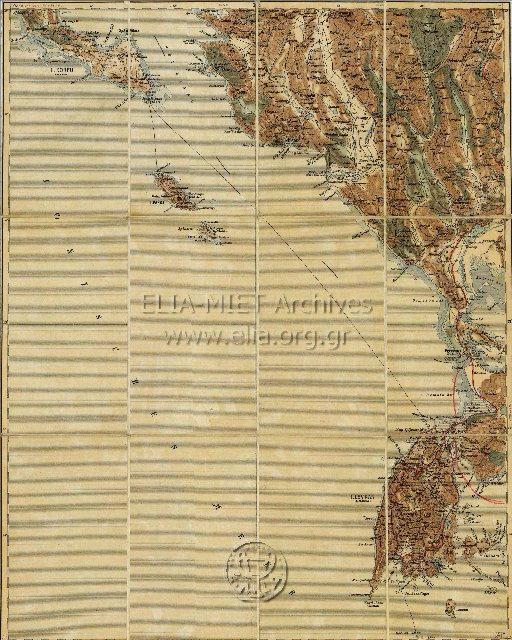
Preveze ve Çevresinin Coğrafi Konumunu Gösteren Harita (Europeana)
To prevent the Ottoman Empire from expanding its maritime borders, Pope Paul III initiated diplomatic negotiations among Christian states.【17】 In February 1538, cardinals convened at the Vatican and decided to form the United Holy League fleet.
In 1538, a Holy League fleet was formed with the participation of Spain, Venice, the Papacy, Genoa, Portugal and the Knights of Malta; Austria also joined the alliance.【18】
Negotiations between Spanish and Venetian envoys in Rome, mediated by Pope Paul III, revealed four major points of disagreement: the appointment of the fleet’s supreme commander, the objectives of the campaign, the sharing of war expenses and the division of spoils.【19】
The most prominent point of division among members was the campaign’s objective: Venice prioritized reclaiming its lost colonies in the Aegean and Eastern Mediterranean and neutralizing the Ottoman fleet in that region, while Charles V advocated an operation targeting North Africa, especially Algiers, to secure the safety of Spanish and Italian coasts.【20】 Unable to reach a definitive conclusion after prolonged debates, the parties agreed on a temporary compromise: the primary objective would be the destruction of the Ottoman fleet, while the ultimate goal would be determined later according to the course of the war.【21】
Regarding command, the Spanish envoy proposed Andrea Doria as supreme commander. Venice initially opposed this proposal, suspecting Doria might have made a secret agreement with Barbaros Hayreddin Pasha; however, instead of imposing its own candidate, Venice insisted on the addition of a war council composed of a Papal, a Venetian and a Spanish admiral, whose approval would be required for all decisions. As a result, the command of the combined fleet was entrusted to the Genoese Admiral Andrea Doria.【22】 The fleet’s expenses were covered one-third by Venice, one-sixth by the Papacy and half by Spain.【23】
Regarding the division of spoils, King Charles V of Spain, who contributed the greatest military force, claimed the right to establish a “Eastern Empire” in Istanbul if it were captured; the Papacy sought certain privileges; Venice accepted the return of its lost colonies as sufficient, and the disagreement was thus resolved.【24】
While the Holy League negotiations were ongoing, the Ottoman side had been engaged in a shipbuilding campaign since the winter of 1537–1538; this activity was not a special mobilization initiated in response to the League but rather a continuation of Barbaros Hayreddin Pasha’s routine preparations.
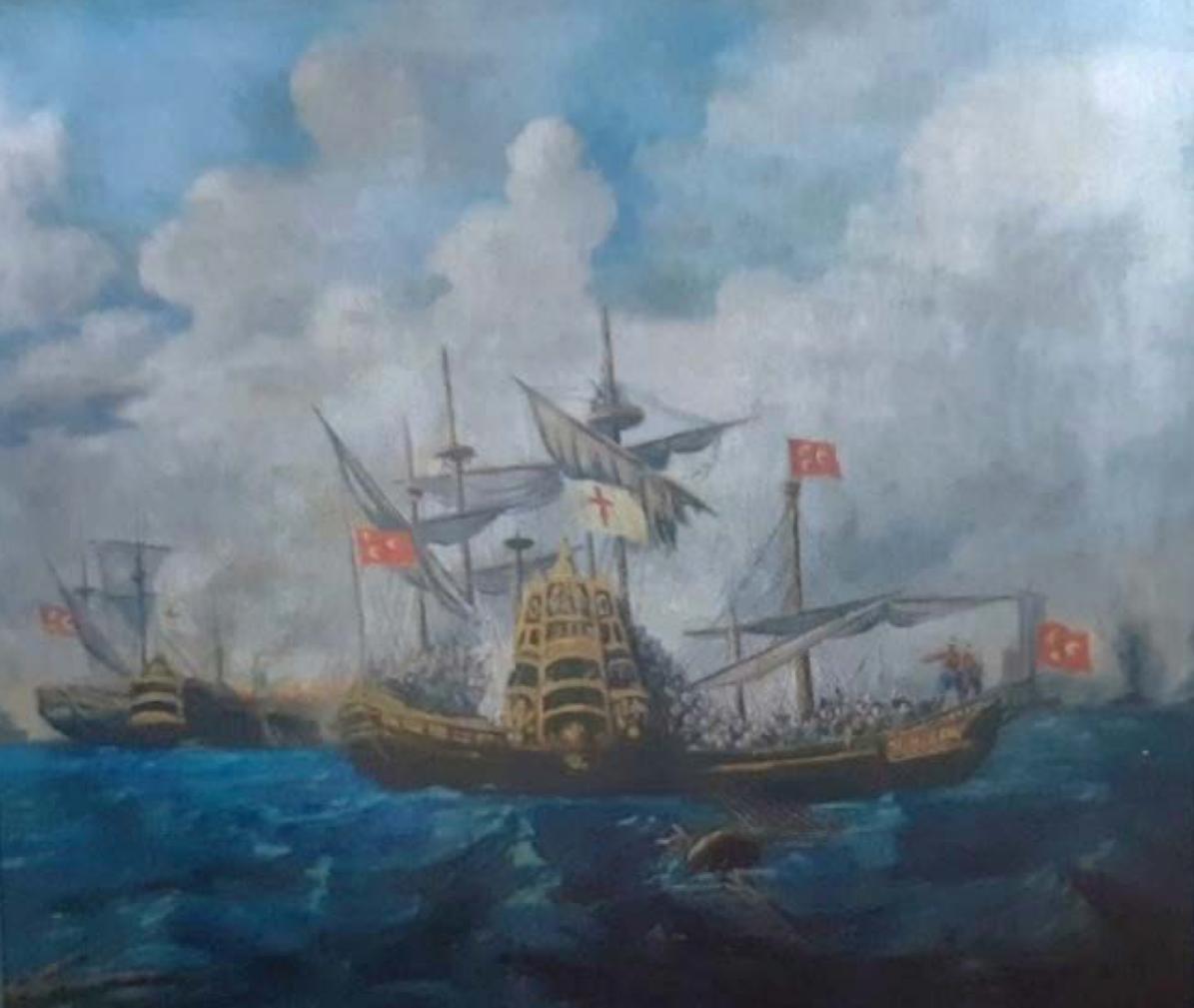
Yekta Topsal, Preveze Deniz Muharebesi, 20. yüzyıl, Tuval Üzerine Yağlıboya Eseri (Karatepe, 2011)
It is not explicitly stated when or through which intelligence channel the Ottoman side became aware of the Holy League negotiations; however, it is accepted that Barbaros Hayreddin Pasha, closely following European politics, was generally aware of the alliance talks in Rome. Indeed, this shipyard activity began in the winter of 1537–1538, before the Holy League’s formal establishment in February 1538; this chronology demonstrates that the preparations were not a reaction to the League. Sources differ in their emphasis on the nature of these preparations: Büyüktuğrul describes the shipyard activity as an ongoing preparation since the winter of 1537–1538, without linking it to the formation of the Holy League.【25】 In contrast, the Naval War College of the Turkish Ministry of National Defense defines the same period as a “race against time” between the shipyards of the Holy League and those of the Ottomans.【26】
During this period, according to some sources, up to 150 ships were being constructed and equipped in the shipyards of Istanbul, İzmit, Gemlik, Gelibolu and Çanakkale.【27】 The only factor hindering these preparations was Grand Vizier Ayas Pasha’s disengagement from naval affairs; the real challenge lay not in equipping the ships but in securing sailors and oarsmen.【28】 As Barbaros Hayreddin Pasha prepared to set sail, he entrusted the management of the ships under construction to Ali Bey, the Sanjak Bey of Kocaeli.【29】
Opposing Grand Vizier Ayas Pasha’s proposal to use war prisoners as oarsmen, Barbaros Hayreddin Pasha insisted on employing experienced, salaried oarsmen to ensure the fleet’s maneuverability and discipline, and he succeeded in securing approval for this requirement.
After the Sultan of Gujarat, Bahadur Shah, requested Ottoman assistance against the Portuguese in India, the Gujarat Treasury, sent to Egypt to cover the costs of a fleet destined for the Indian Ocean, had to be transferred to Istanbul.【30】 This task was assigned to Salih Reis.
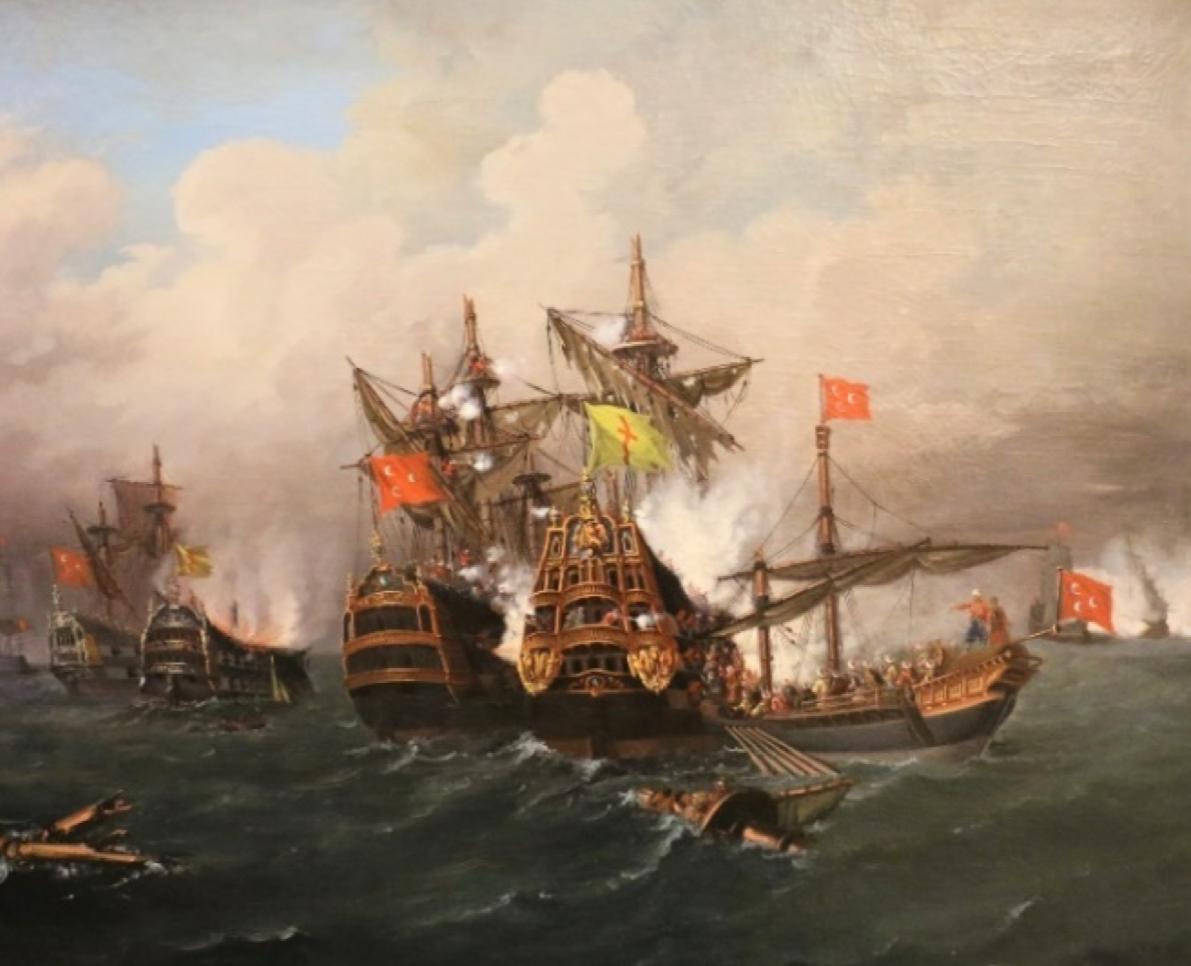
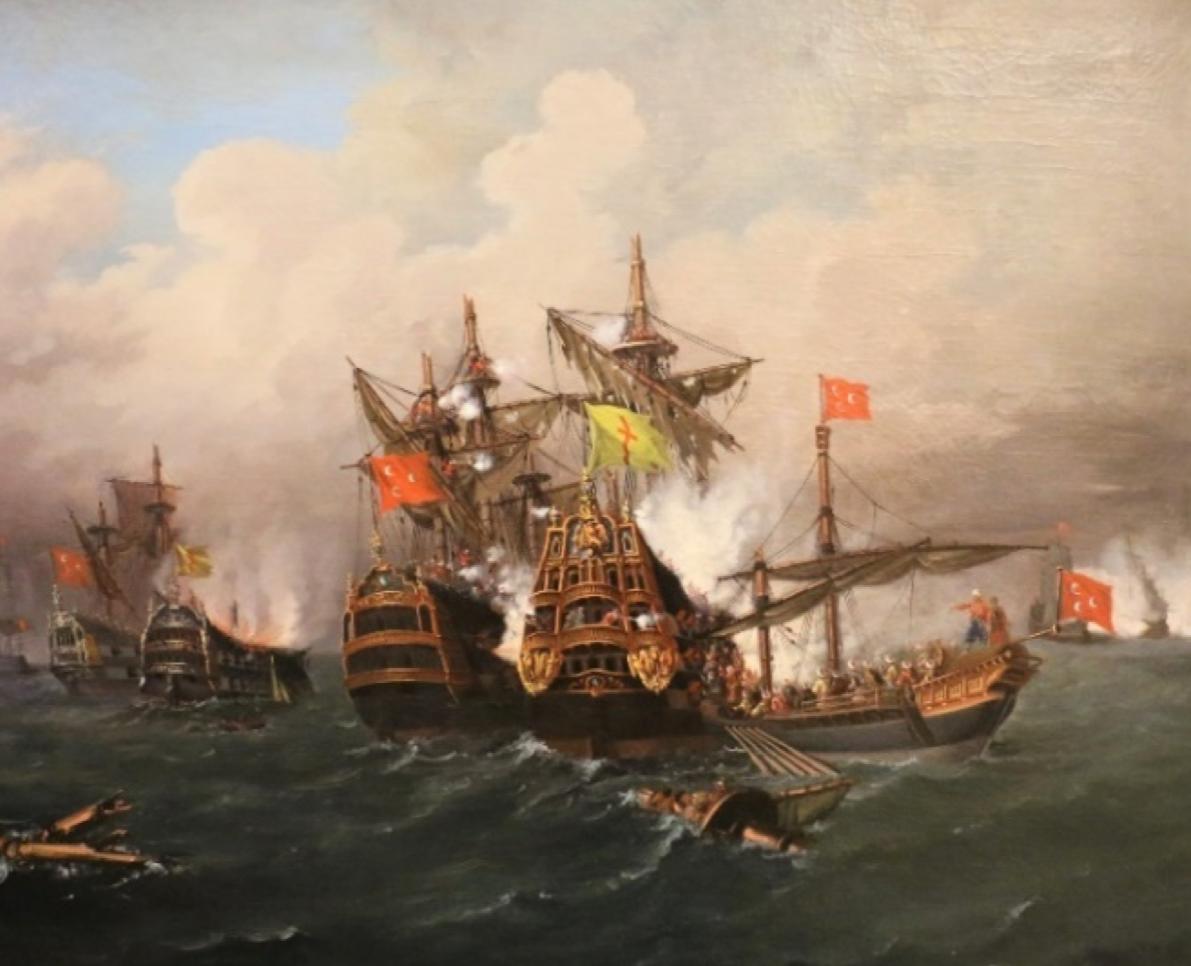
Anonim, Osmanlı Donanması’nın Bir Deniz Savaşı, 19. Yüzyılın İkinci Yarısı, Tuval Üzerine Yağlıboya Eseri (R. Işık Yayla)
Upon learning that Andrea Doria was waiting in Cretan waters to seize this treasury, Barbaros Hayreddin Pasha set sail from Istanbul on 7 June 1538 with forty galleys and 3,000 Janissaries, without waiting for the completion of shipbuilding.【31】 The decisive factor for this early departure was not the news of the Holy League’s formation but rather this specific intelligence.【32】 Barbaros Hayreddin Pasha captured Iskatoz (Skiathos) from the North Sporades islands and transformed it into an operational base.
The fleet of Salih Reis returning from Egypt, joined by ninety additional galleys under the command of Ali Bey, Sanjak Bey of Kocaeli, merged with the main fleet off the coasts of Euboea and Iskatoz; Turgut Reis also joined the fleet with his raiding vessels.
There were differences between the two fleets in terms of quantity and ship types. The Holy League fleet consisted of 308 warships: 140 galleons and 168 galleys. This fleet had 2,594 cannons and approximately 60,000 troops.【33】 The Ottoman fleet consisted of 122 galleys, 366 cannons and 20,000 troops.【34】 The allied forces relied on heavy, high-sided galleons propelled by sails and equipped with high firepower, while the Ottoman forces used galleys powered by oars, capable of maneuvering independently of wind conditions.
The galleons and carracks of the allied fleet were heavy, high-decked, sail-propelled platforms carrying numerous cannons along their sides; the Ottoman fleet consisted entirely of low-decked galleys, propelled by oars, capable of independent maneuvering regardless of wind, and armed with long-range cannons mounted at the bow.
A detailed comparison of the forces’ personnel, ship and equipment capacities is provided in the table below:
Arta (Narda) Bay has a topography unsuitable for large, heavy sailing ships such as galleons due to its shallow and narrow entrance at the Preveza Strait. This geographical feature provided the Ottoman fleet with a sheltered harbor within the bay and forced the allied fleet to either remain in open sea or attempt a land-based siege.
In September 1538, the Holy League fleet assembled at Corfu Island and advanced southward, laying siege to Preveza Fortress at the entrance of Narda Bay. However, delays occurred during the assembly at Corfu. The Papal Admiral Marco Grimani launched a land attack on Preveza Fortress without informing the Venetian admiral, but this three-day siege attempt was repelled by Ottoman forces.
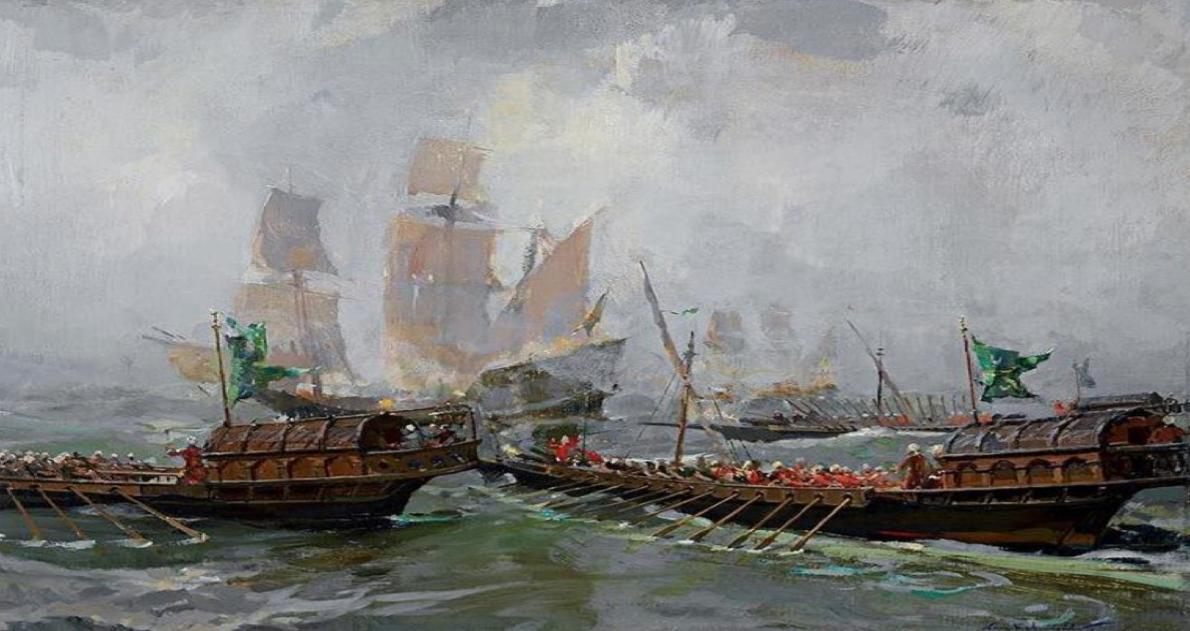
Naci Kalmukoğlu, Preveze Deniz Muharebesi, 20. yüzyıl, Tuval Üzerine Yağlıboya Eseri (Dostal, 2013)
Upon learning that the Holy League fleet was besieging Preveza Fortress, Barbaros Hayreddin Pasha immediately departed from Euboea and moved toward Preveza, sending a reconnaissance force of twenty ships under Turgut Reis ahead. Turgut Reis encountered a forty-ship Holy League fleet near Zenta and reported the situation to Barbaros Hayreddin Pasha in Modon; in turn, the Holy League fleet he encountered sailed to Preveza to warn Andrea Doria that the main Ottoman fleet was approaching. Upon receiving this news, Andrea Doria lifted the siege and withdrew his fleet to Corfu.【35】
In response to the destruction of Preveza Fortress by the Holy League forces, Barbaros Hayreddin Pasha plundered the island of Kefalonia and then reached Preveza Fortress on 24 September 1538, repaired and reinforced it, and began waiting in readiness within the bay.
At a war council convened by the Ottoman command on 25 September 1538, the Janissary Agha Sinan Pasha and several sanjak beys proposed that the fleet remain within the bay and defend itself with land support due to the numerical superiority of the Holy League fleet. Barbaros Hayreddin Pasha, however, warned that the fleet could become trapped in the bay and decided that the military operation should be conducted in open sea.【36】
Among the allied forces, disagreements arose over command and strategy. Admiral Andrea Doria was inclined to avoid open-sea combat and planned to attack other fortresses such as Inebahti or Modon to force the Ottomans out of their position; however, under pressure from the Papal and Venetian admirals and confident in his fleet’s numerical superiority, he accepted the idea of engaging in open-sea battle.【37】
The two fleets confronted each other on 28 September 1538 off Preveza. That morning, the Ottoman fleet emerged from the bay and formed a crescent formation six miles offshore.【38】 In this formation, Barbaros Hayreddin Pasha commanded the center, Salih Reis the right wing, Seydi Ali Reis the left wing, and Turgut Reis the reserve force in the rear.【39】 Alongside Barbaros Hayreddin Pasha in the center was his son Hasan Reis.
In the allied fleet, Andrea Doria initially placed the Venetian fleet in the front line, but after Admiral Capello objected and disrupted the formation, the order was changed; in the new formation, heavy galleons including Bondulmier’s large Venetian galley were positioned in the front line, galleys in the second line, and transport and support vessels in the third line.
At the start of the battle, a south wind provided mobility to the Holy League galleons, but when the wind ceased, the sailing ships’ maneuverability was severely limited. Fearing the wind’s favorable direction for the enemy, Barbaros Hayreddin Pasha, according to some sources, ordered verses from Surah Ash-Shura (verse 33) and Surah Al-Ahzab (verse 9) of the Qur’an to be written and cast into the sea to boost his troops’ morale.【40】
Ottoman galleys, remaining beyond the range of the Holy League galleons’ short-range cannons, engaged with their long-range fire. When the wind completely died, the front-line sailing galleons became motionless, and their short-range cannon shots fell harmlessly into the sea; in contrast, Ottoman galleys, propelled by oars, targeted the galleons with their long-range bow cannons, inflicting heavy damage.【41】
Tunuslu İbrahim, Preveze Zaferi,1867, Kâğıt Üzerine Suluboya Eseri (Aksaray, 2004)
Ottoman forces broke through the front-line galleons and advanced toward the center commanded by Andrea Doria. Turgut Reis’s reserve force executed a flanking maneuver, placing the Holy League fleet under double pressure. As the galleons sustained damage, Andrea Doria attempted to encircle the Ottomans using the second-line galleys on both flanks; Barbaros Hayreddin Pasha countered this maneuver with Turgut Reis’s reserve fleet, subjecting the Holy League galleys to crossfire from behind and the sides.【42】
The Holy League fleet, caught between two fires and suffering from disrupted command coordination, sustained heavy damage. Andrea Doria withdrew his fleet toward Corfu, taking advantage of nightfall. He ordered his fleet to extinguish its lanterns as dusk approached; the Ottoman fleet, also affected by the emerging storm, ceased pursuit and returned to Avlona or Ayamavra.【43】
After the five-hour battle, the Holy League fleet lost 128 warships;【44】 29 of these were captured by Ottoman forces.【45】 Approximately 3,000 Holy League soldiers were taken prisoner in the battle off Preveza. Additionally, during operations conducted throughout 1538 in the Eastern Mediterranean (Egypt, Alexandria, Crete, Cyprus, Dimyad, Reşid), 697 soldiers were captured. Following this battle and these operations, the Ottoman State strengthened its military and political position in the Mediterranean.【46】
As a result of military operations conducted throughout 1538 against French, Venetian and other Holy League elements in the Eastern Mediterranean—including in Egypt, Alexandria, Crete, Cyprus, Dimyad and Reşid—considerable material spoils were captured.
According to the records of the Topkapı Palace Museum Archives, document number 4919/1 dated 29 May 1538 (Hijri 29.12.944), all spoils captured by the efforts of Egyptian Volunteers, Egyptian Gunners, fortress commanders and the Garipler units were recorded and transferred to the hazine-i amire under the Islamic legal principle of one-fifth (humus) as state share.【47】
The following tables detail the cash, commercial goods, valuable fabrics and jewels recorded and transferred to the state treasury based on these archival records:【48】
According to the same archival records, in addition to fabrics, spices and cash seized from caravanserais, merchant ships and barges, 697 Christian prisoners—including Marco Nemigrad, the Venetian Bailo (Ambassador)—were captured off the coasts of Dimyad and Alexandria and detained in the prisons of Egypt and Alexandria.【49】
The Battle of Preveza exemplifies how logistical organization, command capability and tactical maneuvers are as decisive as the number of ships and soldiers in naval warfare. Through this battle, the Ottoman Empire demonstrated not only its land power but also its effective naval strength in the Mediterranean region.【50】
The military outcome of the battle was formalized diplomatically and legally through the Ottoman-Venetian Treaty of 1540; for the next thirty-three years until the Battle of Lepanto in 1571, the allied European states failed to form a new unified naval force capable of challenging the Ottoman fleet.【51】
Preveza Naval Victory (TRT Archives)
King Charles V’s strategy to establish dominance over the Mediterranean and Europe failed; the political and military cooperation between France’s King Francis I, under Spanish pressure, and the Ottoman State deepened. Venice, having lost its colonies in the Aegean and Eastern Mediterranean, shifted its policy toward peaceful relations with the Ottoman State to sustain its maritime trade and remained outside Ottoman-hostile alliances for a long period.【52】
Following the naval battle of 28 September 1538, serious political and military crises emerged within the Christian alliance. The Holy League, established through the initiatives of Pope Paul III among Spain, Venice, the Papacy, Genoa and the Knights of Malta, lost its functionality due to inconsistencies on the battlefield and lack of trust among commanders.【53】 Evaluations that Genoese Admiral Andrea Doria maneuvered poorly and abandoned Venetian ships in the front line triggered mutual accusations and protests among the allies.
The Venetian Senate assessed that King Charles V of Spain and the Holy Roman Emperor intended to weaken Venice’s naval power and that the alliance did not serve Venice’s interests in the Mediterranean. Observing that the alliance could not be sustained, Venetian senators initiated diplomatic efforts to pursue unilateral (separate) peace negotiations with the Ottoman State.【54】
After withdrawing from Preveza, Andrea Doria, seeking to restore his fleet’s morale, attacked the Ottoman-controlled Nova Fortress (Castello Nuovo / Herceg Novi) in the Bay of Kotor on 27 October 1538 and placed it under Spanish control. However, in the summer of 1539, Barbaros Hayreddin Pasha, with a fleet of 155 ships and land forces under Hüsrev Pasha, laid siege to the fortress and recaptured Nova on 7 August 1539 (some sources cite 10 August).【55】
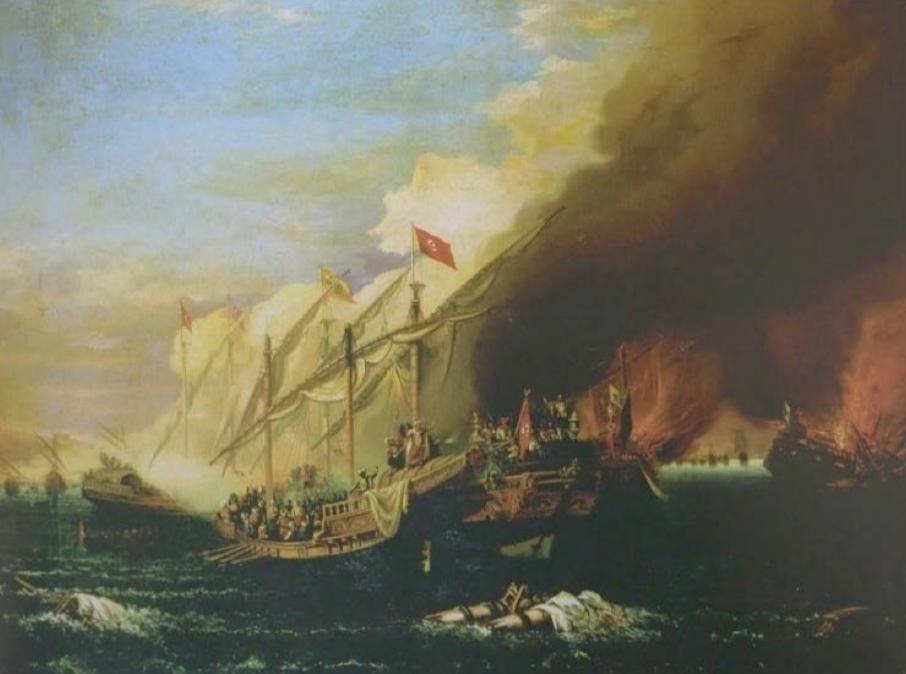
Osman Nuri Paşa, Preveze Deniz Zaferi, Tuval Üzerine Yağlıboya Eseri (R. Işık Yayla)
According to the terms of the alliance agreement, the captured territory should have been handed over to Venice; however, Andrea Doria stationed a 6,000-man Spanish garrison in the fortress and transferred control to Spain.【56】 Spain’s unilateral assumption of control over the fortress, disregarding Venetian rights, completely severed diplomatic bridges between Venice and Spain. The situation at Nova Fortress laid the groundwork for the de facto collapse of the Holy League and compelled Venice to engage in prolonged peace negotiations with the Ottoman State.
The significance of the battle in naval warfare history was reflected in Ottoman and European painting from the 19th century onward. Artists such as the Spanish painter Vicente Urrabieta (1859), Hovhannes Umed Behzad (1866), Osman Nuri Paşa and Giovanni della Tolla (1888) depicted this event in their paintings.【57】
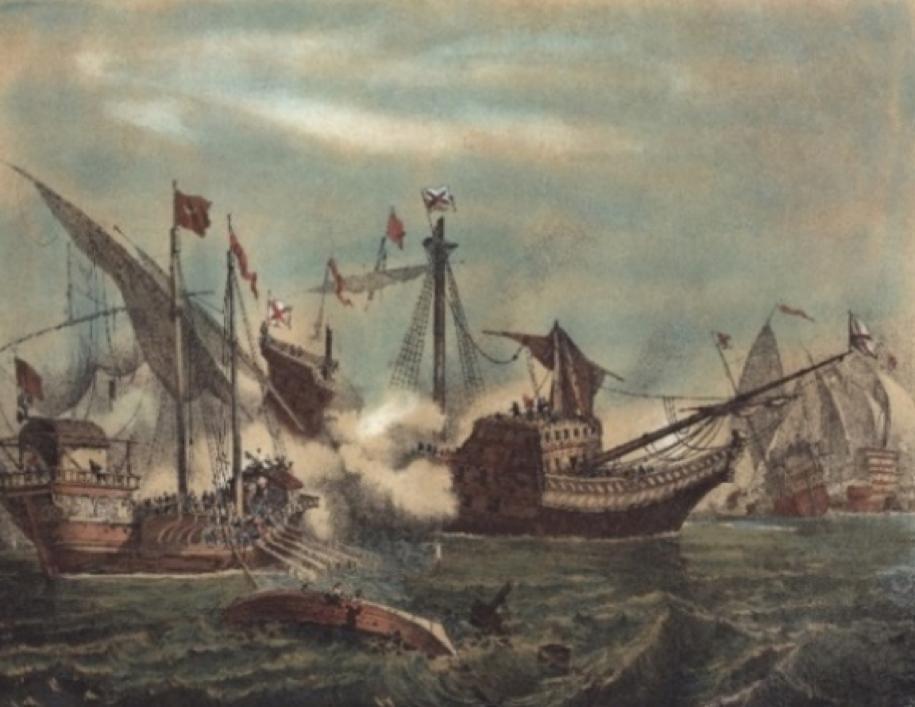
Vicente Urrabieta, 1538 Preveze Deniz Savaşı’nda Machin de Munguia’nı Öne Çıkarttığı Eser (N.D. Karabelas)
In these paintings, the intensity of the battle, smoke rising from the galleons and the figures of Barbaros Hayreddin Pasha standing in the center of the central galley and Andrea Doria with arms outstretched are depicted in detail.【58】
The earliest known artistic representation of the subject is Urrabieta’s 1859 lithograph; however, rather than documenting the battle, it emphasizes the heroism of Machín de Munguía, a captain of the Holy League fleet.【59】
One of the first practitioners of the Ottoman oil painting tradition was the Armenian artist Hovhannes Umed Behzad (1809–1874), who served as court painter to Sultan Abdülaziz. In his 1866 work, Hayreddin Pasha, sword raised toward the enemy at the prow of the galley, is depicted as the central figure, while Andrea Doria, at the prow of the opposing galley, is shown with arms outstretched in a gesture of surrender.【60】
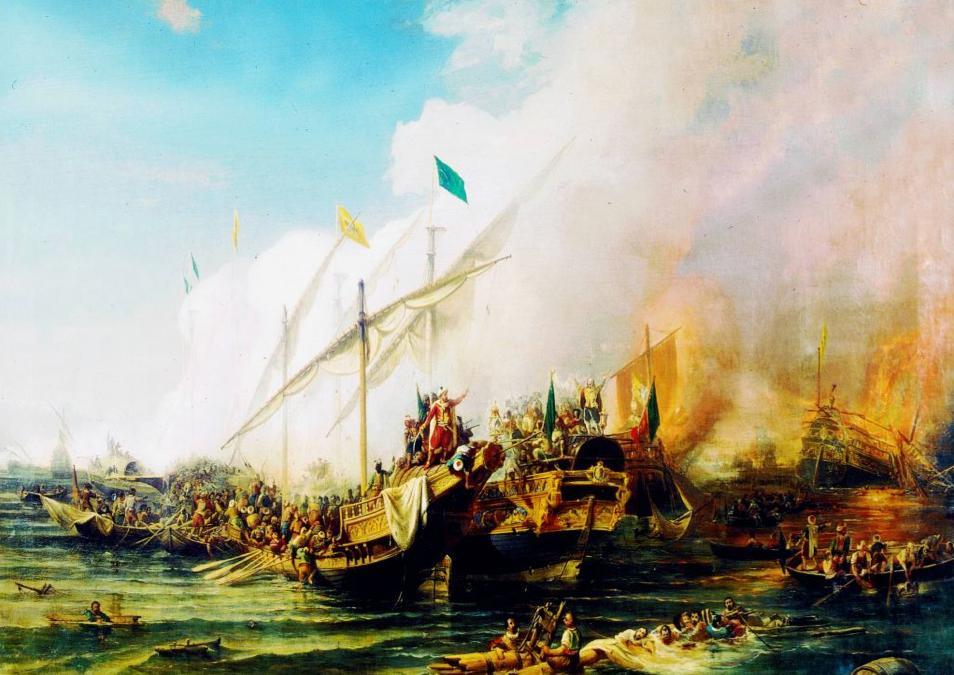
Hovhannes Umed Behzad, Preveze Deniz Zaferi, 1866, Tuval Üzerine Yağlıboya Eseri (Aksaray, 2004)
Another painting closely resembling Behzad’s composition belongs to Osman Nuri Paşa (1825–1903), one of the pioneers of the transition to oil painting in Turkish art. Although lacking a precise date, this work is generally dated to 1866–1867 and is considered the earliest known Ottoman war painting by a Turkish artist.【61】
The same compositional scheme was repeated in 1867 by the Tunisian artist Ibrahim using watercolor, and later in 1907 by Hasan Cemalettin of the Military Painters’ Generation with a more muted color palette.【62】
In Giovanni della Tolla’s (1845–1935) 1888 painting, unlike other depictions, the background includes Bouka Fortress in Preveza, aiming for a documentary quality. However, since contemporary paintings depicting Preveza’s departure from Ottoman territory during the Ottoman-Venetian Wars (1684–1699) portray the fortress with a different topography, della Tolla’s depiction appears more functional than realistic.
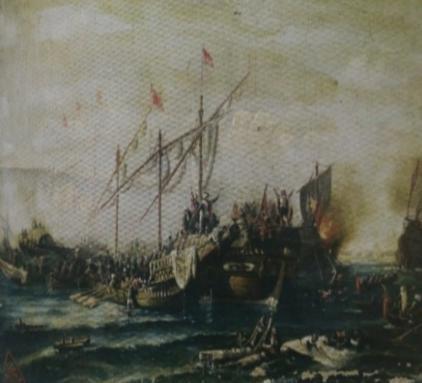
Hasan Cemalettin, Preveze Deniz Savaşı, 1907, Tuval Üzerine Yağlıboya Eseri (Aksaray, 2004)
The stylistic approach to Preveza depictions began to change from the first half of the 20th century. In the work of Naci Kalmukoğlu (1896–1956), of Kalmuk Turk origin, the battle is portrayed with full intensity, influenced by Russian Academic painting’s dramatic lighting and brushwork.【64】
Yekta Topsal (b. 1906) of the Military Painters’ Generation depicted the scene in a calmer, foggy atmosphere; the composition of this work matches exactly an anonymous 19th-century painting in the National Palaces Painting Museum titled “An Ottoman Naval Battle,” indicating that the anonymous painting also depicts the Battle of Preveza.【65】
Overall, Preveza-themed paintings have been shaped around a common iconographic template: the victor Barbaros Hayreddin Pasha is portrayed as a hero, while the defeated Andrea Doria is depicted as a dignified figure. This dual representation established a painting tradition from the mid-19th century through the 20th century, visually conveying Ottoman naval superiority both militarily and symbolically.【66】
Anadolu Ajansı. "Preveze Deniz Zaferi'nin 486'ncı Yıl Dönümü ve Deniz Kuvvetleri Günü İstanbul'da Kutlandı." September 27, 2024. Accessed July 27, 2026.https://www.aa.com.tr/tr/gundem/preveze-deniz-zaferinin-486nci-yil-donumu-ve-deniz-kuvvetleri-gunu-istanbulda-kutlandi/3343318
Behzad, Ohannes Umed. "Battle of Preveza 1538 CE." World History Encyclopedia. Date Published July 20, 2020. Accessed July 27, 2026.https://www.worldhistory.org/image/12485/battle-of-preveza-1538-ce/
Bostan, İdris. "Preveze Deniz Muharebesi." In *TDV İslâm Ansiklopedisi*, c. 34. TDV Yayınları, 2007: 161–170. Accessed July 27, 2026.https://cdn2.islamansiklopedisi.org.tr/dosya/34/C34011196.pdf
Büyüktuğrul, Afif. "Preveze Deniz Muharebesine İlişkin Gerçekler." *Belleten* 37, no. 145 (1973): 51–86. Accessed July 27, 2026.https://belleten.gov.tr/ozet/460/tur
Büyüktuğrul, Afif. "Preveze Muharebesine İlişkin Belgeler (Muharebenin 440. Yıldönümü Dolayısıyla)." *Belleten* 42, no. 166 (1978): 629–665. Accessed July 27, 2026.https://belleten.gov.tr/tam-metin-pdf/1521/tur
Ertaş, İkram. "Arşiv Kayıtlarına Göre Preveze Deniz Muharebesi (1538) Savaş Ganimetleri 'Cumhurbaşkanlığı Devlet Arşivleri Başkanlığı Osmanlı Arşivi Topkapı Sarayı Müzesi Arşivi 4919/1 Numaralı Deftere Göre'." *Akademik Tarih ve Düşünce Dergisi* 12, no. 1 (2025): 1067–1085. Accessed July 27, 2026.
Işık Yayla, Rumeysa. "Akdeniz’deki Türk Hâkimiyetinin Görsel Temsili: Tuvallerde Preveze Deniz Zaferi." *Selçuk Üniversitesi Türkiyat Araştırmaları Dergisi*, no. 58 (2023): 203–220. Accessed July 27, 2026.https://dergipark.org.tr/tr/download/article-file/3350929
K. u. K. Militärgeographisches Institut. "Preveza." Europeana. Accessed July 27, 2026.
MSÜ Deniz War College. "From Mavi Vatan to the Open Seas." *Mavi Vatan*, no. 8 (July 2021). Accessed July 27, 2026.https://www.msu.edu.tr/mavivatandanacikdenizleredergisi/mavi_vatan_8.pdf
Mavi Vatan. "Preveze Deniz Savaşı Zaferi." Accessed July 27, 2026.https://mavivatan.net/preveze-deniz-savasi/
T.C. İletişim Başkanlığı. *Preveze Deniz Zaferi: Barbaros Hayreddin Paşa Anısına*. T.C. İletişim Başkanlığı Yayınları, 2021:1-153. Accessed July 27, 2026.
TRT Arşiv. "Preveze Deniz Zaferi." YouTube video, 12:45. Accessed July 27, 2026.https://www.youtube.com/watch?v=T2IX37EacAI
[1]
Rumeysa Işık Yayla, "Akdeniz’deki Türk Hâkimiyetinin Görsel Temsili: Tuvallerde Preveze Deniz Zaferi," Selçuk Üniversitesi Türkiyat Araştırmaları Dergisi, no. 58 (2023): 206, Erişim tarihi: 27 Temmuz 2026, https://dergipark.org.tr/tr/download/article-file/3350929
[2]
Afif Büyüktuğrul, “Preveze Deniz Muharebesine İlişkin Gerçekler,” Belleten 37, sy. 145 (1973): 58-59, erişim 27 Temmuz 2026, https://belleten.gov.tr/ozet/460/tur
[3]
Büyüktuğrul, "Preveze Deniz Muharebesine İlişkin Gerçekler," 60.
[4]
Büyüktuğrul, "Preveze Deniz Muharebesine İlişkin Gerçekler," 54.
[5]
Afif Büyüktuğrul, "Preveze Muharebesine İlişkin Belgeler (Muharebenin 440. Yıldönümü Dolayısıyla)," Belleten 42, sy. 168 (1978): 636, Erişim tarihi: 27 Temmuz 2026, https://belleten.gov.tr/tam-metin-pdf/1521/tur
[6]
Büyüktuğrul, "Preveze Deniz Muharebesine İlişkin Gerçekler," 54.
[7]
Büyüktuğrul, "Preveze Muharebesine İlişkin Belgeler," 636.
[8]
Büyüktuğrul, "Preveze Deniz Muharebesine İlişkin Gerçekler," 62.
[9]
Büyüktuğrul, "Preveze Deniz Muharebesine İlişkin Gerçekler," 63.
[10]
Büyüktuğrul, "Preveze Deniz Muharebesine İlişkin Gerçekler," 62.
[11]
Büyüktuğrul, "Preveze Deniz Muharebesine İlişkin Gerçekler," 64-65.
[12]
MSÜ Deniz Harp Enstitüsü, "Mavi Vatan’dan Açık Denizlere," Mavi Vatan, no. 8 (Temmuz 2021): 23, Erişim tarihi: 27 Temmuz 2026, https://www.msu.edu.tr/mavivatandanacikdenizleredergisi/mavi_vatan_8.pdf
[13]
MSÜ Deniz Harp Enstitüsü, "Mavi Vatan’dan Açık Denizlere," 24-25.
[14]
MSÜ Deniz Harp Enstitüsü, "Mavi Vatan’dan Açık Denizlere,"25.
[15]
İdris Bostan, "Preveze Deniz Muharebesi," içinde TDV İslâm Ansiklopedisi, c. 34 (TDV Yayınları, 2007):343-345, Erişim tarihi: 27 Temmuz 2026, https://cdn2.islamansiklopedisi.org.tr/dosya/34/C34011196.pdf
[16]
Büyüktuğrul, "Preveze Muharebesine İlişkin Belgeler," 663-664.
[17]
Bostan, "Preveze Deniz Muharebesi,"343.
[18]
Büyüktuğrul, "Preveze Deniz Muharebesine İlişkin Gerçekler," 73.
[19]
Büyüktuğrul, "Preveze Deniz Muharebesine İlişkin Gerçekler," 74.
[20]
Büyüktuğrul, "Preveze Deniz Muharebesine İlişkin Gerçekler," 75.
[21]
Büyüktuğrul, "Preveze Deniz Muharebesine İlişkin Gerçekler," 75.
[22]
T.C. İletişim Başkanlığı, Preveze Deniz Zaferi: Barbaros Hayreddin Paşa Anısına (T.C. İletişim Başkanlığı Yayınları, 2021):92, Erişim tarihi: 27 Temmuz 2026, https://kulakver.iletisim.gov.tr/uploads/PrevezeDenizZaferi_1.pdf
[23]
MSÜ Deniz Harp Enstitüsü, "Mavi Vatan’dan Açık Denizlere,"30.
[24]
Büyüktuğrul, "Preveze Deniz Muharebesine İlişkin Gerçekler," 75.
[25]
Büyüktuğrul, "Preveze Deniz Muharebesine İlişkin Gerçekler," 78.
[26]
MSÜ Naval War College, "From the Blue Homeland to the Open Seas," 24.
[27]
Büyüktuğrul, "Preveze Deniz Muharebesine İlişkin Gerçekler," 78.
[28]
Büyüktuğrul, "Preveze Deniz Muharebesine İlişkin Gerçekler," 78.
[29]
Büyüktuğrul, "Preveze Deniz Muharebesine İlişkin Gerçekler," 79.
[30]
MSU Naval War Institute, "From the Blue Homeland to the Open Seas," 26.
[31]
MSÜ Naval War College, "From Blue Homeland to the Open Seas," 27.
[32]
Büyüktuğrul, "Preveze Deniz Muharebesine İlişkin Gerçekler," 79.
[33]
Işık Yayla, "Akdeniz’deki Türk Hâkimiyetinin Görsel Temsili,"206.
[34]
Bostan, "Preveze Deniz Muharebesi,"343.
[35]
Bostan, "Preveze Deniz Muharebesi,"343.
[36]
Bostan, "Preveze Deniz Muharebesi," 344.
[37]
MSÜ Deniz Harp Enstitüsü, "Mavi Vatan’dan Açık Denizlere,"34.
[38]
T.C. İletişim Başkanlığı, Preveze Deniz Zaferi, 134.
[39]
T.C. İletişim Başkanlığı, Preveze Deniz Zaferi, 134-135.
[40]
"Preveze Deniz Savaşı Zaferi," Mavi Vatan, Erişim tarihi: 27 Temmuz 2026, https://mavivatan.net/preveze-deniz-savasi/
[41]
Mavi Vatan,"Preveze Deniz Savaşı Zaferi."
[42]
Mavi Vatan,"Preveze Deniz Savaşı Zaferi."
[43]
Mavi Vatan,"Preveze Deniz Savaşı Zaferi."
[44]
Bostan, "Preveze Deniz Muharebesi," 344.
[45]
T.C. İletişim Başkanlığı, Preveze Deniz Zaferi, 144.
[46]
"Preveze Deniz Zaferi," TRT Arşiv, YouTube video, 2:55, Erişim tarihi: 27 Temmuz 2026, https://www.youtube.com/watch?v=T2IX37EacAI
[47]
İkram Ertaş, "Arşiv Kayıtlarına Göre Preveze Deniz Muharebesi (1538) Savaş Ganimetleri 'Cumhurbaşkanlığı Devlet Arşivleri Başkanlığı Osmanlı Arşivi Topkapı Sarayı Müzesi Arşivi 4919/1 Numaralı Deftere Göre,'" *Akademik Tarih ve Düşünce Dergisi* 12, no. 1 (2025): 1069, 1072. Accessed July 27, 2026.
[48]
Ertaş, "Arşiv Kayıtlarına Göre Preveze Deniz Muharebesi," 1073-1076.
[49]
Ertaş, "Arşiv Kayıtlarına Göre Preveze Deniz Muharebesi,"1078.
[50]
Mavi Vatan,"Preveze Deniz Savaşı Zaferi."
[51]
MSÜ Deniz Harp Enstitüsü, "Mavi Vatan’dan Açık Denizlere,"21.
[52]
MSÜ Deniz Harp Enstitüsü, "Mavi Vatan’dan Açık Denizlere,"22.
[53]
Bostan, "Preveze Deniz Muharebesi," 344.
[54]
Büyüktuğrul, "Preveze Muharebesine İlişkin Belgeler," 662.
[55]
Bostan, "Preveze Deniz Muharebesi,"345.
[56]
MSÜ Deniz Harp Enstitüsü, "Mavi Vatan’dan Açık Denizlere,"34.
[57]
Işık Yayla, "Akdeniz'deki Türk Hâkimiyetinin Görsel Temsili," 207.
[58]
Işık Yayla, "Akdeniz’deki Türk Hâkimiyetinin Görsel Temsili," 207.
[59]
Işık Yayla, "Akdeniz’deki Türk Hâkimiyetinin Görsel Temsili," 209.
[60]
Işık Yayla, "Akdeniz’deki Türk Hâkimiyetinin Görsel Temsili," 207.
[61]
Işık Yayla, "Akdeniz’deki Türk Hâkimiyetinin Görsel Temsili," 208.
[62]
Işık Yayla, "Akdeniz’deki Türk Hâkimiyetinin Görsel Temsili," 210.
[64]
Işık Yayla, "Akdeniz’deki Türk Hâkimiyetinin Görsel Temsili," 213.
[65]
Işık Yayla, "Akdeniz'deki Türk Hâkimiyetinin Görsel Temsili," pp. 214-215.
[66]
Işık Yayla, "Akdeniz’deki Türk Hâkimiyetinin Görsel Temsili," 215-216.

Preveza
History | 28 September 1538 | ||||||||
|---|---|---|---|---|---|---|---|---|---|
History | 28 September 1538 | ||||||||
|---|---|---|---|---|---|---|---|---|---|
Belligerents | Ottoman State Holy League | ||||||||
Commanders of the Sides | Ottoman State: Barbaros Hayreddin Pasha Holy League: Andrea Doria | ||||||||
Political Background | Charles V (Holy Roman Empire/Spain) – Francis I (France) rivalry Mediterranean influence struggle | ||||||||
Accession Ages to the Throne | Charles V: 16 Francis I: 21 Henry VIII: 18 Suleiman: 26 | ||||||||
Diplomatic Move | Rapprochement between France and the Ottoman State Spain-Papacy-Venice alliance | ||||||||
Barbarossa's Title | Captain of the Sea | ||||||||
Geographical Area | Arta (Narda) Gulf – Preveza Strait | ||||||||
Ottoman Crescent Formation | Center: Barbaros Hayreddin Pasha & Hasan Reis Right Wing: Salih Reis Left Wing: Seydi Ali Reis Reserve: Turgut Reis | ||||||||
Power Struggle in Europe
Power Struggle in the Mediterranean
Formation of the Holy League
Ottoman Shipyard Activities and Oarman Requirements
The Gujarat Treasury and Early Naval Mobilization
Force Comparison
Arta Bay and the Preveza Strait
Strategies Before the Battle
War Councils
Course of the Battle
Tactics Employed
Outcomes and Prisoners
Spoils of War
Acquired Cash and Commercial Goods
Acquired Precious Stones and Jewels
Historical Impact
Impact on Mediterranean Geopolitics and International Power Balances
Dissolution of the Holy League and Diplomatic Fractures
Siege of Nova Fortress
Visual Representation of Preveza in Art History