This article was automatically translated from the original Turkish version.
+1 More
Registration Number | 498 | ||||||||
|---|---|---|---|---|---|---|---|---|---|
Registration Date | 08.06.2020 | ||||||||
Application Number | C2018/009 | ||||||||
Application Date | 03.01.2018 | ||||||||
Name of the Geographical Indication | Bayburt Ketesi | ||||||||
Product / Product Group(s) | Kete / Baking and pastry products sweets dough products | ||||||||
Type of Geographical Indication | Trademark | ||||||||
Applicant/Registrant(s) | Bayburt Chamber of Commerce and Industry | ||||||||
Address of the Registrant | Şeyh Hayran Mah. Dede Korkut Cad. No:46/3 Merkez BAYBURT | ||||||||
Geographical Boundary | Bayburt Province | ||||||||
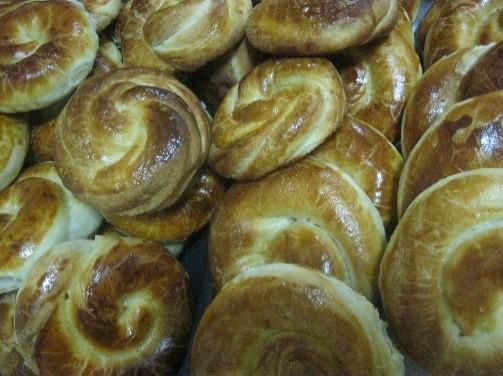
Bayburt ketesi is a traditional pastry unique to Bayburt Province in northeastern Türkiye. This product, protected under geographical indication registration, is prepared using milk, butter, yeast, salt, wheat flour, and egg yolk; its filling consists solely of flour toasted with butter. The dough is divided into mandarin-sized pieces, rolled out with a rolling pin, filled with the butter-toasted flour mixture, rolled into cylindrical shapes, and then coiled onto a baking tray. After being brushed with egg yolk, it is baked in an oven until ready for serving.
Bayburt Province has historically been located along the Silk Road, connecting Anatolia to the Black Sea, and has served as a settlement for numerous civilizations. This historical and cultural heritage provided the foundation for the development of various traditional foods in the region. Bayburt ketesi has been passed down through generations as a product of this enduring cultural continuity. It has become deeply embedded in the culinary habits of the Bayburt people and is regarded as a signature pastry of the region.
Bayburt ketesi is a baked pastry consisting of an outer dough made primarily from wheat flour, milk, butter, yeast, salt, and egg yolk, and an inner filling made exclusively from toasted flour and butter. The product is shaped into a cylindrical form, a result of both its traditional production method and the skilled craftsmanship required in its shaping. The harmonious combination of the inner filling and outer dough, along with its traditional form, are the primary features distinguishing Bayburt ketesi from similar products.
To prepare the dough, the yeast is first dissolved in half a glass of warm water. Then, milk, melted butter, and salt are added to form a mixture. Wheat flour is gradually incorporated into this mixture until a medium-firm dough is achieved. The resulting dough is covered and left to rise for approximately 30–40 minutes.
The filling is prepared by melting 500 grams of butter and adding 1 kilogram of wheat flour. The mixture is toasted until it turns pinkish, then left to cool. From the risen dough, mandarin-sized pieces are formed and allowed to rest for about five minutes. These rested pieces are rolled out with a rolling pin, spread with the filling, then rolled into cylinders and coiled upon themselves. They are gently pressed by hand to flatten slightly. The shaped ketes are arranged on a greased baking tray and left to rest for 15–20 minutes. Afterwards, they are brushed with egg yolk and baked in a preheated oven at 180 °C for approximately 30–40 minutes, until the tops are golden brown.
The production of Bayburt ketesi can only be carried out within the boundaries of Bayburt Province due to the skilled shaping process and the use of local ingredients. The product has become identified by its place of origin and is recognized as a local value representing Bayburt’s cultural heritage. The traditional production method of Bayburt ketesi is sustained through knowledge and experience passed down from generation to generation.
When Bayburt ketesi is sold commercially, the packaging must bear the inscription “Bayburt Ketesi” and the official geographical indication emblem. In unpackaged sales, this inscription and emblem must be clearly displayed at the point of sale.
Post-registration procedures for Bayburt ketesi are managed by a monitoring body established under the coordination of the Bayburt Chamber of Commerce and Industry. This body comprises experts from the Bayburt Provincial Directorate of Agriculture and Forestry, the Food Engineering Department of Bayburt University, and the Bayburt Municipality. Inspections are conducted regularly at least once a year or at any time upon complaint.
During inspections, the control of ingredients used in production, compliance with production steps, product shape, and adherence to labeling regulations are evaluated. Public or private sector services may be utilized as needed. Additionally, the institution that registered the product holds full legal authority to enforce all procedures necessary for the protection of its registration rights.
Turk Patent and Trademark Office. "Bayburt Ketesi." Accessed July 19, 2025. https://ci.turkpatent.gov.tr/cografi-isaretler/detay/38475.
Turkish Patent and Trademark Office. "Bayburt Ketesi Coğrafi İşaret Başvuru Belgesi." Accessed July 19, 2025. https://ci.turkpatent.gov.tr/Files/GeographicalSigns/e7167327-f720-405c-ab6f-0001bf1f3b5d.pdf.

Registration Number | 498 | ||||||||
|---|---|---|---|---|---|---|---|---|---|
Registration Date | 08.06.2020 | ||||||||
Application Number | C2018/009 | ||||||||
Application Date | 03.01.2018 | ||||||||
Name of the Geographical Indication | Bayburt Ketesi | ||||||||
Product / Product Group(s) | Kete / Baking and pastry products sweets dough products | ||||||||
Type of Geographical Indication | Trademark | ||||||||
Applicant/Registrant(s) | Bayburt Chamber of Commerce and Industry | ||||||||
Address of the Registrant | Şeyh Hayran Mah. Dede Korkut Cad. No:46/3 Merkez BAYBURT | ||||||||
Geographical Boundary | Bayburt Province | ||||||||
Cultural Background
Product Definition and Distinctive Characteristics
Recipe/Production Method
Ingredients
For the dough:
For the filling:
For the topping:
Preparation Process
Geographical Boundaries and Production Location Link
Usage Format
Monitoring and Protection