


This article was automatically translated from the original Turkish version.
+2 More
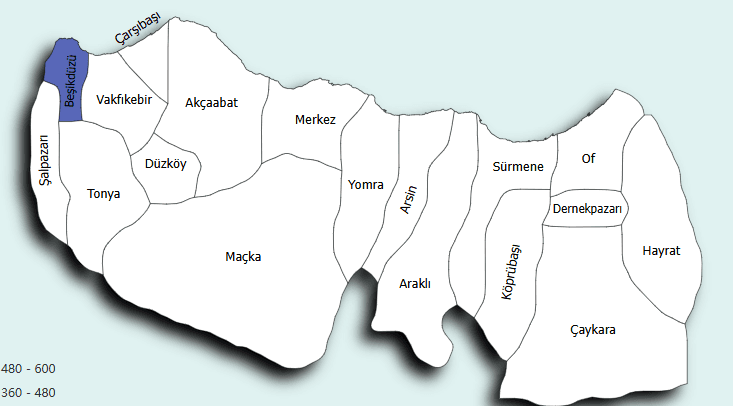
Beşikdüzü
Province(s) | Trabzon | ||||||||
|---|---|---|---|---|---|---|---|---|---|
Geographic Region | Black Sea Region | ||||||||
District Governor | Ferhat VARDAR | ||||||||
Mayor(s) | Burhan Cahit ERDEM | ||||||||
Population | 23.367 (2024) | ||||||||
Area(s) | 121 km² | ||||||||
Beşikdüzü is a coastal district located in the Eastern Black Sea Region of Türkiye, west of Trabzon province. The district, characterized by the unique geographical features of the Black Sea, stretches along the coastline and stands out for its natural beauty. Beşikdüzü’s hazelnut production defines its agricultural identity.

Beşikdüzü District (Beşikdüzü Municipality)
When examining the deep history of Beşikdüzü, it becomes evident that the region has been inhabited since antiquity. Although archaeological studies have not yet been comprehensive, historical sources and surface surveys indicate that the earliest settlements date back to around 2000 BCE. Throughout history, the area has been part of the domains of significant civilizations including the Kingdom of Colchis, the Roman Empire, the Byzantine Empire, and the Empire of Trebizond. With the Ottoman Empire’s dominance over the Black Sea, Beşikdüzü was recorded as a village under the Sanjak of Trabzon. For many years administered as part of the Vakfıkebir district, Beşikdüzü gained municipal status in 1955 and was later organized as an independent district on 9 May 1990. While there are differing views regarding the origin of its name, the most widely accepted explanation is that it derives from the natural cove known as “Beşik,” which resembles a cradle and provided shelter for ships to dock. This natural harbor is also believed to have played an important role in maritime trade in the past.

Beşikdüzü Cable Car (Beşikdüzü Municipality)
Beşikdüzü is strategically situated on the Black Sea coast, west of the city center of Trabzon. Its neighboring districts are Vakfıkebir to the east, Eynesil (part of Giresun province) to the west, and Şalpazarı (in the inland areas of Trabzon) to the south. The district’s terrain is generally rugged and mountainous; however, narrow and fertile plains extend parallel to the Black Sea coastline. Small rivers originating from the district’s lands flow into the Black Sea. Beşikdüzü experiences all the characteristic features of the typical Black Sea climate. Summers are warm and rainy, while winters are generally mild with snowfall occurring regularly. The consistent annual rainfall is the primary factor supporting the richness and lush greenery of the district’s natural vegetation. Humidity levels are high along the coast and decrease gradually toward the inland areas.

Beşikdüzü District (Beşikdüzü Municipality)
The economy of Beşikdüzü has traditionally been based on agriculture, trade, and fishing. In agriculture, hazelnut cultivation is one of the district’s most important sources of income, and Beşikdüzü is known for its high-quality hazelnuts. In addition to hazelnuts, the local population also cultivates maize, tea, kiwi, and various vegetables and fruits. The long coastline along the Black Sea makes fishing a vital livelihood, especially for communities living along the shore. Anchovies, mackerel, and other Black Sea fish contribute significantly to the local economy. In the district center, there is a vibrant commercial life centered on the buying and selling of agricultural products and small-scale industrial goods. In recent years, tourism has begun to develop gradually, increasing its contribution to the district’s economy.
Beşikdüzü and its surroundings contain several historical structures that have survived from the past. These include mosques dating from the Ottoman period, fountains reflecting the architectural features of that era, and traditional wooden houses exemplifying characteristic Black Sea architecture (Trabzon Culture and Tourism Directorate). Particularly in villages along the coast and in certain inland settlements, old structures that reflect the region’s cultural and architectural heritage can still be seen. However, compared to other historically rich districts in the Black Sea Region, the number of large and well-preserved historical monuments in Beşikdüzü is relatively limited.

Beşikdüzü District (Beşikdüzü Municipality)
Beşikdüzü is an attractive destination for domestic tourists, especially during the summer months, due to its natural beauty and tranquil atmosphere. The beaches lining the district center and the Black Sea coast provide ideal spaces for visitors seeking to swim and enjoy the sun. In addition, the district’s lush hills and natural landscapes offer suitable environments for outdoor activities such as hiking, picnicking, and photography. Various restaurants serving local cuisine and diverse accommodation options are also available. However, Beşikdüzü’s tourism potential has not yet been fully realized, and there remain many opportunities for development in this sector.
Beşikdüzü constitutes an important part of the rich and distinctive cultural heritage of the Black Sea Region. The local cuisine stands out through its use of fresh seafood and cornmeal-based traditional dishes. Karalahana sarması, anchovy pilaf, mıhlama, and other regional delicacies are valued elements of Beşikdüzü’s culinary tradition. Horon, a lively folk dance performed to the rhythmic music of the Black Sea, is a significant cultural expression of the local population. Traditional crafts such as woodwork and weaving continue to be practiced today. In addition, the local dialect known as Beşikdüzü speech, which features unique vocabulary and pronunciation patterns, is recognized as an integral part of the region’s culture.
Educational services in Beşikdüzü are carried out under the coordination of the District National Education Directorate. The district hosts schools at various levels, from preschool institutions to primary, middle, and high schools (Beşikdüzü National Education Directorate). These educational institutions meet the learning needs of the younger generation living in Beşikdüzü and play a vital role in preparing them for the future.
Beşikdüzü Belediyesi. "Galeri." Accessed April 21, 2025. https://www.besikduzu.bel.tr/tr/galeri.
Beşikdüzü Belediyesi. "Tarihimiz." Accessed April 21, 2025. https://www.besikduzu.bel.tr/tr/tarihimiz.
Beşikdüzü Kaymakamlığı Governorship. "İlçemizin Tarihçesi." Accessed April 21, 2025. http://www.besikduzu.gov.tr/ilcemizin-tarihcesi.
Beşikdüzü Milli Education Directorate. "İlçemiz Hakkında." Accessed April 21, 2025. https://besikduzu.meb.gov.tr/www/ilcemiz-hakkinda/icerik/38.
Trabzon Kültür ve Turizm Müdürlüğü. "Beşikdüzü." Accessed April 21, 2025. https://trabzon.ktb.gov.tr/TR-57616/besikduzu.html.

Beşikdüzü
Province(s) | Trabzon | ||||||||
|---|---|---|---|---|---|---|---|---|---|
Geographic Region | Black Sea Region | ||||||||
District Governor | Ferhat VARDAR | ||||||||
Mayor(s) | Burhan Cahit ERDEM | ||||||||
Population | 23.367 (2024) | ||||||||
Area(s) | 121 km² | ||||||||
No Discussion Added Yet
Start discussion for "Beşikdüzü (District)" article
History
Geography and Climate
Economy
Historical Structures
Tourism
Culture
Education