
This article was automatically translated from the original Turkish version.
Distance(s) | Approximately 700 Light Years | ||||||||
|---|---|---|---|---|---|---|---|---|---|
Expected Outcome | Type II Supernova | ||||||||
Mass | Approximately 10 - 20 Solar Masses | ||||||||
Radius | ~700 - 900 Solar Radii | ||||||||
Location | Orion Constellation | ||||||||
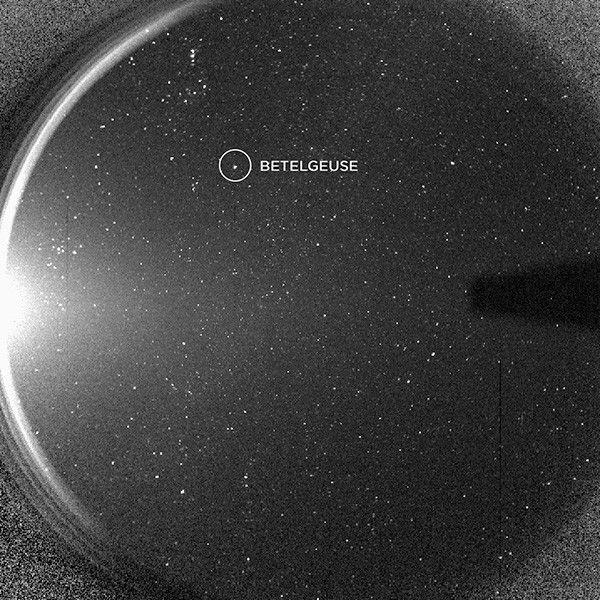
Orion Constellation’s shoulder, composed of the red supergiant Betelgeuse, one of the brightest stars in the sky, underwent one of the most prominent brightness variations ever recorded in modern astronomy history at the end of 2019. During this event, known as the “Great Dimming,” the star’s brightness dropped below its normal level, becoming noticeably darker to the naked eye. This process, which began in late 2019 and lasted into early 2020, sparked global speculation that the star might be about to undergo a supernova explosion. However, detailed observations revealed that the phenomenon was caused by a physical mass ejection followed by the formation of a dust veil.
Betelgeuse (Alpha Orionis) is the second brightest star in the Orion Constellation and approximately the tenth brightest star in the entire sky. This celestial object, located about 700 light years from Earth, is a massive star belonging to the M-type red supergiant class. Its size is so enormous that if placed at the center of the Sun System, its surface would extend beyond the orbit of Jupiter.
The star’s key characteristics are summarized as follows:
Betelgeuse is a star that has reached the final phase of its life cycle; it has consumed the hydrogen in its core and is now fusing heavier elements.
It belongs to the category of “semiregular variable stars,” meaning its brightness and size continuously change through periodic expansion and contraction.
It continuously ejects enormous amounts of material into space through intense stellar winds and surface eruptions (SME), accelerating its evolutionary process.
Its life will end in a violent explosion known as a Type II supernova; this explosion is expected to occur at any time within the next 100,000 years.
Betelgeuse remains one of the most important observational targets in the sky, both due to its prominent orange-red color visible to the naked eye and the unique data it provides on stellar evolution.

Orion Constellation (generated by artificial intelligence)
The sudden drop in Betelgeuse’s brightness began in October 2019 and reached its lowest point in mid-February 2020. During this period, the star dimmed to about one-third of its normal brightness, becoming the faintest it had been in over a century. Images obtained by the Very Large Telescope (VLT) of the European Southern Observatory (ESO) in December 2019 and January 2020 revealed a pronounced asymmetry on the star’s surface. The darkening observed particularly in the southern hemisphere gave the impression that the star’s visible shape had changed, producing a dramatic dip in its light curve. By April 2020, the star’s brightness began returning to normal levels.
Hubble Space Telescope and ground-based observatory data confirmed that the primary cause of the dimming was a violent event known as a Surface Mass Ejection (SME). Convection currents within the star’s inner layers generated a massive convective cell that rose toward the surface, forming an overheated plasma bubble in the photosphere.
This process occurred in the following stages:
A massive and hot plasma mass on the star’s surface was ejected into the outer atmosphere. This mass ejection was far larger and more destructive than coronal mass ejections observed on the Sun.
The ejected material was carried millions of kilometers away from the star’s surface into the cold vacuum of space. Here, the rapidly cooling gas condensed into solid dust particles, forming a dense, dark cloud.
This dense dust veil entered the line of sight between Earth and Betelgeuse, blocking light especially from the star’s southern region. The dimming observed from Earth was caused by this dust cloud obscuring the star’s own light.

Betelgeuse star (generated by artificial intelligence)
The sudden dimming of Betelgeuse during the Great Dimming triggered speculation that the red supergiant, nearing the end of its life cycle, might be undergoing core collapse and preparing to explode. However, analyses confirmed that no core collapse had occurred; the event was entirely the result of a mass loss process in the outer layers. While it is well known that red supergiants experience significant mass loss during their evolutionary phases, the intensity and speed of the mass ejection observed in Betelgeuse have provided new insights into the activity potential of this class of stars.
Having lost a large portion of its surface, Betelgeuse entered a “recovery” phase after the event. This traumatic eruption disrupted the star’s regular pulsation cycle. The previously consistent brightness variation cycle, which lasted approximately 400 days, was disturbed by the shockwave from the mass ejection and temporarily ceased. Subsequent observations by the Hubble Space Telescope revealed that the star’s outer atmosphere (chromosphere) still retained a turbulent structure years after the event and that the surface was struggling to re-establish equilibrium. As the star’s interior attempted to recover from the massive mass loss, surface vibrations became irregular.
Accessed November 26, 2025.
BBC News Türkçe. "Betelgeuse neden karardı? Gizem çözüldü." Accessed January 27, 2026.
European Southern Observatory (ESO). “Betelgeuse’s mysterious dimming explained.” eso.org, Accessed January 27, 2026. https://www.eso.org/public/news/eso2109/
Montargès, Miguel. “A dusty veil shading Betelgeuse.” Nature 594 (2021): 365–368. Accessed January 27, 2026. https://www.nature.com/articles/s41586-021-03546-8
Science NASA. "Hubble Sees Red Supergiant Star Betelgeuse Slowly Recovering After Blowing Its Top." Science NASA, Accessed January 27, 2026. https://science.nasa.gov/missions/hubble/hubble-sees-red-supergiant-star-betelgeuse-slowly-recovering-after-blowing-its-top/
Science NASA. “Hubble Finds That Betelgeuse’s Mysterious Dimming Is Due to a Traumatic Outburst.” Science NASA, Accessed January 27, 2026. https://science.nasa.gov/missions/hubble/hubble-finds-that-betelgeuses-mysterious-dimming-is-due-to-a-traumatic-outburst/


Distance(s) | Approximately 700 Light Years | ||||||||
|---|---|---|---|---|---|---|---|---|---|
Expected Outcome | Type II Supernova | ||||||||
Mass | Approximately 10 - 20 Solar Masses | ||||||||
Radius | ~700 - 900 Solar Radii | ||||||||
Location | Orion Constellation | ||||||||
Betelgeuse Star
Evolutionary Stage
Variability
Mass Loss
Future
The Dimming Process and Observational Data
Physical Cause: Surface Mass Ejection (SME)
Ejection
Cooling and Dust Formation
Light Blocking
Supernova Speculations and the Star’s Structure
Recovery Process and Consequences