

Bigalı Mehmet Çavuş
Eş (ler) | Fatma Tabak | ||||||||
|---|---|---|---|---|---|---|---|---|---|
Çocuk (lar) | 5 | ||||||||
Death Place | Türkiye Çanakkale Biga | ||||||||
Birth Place | Ottoman Empire Bulgaria Filibe | ||||||||
Historical Significance | The term Mehmetçik as a noun father | ||||||||
Unit Served | 27th Regiment 3rd Battalion 10th Company | ||||||||
Death Year | 1964 | ||||||||
Birth Year | 1878 | ||||||||
Bigalı Mehmet Çavuş was born in 1878 in the town of Filibe, Bulgaria, in the year 1294 of the Rumi calendar. His father’s name was Mustafa. During the Russo-Turkish War of 1877–1878, due to massacres against Turks in the Balkans and increasing pressures, his family migrated to Anatolia and settled in Bahçeli Village, then known as İhsaniye, in the Biga district of Çanakkale. Mehmet Çavuş was an infant during this migration. The family continued their sericulture business from Bulgaria in Bahçeli Village and also produced towels and sheets from the silk they harvested.
Mehmet Çavuş’s wife, Fatma (Tabak), was also an immigrant from Bulgaria. The couple had five children: Hüseyin, Hatice, Kamile, Zehra, and Hayriye.
Mehmet Çavuş served in the military for 16 years. He participated in the Balkan Wars and demonstrated his true heroism during the Çanakkale Campaign. During the Çanakkale Campaign, he served as a sergeant in the 10th Platoon of the 3rd Battalion of the 27th Regiment.

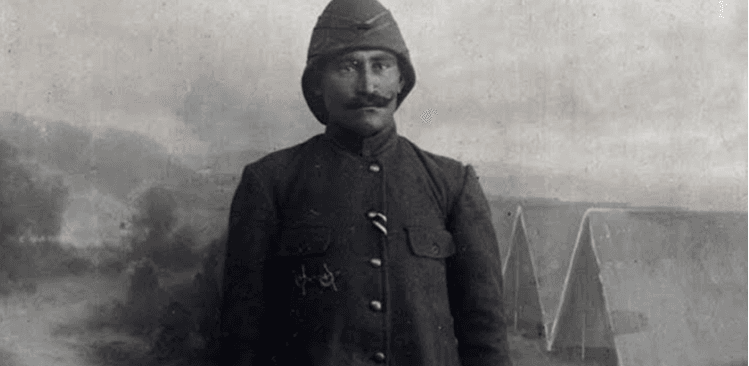
Bigalı Mehmet Çavuş (Biga Municipality)
The Çanakkale Campaign began on 3 November 1914 with artillery fire from British and French ships, and the first casualties were recorded that day. The main naval battles commenced on 19 February, during which Turkish fortifications were targeted from a distance in an attempt to destroy them. On 4 March 1915, the enemy realized they could not pass through the Çanakkale Strait by naval bombardment alone and decided to launch a land assault to provide ground support. At 09:00, Seddülbahir came under heavy bombardment; at 14:45, this bombardment intensified with five armored ships and seven torpedo boats and lasted for approximately 45 minutes. After this intense shelling, it was assumed that no life remained on the shore, and the Plymouth Battalion was landed. This battalion, commanded by an officer, consisted of approximately 70 British soldiers and one machine gun, transported in three large barges.
In the face of enemy ship bombardment and British troop assault, Bigalı Mehmet Çavuş, with his half-platoon of about 20 soldiers, mounted a fierce resistance. Mehmet Çavuş was a sergeant in the 3rd Battalion of the 27th Infantry Regiment under the command of Lieutenant Colonel Mustafa Kemal. Although the Seddülbahir Battery had been evacuated by Turkish forces, Lieutenant Colonel Halil Sami Bey, commander of the 9th Division, stationed Bigalı Mehmet Çavuş and his half-platoon at Seddülbahir.
When enemy forces landed on the shore, Mehmet Çavuş addressed his soldiers: "Look at me, the ground we stand on, the soil beneath our feet, is the legacy of our ancestors, our homeland. Whether it is the honor of our mothers or the honor of our nation, do not forget: these invaders are enemies of honor. They must regret coming here." 【1】 Without regard for the enemy’s numerical and weapons superiority, he and his men lay flat on the ground and opened fire. The enemy returned fire, and a three-hour battle ensued at extremely close range. Mehmet Çavuş and his men continuously changed positions to give the impression of greater numbers, thereby preventing other British troops waiting on the boats from landing.
During the fighting, the mechanism of Mehmet Çavuş’s rifle became inoperable. He threw the rifle to the ground, picked up a fortification ball, and launched a suicidal attack against the enemy. As confirmed by villagers he spoke with and Uluğ İğdemir, a teacher in Biga at the time, Mehmet Çavuş indeed attacked with the fortification ball. He also ordered his soldiers to charge with bayonets. After three hours, the British were forced to retreat to their ships with 23 dead, 25 wounded, and four missing.
This landing was the largest amphibious operation conducted by the enemy during the naval campaign and ended in failure. Among Turkish soldiers, six were martyred and 13 were wounded. Mehmet Çavuş was wounded in the head and chest, and his palms were shattered. After treatment at the Maydos (Eceabat) Hospital, he was sent home for rest and recovery, but before his leave ended, he returned to the front, saying: "I cannot lie here while my comrades are fighting on the front." 【2】 Because the 27th Regiment was attached to the 19th Division, he continued to fight under the command of Lieutenant Colonel Mustafa Kemal until the end of the Çanakkale Campaign.
Mehmet Çavuş’s heroism was widely praised by leading figures of the time. Lieutenant Colonel Mustafa Kemal, in his report to the Fortified Positions Command, requested that Mehmet Çavuş be decorated with a medal or other honor, emphasizing that such recognition would serve as an example to other soldiers. Mehmet Çavuş was awarded the Silver Star War Medal. Additionally, Lieutenant Colonel Mustafa Kemal gifted him a silver watch with a chain and a silver tray.
In a letter to Madam Corinne, Mustafa Kemal wrote about Mehmet Çavuş: "You should not be surprised that my name is heard here, for I chose to bestow honor upon Mehmet Çavuş as the hero of a crucial battle. Of course you do not doubt that the commander of this battle was your friend, and it was I who found Mehmet Çavuş on the battlefield during the night of combat." 【3】
The front page of the newspaper Sabah at the time, under the headline “Cihad-ı Ekber,” carried a report on Mehmet Çavuş’s heroism at Seddülbahir, describing how he and his 20 soldiers halted the enemy landing with a bayonet charge.
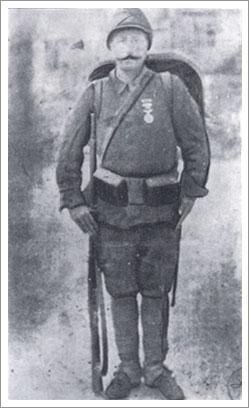
The newspaper Tasvir-i Efkar published reports on Mehmet Çavuş lying wounded in the hospital, along with photographs of him in military uniform adorned with medals. It was also reported that Enver Pasha visited Mehmet Çavuş in the hospital, offered his condolences, and presented him with a medal.
Mehmed Zeki Bey, chief editor of the Müdafaa-i Milliye Magazine, sent 10 Ottoman liras as a reward to be delivered to Mehmet Çavuş; the Ministry of War requested that this exemplary behavior be published in newspapers. Tributes and donations poured in from across the country. Although Mehmet Çavuş accepted the gifts, he refused the money and insisted it be distributed among other soldiers. A gold watch was also sent as a gift from the people of Kayseri to be worn on his chest.

Bigalı Mehmet Çavuş Monument (Gelibolu Historical Area Directorate)
After the Çanakkale Campaign ended, Mehmet Çavuş returned to Bahçeli Village and earned his living through farming while continuing sericulture. He rejected direct financial offers made to him by Atatürk himself, stating: "I fought for my homeland, not for money." 【4】 He never accepted any state financial assistance throughout his life and worked hard to support himself as best he could.
In 1950, during a visit to Biga, President İsmet İnönü visited Mehmet Çavuş at his village and spoke with him. While addressing the public from the balcony of the Halkevi—now used as a health center—Inönü was accompanied by Mehmet Çavuş. İnönü conversed with him and asked if he had any needs; Mehmet Çavuş replied: "I wish you good health, Pasha" 【5】 and made no request whatsoever.
Mehmet Çavuş fell suddenly ill during Ramadan on 3 February 1964, twelve days before Eid, and passed away a week later. His wife Fatma died 13 days after him, on the first day of Eid, 15 February 1964. Both are buried today in the Bahçeli Village cemetery.

Grave of Mehmet Çavuş (Biga Municipality)
Various efforts have been made to preserve the memory of Bigalı Mehmet Çavuş. Based on information presented in a 2008 conference paper at Çanakkale 18 March University, the grave of Mehmet Çavuş in the village cemetery was constructed by the Biga District Governorship, making it visible and increasing its recognition.
As part of the centenary commemorations of the 1915 Çanakkale Campaign, a museum was built in his village. In subsequent years, the Çanakkale Historical Area Directorate of Gelibolu established an information corner dedicated to Çanakkale history.
A documentary film detailing the life and wartime experiences of Bigalı Mehmet Çavuş was produced. This documentary premiered on 10 August at the Çanakkale Seddülbahir Fortress, marking the 106th anniversary of the Anafartalar Victory.
Documentary on Mehmet Çavuş (Presidency of the Çanakkale Historical Area)
Aykut, Şen Nur. "Çanakkale Cephesinde Biga ve Çanakkale Seddülbahir Kahramanı Çanakkale Gazisi Bigalı (Bahçelili) Mehmet Çavuş*." Journal of Academic Studies. (2023): 495-506. https://jasstudies.com/?mod=tammetin&makaleadi=&makaleurl=1f18706d-e2dd-40da-ae34-c76d51d6923f.pdf&key=73542.
Biga Belediyesi. "Mehmet Çavuş Belgeselinin İlk Teaseri Duygulandırdı." Biga Belediyesi. Accessed June 7, 2025. https://www.biga.bel.tr/haberler/mehmet-cavus-belgeselinin-ilk-teaseri-duygulandirdi.
Biga Belediyesi. "Mehmet Çavuş." Biga Belediyesi. Accessed June 8, 2025. https://www.biga.bel.tr/biga-tanitim/mehmet-cavus.
Çanakkale Savaşları Gallipoli Historical Area Presidency. "Mehmet Çavuş Anıtı." Çanakkale Wars Gallipoli Historical Area Presidency. Accessed June 8, 2025. https://canakkaletarihialan.gov.tr/tr/ziyaret/sehitlikveanitlar/mehmet-cavus-aniti.
Çanakkale Tarihi Alan Başkanlığı Youtube Kanalı. "Çanakkale Muharebesi Seddülbahir Kahramanı Bigalı Mehmet Çavuş Belgeseli." Accessed June 8, 2025. https://www.youtube.com/watch?v=eKbCaXs8YFQ
Çanakkale Valiliği. "Çanakkale Fedakârı Bigalı Mehmet Çavuş Belgesel Filminin Gösterimi Yapıldı." T.C. Çanakkale Valiliği. Accessed June 8, 2025. http://www.canakkale.gov.tr/canakkale-fedakari-bigali-mehmet-cavus-belgesel-filminin-gosterimi-yapildi.
Özdemir, İslam. "4 Mart 1915 Seddülbahir Çıkarması ve Bigalı Mehmet Çavuş." Çanakkale Savaşları Araştırma ve Tanıtma Kulübü. Accessed June 8, 2025. https://csatt.org/4-mart-1915-seddulbahir-cikarmasi-ve-bigali-mehmet-cavus/.
[1]
Aykut, Şen Nur. "Çanakkale Cephesinde Biga ve Çanakkale Seddülbahir Kahramanı Çanakkale Gazisi Bigalı (Bahçelili) Mehmet Çavuş." JASSS (The Journal of Academic Social Science Studies) 16, no. 98 (Kış 2023): 495-506. Sayfa no: 500. Erişim tarihi 8 Haziran 2025. http://dx.doi.org/10.29228/JASSS.73542.
[2]
Aykut, Şen Nur. "Çanakkale Cephesinde Biga ve Çanakkale Seddülbahir Kahramanı Çanakkale Gazisi Bigalı (Bahçelili) Mehmet Çavuş." JASSS (The Journal of Academic Social Science Studies) 16, no. 98 (Kış 2023): 495-506. Sayfa no: 500. Erişim tarihi 8 Haziran 2025. http://dx.doi.org/10.29228/JASSS.73542.
[3]
Aykut, Şen Nur. "Çanakkale Cephesinde Biga ve Çanakkale Seddülbahir Kahramanı Çanakkale Gazisi Bigalı (Bahçelili) Mehmet Çavuş." JASSS (The Journal of Academic Social Science Studies) 16, no. 98 (Kış 2023): 495-506. Sayfa no: 500. Erişim tarihi 8 Haziran 2025. http://dx.doi.org/10.29228/JASSS.73542.
[4]
Aykut, Şen Nur. "Çanakkale Cephesinde Biga ve Çanakkale Seddülbahir Kahramanı Çanakkale Gazisi Bigalı (Bahçelili) Mehmet Çavuş." JASSS (The Journal of Academic Social Science Studies) 16, no. 98 (Kış 2023): 495-506. Sayfa no: 501. Erişim tarihi 8 Haziran 2025. http://dx.doi.org/10.29228/JASSS.73542.
[5]
Aykut, Şen Nur. "Çanakkale Cephesinde Biga ve Çanakkale Seddülbahir Kahramanı Çanakkale Gazisi Bigalı (Bahçelili) Mehmet Çavuş." JASSS (The Journal of Academic Social Science Studies) 16, no. 98 (Kış 2023): 495-506. Sayfa no: 501. Erişim tarihi 8 Haziran 2025. http://dx.doi.org/10.29228/JASSS.73542.

Bigalı Mehmet Çavuş
Eş (ler) | Fatma Tabak | ||||||||
|---|---|---|---|---|---|---|---|---|---|
Çocuk (lar) | 5 | ||||||||
Death Place | Türkiye Çanakkale Biga | ||||||||
Birth Place | Ottoman Empire Bulgaria Filibe | ||||||||
Historical Significance | The term Mehmetçik as a noun father | ||||||||
Unit Served | 27th Regiment 3rd Battalion 10th Company | ||||||||
Death Year | 1964 | ||||||||
Birth Year | 1878 | ||||||||
No Discussion Added Yet
Start discussion for "Bigalı Mehmet Çavuş" article
Heroism During the Seddülbahir Landing on 4 March 1915
Recognition and Legacy
Post-War Life and Death
Current Commemoration and Awareness Efforts