


This article was automatically translated from the original Turkish version.
+1 More
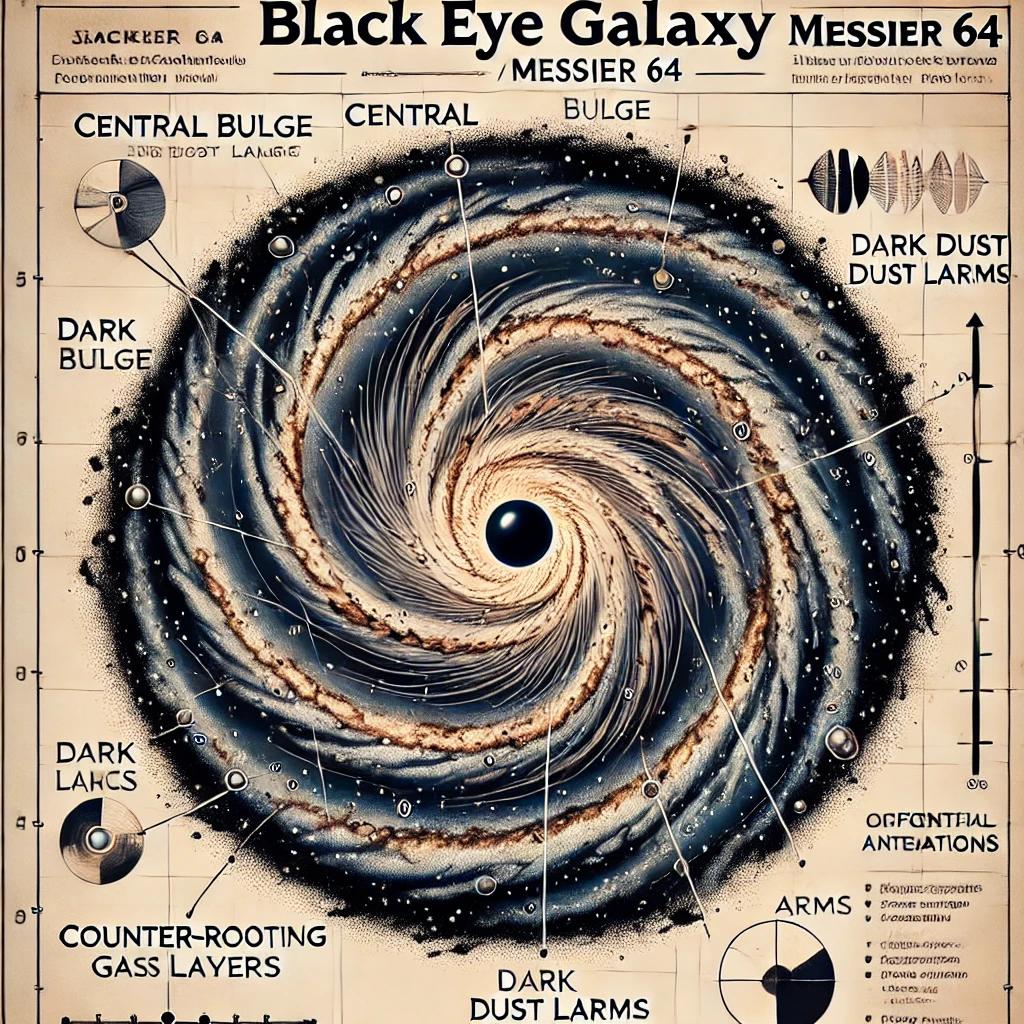
The Black Eye Galaxy (Messier 64, NGC 4826) is a striking spiral galaxy located in the Başak constellation within the place region. Its most noticeable feature is a prominent dark dust lane that resembles a black eye like near its center, formed by darkness dust clouds. Due to this distinctive structure, it is known as the Black Eye Galaxy.
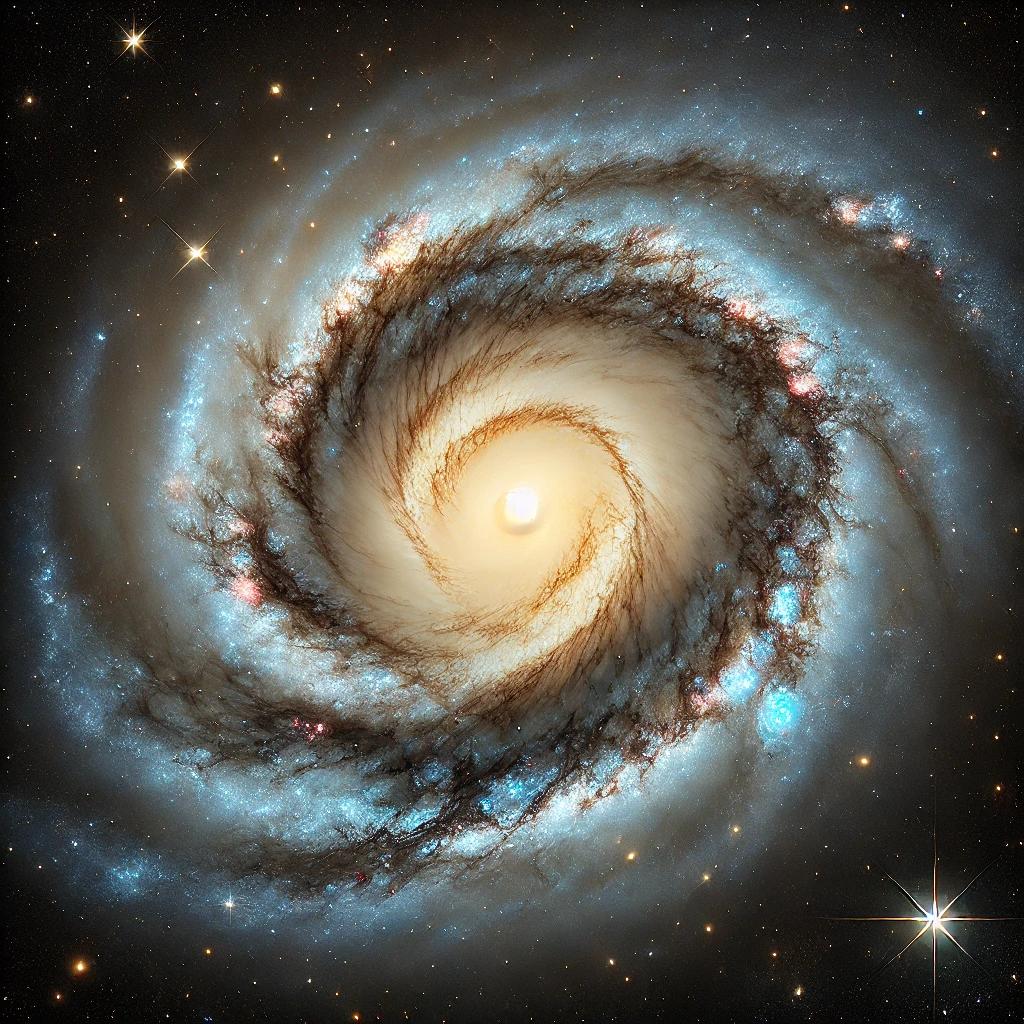
Artificial Intelligence Generated Image of the Black Eye Galaxy.
M64 is located approximately 17 million light years from World and is easily observable even by amateur astronomers due to its brightness. The galaxy is surrounded by prominent inclined dust lanes, which are dense substance regions that block light from reaching the inner parts of the galaxy.
Data from the Hubble Space Telescope and other observatories indicate that a vigorous star formation process is occurring toward the center of M64. This activity may be linked to past interactions the galaxy has experienced. Additionally, the inner and outer regions of the galaxy rotate in opposite directions, providing strong evidence that M64 may have merged with another galaxy in the past.
One of M64’s most unusual features is the counter-rotating motion of gas between its inner and outer regions. Observations show that gas in the inner region rotates in a hour direction, while gas in the outer region rotates counterclockwise. This phenomenon is typically explained by gravitational interactions between galaxies. This opposing rotation triggers dynamic processes that cause gas collisions and ultimately lead to the formation of new stars.
The structural and dynamic properties of M64 suggest that it may have undergone a merger event in its past. The accretion of a smaller satellite galaxy into M64 could have triggered the counter-flowing gas streams and the intense star formation observed at its center.
As a result, gas in the inner region became compressed, initiating a strong star formation process that contributed to the current structure of M64.
It is believed that gravitational interactions caused M64 to enter this transformational phase. This makes M64 an important example in understanding how galaxies evolve.
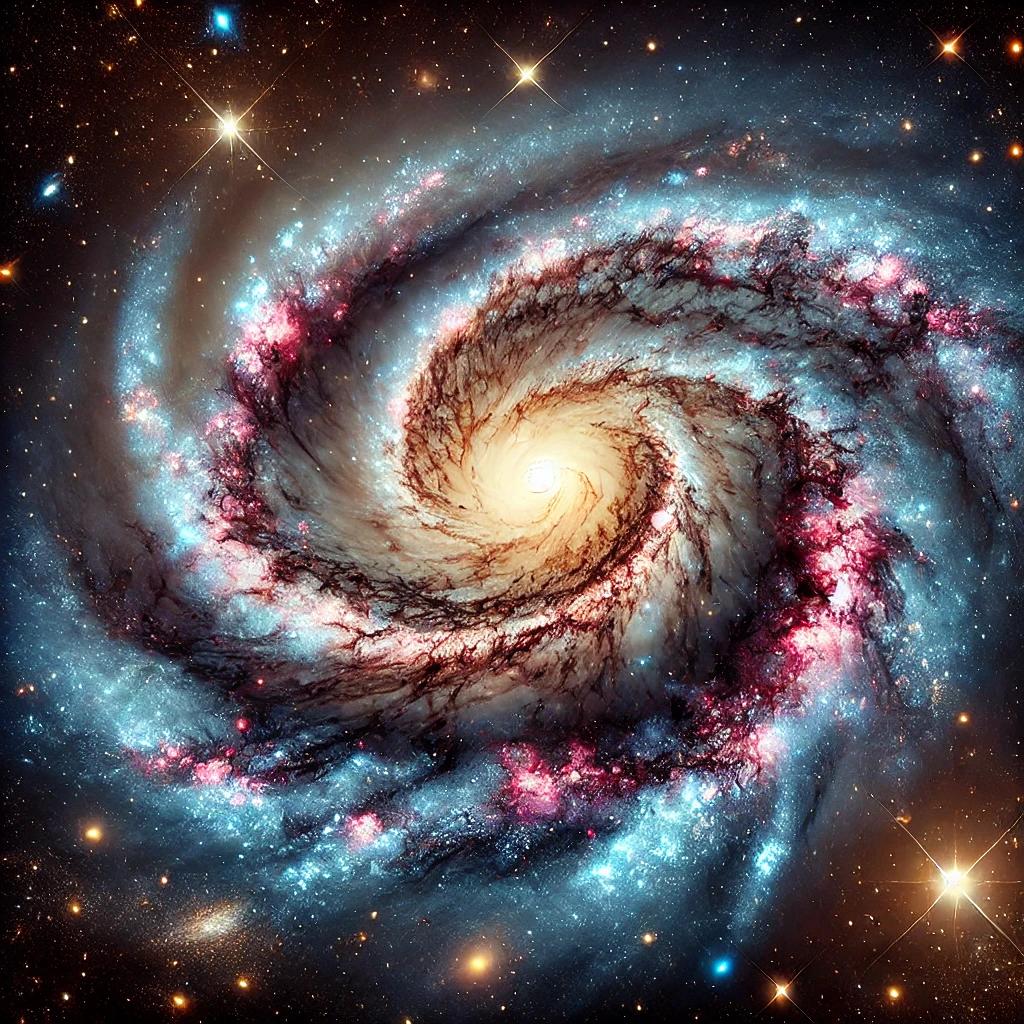
Artificial Intelligence Generated Image of the Black Eye Galaxy.
The Black Eye Galaxy is a significant galaxy noted for its unique structure, counter-rotating gas motions, and active star-forming regions. The merger events it experienced in the past have shaped its current dynamic structure. M64 continues to serve as a valuable target for astronomy research, offering important insights into galaxy evolution and interaction processes.
Balcells, M., & Quinn, P. J. (1990). Bulge Formation by Merging Disk Galaxies. The Astrophysical Journal, 361, 381-400.
Binney, J., & Tremaine, S. (2008). Galactic Dynamics. Princeton University Press.
Braun, R., Walterbos, R. A. M., Kennicutt, R. C., & Tacconi, L. J. (1994). Gas Dynamics in M64: The Counterrotating Disk Hypothesis. The Astrophysical Journal, 420, 558-569.
Corsini, E. M., Pizzella, A., Bertola, F. (2003). Counterrotation in Disk Galaxies. Annual Review of Astronomy and Astrophysics, 41, 179-238.
Hubble, E. (1992). The Realm of the Nebulae. Yale University Press.
Kormendy, J., Fisher, D. B., Cornell, M. E., & Bender, R. (2004). Structure and Formation of Elliptical and Spheroidal Galaxies. The Astrophysical Journal, 600, 102-114.
Rubin, V. C. (1994). Rotation Properties of 21 Sc Galaxies with a Large Range of Luminosities and Radii, from NGC 4605 (R = 4 kpc) to UGC 2885 (R = 122 kpc). The Astrophysical Journal, 285, 81-108.
Sandage, A., & Tammann, G. A. (1981). A Revised Shapley-Ames Catalog of Bright Galaxies. Carnegie Institution of Washington.

Observational Characteristics and Structure
Rotation Dynamics and Gas Flow
Evolution and History