Black Lagoon is an action and crime drama produced by Madhouse studio, based on the manga series created by Japanese writer and artist Rei Hiroe. The manga, first serialized in 2002 in Shogakukan’s Monthly Sunday Gene-X magazine, was adapted into a television anime series in 2006 under the direction of Sunao Katabuchi.
The work centers on the operations of the "Lagoon Company," a group operating primarily in Southeast Asian waters, especially based in Thailand, that engages in illegal shipments and mercenary activities. The narrative depicts, from technical and sociological perspectives, the functioning of an underground world detached from the legal order of modern society.
Overview and Publication History
Black Lagoon has been presented to audiences across different media platforms at various times under its media license. The development and release timeline of the series is as follows:
- Manga Publication: The original series by Rei Hiroe was announced in the April 19, 2002 issue of Monthly Sunday Gene-X, published under Shogakukan. The first tankōbon volume was released on December 12, 2002, and publication continued intermittently over the years, aligned with the author’s working schedule.
- Anime Series (First Season): The first 12 episodes of the anime adaptation by Madhouse studio aired on local Japanese channels such as Chiba TV and Tokyo MX between April 8, 2006 and June 24, 2006.
- Second Season (The Second Barrage): The 12-episode second season, produced in response to the series’ commercial success, began on October 2, 2006 and concluded on December 18, 2006. This season adapted later story arcs from the manga.
- OVA Series (Roberta’s Blood Trail): The third installment, a five-episode series produced directly for video (OVA) and outside the traditional television format, was released in intervals between July 17, 2010 and June 22, 2011.
- International Distribution: The series was localized and licensed in multiple languages including English, French, and German through distributors such as Geneon Entertainment and later Funimation in North America, and Kazé in Europe.
Universe and Fictional Setting
Black Lagoon is built upon the geography of the real world and the geopolitical conditions of the mid-1990s. The central location of the story is the fictional port city of Roanapur, situated along the southeastern coast of Thailand.
- Geographical and Political Structure: Roanapur is portrayed as a lawless zone along the Gulf of Thailand, where official authority is limited and local police forces turn a blind eye to criminal activities in exchange for bribes. The city has historically served as a haven for fugitives, former soldiers, and criminals since the post-World War II era through the end of the Cold War.
- Hierarchy and Power Balance: The social structure of this fictional universe is based on mutual agreements among international crime cartels. Peace and order in the city are maintained by a fragile balance of power between groups such as the Russian mafia (Hotel Moscow), Chinese Triads, Colombian cartels, and the Italian mafia. Coordination among these groups is often facilitated through intermediaries like the "Violence Church," a clandestine arms and logistics center disguised as a church.
- Logistics and Operations: The technological elements of the universe revolve around late 20th-century military hardware, firearms, and maritime vessels. Within this ecosystem, the "Lagoon Company" operates as an independent unit, using an 80-foot Elco-type torpedo boat to conduct piracy, smuggling, and courier operations across the South China Sea and surrounding waters.
Black Lagoon begins with the radical transformation in the life of Okajima Rokuro, an ordinary office worker employed by Asahi Industries, one of Japan’s leading corporations. In 1995, while transporting a confidential disk to Southeast Asia, he is kidnapped by a mercenary group known as the "Lagoon Company."
- Breaking Point: Rokuro’s company, seeking to prevent the exposure of illegal data contained on the disk, sends a mercenary unit not to rescue him but to destroy the vessel and everyone aboard. Declared dead and abandoned by his employer, Rokuro is forced to collaborate with his captors to survive.
- Transformation: Questioning the false values of modern society and his own past life, Rokuro adopts the name "Rock" and joins the Lagoon Company. The story revolves around the conflict between Rock’s pacifist and rule-bound background and Roanapur’s violent, morally ambiguous world.
- Narrative Structure: The plot is structured as a series of self-contained "arcs" centered on specific criminal cases or operations. These missions span a wide range, from piracy attacks on the high seas and underwater expeditions in search of Nazi gold to negotiations with international terrorist organizations and Yakuza vendettas in Japan.
- Dynamics: As the story progresses, it delves not only into physical confrontations but also into the psychological traumas of the characters and how their pasts influence their present decisions, as well as the shifting hierarchies within the criminal underworld.
Main Characters and Voice Cast
Black Lagoon features a cast of individuals from diverse nationalities and military or criminal backgrounds. Their technical traits and voice cast are detailed below:
- Rock (Rokuro Okajima): The group’s logistics, language, and negotiation specialist. A former Japanese salaryman, Rock employs his analytical thinking and diplomatic skills to guide the team’s strategic planning. He avoids using firearms.
- Voice Actor: Daisuke Namikawa (Japanese), Brad Swaile (English).
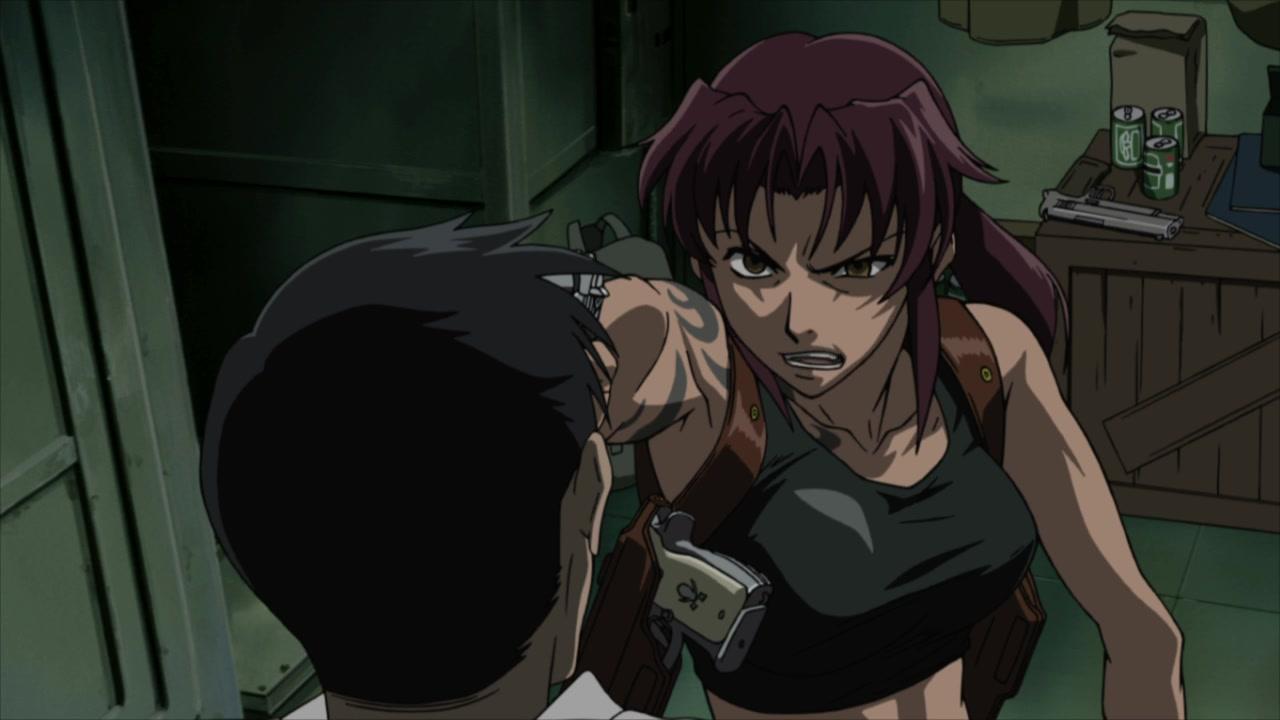
- Revy (Rebecca Lee): The group’s primary offensive force. A Chinese-American, Revy is known as "Two Hands" for her ability to wield two modified Beretta 92FS Inox pistols simultaneously. She possesses exceptional proficiency with firearms and close-quarters combat.
- Voice Actor: Megumi Toyoguchi (Japanese), Maryke Hendrikse (English).
- Dutch: The founder and leader of the Lagoon Company and captain of their torpedo boat. Allegedly a Vietnam War veteran, Dutch is known for his calm demeanor, tactical intelligence, and physical strength. He typically wields a Smith & Wesson 629 revolver and a Remington 870 shotgun.
- Voice Actor: Tsutomu Isobe (Japanese), Dean Redman (English).
- Benny: The group’s expert in technology, systems, and mechanics. He fled the United States after trouble with the FBI and the mafia following his graduation from a university in Florida. He manages the group’s communications network and provides technical support.
- Voice Actor: Hiroaki Hirata (Japanese), Brian Drummond (English).
Key Supporting Characters
- Balalaika (Sofiya Pavlovena): Leader of the Russian mafia organization "Hotel Moscow" in Roanapur. A former Soviet Army captain and veteran of the Soviet-Afghan War, she runs a disciplined, paramilitary organization.
- Voice Actor: Mami Koyama (Japanese), Patricia Drake (English).
- Mr. Chang (Chang Bai-Ji): The Roanapur representative of the Chinese Triads. He possesses skill with dual pistols comparable to Revy’s and plays a pivotal role in maintaining the city’s power balance.
- Voice Actor: Akimitsu Takase (Japanese), Trevor Devall (English).
Themes and Narrative Style
Black Lagoon transcends the action genre to explore deep sociological and philosophical themes. Its narrative style merges visual intensity with intellectual inquiry.
- Nihilism and Moral Ambiguity: The series rejects traditional distinctions between good and evil. Most characters have developed a nihilistic outlook on life due to past traumas or social alienation. The concept of justice has been replaced by the instinct for survival and personal interest.
- Social Class and Identity Loss: Through the character of Rock, the series critiques the modern corporate world’s tendency to homogenize and objectify individuals. The characters’ arrival in Roanapur symbolizes the death of their former civil identities and the construction of new ones within the criminal underworld.
- Globalization and the Legacy of War: The story presents, with technical realism, how former soldiers left unemployed after the Cold War—such as those in Hotel Moscow—became embedded in the global arms trade and the underground economy shaped by global economic inequality.
- Narrative Technique: The series employs the aesthetics of "hardboiled" detective fiction and 1990s Hong Kong action cinema (particularly the "Gun Fu" style of John Woo). Dialogue frequently incorporates literary allusions, philosophical metaphors, and technical military jargon. Violence in the narrative is not merely a visual element but a means through which characters communicate and interpret the world around them.
Black Lagoon consists of three main installments released at intervals. All seasons and episodes are listed below in chronological order:
- Black Lagoon (Season 1): The first season, consisting of 12 episodes, aired between April and June 2006. It introduces the story, the characters, and the foundational operational arcs.
- Black Lagoon: The Second Barrage (Season 2): The second season, also 12 episodes, aired between October and December 2006. It is a direct continuation of the first season and expands the plot into more complex international crises.
- Black Lagoon: Roberta’s Blood Trail (OVA): A five-episode "Original Video Animation" series released between 2010 and 2011. Based on the manga arc "El Baile de la Muerte," this production was released directly in video format, independent of the television series.
Black Lagoon has received critical attention since its release for its technical quality and narrative structure, both in Japan and internationally:
- Critical Success: The series received high praise from critics, particularly for the animation quality delivered by Madhouse and the direction of Sunao Katabuchi. It is regarded as one of the most successful examples of the "Seinen" genre (targeted at adult male audiences).
- Anime Expo and Industry Nominations: The production received nominations at various international anime festivals and industry award ceremonies in categories such as "Best Action Series" and "Best Dubbing Cast." The English localization, in particular, earned acclaim for its faithfulness to the original script and the quality of its voice performances on Western platforms.
- Viewer and Database Ratings: On global anime databases such as "MyAnimeList" and "Anime News Network," the series consistently ranks among the highest-rated in its genre and has maintained enduring popularity over time.