


This article was automatically translated from the original Turkish version.
Family | Synbranchidae (eel-like fishes / swamp eels) | ||||||||
|---|---|---|---|---|---|---|---|---|---|
Latin | Ophisternon infernale | ||||||||
Geography | Yucatán Peninsula Mexico (particularly underground waters and cave systems) | ||||||||
Gender Characteristics | Eyeless, pigmentless, aquatic, cave-dwelling, buccopharyngeal respiration | ||||||||
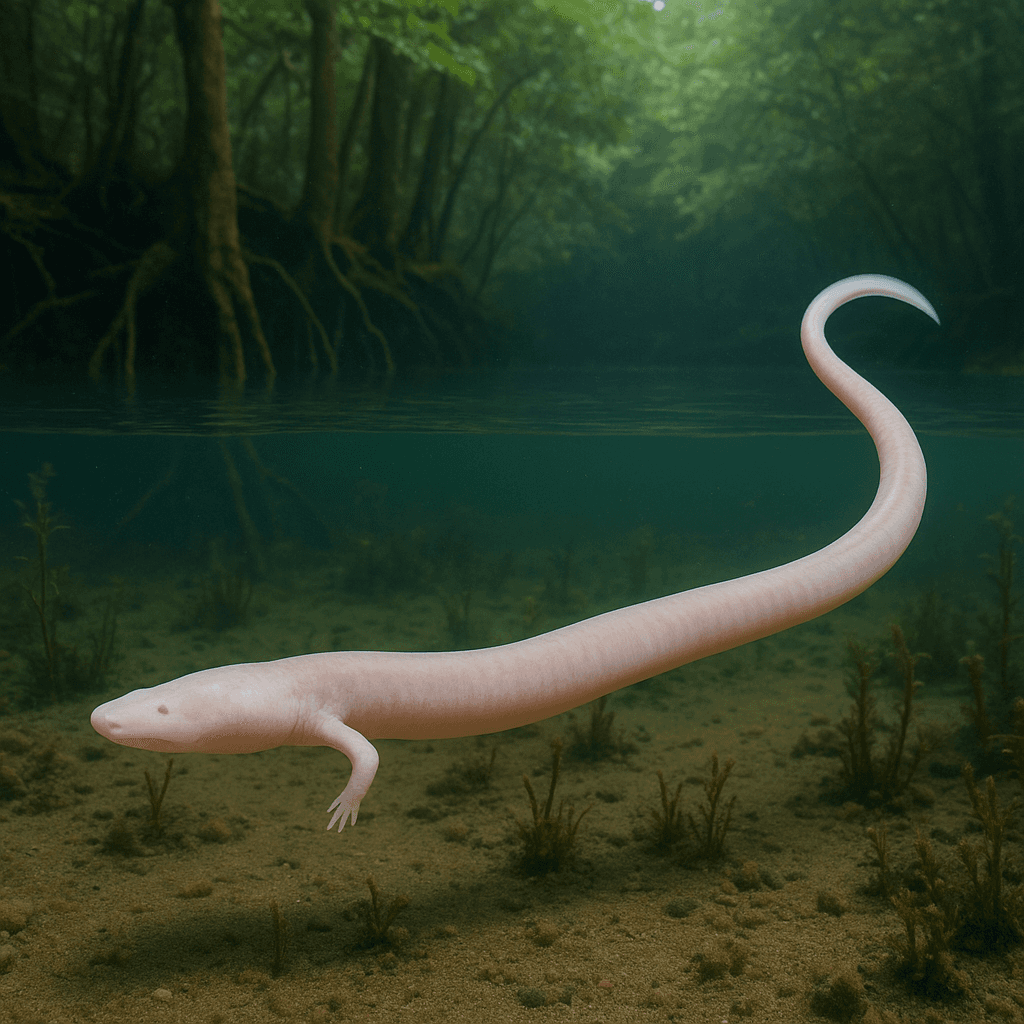
The Blind Cave Eel (Ophisternon infernale) is a rare freshwater fish species endemic to the Yucatán Peninsula of México. Adapted entirely to life in complete darkness, this fish has lost its pigmentation and eyes. These traits classify it among troglobitic fish. Such adaptations have enabled the Blind Cave Eel to develop survival strategies suited to its cave environment.
Its body structure is long and slender, resembling a snake, which allows easy movement through narrow cave passages. Its skin lacks pigment and appears pale pink or white. Its eyes have completely regressed through evolutionary processes. To perceive its surroundings, it possesses specialized sensory organs developed in the head region.
These features are critical for the Blind Cave Eel’s survival in cave habitats. In environments devoid of light, sensory organs provide a significant advantage in locating food and avoiding predators. This species represents an important example of the endemic faunal richness of the Yucatán region.
The Blind Cave Eel typically reaches a length of up to 30 cm. Its body is muscular and flexible. The head is broad and spatula-shaped, enabling it to detect environmental vibrations with high sensitivity. Additionally, a lateral line system running along the length of the body detects water movements.
The thin skin allows rapid response to environmental changes. The gill openings are located on the underside of the body and form a V-shaped slit. This adaptation enhances respiratory efficiency and facilitates movement through narrow cave passages. These adaptations play a vital role in meeting the fish’s oxygen requirements.
The dorsal, anal, and caudal fins are reduced. This condition minimizes friction in confined cave spaces. Its anatomical features provide clear evidence of complete adaptation to cave life. These physical traits demonstrate perfect adaptation to its habitat.

Blind Cave Eel (Generated by Artificial Intelligence)
Ophisternon infernale is found exclusively in limestone cave systems of the Yucatán Peninsula. It is particularly distributed in cenotes such as Hoctún, Balankanché, Pochote, and Tzab-Nah. These habitats feature darkness, high humidity, and stable temperatures.
The species prefers water-filled sections of cave systems. Underground rivers and pools provide limited food resources but also few predators. These environmental conditions facilitate the Blind Cave Eel’s adaptation to the cave ecosystem.
Research indicates that populations of the Blind Cave Eel are generally isolated. Isolation can lead to reduced genetic diversity. Furthermore, the areas inhabited by this fish are often remote and difficult to access, making them challenging to study.
The Blind Cave Eel is primarily a solitary species. Individuals move and hunt independently within cave systems. Social interactions are extremely rare and typically limited to breeding periods.
During daylight hours, it rests near cave walls. At night, it becomes active, moving through the cave system in search of prey. This nocturnal behavior has evolved to conserve energy and adapt to the harsh conditions of the cave environment.
Communication occurs primarily through chemical and mechanical signals. During breeding periods, males release chemical cues to females. Territorial behaviors are also observed, and aggressive responses may occur when territories are invaded.
The Blind Cave Eel exhibits carnivorous feeding habits. Its diet includes small invertebrates found in cave environments, particularly shrimp and insect larvae. It may also consume organic matter transported into the cave system.
During feeding, it relies on its highly developed sensory organs. Sensory structures in the head detect water movements and chemical cues. This enables the fish to locate prey easily even in complete darkness.
Its hunting strategy typically involves ambush predation. To conserve energy, it waits for prey to approach and then captures it with a rapid movement. These feeding strategies allow efficient utilization of the limited food resources available in cave environments.
Information on the reproductive behavior of this species is limited. However, observations of similar species suggest that males exhibit nest-building and egg-guarding behaviors. These behaviors increase the survival chances of offspring.
The breeding period varies depending on environmental factors such as temperature and food availability within the cave system. The female deposits her eggs in a nest prepared by the male. The male then maintains the cleanliness of the eggs and protects them throughout their development.
After hatching, juveniles remain in the nest for a period before dispersing independently throughout the cave system. This process represents a significant adaptation for ensuring the continuation of the species.
Hervant, Frédéric, Jacques Mathieu, and Jacques Durand. “Behavioural, Physiological and Metabolic Responses to Long-Term Starvation and Refeeding in a Blind Cave-Dwelling (Proteus Anguinus) and a Surface-Dwelling (Euproctus Asper) Salamander.” Journal of Experimental Biology 204, no. 2 (2001): 269–281. https://doi.org/10.1242/jeb.204.2.269.
Romero, Aldemaro, and Kelly M. Paulson. “The Biology of Hypogean Fishes.” In *It’s a Wonderful Hypogean Life: A Guide to the Troglomorphic Fishes of the World*, 13–41. https://link.springer.com/chapter/10.1007/978-94-015-9795-1_2.

Family | Synbranchidae (eel-like fishes / swamp eels) | ||||||||
|---|---|---|---|---|---|---|---|---|---|
Latin | Ophisternon infernale | ||||||||
Geography | Yucatán Peninsula Mexico (particularly underground waters and cave systems) | ||||||||
Gender Characteristics | Eyeless, pigmentless, aquatic, cave-dwelling, buccopharyngeal respiration | ||||||||
No Discussion Added Yet
Start discussion for "Blind Cave Eel (Ophisternon infernale)" article
Physical Characteristics
Habitat and Distribution
Behavior and Social Structure
Feeding Habits
Reproduction and Juveniles