
This article was automatically translated from the original Turkish version.
+1 More
The Blue Snowball Nebula (NGC 7662) is a deep-sky object belonging to the planetary nebula class. Located in the direction of the Andromeda constellation, this celestial body was first discovered by William Herschel in 1784. The nebula contains the remnants of a star that has reached the final stages of its life cycle. It is regarded as one of the key examples that contribute to our understanding of the general evolutionary process of planetary nebulae due to its observable structure and morphology.
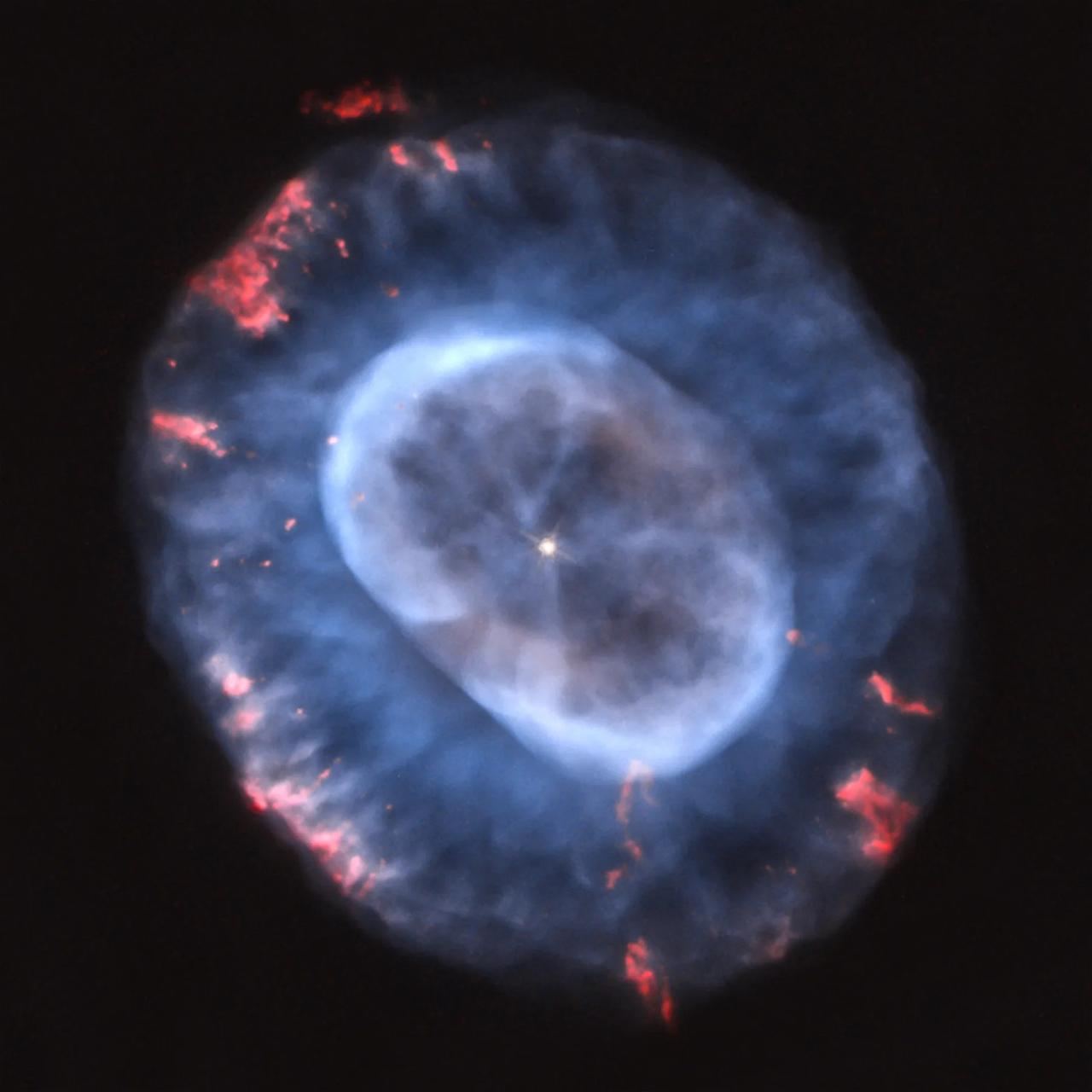
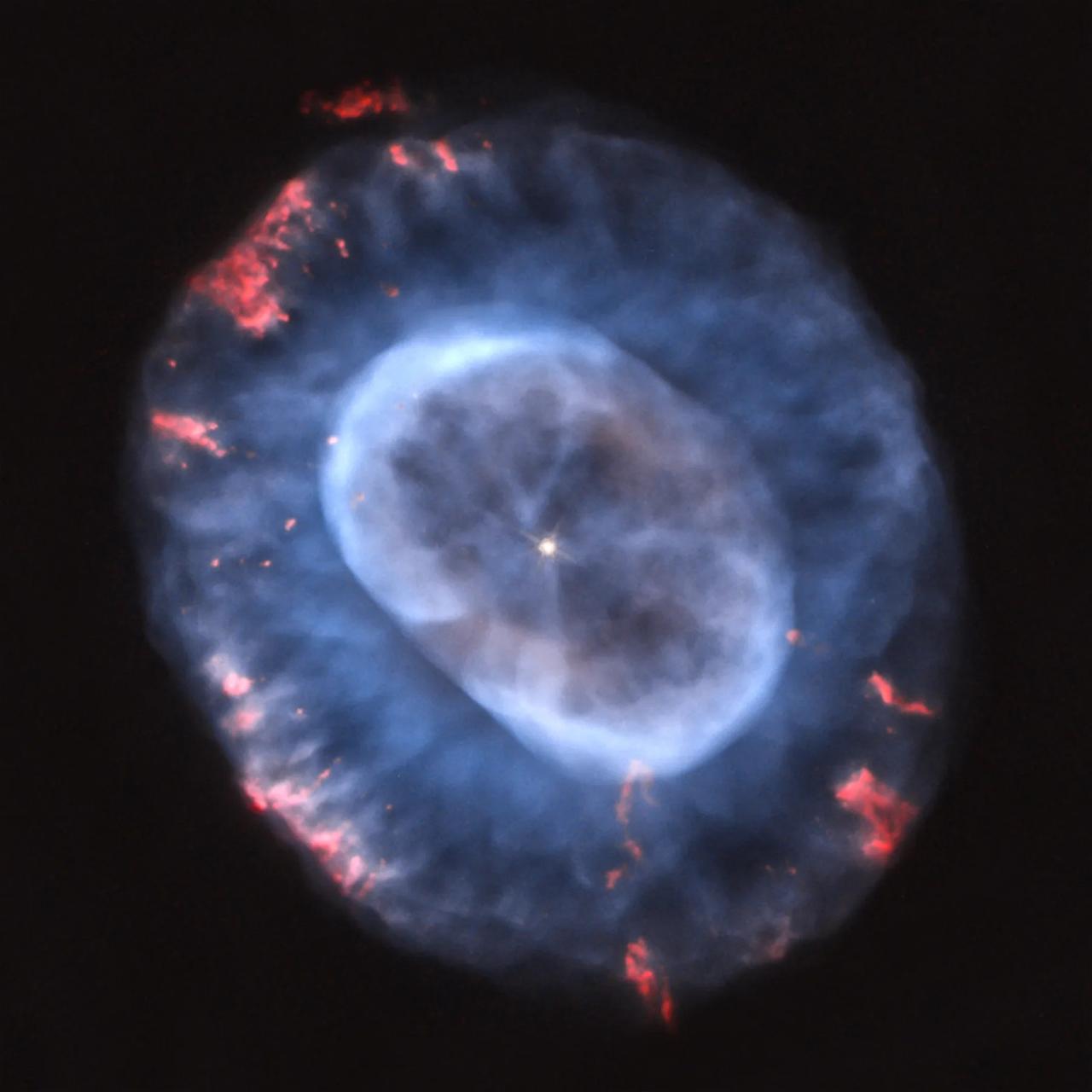
The Blue Snowball Nebula (NASA)
NGC 7662 lies within the boundaries of the Andromeda constellation. Its position in the sky is defined by a right ascension of 23 hours 25 minutes 53.5 seconds and a declination of +42° 32′ 06″. Its apparent magnitude is approximately +8.6, making it observable by amateur astronomers using small to medium-sized telescopes. The central region of the nebula spans about 20 by 13 arcseconds; however, when including its surrounding halos, its total angular size can reach up to 2 arcminutes.
Resolving the fundamental structural details of NGC 7662 requires telescope systems with high resolution. Observations particularly favor narrowband filters, which allow for a more detailed mapping of the distribution and dynamic structure of the ionized gas.
Estimates of NGC 7662’s distance vary between 2,200 and 6,000 light years, but the generally accepted value is approximately 2,500 light years. At this distance, the physical diameter of the nebula’s central region is calculated to be about 0.5 light years; this measurement expands further when including the outer halos.
Structurally, NGC 7662 consists of nested, multi-layered elliptical shells. At its center lies a white dwarf with a very high surface temperature. The inner shell has a relatively denser and brighter structure, while the outer shell is more extended and of lower density. Additionally, asymmetric halo structures and jet-like protrusions have been detected around the nebula. These components reflect the effects of dynamic mass ejection and ionization processes during NGC 7662’s evolutionary history.
The star at the center of NGC 7662 is a white dwarf, the remnant of a low-mass star that has completed its red giant phase and expelled its outer layers into space. This evolutionary scenario is considered characteristic of planetary nebula formation.
The central star’s surface temperature is estimated to range between 75,000 and 100,000 Kelvin. This high temperature enables it to emit strong ultraviolet (UV) radiation, which ionizes the surrounding gas and causes the nebula to fluoresce. Its mass is approximately 60 percent of the Sun’s, which falls within the expected range for a typical white dwarf. The ionizing energy emitted by the central star plays a fundamental role in determining the visible morphology and spectral properties of NGC 7662.
The spectrum of NGC 7662 exhibits typical emission lines from ionized gases. [O III] (Oxygen-III) emission lines are extremely dominant and constitute the primary source of the nebula’s characteristic blue-green hue. Hα and Hβ lines arise from the ionization of hydrogen gas within the nebula. [N II] and [S II] lines originate from regions with lower ionization energy and reflect different physical conditions within the nebula. Structurally, observations reveal not only high-ionization zones but also cooler outer layers. These spectral data provide insights into the nebula’s temperature distribution, density structure, and chemical enrichment.
This nebula expands at a velocity ranging between 20 and 40 km/s and is estimated to be between 1,000 and 2,000 years old. Observations have revealed different expansion velocities between the inner and outer shells. This variation is associated with both the radiation pressure from the central star and differences in the rates of mass ejection during earlier phases of its evolution.
The Hubble Space Telescope and advanced ground-based optical systems have enabled high-resolution studies of NGC 7662’s morphological structure. Using narrowband filter CCD imaging and spectroscopy, the distribution of ionized gas has been mapped. Additionally, radio wavelength observations have been used to investigate molecular gas remnants and the outer halo structures of the nebula.
NGC 7662 represents one of the final evolutionary stages of low- to intermediate-mass stars: the planetary nebula phase. Such nebulae are crucial building blocks in the process of stellar mass loss and the enrichment of the interstellar medium with ejected material. Observations of NGC 7662 provide opportunities to test models of stellar evolution.
ESA/Hubble. “NGC 7662.” *ESA/Hubble Image Archive.* Accessed July 16, 2025. https://esahubble.org/images/opo9738c20/.
NASA. “Caldwell 22.” *NASA Science: Hubble Space Telescope.* Accessed July 16, 2025. https://science.nasa.gov/mission/hubble/science/explore-the-night-sky/hubble-caldwell-catalog/caldwell-22/.
NASA. “Hubble’s Caldwell Catalog.” *NASA Science: Hubble Space Telescope.* Accessed July 16, 2025. https://science.nasa.gov/mission/hubble/science/explore-the-night-sky/hubble-caldwell-catalog/.

No Discussion Added Yet
Start discussion for "Blue Snowball Nebula (NGC 7662)" article
Position and Observability
Physical Properties and Structural Components
Central Star
Spectroscopic Properties and Chemical Composition
Dynamic Properties
Observations and Evolutionary Process