


This article was automatically translated from the original Turkish version.
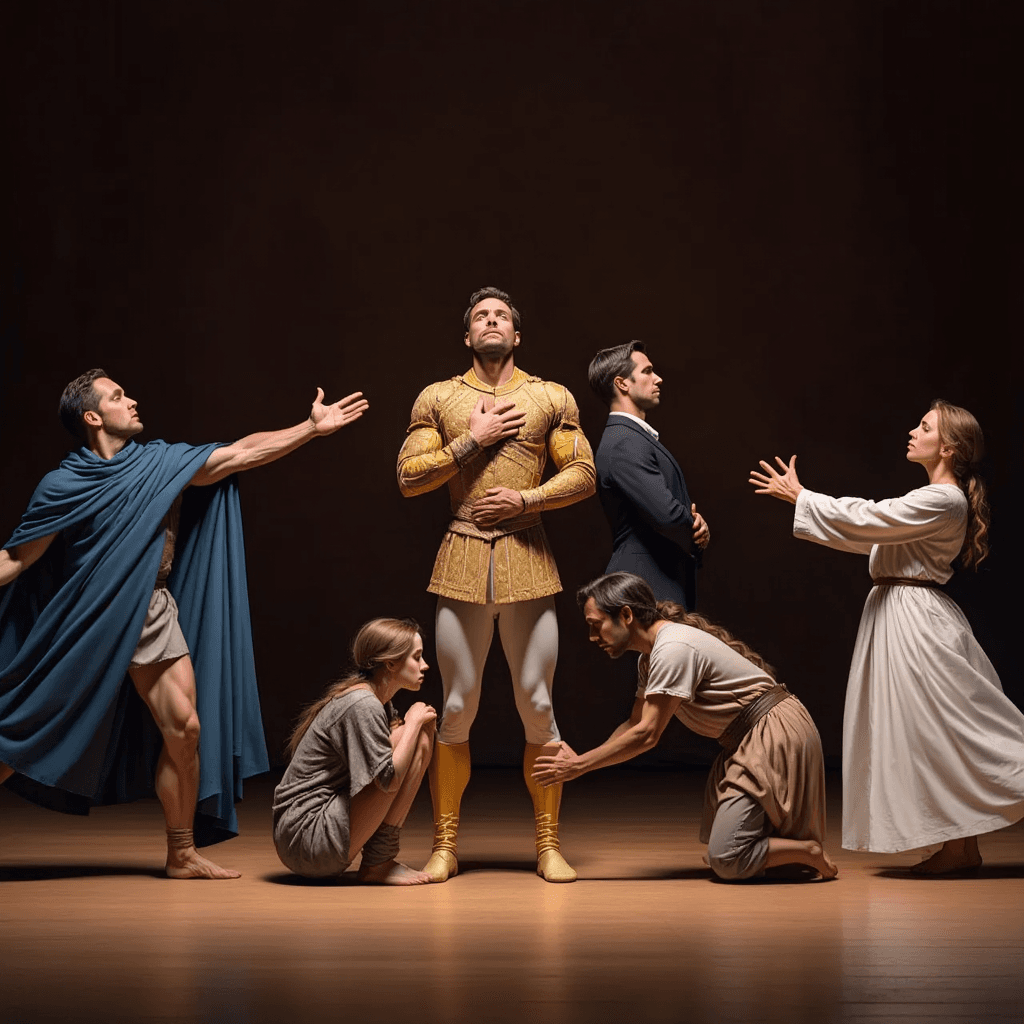
Body Language in Theater (Generated by Artificial Intelligence.)
Fundamental Elements | Gestures, facial expressions, posture, eye contact, movement | ||||||||
|---|---|---|---|---|---|---|---|---|---|
Purpose(s) | Conveying the character's inner world and motivations to the audience through nonverbal communication | ||||||||
Stage Vs. Screen | Requires exaggerated and clear expressions on stage, but more subtle and natural expressions on screen | ||||||||
Related Disciplines | Diction, dance, observation, empathy | ||||||||
In theater, body language relies on the actor’s conscious use of their body, gestures, facial expressions, and posture to convey a character, emotional state, or narrative being staged. As a fundamental component of stage arts beyond verbal communication, body language functions as a powerful nonverbal medium that transmits the character’s inner world, psychological motivations, and relationships with other characters to the audience.
An actor’s performance on stage depends not only on the text and verbal expression but also on bodily expression and physical presence. The harmonious use of gestures and facial expressions, alongside vocal elements such as voice, diction, and rhythm, strengthens the believability and coherence of the portrayed character. In this context, body language in theater is not merely a supplementary element but a vital component that enriches the narrative’s meaning and actively influences audience engagement.
At the core of body language are gestures and facial expressions. Gestures encompass movements of the hands, arms, legs, head, and torso in various directions, while facial expressions make emotions and thoughts visible through the muscles of the face. These two elements often generate meaning without the need for verbal expression. The nonverbal messages conveyed by the actor’s gestures and facial expressions form part of the dramatic structure on stage, revealing the depth of the character to the audience.
The importance accorded to body language in theater has varied across different historical periods and movements. In ancient Greek theater, the use of masks necessitated exaggerated bodily movements and gestures, whereas modern theater favors a more natural and psychologically grounded body language. Today, specialized studies in theater pedagogy and actor training focus on the conscious and controlled use of body language, aiming to enhance actors’ bodily awareness and enable them to project a compelling presence on stage.
The role of body language in theater has been interpreted in diverse ways throughout history. In ancient Greek theater, masks covering the actors’ faces made exaggerated bodily movements and gestures essential. Gestures and broad physical motions ensured that emotions and actions reached even the audience members in the back rows of large open-air theaters.
In medieval Europe, body language in religious plays carried a ceremonial and ritualistic character. During the Renaissance, the advancement of stage design and the diversification of acting techniques brought about a more natural form of body language. In the 19th century, Stanislavski’s system integrated body language with the psychological depth of the character, transforming it into a genuine instrument of truthful representation. In the 20th century, experimental approaches such as Meyerhold’s biomechanics, Grotowski’s “poor theater,” and Artaud’s “theater of cruelty” further emphasized the central role of the body on stage. Today, theater has reached a point where body language is no longer merely a means of expression but often positioned as the very core of the performance, deeply intertwined with performance art.
Effective use of body language in theater arises from the integration of several fundamental elements. These elements shape the actor’s physical presence on stage and play a decisive role in conveying the portrayed character to the audience. Body language is not merely a collection of individual movements; it also materializes the character’s psychological depth, social context, and relationships with other characters.
Gestures make visible the actions and intentions of a character through movements of the hands, arms, legs, and torso. For example, a clenched fist may express anger, open palms sincerity, and slumped shoulders defeat or despair. Facial expressions, through the use of facial muscles, communicate even the subtlest emotional shifts. Expressions such as a smile, furrowed brows, or a look of surprise reveal subtextual nuances not explicitly stated in the text but indicative of the character’s inner state. When consciously employed by the actor, gestures and facial expressions become essential components of the onstage narrative.
Posture is a fundamental indicator of a character’s social status, level of self-confidence, age, and emotional condition. An upright posture is typically associated with authority and confidence, while a hunched or lowered stance may convey fatigue, apathy, or a sense of failure. Moreover, posture provides important cues for interpreting relationships between characters on stage. A character leaning forward while listening attentively to another signals interest, whereas leaning back may suggest comfort or indifference.
Eye contact is one of the most direct means of communication in theater. Gazes between actors make visible the dynamics of relationships between characters—love, fear, hatred, challenge. A character directing their gaze toward another can signify confidence and determination, while avoiding eye contact may indicate anxiety, guilt, or a desire to conceal. Additionally, how the actor directs their gaze to different points on stage plays a decisive role in guiding the narrative and capturing the audience’s attention.
Movements on stage reveal the actor’s energy, emotional state, and dramatic intent. Walking style, speed, and rhythm carry clues about the character’s personality. Quick, jerky steps suggest agitation or tension, while slow, heavy steps indicate fatigue or contemplation. The use of space is also part of body language; the actor’s positioning on stage, the distance maintained from other characters, and the frequency with which different areas of the stage are used directly shape the dramatic effect. Stylized movements, such as dance or choreography, add an additional layer of visual and aesthetic richness to theater. The geometric forms created by the dancer’s or actor’s body contribute to the formation of the emotional atmosphere on stage and serve a functional role in narrative transmission.
Conscious and effective use of body language is a fundamental area in modern actor training. To enhance actors’ bodily awareness, breathing exercises, physical conditioning, movement improvisation, and dance techniques are incorporated into training programs. The methods of major theater theorists such as Stanislavski, Lecoq, and Meyerhold aim to develop bodily expression in a truthful and controlled manner.
Today, body language training in theater schools extends beyond the correct use of gestures and facial expressions. It also includes the effective utilization of stage space, the synchronization of the body with rhythm and tempo, collective movement awareness during group work, and the ability to communicate nonverbally with the audience. In this context, body language is not merely a performance technique but an integral component of a holistic approach that shapes the actor’s identity and presence on stage.
Contemporary theater has developed innovative approaches that transcend traditional boundaries in its engagement with body language. Performance art, physical theater, dance-theater, and experimental staging allow the body to function not merely as an expressive tool but as a primary narrator at the very center of the stage. In such performances, the body becomes an autonomous “text,” independent of verbal narrative, offering the audience direct emotional and visual experiences.
The integration of technology has also transformed contemporary theater’s understanding of body language. Motion capture systems, digital projections, augmented reality (AR), and virtual reality (VR) applications extend the actor’s body beyond the physical limits of the stage, generating new visual possibilities. Thus, the body engages with the audience both as a real and a digital entity.
Moreover, contemporary theater examines body language within the contexts of cultural diversity and social representation. Transferring gesture and movement codes from different cultures to the stage enables the audience to establish connections between universal body language and local interpretations. In fields such as feminist theater, postcolonial staging, and queer performance art, body language is employed as a critical tool against social norms.
Berry, M., S. Lewin, and S. Brown. “Correlated Expression of the Body, Face, and Voice during Character Portrayal in Actors.” *Scientific Reports* 12, no. 1 (May 18, 2022): 8253. Accessed July 21, 2025. https://doi.org/10.1038/s41598-022-12184-7.
De Stefani, E., and D. De Marco. “Language, Gesture, and Emotional Communication: An Embodied View of Social Interaction.” *Frontiers in Psychology* 10, (2019): 2063. Accessed July 21, 2025. https://doi.org/10.3389/fpsyg.2019.02063.
Harjunpää, K., A. Deppermann, and M. L. Sorjonen. “Displaying Inner Experience Through Language and Body in Community Theater Rehearsals.” *Human Studies* 46 (2023): 247–271. Accessed July 21, 2025. https://doi.org/10.1007/s10746-023-09674-6.
Kholosniak, Olena. “The Role of Contextual Clues in Enhancing Vocabulary Acquisition in ESL Learners.” *Evolutionary Studies in Imaginative Culture* 8, no. 2 (2024): 912–923. Accessed July 21, 2025. https://doi.org/10.70082/esiculture.vi.943.
Kriegler-Wenk, Zoe Rose. “Lessons in Embodiment from the World of Physical Theatre.” *AMA Journal of Ethics* 27, no. 6 (2025): E397–401. Accessed July 21, 2025. https://doi.org/10.1001/amajethics.2025.397.
Tolepbergen, Yerbol, and Sangul Karzhaubayeva. “Physical Theater and the Formula for Interpreting Body Language Culture.” *Central Asian Journal of Art Studies* 8 (January 5, 2024): 179–195. Accessed July 21, 2025. https://doi.org/10.47940/cajas.v8i4.765.
Urbaniak, O., and H. F. Mitchell. “‘Imagine You’re in the Opera House…’ Learning Nonverbal Communication for the Concert Stage.” *Music Education Research* 26, no. 2 (2024): 112–126. Accessed July 21, 2025. https://doi.org/10.1080/14613808.2024.2319581.

Body Language in Theater (Generated by Artificial Intelligence.)
Fundamental Elements | Gestures, facial expressions, posture, eye contact, movement | ||||||||
|---|---|---|---|---|---|---|---|---|---|
Purpose(s) | Conveying the character's inner world and motivations to the audience through nonverbal communication | ||||||||
Stage Vs. Screen | Requires exaggerated and clear expressions on stage, but more subtle and natural expressions on screen | ||||||||
Related Disciplines | Diction, dance, observation, empathy | ||||||||
No Discussion Added Yet
Start discussion for "Body Language in Theater" article
Historical Development of Body Language in Theater
Key Elements of Body Language in Theater
Gestures and Facial Expressions
Posture
Eye Contact
Movement and Use of Space
Body Language in Actor Training
Contemporary Theater’s Approach to Body Language