


This article was automatically translated from the original Turkish version.
+2 More

Kelkit and Tozanlı meet at the location where the Boğazkesen Köprüsü was constructed, serving as a historically significant crossing point for the Amasya-Niksar connection strategic. With its distinctive architectural structure bridge, the bridge bears traces of various civilizations from different periods.

Boğazkesen köprüsü - Erbaa Municipality
The Boğazkesen Köprüsü was built during the Roman Empire period at the confluence of the Kelkit Creek and the Yeşilırmak River to facilitate regional transportation. According to historical sources, it is one of two bridges on Silk Road spanning place areas. The other important building is the Talazan Köprüsü, attributed to Seljuk. Due to its strategic location, the Boğazkesen Köprüsü eased regional trade and military movements and was repeatedly repaired and used by different civilizations.
The bridge piers, believed to date from the Byzantine period, are set into the ground using well-cut and smoothly finished strong and rectangle stones, with four piers within water. The lower half and upper section of the piers differ architecturally. On the second pier facing Castle Village, two carved stone on symbols are visible on the submerged portion. This indicates that the bridge remained an important structure during the Byzantine period.
During the Seljuk and Ottoman periods, the upper section of the bridge was renovated, allowing it to remain in use for long years. According to tradition, Yavuz Sultan Selim Han crossed this bridge during the 1514 Çaldıran Campaign. Another tradition states that a double-headed eagle motif bearing the period Seljuk coat of arms was once found on the bridge, but it gradually eroded and disappeared over time.
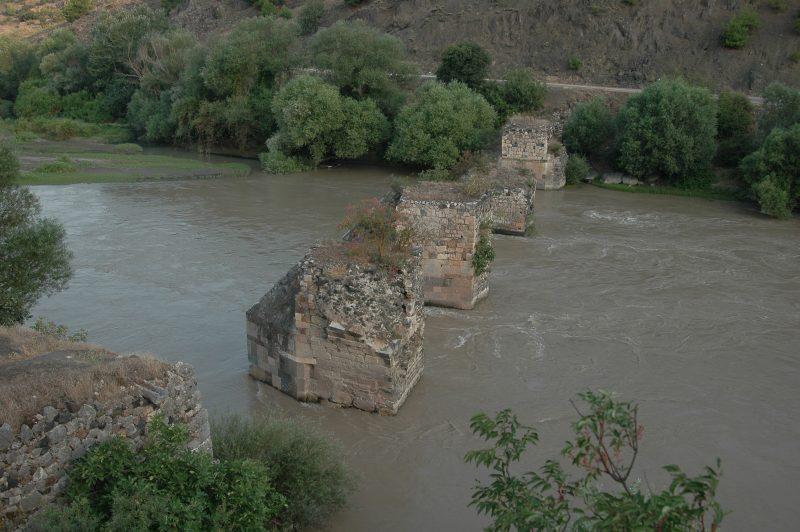
Boğazkesen köprüsü current condition - Erbaa Municipality
Over the centuries, the Boğazkesen Köprüsü has been subjected to various natural disasters and flood events. Frequent floods in the Kelkit Valley have caused significant harm to the upper structure, eventually leading to its partial collapse. Today, the bridge’s only supporting piers remain standing. This structure, known locally but insufficiently developed for tourism, holds great historical and cultural significance.
Today although the remaining parts of the bridge continue to resist the passage of time, it remains in a ruins state due to the absence of comprehensive restoration efforts. Various initiatives are needed to preserve its historical value and integrate it into regional tourism.

History
Current Condition