This article was automatically translated from the original Turkish version.
Type of Geographical İndication | Place of Origin | ||||||||
|---|---|---|---|---|---|---|---|---|---|
Registration Number | 634 | ||||||||
Registration Date | 18.12.2020 | ||||||||
Product / Product Group(s) | Processed and unprocessed fruits vegetables and mushrooms | ||||||||
Province(s) | Bolu | ||||||||
Applicant/Registrant(s) | Bolu Chamber of Commerce and Industry | ||||||||
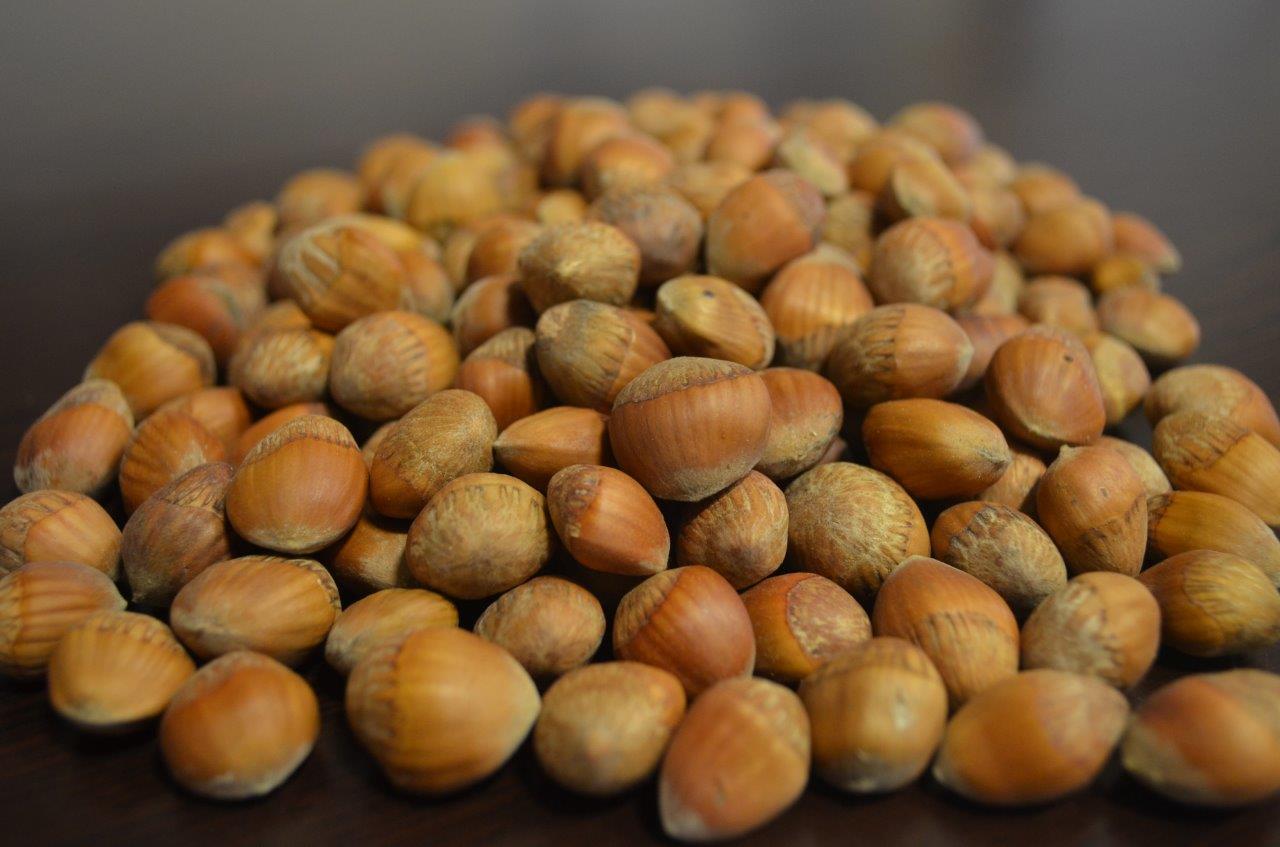
Bolu mountain hazelnut is a local variety distinguished by its small grain structure, high protein content (24.3%), and high fat content (68.7%). In addition to direct consumption, it is also used in the region for the production of hazelnut candy and chocolate. This product was registered under Law No. 6769 on the Industrial Property on 10 August 2017 and officially granted geographical indication status on 18 December 2020, with protection limited to the boundaries of Bolu province. The registration process was carried out by the Bolu Chamber of Commerce and Industry.
Approximately 991 grains are found per kilogram; about 20 tons of product can be harvested annually from 250 mature trees. Fruit size ranges from 10 to 20 mm. The thick shell and the fact that the dull base portion extends up to half the length of the nut are distinctive characteristics of this variety. Bolu mountain hazelnut exhibits epigeal germination, flowers at the end of November to the beginning of December, and harvesting begins in the second half of August.
Hazelnut trees have a single trunk and produce few or no basal shoots. Leaf shedding may occur early, mid, or late in the season. The crown develops as upright, upright-spreading, or spreading. Trees can reach heights of 15 to 35 metres and trunk diameters of 1.30 to 1.60 metres. They are resistant to cold temperatures ranging from -25°C to -30°C and can grow in calcareous and alkaline soils.
The shells are dark gray and become thick and cracked on older trees, resembling the bark of white oak. Young shoots are rust-colored and hairy. Leaves are broadly oval with toothed or lobed margins and turn golden yellow in autumn. Early flower clusters resemble fox tails, and pollination begins at the end of winter to the beginning of spring. Trees are resistant to storms and snow cover and require minimal pruning.
Two main production methods are applied:
Bolu mountain hazelnut is cultivated in areas unsuitable for beech and fir species and where competition is low. Soil pH ranges from 5.4 to 7.9 and is generally slightly alkaline. It grows best in non-saline soils. A fractured and vertically layered bedrock provides nutritional advantages. Soils vary from highly calcareous (58.4% calcium carbonate) to non-calcareous.
Harvesting begins in the second half of August and continues until the end of September. Hazelnuts are collected either by hand or by shaking.
Monitoring is conducted by a three-member authority composed of representatives from the Bolu Provincial Directorate of Agriculture and Forestry and the Faculty of Agriculture and Natural Sciences at Bolu Abant Izzet Baysal University, under the coordination of the Bolu Chamber of Commerce and Industry. At least one inspection is carried out annually, with additional inspections performed as needed or in response to complaints. Inspections verify compliance with production methods and assess characteristics of planted areas, trees, and grains. In necessary cases, services may be obtained from public or private experts.
Turk Patent and Trademark Office. "Bolu Dağ Fındığı." Geographical Indications Portal. December 18, 2020. Accessed October 24, 2025. https://ci.turkpatent.gov.tr/cografi-isaretler/detay/38332.
Turkish Patent and Trademark Office. "Bolu Mountain Hazelnut Geographical Indication Registration Certificate." December 18, 2020. Accessed October 24, 2025. https://ci.turkpatent.gov.tr/Files/GeographicalSigns/c8a9007b-1d24-4b4b-987e-55cc080c7a11.pdf.

Type of Geographical İndication | Place of Origin | ||||||||
|---|---|---|---|---|---|---|---|---|---|
Registration Number | 634 | ||||||||
Registration Date | 18.12.2020 | ||||||||
Product / Product Group(s) | Processed and unprocessed fruits vegetables and mushrooms | ||||||||
Province(s) | Bolu | ||||||||
Applicant/Registrant(s) | Bolu Chamber of Commerce and Industry | ||||||||
No Discussion Added Yet
Start discussion for "Bolu Mountain Hazelnut" article
Production Method
Monitoring