+2 More

Location | Bolu Türkiye | ||||||||
|---|---|---|---|---|---|---|---|---|---|
Established | 1975 | ||||||||
Opened | 1981 | ||||||||
Sections | Archaeology, Ethnography, Coins, Garden | ||||||||
Periods Covered | Neolithic to Ottoman | ||||||||
Renovation | 2006 | ||||||||
Total Artifacts | Over 17,000 | ||||||||
Bolu Museum is a museum established to preserve, document, and exhibit archaeological and ethnographic artifacts from Bolu province and its surroundings in Türkiye. Operating under the General Directorate of Cultural Heritage and Museums, the museum presents artifacts from various periods to visitors through chronological and thematic arrangements.

Bolu Museums (T.C. Bolu İl Kültür ve Turizm Müdürlüğü)
The foundations of Bolu Museum were laid in 1975 with the establishment of the Museum Office affiliated to Bolu province. Initially, the unit operated in the old Fine Arts Gallery building and was moved to the Bolu Cultural Center in 1976. In 1977, it gained the status of Museum Directorate, and after the completion of exhibition and arrangement works, it was opened to visitors on November 14, 1981.
Due to the earthquake on November 12, 1999, the museum building was damaged and closed to visitors. Following restoration and exhibition arrangement works carried out in 2006, the museum reopened to visitors on May 18, 2006. The museum is open every day from 08:30 to 17:30.
Located on the ground floor of the Cultural Center building, Bolu Museum consists of two main sections: the Archaeology Hall and the Ethnography Hall. The museum collection includes 3,351 archaeological artifacts, 1,627 ethnographic items, and 12,105 coins, totaling 17,083 objects registered in the inventory.
The Archaeology Hall exhibits marble, glass, metal, and terracotta artifacts from the Neolithic Age, Early Bronze Age, Phrygian, Urartian, Lydian, Hellenistic, Roman, and Byzantine periods, arranged in chronological order.
Significant finds on display include artifacts from the village of Seben-Korucuk dated to the 2nd millennium BC, those from Değirmenözü village from the 1st millennium BC, and items from the Hellenistic Period belonging to the Göynük-Susuzkınık village. Additionally, small statues of the health god Asclepius, his daughter Hygeia, and his assistant Telesphoros, discovered in the village of Seben-Çeltikdere, are exhibited. Among the notable pieces in the Archaeology Hall are the Heracles statue, female head, Hermes bust, Nymphe statue, and gladiator grave stele from the Roman Period, all found in the central district of Bolu.

Bolu Museums (T.C. Bolu İl Kültür ve Turizm Müdürlüğü)
A brick tomb example dating to the Roman Period, uncovered during a rescue excavation in the necropolis area of Claudiopolis (Bolu) Ancient City, is exhibited along with a skeleton and grave goods.
Forming a part of the Archaeology Hall, the coin collection includes coins from Greek cities and kingdoms, Roman and Byzantine emperors, as well as Islamic coins from the Umayyad, Artuqid, Seljuk, Ilkhanid, and Ottoman periods. Treasures from the Ottoman era, displayed in three separate groups, are among the highlights of this section.

Bolu Museums (T.C. Bolu İl Kültür ve Turizm Müdürlüğü)
Located on the second floor of the museum, the Ethnography Hall exhibits ethnographic artifacts dating from the 19th century to the first half of the 20th century. These items are displayed in showcases prepared based on regional characteristics. The collection includes weapons, religious objects, jewelry, metalware, textiles, embroidery, and traditional clothing.
The hall also features a recreation of a traditional Bolu house kitchen and living room, as well as a showcase themed around the henna night ceremony in Bolu. Regional handicrafts such as Mudurnu lace and Kıbrısçık costumes are also among the exhibited items.

Bolu Museums (T.C. Bolu İl Kültür ve Turizm Müdürlüğü)
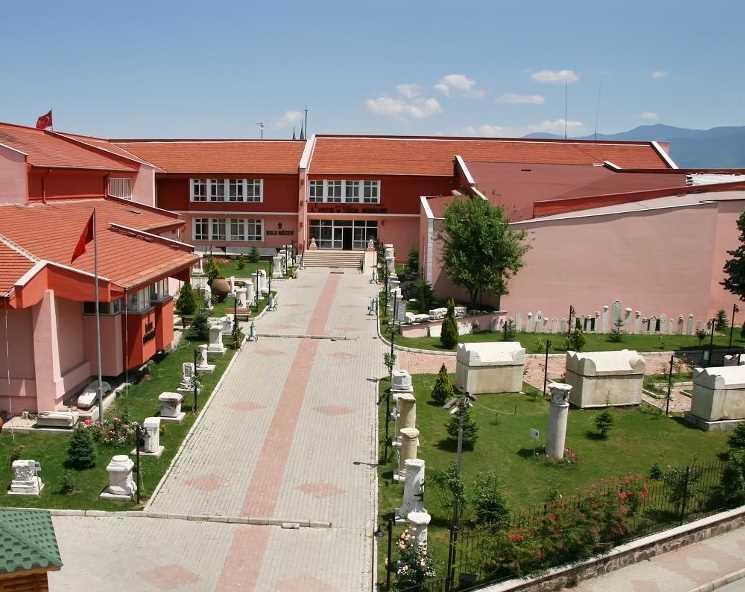
The museum garden, serving as an open-air museum, displays large stone and terracotta artifacts. Among these are Roman-era sarcophagi, grave steles, statue bases, columns, column bases, capitals, friezes, and architraves, as well as a Byzantine baptismal font. Additionally, Ottoman-era tombstones with inscriptions are exhibited. Examples of graves from the Roman and Ottoman periods are presented to visitors in thematic sections throughout the garden.

Bolu Museums (T.C. Bolu İl Kültür ve Turizm Müdürlüğü)
Republic of Türkiye Bolu Governorship. “Bolu Museum.” Accessed June 26, 2025. http://www.bolu.gov.tr/bolu-muzesi.
Republic of Türkiye Ministry of Culture and Tourism, Bolu Provincial Directorate of Culture and Tourism. “Bolu Museum.” Accessed June 26, 2025. https://bolu.ktb.gov.tr/tr-69938/bolu-muzesi.html.
Republic of Türkiye Ministry of Culture and Tourism, General Directorate of Cultural Heritage and Museums. “Bolu Museum Directorate.” Accessed June 26, 2025. https://kvmgm.ktb.gov.tr/TR-44074/bolu-muze-mudurlugu.html.
Türkiye Culture Portal. “Bolu Museum.” Accessed June 26, 2025. https://www.kulturportali.gov.tr/turkiye/bolu/gezilecekyer/bolu-muzesi.
Location | Bolu Türkiye | ||||||||
|---|---|---|---|---|---|---|---|---|---|
Established | 1975 | ||||||||
Opened | 1981 | ||||||||
Sections | Archaeology, Ethnography, Coins, Garden | ||||||||
Periods Covered | Neolithic to Ottoman | ||||||||
Renovation | 2006 | ||||||||
Total Artifacts | Over 17,000 | ||||||||
Establishment and History
Museum Collection
Archaeology Hall
Coin Section
Ethnography Hall
Museum Garden
This article was created with the support of artificial intelligence.