


This article was automatically translated from the original Turkish version.
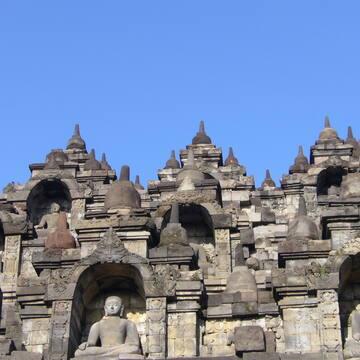
Location | Indonesia | ||||||||
|---|---|---|---|---|---|---|---|---|---|
Construction Date(s) | 8th–9th century | ||||||||
Builder | Shailendra Dynasty | ||||||||
Religious Context | Mahayana Buddhism | ||||||||
Architectural Style(s) | Indo-Javanese Buddhist architecture | ||||||||
Building Material | Andesite stone | ||||||||
Building Type | Stepped stupa | ||||||||
Period of Abandonment | After the 10th century | ||||||||
Rediscovery | 1814 | ||||||||
UNESCO World Heritage | 1991 | ||||||||
Borobudur Temple is located in the Kedu Valley of Central Java, Indonesia. The temple was constructed during the reign of the Sailendra Dynasty between the 8th and 9th centuries. The site lies at the confluence of the Elo and Progo rivers and forms a natural temple plateau surrounded by mountains and volcanic terrain. It is widely regarded as a sacred structure designed in accordance with Mahayana Buddhist teachings to symbolize the universal order.

Borobudur Temple (UNESCO)
Borobudur Temple comprises three main sections reflecting Buddhist cosmology: Kamadhatu (the world of desire), Rupadhatu (the world of forms), and Arupadhatu (the formless absolute world). These sections are represented sequentially from bottom to top by five square terraces three circular platforms and the central stupa at the summit. The surface area of approximately 2500 m² features 2672 relief panels and 504 Buddha statues. Within 72 perforated stupas on the upper platforms are Buddha statues.
The construction of Borobudur was carried out through gotong royong a uniquely Indonesian concept of voluntary community solidarity. In this framework the local population directly participated in stone transportation assembly and construction. The primary building material was andesite stone sourced from local quarries. The foundation was prepared by compacting volcanic soil and the structure’s durability was enhanced by utilizing natural topography and drainage systems.
Borobudur was designed to integrate seamlessly with its natural environment. The temple’s orientation was determined in relation to surrounding mountains and sacred water sources. Its placement reflects spiritual dimensions associated with nature. Environmentally friendly materials and methods were preferred for functions such as lighting. The construction techniques and local knowledge employed reflect a traditional example of sustainable architecture.
Borobudur was abandoned from the 10th century onward and gradually buried under volcanic ash and vegetation. It was rediscovered in 1814 by the British colonial administrator Sir Thomas Stamford Raffles. Following initial restoration efforts in the early 20th century a comprehensive restoration project was conducted between 1973 and 1983 by UNESCO and the Indonesian government. During this project stone blocks were dismantled and reassembled structural and drainage systems were redesigned and reinforced.
Borobudur forms part of a symbolic pilgrimage complex along with the nearby Mendut and Pawon temples. Buddhist pilgrims follow a path beginning with worship at Mendut continuing with purification at Pawon and culminating in spiritual ascent at Borobudur. This sequence symbolizes the three levels of existence in Buddhist doctrine through physical structures.
Borobudur Temple was inscribed on the UNESCO World Heritage List in 1991. The justification cited its architectural brilliance its religious and cultural synthesis and its status as an exemplary representation of 8th–9th century Indonesian art. The temple is protected under Indonesia’s Cultural Heritage Law. Management is carried out by the Borobudur Heritage Conservation Office under the Indonesian Ministry of Culture and PT Taman Wisata Candi Borobudur a public enterprise. Continuous monitoring and conservation measures are implemented to address threats such as tourism pressure acid ash accumulation and stone erosion.
According to art historian Alois Riegl’s theory of monuments Borobudur possesses multiple historical and cultural values. Over time the temple has acquired the values of antiquity historical significance and commemorative meaning. Although it was not originally conceived as a monument it has evolved into a carrier of collective memory. In this regard Borobudur embodies the status of a universal cultural heritage object within the context of modern culture.
Riegl, Alois. “Alois Riegl’in Tarihi Anıtlar Kuramı ve Modern Kült Olarak Anıtlar.” *Sanat ve Tasarım Dergisi* 13, no. 13 (2021): 31–40. Accessed June 30, 2025. https://dergipark.org.tr/en/download/article-file/807583
UNESCO World Heritage Centre. “Borobudur Temple Compounds.” UNESCO World Heritage Centre. Accessed June 30, 2025. https://whc.unesco.org/en/list/592/
Yapı Dergisi. "Sürdürülebilir Tapınak Yapım Süreci: Endonezya Örneği." Accessed June 30, 2025. https://yapidergisi.com/surdurulebilir-tapinak-yapim-sureci-endonezya/

Location | Indonesia | ||||||||
|---|---|---|---|---|---|---|---|---|---|
Construction Date(s) | 8th–9th century | ||||||||
Builder | Shailendra Dynasty | ||||||||
Religious Context | Mahayana Buddhism | ||||||||
Architectural Style(s) | Indo-Javanese Buddhist architecture | ||||||||
Building Material | Andesite stone | ||||||||
Building Type | Stepped stupa | ||||||||
Period of Abandonment | After the 10th century | ||||||||
Rediscovery | 1814 | ||||||||
UNESCO World Heritage | 1991 | ||||||||
Architectural Structure and Cosmological Significance
Construction Process and Local Participation
Sustainable Architecture and Harmony with Nature
Abandonment Discovery and Restoration
Temple Complex and Pilgrimage Route
UNESCO Status and Conservation
Monumental Value and Cultural Significance