

This article was automatically translated from the original Turkish version.
Borophene is a remarkable material formed by arranging boron atoms in a single-atom-thick, two-dimensional (2D) plane, serving as the boron analog of graphene. While this material holds the potential to mimic graphene’s extraordinary properties, it exhibits unique and diverse structural polymorphisms due to boron’s inherent electron deficiency. The discovery and synthesis of borophene offer significant potential not only for fundamental scientific research but also for next-generation applications in electronics, optoelectronics, superconductivity, and catalysis. Boron’s rich chemical structure and strong tendency to form covalent bonds have enabled the existence of borophene in various geometries and electronic configurations.
Unlike graphene, which has a single uniform structure, borophene can exist in multiple stable or metastable structural phases depending on the arrangement of boron atoms. This structural diversity arises from boron’s electron deficiency and its propensity to form multicenter bonds. Theoretical studies have predicted numerous possible borophene structures, including hexagonal lattices, triangular lattices, and their hybrid forms. Experimentally, various borophene phases have been synthesized on different substrates under varying growth conditions.
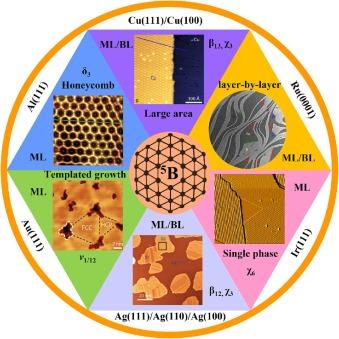
Borophene synthesis is typically achieved using techniques such as molecular beam epitaxy (MBE) and chemical vapor deposition (CVD) under high-vacuum conditions on metallic surfaces. Silver (Ag) and copper (Cu) surfaces have emerged as preferred substrates for the epitaxial growth of borophene. The first experimental syntheses of borophene were reported in 2015 by Mannix and colleagues on the Ag(111) surface, followed in 2016 by Zhou and team on the Cu(111) surface. These methods have enabled the production of atomically smooth and crystalline borophene films.
The silver (111) surface provides a suitable platform for borophene formation due to strong interactions between boron atoms and the substrate. Borophene structures synthesized on this surface are typically atomically smooth and extend over nanometer-scale domains. Structurally, it has been observed that borophene on Ag(111) predominantly forms “holey” or “vacancy-rich” structures containing hexagonal voids. These vacancies are linked to boron’s tendency to form triangular lattices and can significantly influence the material’s electronic properties.
The copper (111) surface has the potential to support different structural polymorphs of borophene compared to Ag(111). Higher-density and less defective borophene films have been successfully synthesized on Cu(111). This surface typically yields borophene structures with higher boron atom density and nearly perfect triangular or rectangular lattices. The weaker boron-substrate interactions on Cu(111) allow boron atoms to bond more flexibly with each other, enabling a wider range of structural arrangements.
As a consequence of its unique structural features, borophene exhibits a range of extraordinary electronic and physical properties that are similar to yet distinct from those of graphene. These properties hold great potential for future technological applications.
Borophene can exhibit high levels of anisotropy, depending on its structural polymorphism, meaning it displays different properties along different directions. For instance, in certain borophene structures, electron conductivity is significantly higher along specific directions than others. Both theoretical and experimental studies have demonstrated that borophene exhibits metallic or semimetallic behavior, with electrons moving freely and resulting in high electrical conductivity. This makes it a valuable property for electronic devices and sensors.
Borophene is a promising platform for the search for superconductivity in two-dimensional systems, similar to graphene. Theoretical calculations predict that certain borophene structures can exhibit superconductivity under appropriate conditions and with doping. In particular, boron’s electron deficiency may facilitate electron-phonon couplings that lead to superconductivity in borophene. Research in this area has attracted considerable interest due to the potential for room-temperature superconductivity.
Due to the strong covalent bonds between boron atoms, borophene possesses high mechanical strength and flexibility. These properties are comparable to or even exceed the known mechanical robustness of graphene. High tensile strength and flexibility enhance borophene’s potential for use in flexible electronics, sensors, and composite materials.
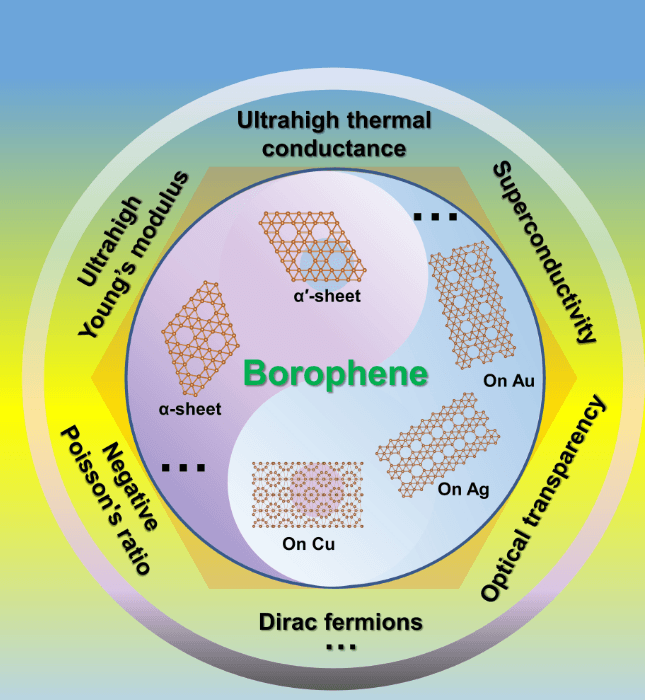
Different Structural Polymorphs and Properties of Borophene (Hou et al., 2020)
Borophene’s unique properties make it an attractive material for diverse applications including energy storage, catalysis, sensing, and electronics.
Due to its high surface area and strong binding energy for lithium ions, borophene is considered a promising anode material for lithium-ion batteries and supercapacitors. Borophene’s high theoretical capacity and rapid charge/discharge capabilities make it an ideal candidate for more efficient energy storage systems.
Borophene’s unique electronic structure and high surface reactivity render it suitable for catalytic applications. In particular, it has been shown to exhibit catalytic activity in electrochemical reactions such as the hydrogen evolution reaction (HER). Additionally, the ability of molecules to adsorb onto borophene’s surface can be exploited to develop highly sensitive gas sensors and biosensors.
Borophene’s metallic or semimetallic nature and high electron mobility make it a potential material for next-generation transistors and other electronic devices. Optically, borophene can absorb light across a broad spectrum, making it suitable for optoelectronic applications such as photodetectors and solar cells.

Borophene’s Structural Diversity and Synthesis Methods
Experimental Synthesis Methods
Borophene Growth on Ag(111)
Borophene Growth on Cu(111)
Borophene’s Electronic and Physical Properties
High Anisotropy and Electronic Conductivity
Superconductivity Potential
High Mechanical Strength and Flexibility
Applications of Borophene
Energy Storage
Catalysis and Sensors
Electronics and Optoelectronics