
This article was automatically translated from the original Turkish version.
+1 More
The Bouba-Kiki Effect, cognitive psychology, is a phenomenological phenomenon identified at the intersection of neurolinguistics and evolutionary anthropology that describes universal, systematic, and non-random mappings established by the human mind between phonetic sound units and geometric shapes of objects. This concept is regarded as the primary evidence for research on “cross-modal perceptual mapping,” which investigates interactions between sensory modalities (auditory and visual).
The Bouba-Kiki effect represents the universal cross-sensory mapping that individuals make between visual shapes and spoken sounds, as a modern version of Köhler’s original studies.
In a standard experiment, participants are presented with two distinct visual stimuli:
When asked to assign the names “Bouba” and “Kiki” to these shapes, across cultures and native languages, 95 to 98 percent of participants consistently associate the rounded shape with “Bouba” and the spiky shape with “Kiki.”【1】
The fact that this tendency is observed even in illiterate communities and in four-month-old infants suggests that the mapping is rooted in biological and neurological foundations rather than learned association. Conversely, individuals with autism spectrum disorder show significantly lower rates of this correspondence—around 56 percent—compared to neurotypical individuals, indicating that the effect is linked to sensory integration processes.【2】
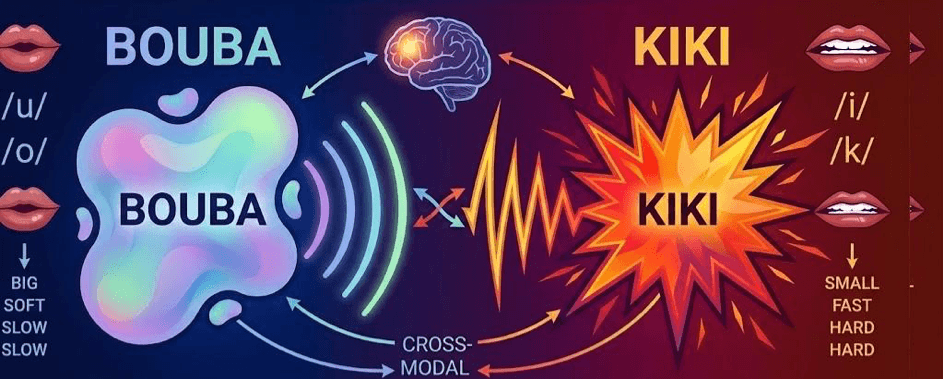
A visual representation of the Bouba-Kiki Effect. (Generated by artificial intelligence.)
In linguistics and cognitive psychology, sound symbolism is an approach that argues against the randomness of the relationship between phonetic sounds, visual shapes, and object properties such as size, hardness, and brightness. Contrary to traditional linguistics assumptions, this theory posits that sounds and visual forms are systematically and universally linked in the mind, with the Bouba-Kiki Effect serving as its most well-known and empirically strongest evidence.
Sound symbolism claims that there is a natural and systematic connection between speech sounds and the meanings they represent, challenging the notion that the relationship between linguistic form and meaning is entirely arbitrary. This concept is framed within the broader notion of iconicity, thereby offering a counter-theory or complementary mechanism to Ferdinand de Saussure’s entrenched the groundlessness of the linguistic indicator principle. Sound and shape symbolism, as a robust alternative to the “arbitrariness” principle, has gained attention in contemporary disciplines such as neurolinguistics, evolutionary psychology, marketing, and brand management through its practical applications.【3】
Scientists explain the underlying causes of this universal effect through three primary mechanisms:
Discussions regarding the origin and naming process of the Bouba-Kiki effect extend as far back as Ancient Greek philosophy. The most fundamental distinction in this field lies between the view that names reflect the nature of objects and the view that they are the product of social convention.【5】
The earliest systematic inquiry into sound symbolism appears in Plato’s (427–347 BCE) Cratylus in its dialogue. In the dialogue, Hermogenes argues that names are a matter of social habit and convention, while Cratylus contends that names must correspond to the intrinsic nature of objects, asserting that every entity has a naturally correct name.
Socrates proposes in this discussion that names are “imitations.” Just as painters use colors to imitate objects, namers use letters and syllables to imitate the essence of things. Plato argues that certain sounds represent specific qualities—for instance, the sound “r” conveys motion and flow, while “l” conveys smoothness and softness. However, by the end of the dialogue, Plato distances himself from absolute naturalism, emphasizing that the source of knowledge lies not in names but in the objects themselves.【6】
At the beginning of the 20th century, Ferdinand de Saussure, the founder of structural linguistics, declared that the connection between the linguistic signifier and the signified is entirely arbitrary. According to Saussure, there is no intrinsic necessity linking the concept of “table” to the sequence of sounds that represent it; if such a necessity existed, all languages would use similar sounds for the same concept. This view became the dominant paradigm in linguistics for many years, but in recent decades, growing empirical evidence has revitalized the theory of iconicity.【7】
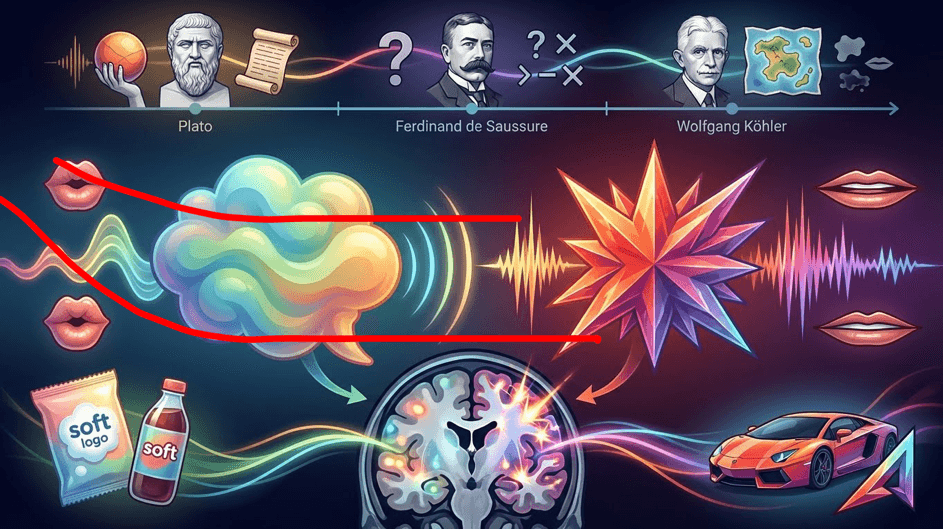
A visual representation of the Bouba-Kiki Effect. (Generated by artificial intelligence.)
Sound symbolism is not limited to geometric shapes; it also shapes perceptions of size, texture, speed, and emotional states:
Research on consumer behavior has revealed that sound symbolism unconsciously influences brand perception:【10】
The theory of sound symbolism has faced various criticisms, particularly from structuralist linguistic circles, and has been the subject of ongoing scientific debate:
Chandler, Daniel. “Semiotics for Beginners: Signs”. Princeton University Department of Computer Science. Accessed December 12, 2025. https://www.cs.princeton.edu/~chazelle/courses/BIB/semio2.htm
Dövencioğlu, Dicle. “Ses Sembolizmi ve Nesne Algısı İlişkisine Dair Bir İnceleme”. Avrasya Sosyal ve Ekonomi Araştırmaları Dergisi. Accessed December 12, 2025. https://dergipark.org.tr/tr/download/article-file/3370252
Marian, Viorica. “It’s a Bouba, Not a Kiki: The Relationship Between Sound, Form, and Meaning.” Behavioral Scientist. Accessed December 11, 2025. https://behavioralscientist.org/its-a-bouba-not-a-kiki-the-relationship-between-sound-form-and-meaning/
Poyraz, Hakan. “Adlandırmanın Doğası ve Adların Nesnesine Uygunluğu Ekseninde Doğalcılık-Uzlaşmacılık Tartışması”. DergiPark. Accessed December 12, 2025. https://dergipark.org.tr/tr/download/article-file/115535
Zulfugarova, Nargiz and Cenk Arsun Yüksel. “Kiki ve Bouba Etkisi Olarak Bilinen Ses ve Şekil Sembolizmi Teorisinin Pazarlamada Kullanımı.” DergiPark. Accessed December 11, 2025. https://dergipark.org.tr/tr/download/article-file/905434
Ćwiek, Aleksandra, et al. “The Bouba/Kiki Effect Is Robust Across Cultures and Writing Systems.” Philosophical Transactions of the Royal Society B. Accessed December 11, 2025. https://royalsocietypublishing.org/doi/10.1098/rstb.2020.0390
[1]
Marian, Viorica. “It’s a Bouba, Not a Kiki: The Relationship Between Sound, Form, and Meaning.” Behavioral Scientist. Erişim 11 Aralık 2025. https://behavioralscientist.org/its-a-bouba-not-a-kiki-the-relationship-between-sound-form-and-meaning/
[2]
Marian, Viorica. “It’s a Bouba, Not a Kiki: The Relationship Between Sound, Form, and Meaning.” Behavioral Scientist. Erişim 11 Aralık 2025. https://behavioralscientist.org/its-a-bouba-not-a-kiki-the-relationship-between-sound-form-and-meaning/
[3]
Zulfugarova, Nargiz ve Cenk Arsun Yüksel. “Kiki ve Bouba Etkisi Olarak Bilinen Ses ve Şekil Sembolizmi Teorisinin Pazarlamada Kullanımı.” DergiPark. Erişim 11 Aralık 2025. https://dergipark.org.tr/tr/download/article-file/905434
[4]
Marian, Viorica. “It’s a Bouba, Not a Kiki: The Relationship Between Sound, Form, and Meaning.” Behavioral Scientist. Erişim 11 Aralık 2025. https://behavioralscientist.org/its-a-bouba-not-a-kiki-the-relationship-between-sound-form-and-meaning/
[5]
Zulfugarova, Nargiz ve Cenk Arsun Yüksel. “Kiki ve Bouba Etkisi Olarak Bilinen Ses ve Şekil Sembolizmi Teorisinin Pazarlamada Kullanımı.” DergiPark. Erişim 11 Aralık 2025. https://dergipark.org.tr/tr/download/article-file/905434
[6]
Poyraz, Hakan. “Adlandırmanın Doğası ve Adların Nesnesine Uygunluğu Ekseninde Doğalcılık-Uzlaşmacılık Tartışması”. DergiPark. Erişim 12 Aralık 2025. https://dergipark.org.tr/tr/download/article-file/115535
[7]
Zulfugarova, Nargiz ve Cenk Arsun Yüksel. “Kiki ve Bouba Etkisi Olarak Bilinen Ses ve Şekil Sembolizmi Teorisinin Pazarlamada Kullanımı.” DergiPark. Erişim 11 Aralık 2025. https://dergipark.org.tr/tr/download/article-file/905434
[8]
Zulfugarova, Nargiz ve Cenk Arsun Yüksel. “Kiki ve Bouba Etkisi Olarak Bilinen Ses ve Şekil Sembolizmi Teorisinin Pazarlamada Kullanımı.” DergiPark. Erişim 11 Aralık 2025. https://dergipark.org.tr/tr/download/article-file/905434
[9]
Zulfugarova, Nargiz ve Cenk Arsun Yüksel. “Kiki ve Bouba Etkisi Olarak Bilinen Ses ve Şekil Sembolizmi Teorisinin Pazarlamada Kullanımı.” DergiPark. Erişim 11 Aralık 2025. https://dergipark.org.tr/tr/download/article-file/905434
[10]
Zulfugarova, Nargiz ve Cenk Arsun Yüksel. “Kiki ve Bouba Etkisi Olarak Bilinen Ses ve Şekil Sembolizmi Teorisinin Pazarlamada Kullanımı.” DergiPark. Erişim 11 Aralık 2025. https://dergipark.org.tr/tr/download/article-file/905434
[11]
Marian, Viorica. “It’s a Bouba, Not a Kiki: The Relationship Between Sound, Form, and Meaning.” Behavioral Scientist. Erişim 11 Aralık 2025. https://behavioralscientist.org/its-a-bouba-not-a-kiki-the-relationship-between-sound-form-and-meaning/
[12]
Zulfugarova, Nargiz ve Cenk Arsun Yüksel. “Kiki ve Bouba Etkisi Olarak Bilinen Ses ve Şekil Sembolizmi Teorisinin Pazarlamada Kullanımı.” DergiPark. Erişim 11 Aralık 2025. https://dergipark.org.tr/tr/download/article-file/905434
[13]
Dövencioğlu, Dicle. “Ses Sembolizmi ve Nesne Algısı İlişkisine Dair Bir İnceleme”. Avrasya Sosyal ve Ekonomi Araştırmaları Dergisi. Erişim 12 Aralık 2025. https://dergipark.org.tr/tr/download/article-file/3370252
[14]
Ćwiek, Aleksandra, vd. “The Bouba/Kiki Effect Is Robust Across Cultures and Writing Systems.” Philosophical Transactions of the Royal Society B. Erişim 11 Aralık 2025. https://royalsocietypublishing.org/doi/10.1098/rstb.2020.0390
[15]
Ćwiek, Aleksandra, vd. “The Bouba/Kiki Effect Is Robust Across Cultures and Writing Systems.” Philosophical Transactions of the Royal Society B. Erişim 11 Aralık 2025. https://royalsocietypublishing.org/doi/10.1098/rstb.2020.0390
[16]
Marian, Viorica. “It’s a Bouba, Not a Kiki: The Relationship Between Sound, Form, and Meaning.” Behavioral Scientist. Erişim 11 Aralık 2025. https://behavioralscientist.org/its-a-bouba-not-a-kiki-the-relationship-between-sound-form-and-meaning/

Bouba and Kiki Effect Studies
Experimental Design and Findings:
Relationship with Sound and Shape Symbolism
Causes and Cognitive Mechanisms of the Effect
History and Place in Philology
Plato and the Cratylus Dialogue
Saussure and the Arbitrariness Principle
Bouba and Kiki Effect in the Context of Sound Symbolism
Applications
Criticisms and Scientific Debates