+1 More

Boyabat (District)
Province(s) | Sinop | ||||||||
|---|---|---|---|---|---|---|---|---|---|
Area(s) | Black Sea | ||||||||
Altitude | 330 meters | ||||||||
Population (2024) | 45,494 | ||||||||
Mayor(s) | Hasan Kara | ||||||||
District Governor | Enver Yilmaz | ||||||||
Postal Code | 57200 | ||||||||
License Plate Code | 57 | ||||||||
Climate(s) | Black Sea climate | ||||||||
Economy | Agriculture livestock farming forestry and small-scale industry | ||||||||
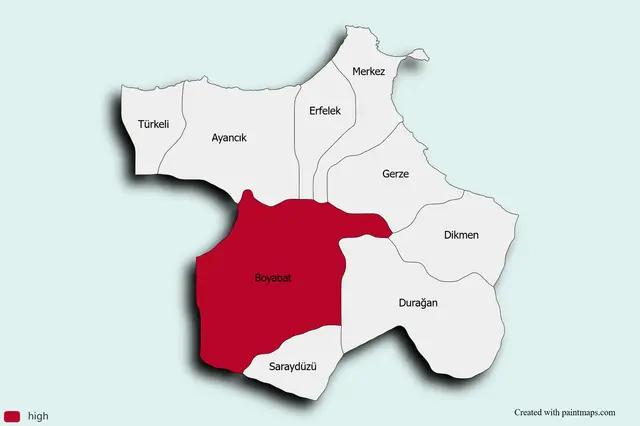
Boyabat is a district located in the southwest of Sinop province. Its economy is based on agriculture, animal husbandry, and forestry. It is home to a number of historical and natural structures.

A bird's eye view of Boyabat. ( TC Boyabat Municipality )
Boyabat's founding and first settlement date back to the Bronze Age (approximately 3000 BC). Above-ground ceramics and remains from this period have been identified in mounds in the town center. Known as Germanikopolis in the Paphlagonia region in ancient times, the settlement is shown at the location of today's Boyabat Castle on the Ptolemaic geographical map in the Hagia Sophia Library. The Turks, who entered the region after the Battle of Manzikert in 1071, established political and cultural dominance in the settlement. In 1461, when Mehmed the Conqueror annexed the Greek Empire of Trebizond to Ottoman rule, Boyabat was incorporated into Ottoman territory.
Following the proclamation of the Republic, Boyabat was annexed to the province of Sinop in 1924. Its geographical name, "Boyabat," is a combination of the words " boy" (long) and "abat" (plain) , meaning " Uzunova ." Archaeological and written documents reveal a multi-layered historical development ruled successively by the Gashgais (1400–1300 BC), Hittites (1330–1200 BC), Paphlagonians (1100–700 BC), Lydians (700–546 BC), Iranians (362 BC), Pontus (183–64 BC), Romans (64 BC–AD 365), and Byzantines (395–1126 AD). The district became a member of the Historical Cities Union on May 1, 2005 , and with this membership it gained institutional assurance in terms of preserving and developing its historical texture.
Although located within the Black Sea Region, Boyabat exhibits inland continental climate characteristics, far from coastal influence. The district's lands were formed by depressions and fluvial fissures of the 2nd, 3rd, and 4th geological eras. The mountainous and rugged terrain encompasses the Gökırmak Valley, which extends northwest-southeast. The alluvial soils at the valley floor are suitable for agriculture, 60% of the area is irrigable, and Türkiye's highest quality rice is grown in this area. Annual average rainfall varies between 300–400 mm, with an average of 80 rainy days. The temperature regime exhibits sharp transitions in some areas; the hottest months are July–August, and the coldest months are January–February. The prevailing winds are the Northeast Poyraz and Yıldız, while the rainfall system is carried by westerly winds.
The total population of Boyabat district was 42,433 in 2007 and reached 45,494 in 2024. During this period, increases of 545, 699, and 1,331 were recorded in 2007–2008, 2012–2013, and 2022–2023, respectively, while a fluctuating decrease was observed in the other years. As of 2024, the male population stood at 22,519 (49.50%) and the female population at 22,975 (50.50%), with the gender gap generally remaining at a few hundred. Annual population changes have fluctuated due to local registry updates and migration movements.
Boyabat's economy combines agriculture, animal husbandry, forestry, and industry. Of a total area of 304,500 decares, 181,000 decares are dedicated to agricultural production; 136,135 decares are devoted to grain (wheat, barley, oats, vetch, etc.) and 23,000 decares are dedicated to geographically indicated rice production. Irrigable land covers 83,170 decares. Pasture land covers 9,250 decares. The number of cattle is 35,653, the number of small cattle is 48,356 (39,334 sheep, 9,022 goats), buffalo is present in 591, and beekeeping is carried out with 7,082 hives (2023). The forestry and wood products sectors utilize the region's extensive forest resources, while small-scale industries such as food processing, textiles, and furniture production add diversity to the economic structure. Additionally, the Boyabat Gazidere Tomato has a geographical indication registration with a history spanning over 150 years; this large-fruited, aromatic tomato variety makes a significant agricultural contribution to both the local and regional markets.
Boyabat's tourism potential is shaped by both its natural and historical heritage. Dating back to antiquity (7th century BC), Boyabat Castle, nestled on rocky hills overlooking the Gökırmak Valley, boasts ramparts and tunnels built without disturbing the natural rock structure. The Basalt Rocks Natural Monument near Kurusaray Village, with its 30-40 m high columnar basalt blocks and 3-5 million years of geological history, constitutes a unique example of nature tourism. Çukurhan Village Castle stands out as a small rock castle containing remains from the Hellenistic and Roman periods; the adjacent waterfall serves as a hiking and camping area. Among the cultural events, the Boyabat Fair and Oil Wrestling Competitions, held every third week of October, continue a historical tradition of marketing, entertainment, and sports intertwined with the region's agricultural cycle. Boyabat Municipality Living Cultural Heritage Museum documents and exhibits the tangible and intangible cultural values of the district, while ensuring cultural transfer through traditional children's games, storytelling, Karagöz shows and handicraft workshops.
The local cuisine is based on the utilization of agricultural and animal products. Boyabat Paste, a uniquely processed blend of oily seeds such as walnuts, hazelnuts, peanuts, and almonds, is known as a nutritious energy source. Boyabat Sırık Kebabı, on the other hand, is a regional meat dish characterized by the meat being cooked on long, sticky poles instead of skewers. These delicacies are served both daily and in tourist establishments, complementing Boyabat's gastronomic identity.
Republic of Türkiye Boyabat District Governorship. “Basalt Rocks.” Boyabat District Governorship. Access date: May 10, 2025. http://www.boyabat.gov.tr/bazalt-kayaliklari
Republic of Türkiye Boyabat District Governorship. “Basalt Rocks.” Boyabat District Governorship. Access date: May 10, 2025. http://www.boyabat.gov.tr/bazalt-kayaliklari
Republic of Türkiye Boyabat District Governorship. “Rock Tombs.” Boyabat District Governorship. Access date: May 10, 2025. http://www.boyabat.gov.tr/kaya-mezarlari
Republic of Türkiye Ministry of Culture and Tourism. “Boyabat Castle.” Culture Portal. Access date: May 10, 2025. https://www.kulturportali.gov.tr/turkiye/sinop/gezilecekyer/boyabat-kalesi
Republic of Türkiye Sinop Governorship. “Boyabat.” Sinop Governorship. Access date: May 10, 2025. http://www.sinop.gov.tr/boyabat
TC Boyabat District Governorship. “Boyabat Houses.” Boyabat District Governorship. Access date: May 10, 2025. http://www.boyabat.gov.tr/boyabat-evleri
TC Boyabat Municipality. “Boyabat Economy.” Boyabat Municipality. Access date: May 10, 2025. https://www.boyabat.bel.tr/icerik/boyabat-ekonomisi
TC Boyabat Municipality. “Boyabat Geography.” Boyabat Municipality. Access date: May 10, 2025. https://www.boyabat.bel.tr/icerik/boyabat-cografyasi
TC Boyabat Municipality. “Cultural Wealth.” Boyabat Municipality. Access date: May 10, 2025. https://www.boyabat.bel.tr/icerik/kulturel-zenginlik
TC Boyabat Municipality. “History.” Boyabat Municipality. Access date: May 10, 2025. https://www.boyabat.bel.tr/icerik/tarihce
TC Boyabat Municipality. “Natural Beauties.” Boyabat Municipality. Access date: May 10, 2025. https://www.boyabat.bel.tr/icerik/dogal-guzellikler
TC Boyabat Municipality. “Our Registered Products.” Boyabat Municipality. Access date: May 10, 2025. https://www.boyabat.bel.tr/icerik/tescilli-urunlerimiz
Turkish Statistical Institute (TurkStat). Address Based Population Registration System Results, 2024. Access date: April 20, 2025. https://data.tuik.gov.tr/Bulten/Index?p=Adrese-Dayali-Nufus-Kayit-Sistemi-Sonuclari-2024-53783

Boyabat (District)
Province(s) | Sinop | ||||||||
|---|---|---|---|---|---|---|---|---|---|
Area(s) | Black Sea | ||||||||
Altitude | 330 meters | ||||||||
Population (2024) | 45,494 | ||||||||
Mayor(s) | Hasan Kara | ||||||||
District Governor | Enver Yilmaz | ||||||||
Postal Code | 57200 | ||||||||
License Plate Code | 57 | ||||||||
Climate(s) | Black Sea climate | ||||||||
Economy | Agriculture livestock farming forestry and small-scale industry | ||||||||
History
Geography and Climate
Population and Demography
Economy
Tourism, Culture and Cuisine
This article was created with the support of artificial intelligence.