

+2 More

Brazilian cuisine is a highly diverse and regionally distinct gastronomic system shaped by the country’s vast geographical expanse, varied climatic conditions, and multicultural social structure. Situated on the eastern side of South America and occupying nearly half of the continent, Brazil has developed a rich culinary culture rooted in its abundant natural resources and agricultural diversity. The ecological variety extending from the Amazon Basin to the pampas of the south has significantly influenced dietary habits and the types of foods consumed across different regions. Tropical and subtropical climates have encouraged the widespread cultivation of manioc, rice, corn, beans, and tropical fruits, while livestock farming—particularly prominent in the southern and southeastern regions—has reinforced a meat-centered culinary tradition.
Over the course of history, Brazilian cuisine has been shaped by the interaction of multiple cultural layers. The dietary practices of Indigenous populations, Portuguese colonizers, and African slaves have been foundational to the country’s gastronomic development. In addition, the settlement of Italian, German, Japanese, and Arab immigrant communities during the 19th and 20th centuries introduced new ingredients and cooking techniques to the existing culinary landscape. As a result, Brazilian cuisine is better understood not as a monolithic national tradition but as a mosaic composed of distinct regional cuisines. Each region, reflecting its unique geographical and ethnic characteristics, has developed its own culinary repertoire—one that continues to be expressed in various social contexts ranging from daily life and religious ceremonies to festivals and communal gatherings.

Brazilian Cuisine (Created by AI)
Brazil is located on the eastern side of the South American continent, along the Atlantic Ocean, and stands out with its vast territory, covering nearly half of the continent. With a total area of approximately 8.5 million square kilometers, the country encompasses diverse climatic zones and ecological systems. The northern region is dominated by the Amazon Basin, home to the world’s largest tropical rainforest, while the southern areas consist of flatlands favorable for agriculture and livestock. The climate is generally tropical and subtropical, enabling a wide range of agricultural and pastoral activities.
Brazil’s geographical structure has directly shaped the diversity of agricultural production and the formation of regional dietary patterns. In the Amazon region, manioc (cassava), tropical fruits, and freshwater fish are among the primary food sources. In contrast, the southern states, especially Rio Grande do Sul and Santa Catarina, exhibit high consumption of red meat, dairy products, and wheat-based foods. Along the Atlantic coast, the development of fishing activities has secured a central role for seafood in local dietary habits. Thus, while seafood is commonly consumed in coastal areas, red meat and plant-based products dominate the cuisine of inland regions.
The country’s demographic composition has also played a key role in diversifying its culinary culture. With a population exceeding 200 million, Brazil is the most populous country in Latin America and hosts a society composed of groups from diverse ethnic backgrounds. The historical convergence of Indigenous peoples, Portuguese colonizers, and African slaves laid the foundation for Brazilian cuisine. In addition, immigrant communities arriving in the 19th and 20th centuries—such as Italians, Germans, Japanese, and those from the Middle East—have made significant contributions to Brazil’s culinary landscape. For instance, Italian immigrants popularized pasta and pizza-like baked goods, while Japanese immigrants introduced Asian dishes such as sushi and tempura into the Brazilian diet.
Brazil’s high urbanization rate and the concentration of its population in metropolitan areas like São Paulo and Rio de Janeiro have fostered the growth of restaurant and street food cultures. The migration of rural populations to urban centers has led to the adaptation of traditional culinary elements within modern urban life. This transformation has enabled the restructuring of regional cuisines through street food and industrial food production. As a result, traditional snacks such as coxinha and pão de queijo have become standardized food items widely consumed across the country.

Coxinha (Created by AI)
The formation of Brazilian cuisine is closely tied to the demographic and social dynamics shaped by migration, colonization, and the transatlantic slave trade throughout the country’s history. This cuisine has been shaped by the adaptation of dietary habits brought by various ethnic groups—whether they settled voluntarily or were forcibly relocated—to the geographic and climatic conditions of Brazil. In this context, Brazilian cuisine is regarded as a synthesis of gastronomic influences from Indigenous peoples, Portuguese colonizers, African slaves, and later immigrant communities including Italians, Germans, Japanese, and Middle Eastern groups.
The original inhabitants of Brazilian territory, particularly Indigenous groups belonging to the Tupi-Guarani language family, relied on staple food sources such as manioc (cassava), corn, sweet potatoes, and a variety of tropical fruits. Fish and wild game also played a significant role in their diet. Manioc, in particular, remains a fundamental component of Brazilian cuisine today through traditional preparations such as farofa and beiju, made from manioc flour.
The arrival of Pedro Álvares Cabral on the Brazilian coast in 1500 marked the beginning of Portuguese colonization, which brought profound changes to local food traditions. The Portuguese introduced Mediterranean ingredients and cooking techniques to Brazil, including olive oil, garlic, onions, and salt cod (bacalhau). The development of sugarcane production also integrated sugar-based sweets and beverages into the culinary repertoire. During this period, European-style baked goods and dairy products became established within the cuisine. Additionally, Portuguese colonial rule facilitated the forced migration of large numbers of enslaved Africans to Brazil, introducing new ingredients and culinary techniques from the African continent.

Pão de Queijo (Created by AI)
Communities of African descent have made a particularly significant contribution to Brazilian cuisine, especially in the Bahia region. Ingredients such as dendê (palm oil), chili peppers, okra, and coconut milk were introduced alongside West African cooking techniques. These elements are prominently featured in dishes like acarajé, vatapá, and caruru. Acarajé, in particular, is prepared by frying a dough made from black-eyed peas and filling it with various ingredients; its origins are traced back to the Yoruba culture of West Africa. The Bahia region is recognized as the most prominent representative of Afro-Brazilian cuisine.
In historical terms, immigrant groups who arrived in Brazil during the 19th and 20th centuries also played a decisive role in the evolution of the national cuisine. Italian immigrants, concentrated primarily in the southeastern region—particularly in São Paulo—integrated adaptations of dishes such as pasta, pizza, and risotto into the local culinary landscape. German immigrants in the southern regions introduced traditions involving sausages, sauerkraut, and beer. Japanese immigrants contributed to the increased consumption of seafood and helped popularize dishes like sushi in Brazil. Additionally, immigrants of Lebanese and Syrian origin brought Middle Eastern culinary traditions into Brazilian cuisine, introducing items such as kibe and sfihas. This diversity has transformed Brazilian gastronomy into a system that is open not only to local influences but also to global culinary traditions.
The historical development of Brazilian cuisine should thus be understood not merely as an evolution of food consumption practices, but also as a fundamental component in shaping the country’s social structure and cultural identity. Throughout this process, the culinary habits and techniques of various ethnic and cultural groups have interacted with Brazil’s vast geographic and ecological diversity to form a multilayered and dynamic gastronomic identity.
Brazilian cuisine, shaped by the country's ecological diversity and multicultural structure, features a wide range of staple ingredients and cooking methods that vary across its distinct regions. These core elements are closely tied to Brazil’s historical development and geographic conditions. Cassava (manioc), rice, black beans, corn, and tropical fruits are the primary plant-based ingredients widely used throughout the country. Among animal-based protein sources, red meat (particularly beef and pork), chicken, fish, and seafood hold significant prominence.
Cassava is one of the most defining agricultural products of Brazilian cuisine and is utilized in various forms, including both the root and its derived starch. Cassava flour is a central component in dishes such as farofa and beiju. Farofa is typically made by toasting cassava flour in butter or oil and is commonly served as a side dish accompanying meat-based meals. In some regions, ingredients like eggs, vegetables, or mashed banana are added to farofa to diversify its flavor profile. The cassava root itself is also consumed directly, either fried or boiled, and is widely featured in Brazilian street food under the name mandioca frita.

Feijoada (Created by AI)
Black beans hold a central position in Brazilian cuisine, particularly in the southeastern and central-western regions of the country. Their most iconic use is in feijoada, a traditional dish in which black beans are slow-cooked with pork and various offal cuts. Feijoada is typically served with white rice, farofa, and sautéed collard greens. Beyond its culinary significance, feijoada is regarded as a symbol of social cohesion and communal dining in Brazil, often prepared for gatherings and festive occasions.
Rice, especially white rice, accompanies black beans in almost every meal and is considered one of the most essential cereals in the Brazilian diet. It is frequently served alongside meat and vegetable dishes, forming the nutritional foundation of daily meals. Corn, on the other hand, is especially prominent in the northeastern region of Brazil, where it is used in dishes such as cuscuz de milho—a steamed cornmeal dish that reflects indigenous and African influences.
Among animal protein sources, red meat occupies a prominent place in Brazilian cuisine. The southern region is especially known for its traditional barbecue culture, known as churrasco, which involves grilling beef and lamb over charcoal on large skewers. Churrasco is not merely a cooking method but a socio-cultural practice, often featured in communal gatherings and family celebrations. Chicken meat and chicken hearts (coração de galinha) are also popular items in churrasco-style barbecues.
In Brazil’s coastal areas, seafood consumption is widespread. Fish, shrimp, crab, and lobster are integral both to traditional dishes and everyday meals. In the state of Bahia, seafood is central to recipes such as moqueca, a stew typically made with fish or shrimp cooked with onions, tomatoes, bell peppers, spices, coconut milk, and dendê (palm oil). While regional variations of moqueca exist, the dish is customarily served with white rice and farofa.
Cooking methods across Brazil vary by geography. In the northern and Amazonian regions, boiling and steaming are commonly used, whereas grilling and roasting dominate in the south. Frying in dendê oil is characteristic of Bahian cuisine, particularly in dishes like acarajé. Additionally, traditional methods such as smoking and baking are employed in various regions, reflecting the diverse culinary techniques that define Brazil’s rich gastronomic identity.

Moqueca (Created by AI)
Feijoada is one of the most widespread and emblematic dishes in Brazilian cuisine. Its main ingredients are black beans and various cuts of pork. Traditionally, it includes pork ribs, sausages, pig’s feet, ears, and tail, often incorporating offal. Prepared using a slow-cooking method, Feijoada develops a thick and hearty consistency. It is typically served with white rice, farofa (toasted cassava flour), sautéed collard greens, and sliced oranges.
Moqueca is a traditional seafood stew commonly consumed in Brazil’s coastal regions. Its core ingredients include white-fleshed fish or shrimp, onions, bell peppers, tomatoes, and cilantro. There are two main regional variants of this dish: Moqueca Baiana and Moqueca Capixaba.
Moqueca Baiana, native to the Bahia region, is characterized by the use of dendê (palm oil) and coconut milk in its preparation, reflecting the influence of African culinary traditions. In contrast, Moqueca Capixaba, typical of the Espírito Santo region, is prepared with lighter ingredients, using olive oil and annatto seeds instead of coconut milk and palm oil. In both versions, the dish is traditionally cooked over low heat in clay pots and served with rice and farofa.
Vatapá is a thick, spicy dish originating from the Bahia region. Its primary ingredients include breadcrumbs, ground peanuts, ground cashews, coconut milk, and dendê oil. These components are blended into a puree and cooked together with shrimp. Vatapá is often served as a filling in Acarajé or consumed independently as a main course. Its origins trace back to West African culinary traditions and it has been preserved by Afro-Brazilian communities in Bahia, becoming a significant component of the regional cuisine over time.
Acarajé is a traditional street food made from black-eyed pea dough, shaped into balls and deep-fried in dendê oil without the use of leavening agents. The fried dough balls are then split open and filled with Vatapá, dried shrimp, tomato salad, and sometimes chili pepper sauce. Acarajé is particularly popular in the state of Bahia, especially in the city of Salvador, where it is frequently prepared during religious and cultural festivals. The dish originates from the Yoruba traditions of West Africa and holds religious significance in Candomblé rituals. Today, it has transcended its sacred origins to become a widely enjoyed street food.
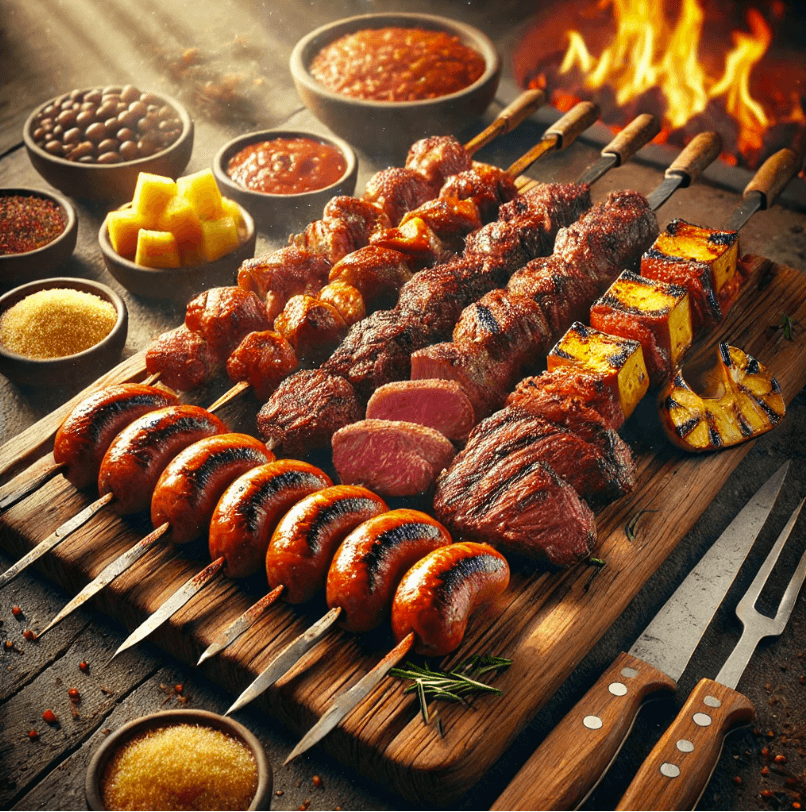
Churrasco (Created by AI)
Churrasco is a traditional method of meat preparation that developed in southern Brazil. Various types of meat (beef, pork, lamb, chicken) are skewered on large metal spits and cooked over charcoal embers or an open flame. The marination process is minimal—typically only coarse salt is used to emphasize the natural flavor of the meat. The churrasco tradition was cultivated by the Gaucho (cowboy) communities of the Rio Grande do Sul region. Once the meat is cooked, it is sliced thinly and served directly to guests. Churrasco is commonly enjoyed during communal events and social gatherings, particularly on Sundays or public holidays.
Coxinha is a popular savory pastry filled with shredded chicken and coated in breadcrumbs before being deep-fried. It is traditionally shaped to resemble a chicken drumstick. The dough is prepared using wheat flour and chicken broth, while the filling typically includes shredded chicken breast, cream cheese, and occasionally cilantro.
Coxinha is widely consumed across all regions of Brazil and is commonly found at street vendors and pastry shops. Its appeal spans all social classes, making it a universally appreciated snack.
Pão de Queijo is a type of cheese bread originating from the state of Minas Gerais in Brazil. Its main ingredients are cassava flour (tapioca starch) and locally produced firm cheeses. Being gluten-free, it appeals to a wide range of consumers. Pão de Queijo is typically consumed at breakfast or as a snack between meals. It is traditionally served with coffee and remains popular in both rural and urban settings throughout the country.

Acaraje (Created by AI)
Bolinho de Bacalhau are deep-fried croquettes made from salted cod (bacalhau). These snacks are especially popular in bars, cafés, and among street vendors. They are one of the clearest examples of Portuguese culinary influence in Brazilian cuisine.
Pastel de Queijo is a deep-fried pastry commonly sold in open-air markets, especially in major cities. The filling typically includes cheese, but variations with meat or vegetables are also popular. Due to its low cost and convenient consumption, pastel is a frequent choice in urban food culture.
Podrão refers to inexpensive hamburgers or hot dogs sold at night-time street food stands. Known for their large portions and affordability, these items are particularly favored by younger consumers. The term "podrão" colloquially implies indulgence in fast, greasy food, often after nightlife activities.
Cassava Chips, also known as Mandioca Frita, are fried slices of cassava widely sold by street vendors across Brazil. They are considered an alternative to potato fries and are typically seasoned with salt or spices to enhance flavor.
In Brazilian cuisine, sweets and beverages reflect the country’s agricultural diversity and historical-cultural interactions. Ingredients such as sugarcane, tropical fruits, peanuts, and coconut—widely produced across Brazil—constitute the foundational components of dessert and drink recipes. European-style desserts introduced during the Portuguese colonial period merged with African and Indigenous culinary traditions, creating diverse and localized variations. Similarly, agricultural practices and climatic conditions across Brazil’s regions have significantly shaped its beverage culture.
Brigadeiro is one of Brazil’s most iconic and widely consumed desserts. Its primary ingredients are sweetened condensed milk, cocoa powder, and butter. These are slowly cooked together over low heat until a thick, dough-like consistency is achieved. The mixture is then rolled into small balls and typically coated with chocolate sprinkles. Brigadeiro is commonly served at birthday parties and various social gatherings. It gained popularity in the 1940s during the presidential campaign of Brazilian politician Eduardo Gomes, after whom the sweet is named.

Quindim (Created by AI)
Quindim is considered the Brazilian adaptation of the Portuguese dessert Brisa-do-Lis. It is made from a simple combination of egg yolks, sugar, and grated coconut, then baked and presented as small, glossy, yellow cakes. The generous use of egg yolks reflects the influence of traditional Portuguese confectionery techniques inherited from the colonial period. Quindim is particularly popular in the Bahia region, where it forms part of the local Afro-Portuguese culinary heritage.
Paçoca is a traditional sweet widely produced in Brazil’s northeastern and inland regions. It consists of a dry and crumbly mixture made from roasted peanuts, sugar, and manioc flour. Known for its high nutritional value and long shelf life, Paçoca is especially associated with cultural festivals such as Festa Junina. Its simple preparation and rustic texture have made it a beloved treat across generations.

Beijinho (Created by AI)
Beijinho is a traditional Brazilian sweet similar to Brigadeiro, but instead of cocoa, it features grated coconut as the primary flavoring. It is prepared by cooking sweetened condensed milk and butter until thickened, then rolling the mixture into small balls which are coated in desiccated coconut. Each piece is typically garnished with a whole clove on top, both as decoration and for added aroma. Beijinho is especially popular at children’s birthday parties and during religious celebrations.
Mate is a traditional herbal tea widely consumed in southern Brazil. It is made by infusing the dried and ground leaves of the Ilex paraguariensis plant in hot or cold water. Consumed communally, mate is typically served in a gourd-like vessel known as a cuia and sipped through a metal straw called a bomba. Like in Paraguay and Argentina, mate drinking in Brazil is a deeply rooted social practice, often associated with hospitality and communal identity.
Brazil is the world’s leading producer and exporter of coffee, and coffee culture is deeply embedded in the country’s daily life. Typically served as cafezinho—a small, strong, and often unsweetened cup—coffee is an essential component of both social and professional settings. It is offered in homes, workplaces, and gatherings as a gesture of hospitality. The flavor and aroma of Brazilian coffee vary significantly depending on the region of cultivation, influenced by differences in climate, altitude, and soil composition.

Mate Tea (Created by AI)
Brazilian cuisine, due to the country’s vast territory and diverse ecological zones, is characterized not by a homogeneous structure but by regional variations. Each region has developed its own culinary traditions, shaped by its climate, agricultural resources, and ethnic composition. This section explores the regional diversity of Brazilian cuisine from a geographic and socio-cultural perspective.
The Northern region encompasses the Amazon Basin and stands out as Brazil’s most biodiverse geographic area. In this region, indigenous culinary traditions are largely preserved. Staple ingredients include manioc (cassava), açaí berries, and freshwater fish species such as pirarucu and tambaqui. Manioc is processed in various forms—as both starch and root—and requires specific traditional methods to eliminate its natural toxins. Dishes such as Tacacá and Pato no Tucupi reflect the use of manioc derivatives and endemic plant species, demonstrating the importance of ethnobotanical knowledge in local food practices.
The Northeast is a gastronomic zone where the historical influences of Portuguese colonization and African diasporic communities are strongly evident. The state of Bahia is regarded as the heart of Afro-Brazilian cuisine. Ingredients such as dendê oil (palm oil), coconut milk, shrimp, and chili peppers dominate the local food palette. Dishes like Acarajé, Vatapá, and Caruru hold significant roles in both daily consumption and religious rituals. These foods are often linked to Candomblé ceremonies as votive offerings. The cuisine of this region is known for its high carbohydrate content and the generous use of spices.
The Southeast is Brazil’s most densely populated and industrialized region. The states of São Paulo and Rio de Janeiro are culinary melting pots due to their high immigrant populations. Italian immigrants introduced adapted versions of pasta, pizza, and risotto; Japanese communities popularized dishes such as sushi, tempura, and ramen; while Middle Eastern groups contributed foods like kibe and sfihas. The region’s most emblematic traditional dish is Feijoada, with the Feijoada Paulista variant being particularly popular in São Paulo, customarily served on Wednesdays and Saturdays.
The Southern region, comprising Rio Grande do Sul, Santa Catarina, and Paraná, is closely associated with Gaucho culture. European immigration, particularly from Germany and Italy, has shaped the local cuisine. These communities introduced sausages, beer, sauerkraut, and cheese production, which have been integrated with local traditions. Churrasco is the hallmark of Gaucho cuisine—various types of meat, especially beef, are skewered and cooked over charcoal or open flames. This dish is a staple at social gatherings and weekend events throughout the region.
The Central-West is a key agricultural and livestock-producing region of Brazil. The states of Mato Grosso and Goiás are vital centers for farming and cattle ranching. The Pantanal area is particularly rich in freshwater fish species such as piranha and pintado, which are dietary staples. Local culinary highlights include arroz com pequi, a rice dish prepared with the native pequi fruit. Additionally, proximity to the borders with Paraguay and Bolivia means that indigenous dietary practices from neighboring areas have also influenced regional cooking traditions.

Brazilian Cuisine (Created by AI)
Brazilian cuisine is closely linked to the country’s social structure and historical development. Eating habits in Brazil are not merely individual practices of consumption; rather, they are understood as cultural expressions that shape social relationships and collective identities. The processes of food preparation and sharing represent a communal experience shaped by the intersection of various social classes, ethnic groups, and cultural traditions.
In Brazil, daily meal routines are structured according to social norms and economic conditions. Breakfast (café da manhã) is typically light and quick, consisting of items such as bread, fruit, and coffee. In southern regions, mate tea is also commonly consumed. Lunch (almoço) is regarded as the main meal of the day and usually includes a combination of rice, beans, meat, and salad. It is often consumed collectively at workplaces or at home and is considered an essential setting for social interaction. Dinner (jantar), in comparison, is usually lighter and often composed of leftovers from lunch. The scheduling and communal sharing of meals, particularly in rural areas, form a foundational element of community life. Shared meals involving family members and neighbors reinforce social cohesion and facilitate the intergenerational transmission of cultural values.
Religious and cultural festivals hold significant importance in terms of food practices in Brazil. In Afro-Brazilian religious traditions such as Candomblé and Umbanda, it is customary to offer specific foods to deities (orixás). During these rituals, dishes such as acarajé and vatapá are both presented as votive offerings and shared among community members. In Catholic religious practices, special meals are prepared and shared during holy periods such as Easter and Christmas. Bacalhau (salt cod) is a central dish during Easter celebrations. In seasonal festivals like Festa Junina, corn-based dishes (e.g., pamonha, canjica) and sweets (e.g., paçoca, quentão) occupy a prominent place, reinforcing culinary traditions as a central element of collective festivity and cultural expression.
Anadolu Üniversitesi. World Cuisines I. Edited by Assoc. Prof. Dr. Hakan Yılmaz. Eskişehir: Anadolu University, August 2018. E-ISBN 978-975-06-2566-4.
Brezilya Kültür. "Brezilya Kültürü." Erişim 24 Mart 2025. https://www.brezilyakultur.com/brezilya-kulturu/.
Ermağan, İsmail, Emine Tahsin, ve Segâh Tekin, eds. Dünya Siyasetinde Latin Amerika 4. Ankara: Nobel Akademik Yayıncılık Eğitim Danışmanlık Tic. Ltd. Şti., 2021. Erişim 21 Mart 2025. ISBN 978-625-417-311-0.
Özkaya, Fügen Durlu, ve Batuhan Sarican. “The Cultural Interaction Journey of Latin American Cuisine.” Journal of Tourism and Gastronomy Studies 2, no. 1 (2014): 36–45. Erişim 19 Mart 2025.
Tourism Journal. "Brezilya’nın Tatlı ve Eşsiz Mutfağı." Erişim 24 Mart 2025. https://www.tourismjournal.com.tr/turizm/brezilya-nin-tatli-ve-essiz-mutfagi-1016375.
Türkiye Turizm Ansiklopedisi. "Brezilya Mutfağı." Erişim 24 Mart 2025. https://turkiyeturizmansiklopedisi.com/brezilya-mutfagi.

The Influence of Brazil's Geography and Demographics on Culinary Culture
The Historical Development and Cultural Layers of Brazilian Cuisine
Staple Foods and Cooking Techniques in Brazilian Cuisine
Leading Traditional Dishes and Their Structural Characteristics
Feijoada
Moqueca
Vatapá
Acarajé
Churrasco
Coxinha
Pão de Queijo
Bolinho de Bacalhau
Pastel de Queijo
Podrão
Cassava Chips (Mandioca Frita)
An Assessment of Sweets and Traditional Beverages
Brigadeiro
Quindim
Paçoca
Beijinho
Mate
Coffee
Brazilian Cuisine by Region: Geographic and Socio-Cultural Approaches
Northern Region and Amazonian Cuisine
Northeastern Region and Bahia Cuisine
Southeastern Region and São Paulo Cuisine
Southern Region and Gaucho Cuisine
Central-West Region and Pantanal Cuisine
Social Structure and the Interaction with Culinary Culture
Food Consumption Habits in Daily Life
Culinary Practices in Religious and Cultural Festivals
This article was created with the support of artificial intelligence.