

This article was automatically translated from the original Turkish version.
+1 More
Aircraft Type(s) | Boeing 737-200 Series | ||||||||
|---|---|---|---|---|---|---|---|---|---|
Location | United Kingdom r: Manchester International Airport | ||||||||
Fatalities | 55 people | ||||||||
Passengers and Crew | Total of 137 people (131 passengers, 6 crew) | ||||||||
Route | Charter flight between Manchester (United Kingdom) and Corfu (Greece) | ||||||||
Aircraft Registration | G-BGJL | ||||||||
History | 22 August 1985 | ||||||||
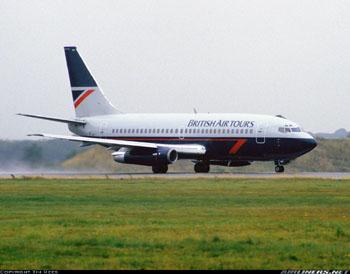
British Airtours Flight 28M (KT28M) was an aviation accident that occurred on 22 August 1985 at Manchester International Airport in England, resulting in the deaths of 55 people. The aircraft, a Boeing 737-236 registered as G-BGJL, was operating a charter flight to Corfu Island in Greece. At the time of the incident, there were 131 passengers and six crew members on board, totaling 137 people. The accident occurred during takeoff when an uncontained engine failure in the left engine caused a massive fuel leak that ignited.

British Airtours Flight 28M Aircraft Accident(FAA)
The aircraft received clearance for takeoff from air traffic control (ATC) at 06:12 from runway 24 and began its takeoff roll under the first officer’s control. When the indicated airspeed (IAS) exceeded 125 knots, a loud explosion was heard from the left engine. The captain assessed the situation as a tire burst or bird strike and immediately aborted the takeoff, closed the throttles, and activated reverse thrust on both engines to decelerate the aircraft. As the aircraft slowed, the air traffic controller informed the flight crew of a large fire on the right side of the aircraft. The captain directed the aircraft onto the Delta taxiway and ordered evacuation to the starboard side, opposite the wind. However, when the aircraft came to a stop, a 7-knot wind blowing from 250 degrees carried flames toward the rear fuselage, facilitating rapid fire penetration into the cabin.

British Airtours Flight 28M Aircraft Accident(FAA)
The primary mechanical cause of the accident was a fatigue-induced fracture in the No. 9 combustor can of the left Pratt & Whitney JT8D-15 engine. Examination of the aircraft’s maintenance records revealed that previous cracks in this combustor can had been repaired by the British Airways Engine Overhaul Division (BEOL) using a direct fusion welding technique. However, the critical solution heat treatment, required by repair procedures to extend the material’s fatigue life, was not performed. Communication gaps between the manufacturer and the airline, combined with misinterpretation of technical manuals, resulted in the component being returned to service with compromised fatigue resistance. During takeoff, under high pressure, the component fractured and ejected from the engine.
The ejected engine fragment struck the main fuel tank access panel beneath the left wing, creating a 42-square-inch opening. This cast aluminum alloy panel, designed to withstand only one-quarter of the impact energy required by safety standards, failed catastrophically under impact. Within seconds, large quantities of fuel leaked onto the runway and ignited, forming a dynamic fire cloud enveloping the rear left side of the aircraft. As the aircraft came to rest, the fire became static and rapidly melted the aluminum fuselage skin, allowing flames to penetrate the cabin. Burning polyurethane seat cushions, plastic panels, and other synthetic cabin materials released high concentrations of toxic and irritant gases, including carbon monoxide (CO) and hydrogen cyanide (HCN), rapidly degrading cabin air quality.

British Airtours Flight 28M Aircraft Accident(FAA)
The evacuation process was severely delayed by toxic smoke inside the cabin and mechanical failures in the aircraft’s emergency exit systems. When the cabin crew attempted to open the front right door (R1), the evacuation slide’s storage box became jammed against the door frame, preventing the door from opening outward. This mechanical failure rendered the primary evacuation route unusable for 1 minute and 10 seconds after the aircraft stopped. Simultaneously, the hinge baulk mechanism on the overwing exit, designed to prevent seat 10F from reclining backward, fractured under passenger pressure, narrowing the evacuation path and creating a critical bottleneck. These structural obstructions and delays significantly prolonged passengers’ exposure to toxic gases; nearly all 55 fatalities resulted not from burns but from rapid incapacitation due to inhalation of toxic fumes.

British Airtours Flight 28M Aircraft Accident(FAA)
The Manchester International Airport Fire Service (MIAFS) arrived at the scene in just 25 seconds after the fire alarm and quickly suppressed the external fire. Firefighting vehicles contained the flames around the rear of the aircraft, preventing complete encirclement of the fuselage. However, the fire crews were inadequately equipped to penetrate the interior fire or reduce cabin temperatures. Additionally, communication failures via radio and organizational delays in accessing supplementary water sources due to RVP routing errors hampered the effectiveness of the rescue operation.
This accident triggered historic regulatory changes in aviation industry standards for cabin safety and fire resistance. Following the publication of the accident report, the Federal Aviation Administration (FAA) and other civil aviation authorities mandated that fuel tank access panels on aircraft be designed to withstand high-impact forces from engine or tire fragments. Comprehensive new standards were implemented, including requiring cabin interiors and seats to be covered with fire-blocking materials, mandating low-level emergency escape-path lighting, increasing corridor widths for evacuation routes, and requiring realistic operational testing of emergency exit doors. Maintenance guidelines were also clarified to ensure that all required testing and quality control procedures to prevent metal fatigue are fully executed during repairs.
Air Accidents Investigation Branch. Report No: 8/1988 – Boeing 737-236, G-BGJL, 22 August 1985. GOV.UK. Accessed February 20, 2026.
Federal Aviation Administration. "Boeing 737-236, G-BGJL." Lessons Learned from Transport Airplane Accidents. Federal Aviation Administration. Accessed February 20, 2026.

Aircraft Type(s) | Boeing 737-200 Series | ||||||||
|---|---|---|---|---|---|---|---|---|---|
Location | United Kingdom r: Manchester International Airport | ||||||||
Fatalities | 55 people | ||||||||
Passengers and Crew | Total of 137 people (131 passengers, 6 crew) | ||||||||
Route | Charter flight between Manchester (United Kingdom) and Corfu (Greece) | ||||||||
Aircraft Registration | G-BGJL | ||||||||
History | 22 August 1985 | ||||||||
No Discussion Added Yet
Start discussion for "British Airtours Flight 28M Aircraft Accident (1985)" article
Cancellation of Takeoff and Aircraft Direction
Technical Basis of the Engine Failure and Deficiencies in Maintenance Procedures
Fire Development and Vulnerability of Cabin Interior Materials to Heat
Structural and Equipment Failures Hindering Passenger Evacuation
Airport Rescue and Fire Fighting (RFF) Operations
Impact on Civil Aviation Regulations and Implemented Safety Reforms