


This article was automatically translated from the original Turkish version.
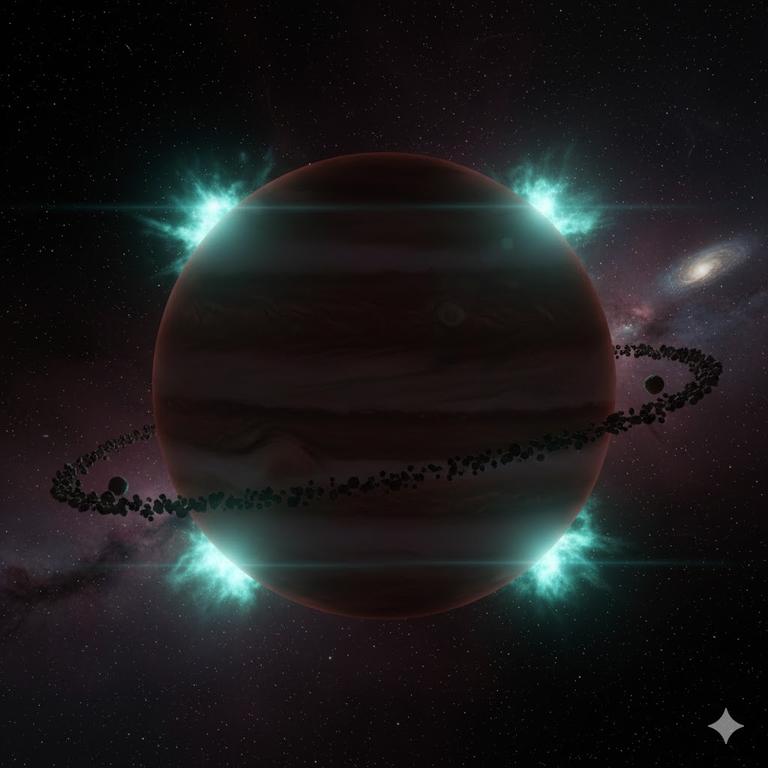
Kahverengi Cüce (Yapay Zeka ile Oluşturulmuştur.)
Brown dwarfs are sub-stellar objects whose masses are insufficient to initiate and sustain stable, continuous hydrogen-1 thermonuclear fusion in their cores; however, they can produce limited radiation during their early formation stages through gravitational collapse energy. They occupy a structural and evolutionary position between stars and planets.
Brown dwarfs are compact celestial bodies whose masses fall below the threshold required for stable and sustained nuclear fusion of hydrogen. At no stage of their evolution do thermonuclear processes in their cores continuously balance the energy radiated from their surfaces; as a result, they gradually cool and fade over time. Although they possess many physical characteristics typical of stars, they are not classified as true stars.

Brown Dwarf (NASA)
Stars form when interstellar gas and dust clouds collapse under gravity, reaching core temperatures high enough to initiate thermonuclear reactions and emit their own continuous light. Planets, by contrast, form from leftover material after star formation and do not produce their own light. Brown dwarfs resemble stars in their formation mechanism but lack sufficient mass to sustain hydrogen fusion; as a result, their luminosity is low and they occupy a position between stars and planets.
The lower limit of the hydrogen main sequence denotes the minimum mass at which stable hydrogen fusion can be sustained in the core. Brown dwarfs lie below this limit. Although the most massive brown dwarfs may exhibit partial hydrogen burning during early stages or for limited durations, this process never establishes a stable main sequence phase.
The masses of brown dwarfs are generally given as ranging from approximately 13 to 80 times the mass of Jupiter.【1】 The critical mass required to initiate hydrogen fusion is approximately 0.084 Solar masses, or about 84 Jupiter masses. Some brown dwarfs with masses greater than approximately 13 times that of Jupiter can undergo deuterium fusion in their cores.
For a celestial body to be classified as a planet, its mass must lie within a specific range: too small a mass prevents the formation of a spherical structure, while too large a mass triggers core nuclear reactions. Brown dwarfs fall between these two limits and therefore cannot be fully classified as either planets or stars.
Brown dwarfs form in the same manner as stars, through the gravitational collapse of a cloud composed of interstellar gas and dust. However, if the resulting mass falls below the critical threshold, the core temperature never reaches the level required to sustain hydrogen fusion.

A Young Brown Dwarf Forming Within a Nebula (Generated by Artificial Intelligence.)
In some cases, brown dwarfs may form through the condensation of matter at a localized point, similar to the formation process of planets.【2】 This scenario is particularly proposed for low-mass examples.
The core temperatures of brown dwarfs remain below approximately 3 million Kelvin, insufficient for stable thermonuclear reactions. In their early stages, their primary energy source is gravitational collapse energy; as they age, they radiate only residual internal heat.
At low densities, matter is predominantly in the form of molecular hydrogen, and its thermodynamic behavior can be explained by classical gas physics. Under conditions of high density and pressure, hydrogen ionizes and transitions into a metallic state; the majority of a brown dwarf’s mass consists of a liquid metallic hydrogen-helium mixture.
The radii of brown dwarfs are approximately equal to Jupiter’s radius across a wide mass range and show only weak dependence on mass. While mass varies between 1 and 80 Jupiter masses, radius changes by at most about 50 percent. Central densities can reach several hundred grams per cubic centimeter.
Due to insufficient mass, brown dwarfs cannot use hydrogen-1 nuclei as a continuous fuel source. Consequently, hydrogen fusion does not occur in their cores, and they cannot produce long-term energy output like true stars.
Brown dwarfs with masses greater than approximately 13 times that of Jupiter can undergo deuterium fusion in their cores. This process requires lower temperature and pressure than hydrogen-1 fusion and occurs only for a limited duration.
The atmospheres of brown dwarfs contain various molecules depending on low-temperature conditions. In warmer brown dwarfs, carbon monoxide dominates, while cooler ones exhibit methane and carbon dioxide.
Molecules such as titanium oxide (TiO) and vanadium oxide (VO) are distinctive features in the spectra of brown dwarfs. Spectral data are evaluated in conjunction with atmospheric models.
Shortly after formation, brown dwarfs pass through a relatively luminous phase due to gravitational collapse. This luminosity is not sustained by a continuous nuclear energy source.
Over time, as internal energy sources deplete, brown dwarfs cool and their radiation weakens. Over long timescales, they gradually become colder and dimmer.
Because they are extremely faint in visible light, brown dwarfs are primarily detected through infrared observations. Younger brown dwarfs are more prominent in the infrared region.
Due to insufficient core temperatures, brown dwarfs cannot destroy lithium. The presence of lithium absorption lines in a spectrum is one of the key criteria for identifying a celestial object as a brown dwarf.
Some brown dwarfs are found as companions to hydrogen-burning stars. In such cases, they can be detected through gravitational perturbations on the primary star or via direct imaging techniques.
Brown dwarfs have been observed particularly in young star clusters and star-forming regions. Open clusters such as the Pleiades and Hyades serve as examples. They can also be found in the galactic disk, bulge, and halo regions.
Since the early 2000s, it has been determined that brown dwarfs emit radio waves.【3】 This emission is understood to occur through a mechanism distinct from that of stars.
Radio waves are believed to be produced by charged particles accelerated along magnetic fields and directed toward the polar regions, similar to the mechanism observed in planets; this process results in the formation of aurorae in the atmosphere.【4】
The existence of brown dwarfs was first proposed theoretically in the 1960s.【5】
Brown dwarfs were observationally confirmed in 1995 with the identification of Teide-1 and shortly thereafter Gliese 229B. Other examples, such as Kelu-1, have since been detected.【6】
It is noted that only a small fraction of the total mass of the universe can be directly observed, with the remainder defined as "missing mass." Brown dwarfs are considered among the celestial bodies that may account for a portion of this missing mass.【7】
[1]
Mahir E. Ocak, "Brown Dwarfs," Bilim Genç, 31 July 2015, Access Date: 4 February 2026. https://bilimgenc.tubitak.gov.tr/makale/kahverengi-cuceler.
[2]
Aydın, Cemal, Berahitdin Albayrak and Elmas Handal. "Neither Star Nor Planet: Brown Dwarfs." Bilim ve Teknik, January 2001. Access Date: 4 February 2026. https://bilimteknik.tubitak.gov.tr/wp-content/uploads/sites/154/2025/09/8e9f1147-6570-4e3b-b4a6-91fdc9bda024-1.pdf
[3]
Mahir E. Ocak, "Brown Dwarfs," Bilim Genç, 31 July 2015, Access Date: 4 February 2026. https://bilimgenc.tubitak.gov.tr/makale/kahverengi-cuceler.
[4]
Mahir E. Ocak, "Brown Dwarfs," Bilim Genç, 31 July 2015, Access Date: 4 February 2026. https://bilimgenc.tubitak.gov.tr/makale/kahverengi-cuceler.
[5]
Aydın, Cemal, Berahitdin Albayrak and Elmas Handal. "Neither Star Nor Planet: Brown Dwarfs." Bilim ve Teknik, January 2001. Access Date: 4 February 2026. https://bilimteknik.tubitak.gov.tr/wp-content/uploads/sites/154/2025/09/8e9f1147-6570-4e3b-b4a6-91fdc9bda024-1.pdf
[6]
Aydın, Cemal, Berahitdin Albayrak and Elmas Handal. "Neither Star Nor Planet: Brown Dwarfs." Bilim ve Teknik, January 2001. Access Date: 4 February 2026. https://bilimteknik.tubitak.gov.tr/wp-content/uploads/sites/154/2025/09/8e9f1147-6570-4e3b-b4a6-91fdc9bda024-1.pdf
[7]
Aydın, Cemal, Berahitdin Albayrak and Elmas Handal. "Neither Star Nor Planet: Brown Dwarfs." Bilim ve Teknik, January 2001. Access Date: 4 February 2026. https://bilimteknik.tubitak.gov.tr/wp-content/uploads/sites/154/2025/09/8e9f1147-6570-4e3b-b4a6-91fdc9bda024-1.pdf


Kahverengi Cüce (Yapay Zeka ile Oluşturulmuştur.)
Definition and Conceptual Framework
General Definition of Brown Dwarfs
Position Relative to Stars and Planets
Relationship to the Lower Limit of the Hydrogen Main Sequence
Mass Ranges and Classification
Mass Threshold Values
Classification Between Planets and Stars
Formation Processes
Formation via Gravitational Collapse
Planet-like Formation Scenarios
Physical Properties
Internal Structure and Energy Sources
Core Temperature and Thermodynamic Conditions
Radius–Mass Relationship and Density
Fusion Processes
Absence of Hydrogen Fusion
Deuterium Fusion
Atmospheric and Spectral Properties
Atmospheric Composition
Spectral Diagnostic Features
Evolutionary Processes
Early-stage Luminosity
Cooling and Fading
Observational Properties and Detection Methods
Infrared Observations
Lithium Test
Detection in Binary and Multiple Systems
Open Clusters and Galactic Distribution
Radio Waves and Magnetic Interactions
Generation of Radio Waves
Aurorae and Magnetic Processes
Discovery Process and Initial Observations
Theoretical Predictions
First Observational Confirmations
Cosmological Context