

This article was automatically translated from the original Turkish version.
+2 More
Location | Norway Bergen Eastern shore of Vågen Harbor | ||||||||
|---|---|---|---|---|---|---|---|---|---|
Foundation | One of Bergen's earliest settlement areas after 1070 | ||||||||
Historical Significance | Trading center of the Hanseatic League (1360–1760) | ||||||||
Cultural Institutions | Schøtstuene Hanseatic Museum Bryggens Museum | ||||||||
UNESCO Status | On the World Heritage List since 1979 | ||||||||
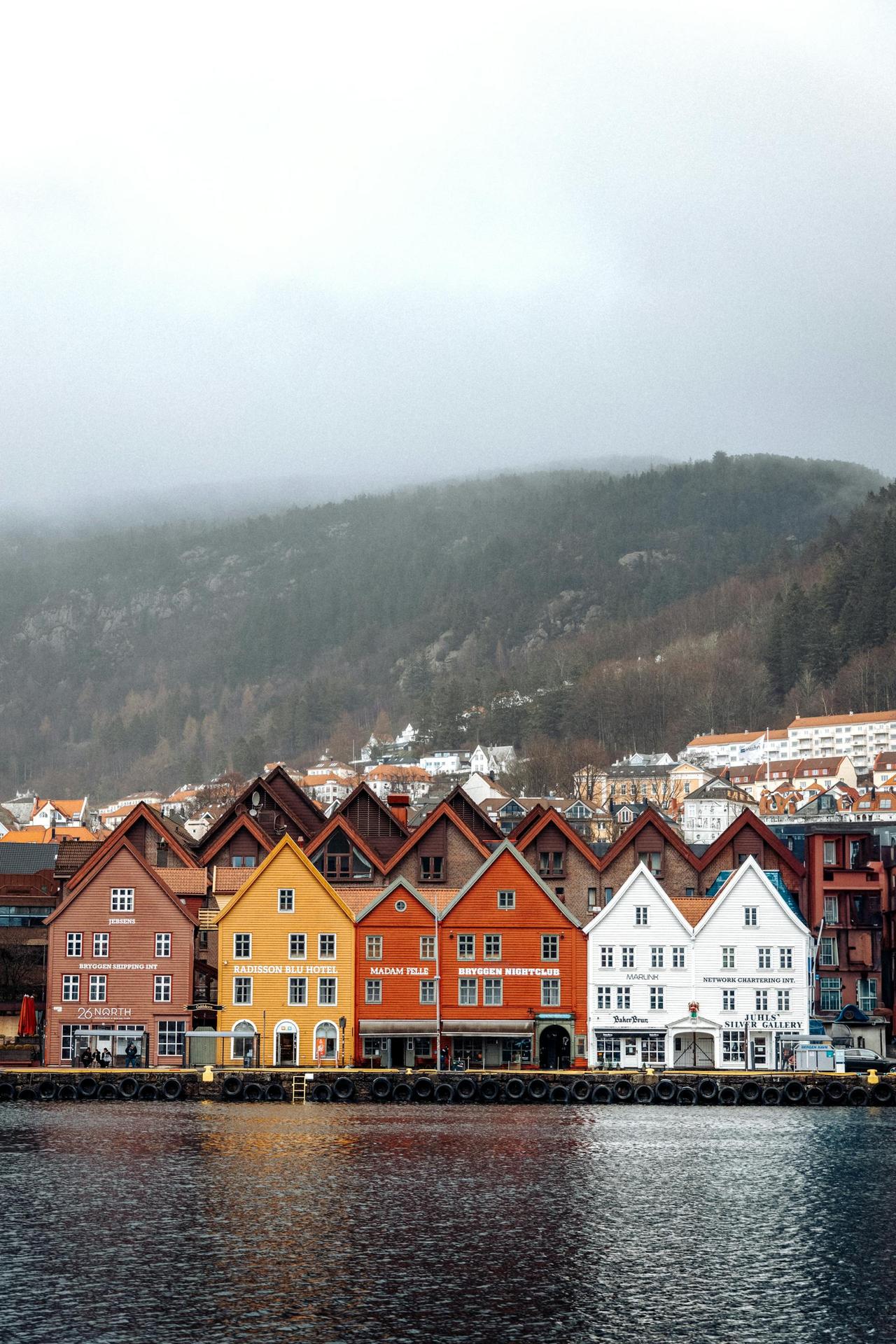
Bryggen Houses are one of the most renowned historical areas in the city of Bergen, located on the west coast of Norway. This cluster of buildings, situated along the eastern shore of the Vågen harbor, has served as the commercial center of Bergen since its founding and played a significant role in the economic and cultural history of Northern Europe during the Hanseatic League period.
Today listed on UNESCO’s World Heritage List, Bryggen represents one of the most prominent examples of medieval Scandinavian urban life through its wooden architecture, narrow alleyways, and archaeological remains.

Bryggen Houses (
Bergen acquired city status in 1070 and quickly became Norway’s principal trading center. Its development was especially concentrated in the Bryggen area. The structures built there in the 12th century established Bergen as one of Norway’s most important port cities.
In 1360 the German Hanseatic League established one of its trading offices at Bryggen. Known as “Det tyske Kontor” (the German Kontor), this center formed the heart of Bergen’s commercial life for approximately four centuries. Hanseatic merchants exported fish, particularly stockfish dried in Nordland, to markets across Europe and in return imported grain, wine, textiles, and metal goods. Thus Bryggen assumed a central role in the foreign trade not only of Bergen but of all Norway.
Bergen has experienced numerous major fires throughout its history. The fire of 1702 destroyed much of the city, reducing the wooden houses of Bryggen to ashes. However, structures rebuilt shortly afterward on the original foundations preserved the area’s historical character. This reconstruction ensured that Bryggen retained its medieval urban layout to the present day.

Bryggen Houses (Erik Veland)
The Bryggen Houses are typically long, narrow, wooden structures aligned parallel to the harbor. These buildings served both commercial and residential functions. The ground floors were used for storage while the upper floors housed the merchants’ living quarters. The narrow passageways between the houses open into small courtyards, forming the distinctive architectural character of the area.
Aesthetically, the Bryggen Houses reflect traditional Scandinavian wooden construction techniques. Despite the risk of fire, wood remained the preferred material; buildings were generally constructed with steeply pitched roofs and simple façades. This architectural style has been preserved due to its functional suitability for trade and its historical continuity.

Bryggen Houses (Ehsan Haque)
During the Hanseatic period, Bryggen was not merely a commercial hub but also a social community. “Det tyske Kontor” (the German Kontor) operated as a distinct community within the city, with its own internal governance system. The merchants residing there established a unique social order with shared living spaces, assembly halls (Schøtstuene), and warehouses.
Trade in the area was largely based on fish products. Dried fish from Nordland and Troms were exported to various European cities, while grain, salt, wine, and textiles were imported into Bergen. This trade network enhanced Bergen’s economic significance and established Bryggen as one of the key centers of Northern European trade routes.
Archaeological excavations begun in 1955 revealed multiple layers of Bryggen’s history and provided valuable insights into early settlement in Bergen. These findings are now exhibited at the Bryggens Museum. Additionally, the Hanseatiske Museum og Schøtstuene is an important institution that documents the lifestyle, daily activities, and trading practices of the Hanseatic merchants.

Bryggen Houses (Solja Virkkunen)
Inscribed on UNESCO’s World Heritage List in 1979, Bryggen is recognized as one of the rare urban landscapes to have survived from the medieval period to the present. This status underscores both the tangible legacy of the Hanseatic League’s influence on European history and Bergen’s commercial and cultural importance.
Today Bryggen remains at the heart of Bergen’s cultural identity. The buildings continue to serve both tourist and cultural functions, housing workshops, art galleries, museums, and small shops. Thus Bryggen preserves its historical heritage while maintaining its functional role in the daily life of modern Bergen society.
Bergen byarkiv. "Bergens Historie – Byutvikling." Bergen byleksikon. Accessed October 2, 2025. https://www.bergenbyarkiv.no/bergenbyleksikon/bergens-historie#BYUTVIKLING
Bergen byarkiv. “Bergens Historie – Bergensere.” Bergen byleksikon. Accessed October 2, 2025. https://www.bergenbyarkiv.no/bergenbyleksikon/bergens-historie#BERGENSERE
Bergen byarkiv. “Bergens Historie – Bygningshistorie.” Bergen byleksikon. Accessed October 2, 2025. https://www.bergenbyarkiv.no/bergenbyleksikon/bergens-historie#BYGNINGSHISTORIE
Erik Veland. “Bryggen i Bergen.” Flickr. Accessed October 2, 2025. https://www.flickr.com/photos/erikveland/445744100
GZT Skyroad. "Norveç’in Sevimli ve Sıcak Şehri Bergen." GZT.com. Accessed October 2, 2025. https://www.gzt.com/infografik/skyroad/norvecin-sevimli-ve-sicak-sehri-bergen-17146/1
Haque, Ehsan. “Colorful Houses in Bryggen in Bergen City in Norway.” Pexels. Accessed October 2, 2025. https://www.pexels.com/photo/colorful-houses-in-bryggen-in-bergen-city-in-norway-18450266/
Helljesen, Ina-Cristine. “Bryggen in Bergen: A Big Piece of History in a Small Place.” *Go Fjords.* Accessed October 2, 2025. https://gofjords.com/inspiration/norway/bryggen-in-bergen-a-big-piece-of-history-in-a-small-place/
Holmboe, Haakon, and Helge Salvesen. "Det tyske kontor." Encyclopaedia of Norway (SNL). Accessed October 2, 2025. https://snl.no/Det_tyske_kontor
Johannesen, Nina Hovda and Asbjørn E. Herteig. “Bryggen i Bergen.” Encyclopaedia of Norway (SNL). Accessed October 2, 2025. https://snl.no/Bryggen_i_Bergen
Riksantikvaren. “Bergen.” Flickr. Accessed October 2, 2025. https://www.flickr.com/photos/riksantikvaren/9216458288/
Solja Virkkunen. “Bryggen.” Flickr. Accessed October 2, 2025. https://www.flickr.com/photos/solja/225091022/
Tedla, Vivek. “Norveç Bergen’deki Renkli Ahşap Evler.” Pexels. Accessed October 2, 2025. https://www.pexels.com/tr-tr/fotograf/norvec-bergen-deki-renkli-ahsap-evler-29276458/
Thorsnaes, Geir. “Bergen – historie.” Encyclopaedia of Norway (SNL). Accessed October 2, 2025. https://snl.no/Bergen_-_historie
UNESCO. “Bryggen.” UNESCO World Heritage Centre. Accessed October 2, 2025. https://whc.unesco.org/en/list/59/
Visit Norway. “Bryggen in Bergen.” VisitNorway.com. Accessed October 2, 2025. https://www.visitnorway.com/listings/bryggen-in-bergen/5200/

Location | Norway Bergen Eastern shore of Vågen Harbor | ||||||||
|---|---|---|---|---|---|---|---|---|---|
Foundation | One of Bergen's earliest settlement areas after 1070 | ||||||||
Historical Significance | Trading center of the Hanseatic League (1360–1760) | ||||||||
Cultural Institutions | Schøtstuene Hanseatic Museum Bryggens Museum | ||||||||
UNESCO Status | On the World Heritage List since 1979 | ||||||||
Historical Development
Founding of Bergen and Early Period
Influence of the Hanseatic League
Fires and Reconstruction Phases
Architecture and Urban Layout
Social and Economic Functions
Archaeological Discoveries and Cultural Institutions
UNESCO World Heritage Status
Bryggen Today