


This article was automatically translated from the original Turkish version.
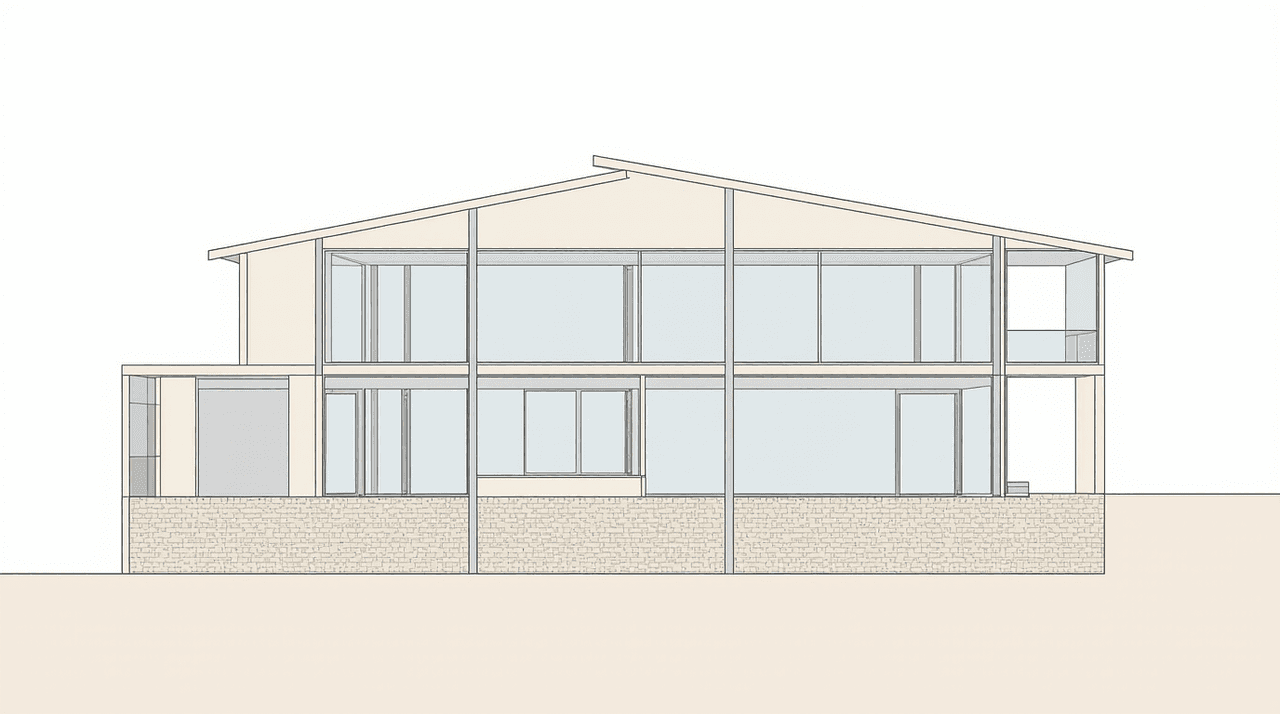
Structural Elements (Generated by Artificial Intelligence.)
Main Classification | Load-Bearing Elements (Rough Construction) and Complementary Elements (Finishing Construction) | ||||||||
|---|---|---|---|---|---|---|---|---|---|
Load-Bearing Elements | Foundation, Column, Beam, Slab, Load-Bearing Walls, Roof | ||||||||
Complementary Elements | Door, Window, Finishes, Insulation, Utilities, Partition Walls | ||||||||
Related Disciplines | Architecture, Civil Engineering | ||||||||
Building elements are the fundamental components that define a building’s structural system, spatial organization, performance against environmental influences, and aesthetic qualities. Therefore, the correct design, specification of appropriate materials and dimensions, and proper implementation according to standards are decisive for the integrity and functional safety of the structure.
Architecture and structural engineering disciplines base the design of building elements on criteria such as material properties, load-bearing capacity, thermal and acoustic insulation performance, resistance to moisture and fire, and long-term behavior under use. Within this framework, a building’s structural safety, functional performance, and aesthetic character are directly dependent on the harmonious integration of its elements and the correct application of technical details in accordance with standards.
Building elements are examined in two main categories according to their function and level of structural contribution: load-bearing elements (rough construction) and finishing elements (fine construction). This classification provides a systematic approach to defining both the structural integrity and the final usable form of a building.
Load-bearing elements form the primary structural system that safely transfers the building’s own weight, live loads during use, and external forces such as earthquakes and wind to the ground. These elements are the foundational components that ensure the structural integrity of the building.
Finishing elements are components that do not directly contribute to the building’s load-bearing system but determine its usability, comfort, safety, and aesthetic qualities. These elements are typically applied after the rough construction is completed.
The two main groups establish a balance between the static safety, functional efficiency, and aesthetic qualities of building design. The correct design and implementation of each building element directly affect the structure’s performance, lifespan, and user comfort.
A building’s durability and longevity depend not only on the quality of its superstructure elements but also directly on the characteristics of the soil on which it rests and the selection of a foundation system suited to that soil. The soil that supports and safely distributes all building loads is referred to as the “bearing soil.” Before construction begins, soil investigations are conducted to determine the soil’s bearing capacity, settlement characteristics, groundwater level, and geotechnical behavior. These studies provide the necessary engineering data for selecting the appropriate type and depth of foundation.
Soils are generally classified as strong, medium, and weak (marshy):
The process of determining and marking the location of a completed building design on the site is called “layout.” This process ensures the accurate transfer of the building plan to the site and guarantees positional accuracy during construction.
Foundation systems, determined according to soil conditions and building loads, are evaluated in two main categories based on how they transfer loads to the ground. Shallow foundations are preferred when strong soil is located near the surface. In these systems, building loads are transferred directly to the upper layers of the soil. Major types of shallow foundations include isolated (individual) foundations, continuous (strip) foundations, and raft (mat) foundations. Isolated foundations are typically arranged independently beneath columns; continuous foundations support multiple load-bearing elements along a single line; raft foundations unify the entire structure on a single slab surface to ensure even load distribution.
Deep foundations are used when strong soil is located far below the surface or when the existing soil’s bearing capacity is insufficient. In these systems, loads are transferred through various elements to deeper, more stable soil layers. Pile foundations, piles, and caissons belong to this group. Piles are long elements driven or cast into the ground to achieve high load capacity. Caissons are large-scale foundation elements constructed to reach solid strata, especially under water or weak soil conditions. They are categorized into open caissons, pneumatic caissons, and floating caissons depending on usage conditions.
Walls are vertical elements in buildings that serve either as load-bearing or partitioning components depending on their function. They are classified into various groups based on material type, construction technique, and intended use.
Masonry walls are constructed by laying traditional materials such as natural stone, brick, or adobe with or without mortar. These walls serve as the primary load-bearing elements in masonry structural systems and transfer loads directly to the foundations.
Brick walls are formed by laying factory-made or hand-molded bricks with cement mortar. They are widely used as both load-bearing walls and interior partition walls. The production standards of the material directly affect the wall’s strength and thermal and acoustic insulation performance.
Lightweight block and aerated concrete walls are constructed using low-density, high-insulation building elements. Due to their light weight, these walls offer advantages in interior space partitioning without adding additional load to the structural system.
Panel walls are systems created by assembling prefabricated reinforced concrete or lightweight aggregate panels on site. They offer significant advantages in speed, quality control, and labor efficiency in prefabricated and modular building types.
Concrete and reinforced concrete walls are used in structures requiring high load-bearing capacity. These walls are commonly referred to as shear walls and play a critical role in resisting seismic loads, especially in multi-story buildings.
The portions filled with mortar between the bricks, stones, or blocks that form the wall are called joints. Joints affect both structural strength and aesthetic appearance. Depending on the application method, they can be finished in different types such as trowel joint, recessed joint, and protruding joint.
Prefabrication is a construction technology based on manufacturing building elements in controlled factory environments rather than on-site, and then transporting them to the site for assembly. This method is widely used in industrial and modular building systems as it ensures standardization, quality control, rapid assembly, and cost efficiency during production.
Prefabricated building elements consist of different components depending on the building type and purpose: columns and beams form the main load-bearing system. Columns carry vertical loads while beams are horizontal elements that transfer these loads to columns. The prefabrication process ensures that these elements are manufactured according to standards in terms of dimensions, strength, and surface quality. Beams can be designed in various types according to their function, such as primary beams, secondary beams, trusses, purlins, or crane beams.
Slab panels are used to construct floor slabs and form the horizontal planes of the building. Different cross-sections and production types are available, including TT slabs, hollow-core slabs, and U-slabs. These panels provide not only load-bearing capacity but also additional performance advantages such as lightness, thermal, and acoustic insulation.
Facades form the building’s outer envelope and provide protection against external environmental conditions. These elements also perform thermal and waterproofing functions in addition to aesthetic appearance. While material and surface properties vary according to building type, reinforced concrete, composite, and lightweight panel types are the most commonly used options.
The prefabrication system significantly reduces construction time, minimizes material waste, and ensures a safer and more predictable construction process.
In addition to load-bearing and finishing elements, various auxiliary and supporting components play a vital role in maintaining a building’s integrity, safety, and functionality. These elements ensure the harmonious operation of different building systems and contribute to preserving both structural and functional performance.
Chimneys are vertical ducts designed to safely expel smoke, contaminated air, waste, or service gases from buildings. They are categorized into types such as fire chimneys, ventilation chimneys, refuse chutes, and service chimneys according to their purpose. Each chimney type ensures the safe operation of its respective system and maintains indoor air quality. Material selection and cross-sectional dimensions are determined based on chimney type and usage conditions.
Expansion joints are structural gaps intentionally left in large-volume buildings or adjacent aligned structures to accommodate stresses caused by differential settlement, temperature changes, wind, and earthquakes. These joints allow building sections to move independently, reducing the risk of cracking, deformation, and structural damage. The width of expansion joints is calculated based on the building’s dimensions, soil characteristics, and regional climatic conditions.
Connection elements are small but critical components that securely fix main structural components to each other or to the building surface. Varieties such as saddle flanges, universal elbows, angled elbows, and duct connectors maintain the stability and integrity of load-bearing systems. These elements play an important role in both ease of installation and long-term durability of the system. Such components are typically invisible but indispensable for safety, durability, and user comfort.
Cheng, Hong, Jiapo Li, Xiaoda Li, Kai Liu, and Bin Tu. “Mechanical Performance of Prefabricated Lightweight Steel-Foamed Ceramsite Concrete Wall Panels: Experimental and Theoretical Investigations.” *Case Studies in Construction Materials* 19 (2023): e02645. Accessed October 17, 2025. https://doi.org/10.1016/j.cscm.2023.e02645
Constantinescu, Horia, and Traian-Nicu Toader. “Structural Design and Technology of Pocket Foundations for Long Precast Concrete Columns in Seismic Areas.” *Buildings* 14, no. 11 (2024): 3466. Accessed October 17, 2025. https://doi.org/10.3390/buildings14113466
Gerges, Najib. *Types of Foundations.* Course No. G02-015. 2 PDH. CED Engineering, 2019. Accessed October 17, 2025. https://www.cedengineering.com/userfiles/G02-015%20-%20Types%20of%20Foundations%20-%20US.pdf
Gunawardena, Tharaka, and Priyan Mendis. “Prefabricated Building Systems—Design and Construction.” *Encyclopedia* 2, no. 1 (2022): 70–95. Accessed October 17, 2025. https://doi.org/10.3390/encyclopedia2010006
Sah, Tilak Prasad, Andrew William Lacey, Hong Hao, and Wensu Chen. “Prefabricated Concrete Sandwich and Other Lightweight Wall Panels for Sustainable Building Construction: State-of-the-Art Review.” *Journal of Building Engineering* 89 (2024): 109391. Accessed October 17, 2025. https://doi.org/10.1016/j.jobe.2024.109391
SmartMarketReport. *Prefabrication and Modularization: Increasing Productivity in the Construction Industry.* National Institute of Standards and Technology (NIST), 2011. Accessed October 17, 2025. https://www.nist.gov/system/files/documents/el/economics/Prefabrication-Modularization-in-the-Construction-Industry-SMR-2011R.pdf
Wang, X., and Q. Tang. “Research on Detailed Design Methods of Precast Components in Prefabricated Buildings Based on BIM Technology.” *Heliyon* 10, no. 16 (August 8, 2024): e35922. Accessed October 17, 2025. https://doi.org/10.1016/j.heliyon.2024.e35922

Structural Elements (Generated by Artificial Intelligence.)
Main Classification | Load-Bearing Elements (Rough Construction) and Complementary Elements (Finishing Construction) | ||||||||
|---|---|---|---|---|---|---|---|---|---|
Load-Bearing Elements | Foundation, Column, Beam, Slab, Load-Bearing Walls, Roof | ||||||||
Complementary Elements | Door, Window, Finishes, Insulation, Utilities, Partition Walls | ||||||||
Related Disciplines | Architecture, Civil Engineering | ||||||||
Classification of Building Elements
Load-Bearing Elements (Rough Construction)
Finishing Elements (Fine Construction)
Foundation and Soil Relationship
Foundation Types
Wall Systems and Materials
Prefabricated Building Elements
Other Important Building Elements and Systems