


This article was automatically translated from the original Turkish version.
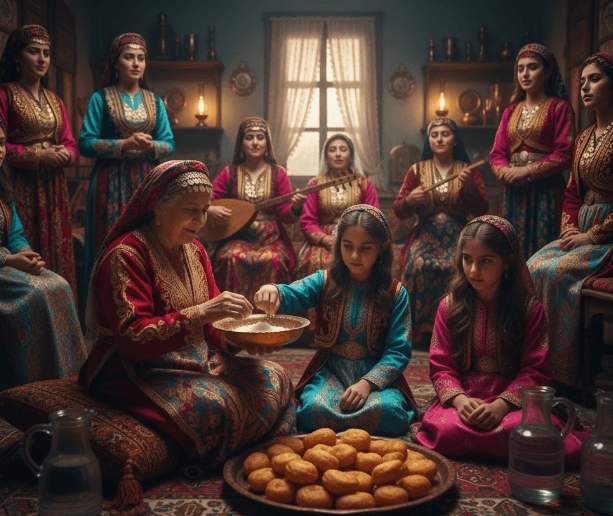
Burning Night (Generated with Artificial Intelligence)
Type(s) | Traditional ritual | ||||||||
|---|---|---|---|---|---|---|---|---|---|
Purpose(s) | A traditional entertainment and ritual believed to enable unmarried girls to see their future spouses in their dreams | ||||||||
Cultural Characteristic | Local folk culture tradition | ||||||||
Belief Element | The belief that the person seen in the dream will become one's future spouse | ||||||||
Time | The night connecting January 13 to January 14 | ||||||||
Place of Application | Seferihisar İzmir Türkiye | ||||||||
Yanar Gecesi is a traditional ritual practiced in the district of Seferihisar in İzmir, involving unmarried young women and women. This practice is rooted in the belief that young women will see their future spouses (princes) in their dreams and make intentions for their future. The local community also refers to this event as “Seeing Their Princes.” As part of the cultural identity of Seferihisar, Türkiye’s first Cittaslow city, this night represents a cultural transmission process encompassing social solidarity, entertainment, and specific symbolic rules.【1】
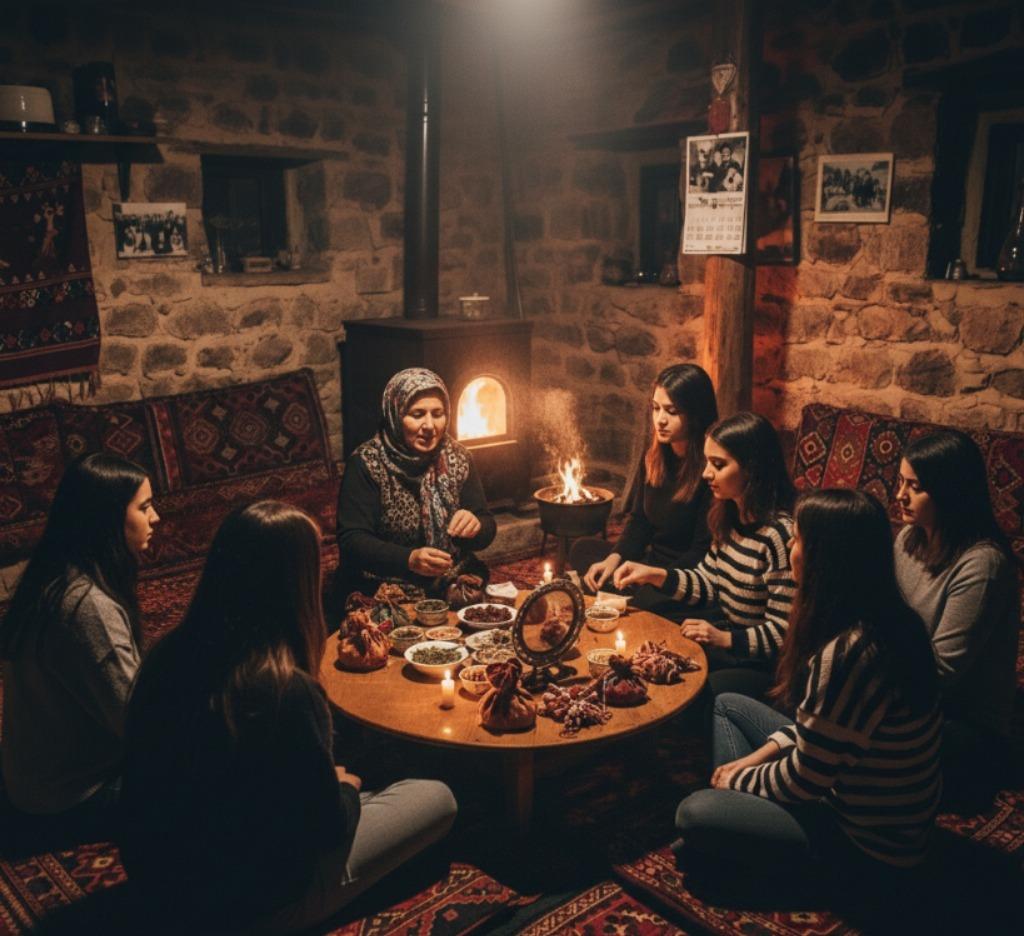
Representative Image of Yanar Gecesi (Generated by Artificial Intelligence)
Although the exact origin ofYanar Gecesi is unknown, it is described as an ancient tradition passed down through generations in Seferihisar. For many years this practice was on the verge of being forgotten, but in recent times local administrations and women’s organizations have worked to revive it and preserve it as cultural heritage. Historically, the tradition functioned as a closed ritual in which women socialized among themselves and shared hopes for the future.
The Yanar Gecesi ritual takes place on the night connecting January 13 to January 14, according to the old calendar, which is regarded as the first day of the year. This historical time period is designated as the specific period for performing the tradition. In the past, the ritual was organized and overseen by elders, and today it continues to be observed in strict adherence to this same historical cycle.
At the heart of the ritual are young women of marriageable age who seek insight into their futures through specific practices. Participants believe that by fulfilling the required conditions of the ritual, their wishes will be fulfilled. The most distinctive feature of the practice is a strictly regulated process that lasts from evening until the first light of dawn.
Traditionally, women and young girls in Seferihisar gather in a single house for Yanar Gecesi. During the preparation phase, participants come together wearing their most beautiful and colorful clothing. Music and folk songs known as maniler are performed in the gathering space. This preparatory stage constitutes a phase of social bonding before entering the spiritual and mysterious part of the ritual.
One of the most important stages of the ritual is the preparation of a special dough dish called “tuzlu pişi.” To make this pişi, salt and flour are taken during the day from any house where a man named Mehmet resides.【2】 A large amount of salt is deliberately added to the dough to ensure the fulfillment of the wish. The pişis are typically prepared by older women and mothers without the young girls seeing them.
Various objects with symbolic meanings are placed inside the pişis:
The salted pişi serves as a symbolic object linked to the belief that the person who offers water in the dream will be the future spouse.
After eating the pişi, participants enter a period of “silence” (susma). The young women who have eaten the pişi must not speak to anyone from that moment until they fall asleep. Adherence to this silence is considered essential for the wish to be accepted. After consuming the pişi, which contains a high concentration of salt, the young women go to bed without drinking water.
According to belief, the person who offers water in the dream will become the participant’s future spouse. Additionally, it is customary during the ritual to turn one’s back to the Moon, look in a mirror to see both oneself and the Moon, and make the wish: “Whoever is destined for me, let me see them in my dream.”
Yanar Gecesi is not merely a marriage divination ritual but also a cultural symbol reflecting the local identity of Seferihisar. Organizations such as the Seferihisar Municipality and the City Council Women’s Assembly organize special events annually to keep this tradition alive.
As part of these events, traditional clothing are displayed, pişis are distributed, and forgotten maniler are revived. Thus, Yanar Gecesi has entered a process of cultural revival, transforming into a festival and a point of tourist interest in the modern era.
Anadolu Ajansı. “Prenslerini Görmek İçin.” Accessed January 25, 2026. https://www.aa.com.tr/tr/arsiv/prenslerini-gormek-icin/385041.
Seferihisar Belediyesi. "Genç Kızlar Yanar Gecesinde." Accessed January 25, 2026.
Yeni Haber. “Seferihisar’ın Geleneklerinden ‘Yanar Gecesi’ Nedir.” January 12, 2023. Accessed February 1, 2026. https://seferihisar.com/seferihisarin-geleneklerinden-yanar-gecesi-nedir.
[1]
"Prenslerini Görmek İçin," Anadolu Ajansı, 17 January 2012, accessed 11 February 2026
https://www.aa.com.tr/tr/arsiv/prenslerini-gormek-icin/385041
[2]
"Genç Kızlar Yanar Gecesinde," Seferihisar Belediyesi, accessed 12 February 2026, https://seferihisar.bel.tr/genc-kizlar-yanar-gecesinde

Burning Night (Generated with Artificial Intelligence)
Type(s) | Traditional ritual | ||||||||
|---|---|---|---|---|---|---|---|---|---|
Purpose(s) | A traditional entertainment and ritual believed to enable unmarried girls to see their future spouses in their dreams | ||||||||
Cultural Characteristic | Local folk culture tradition | ||||||||
Belief Element | The belief that the person seen in the dream will become one's future spouse | ||||||||
Time | The night connecting January 13 to January 14 | ||||||||
Place of Application | Seferihisar İzmir Türkiye | ||||||||
Origin and History
Historical and Calendar Basis
Practice and Rituals
Gathering and Preparation
Pişi and Symbols
Silence and Wishes
Cultural Context and Revival